
The landscape of web application development is undergoing a significant transformation, driven by the increasing demand for instant responsiveness, robust offline capabilities, and enhanced user data ownership. As of 2026, local-first architecture, once considered a niche or academic concept, has evolved into a practical and compelling solution for a specific class of web applications. This paradigm shift prioritizes the client device as the primary repository for user data, allowing for immediate interactions and background synchronization with remote servers, fundamentally altering traditional client-server dynamics.
The Imperative for Local-First: Addressing Traditional Web App Limitations
The journey towards local-first adoption is often catalyzed by real-world frustrations with conventional web architectures. A common scenario involves applications rendered unusable by unreliable network connections, where crucial user data remains inaccessible without a round-trip to a distant server. For instance, an experience recounted from October of an earlier year highlights the inadequacy of a React/Node/Postgres stack when hotel Wi-Fi failed, leaving a project management tool displaying only blank screens and timeout errors. Even with a shaky cellular connection, basic operations like creating or moving tasks suffered from multi-second delays, exposing a fundamental flaw: despite complex server-side infrastructure, the application couldn’t display a user’s own data without external dependency. This type of performance bottleneck, particularly prevalent in regions with inconsistent internet access or during mobile use, underscores the need for a more resilient architecture.
The concept of local-first software gained significant theoretical grounding with the publication of the "Local-First Software" paper by Ink & Switch in 2019. This seminal work outlined seven core ideals: fast performance, multi-device support, offline functionality, real-time collaboration, data longevity, enhanced privacy, and user data ownership. While initially perceived by many developers as aspirational research rather than practical engineering requirements, the subsequent years have witnessed rapid advancements in tooling and browser capabilities, transitioning these ideals into achievable technical specifications.
Distinguishing Local-First from Related Concepts
A crucial point of clarity in the discourse surrounding local-first architecture is its precise definition. It is frequently conflated with "offline-first" or "Progressive Web Apps (PWAs)," leading to misunderstandings. Offline-first strategies, while valuable for network resilience, typically maintain the server as the ultimate source of truth; data served during network outages is often cached, with server data overriding local changes upon reconnection. Similarly, PWAs primarily concern delivery mechanisms, offering installability, improved caching via service workers, and push notifications, but do not inherently dictate data ownership or synchronization patterns.
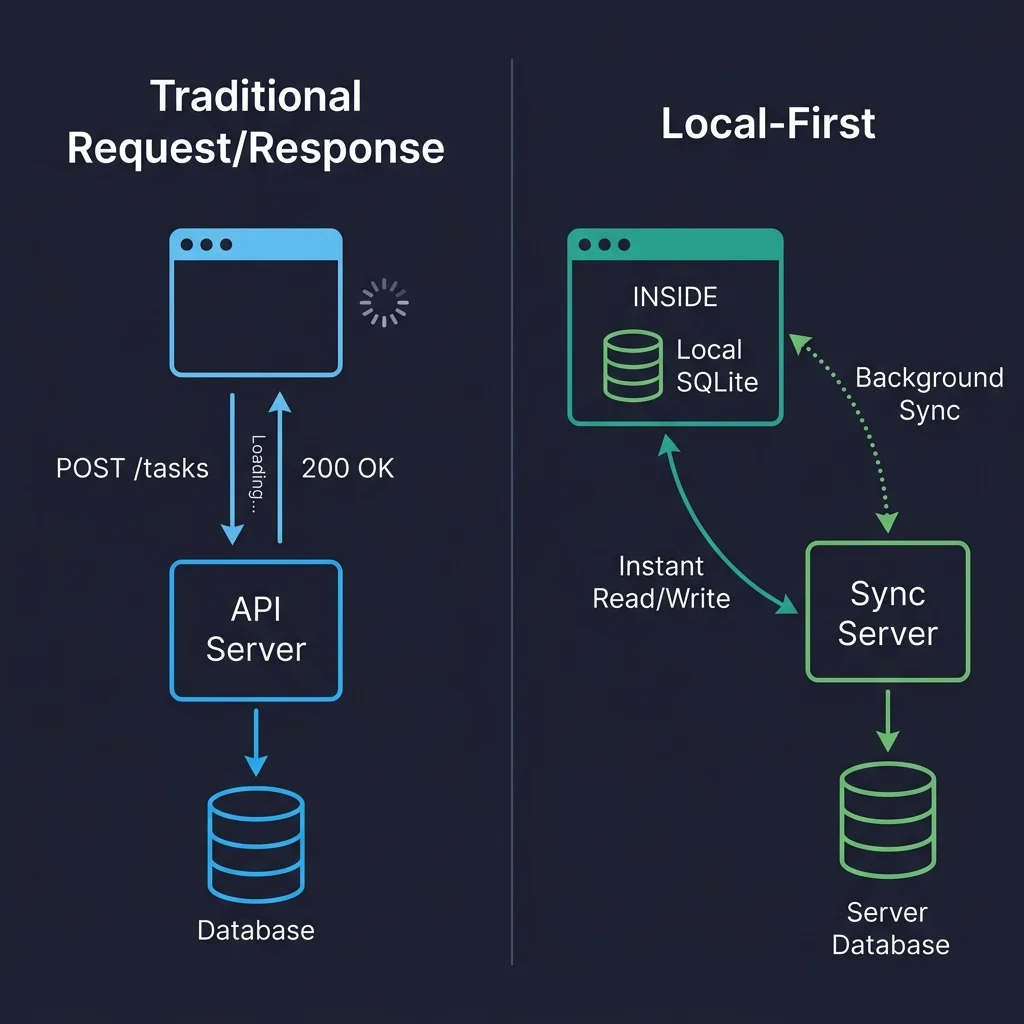
Local-first, in contrast, represents a fundamental shift in data architecture. It establishes the user’s device as the authoritative source for their data. Applications read from and write to a local database, guaranteeing instant responsiveness. Synchronization with servers or other devices occurs asynchronously in the background. The server, when present, acts as a peer in a distributed system, handling authentication, backups, and access control, but it does not gate access to the user’s primary data. The core distinction, as articulated by the Ink & Switch paper, is that "the client is not a thin view requesting permission to show data. The client is a node in a distributed system with its own database." This seemingly subtle difference profoundly impacts the entire application stack, from front-end data fetching strategies to back-end API design.
Strategic Application: When Local-First Excels and When to Exercise Caution
The adoption of local-first architecture is not a universal panacea. Its efficacy is highly dependent on the application’s core functionality and data characteristics. Experience shows that misapplying this architecture can lead to unnecessary complexity and wasted development effort.
Local-first is ill-suited for applications where data is predominantly server-generated or derived. Examples include analytics dashboards, social media feeds, or search result pages, where the server is inherently the data producer. In such cases, traditional client-server API requests remain the most efficient and logical approach. Furthermore, systems requiring strong transactional consistency, such as banking platforms, payment processors, or inventory management systems, are poor candidates. These domains demand ACID (Atomicity, Consistency, Isolation, Durability) guarantees, where eventual consistency models inherent in distributed systems can lead to critical errors or financial losses. Similarly, simple CRUD (Create, Read, Update, Delete) applications with no explicit offline or collaboration requirements, or those managing datasets too vast to fit on client devices, represent scenarios where local-first would constitute over-engineering.
However, local-first truly shines in applications centered around user-generated data that benefits from immediate interaction, multi-device access, and resilience to network failures. Prime use cases include:
- Note-taking and Document Editing: Enabling seamless, real-time collaboration and offline content creation.
- Collaborative Design and Project Management Tools: Facilitating instant updates and shared workspaces regardless of connectivity.
- Field Applications: Critical for industries like logistics, healthcare, or maintenance, where personnel operate in environments with unreliable or no internet access.
- Data Privacy-Focused Applications: Offering a compelling value proposition by keeping sensitive user data primarily on the device, with server-side components handling only encrypted or synchronized deltas.
A pragmatic approach often involves adopting local-first patterns for specific features within a broader, more traditional application. This "spectrum of local-first" strategy allows teams to incrementally integrate the architecture where it provides the most significant user benefits, such as offline drafting capabilities in a blog editor or real-time collaborative sections within a standard project management suite.
The Core Mechanism: Replicas Over Requests
The fundamental conceptual shift in local-first development mirrors the evolution from centralized version control systems like SVN to distributed systems like Git. In SVN, developers checked out files, made changes, and committed them to a single server; server downtime halted all operations. Git, conversely, provides every developer with a full local clone, allowing for local commits, branching, and merging, with push/pull operations to a remote repository occurring when ready.
Local-first web development applies this "Git for application data" model. Each client device maintains a replica—either full or partial—of the relevant data. All read and write operations occur against this local database, resulting in instantaneous UI updates. Synchronization with the server is a background process, resolving conflicts through predefined merge strategies. This eliminates the need for common web development patterns like React Query or SWR for data fetching, as data is always local. Similarly, state management libraries like Redux or Zustand are simplified because the local database itself serves as the application’s authoritative state.
Client-Side Data Persistence: The Rise of SQLite via WebAssembly
The foundation of local-first architecture rests on robust client-side data storage. While localStorage is trivial (synchronous, limited capacity, string-only), and IndexedDB offers asynchronous operations and larger storage but with a notoriously cumbersome API, the real breakthrough in 2026 is SQLite running in the browser via WebAssembly (WASM).
SQLite compiled to WASM, coupled with the Origin Private File System (OPFS) API, provides a full-fledged relational database environment directly within the browser. This enables complex SQL queries, transactions, and indexing capabilities locally. OPFS is critical here, offering web applications a sandboxed, high-performance file system that supports synchronous access from Web Workers, which SQLite leverages for optimal performance. Prior to OPFS, running SQLite in-memory and manually persisting to IndexedDB was a less performant and more fragile workaround.
Libraries like wa-sqlite facilitate this integration, allowing developers to initialize a SQLite database, define schemas, and execute SQL statements directly in JavaScript. While powerful, specific browser quirks, particularly in Safari’s OPFS implementation, have necessitated fallbacks to IndexedDB-backed persistence or careful serialization of writes to mitigate concurrency issues. The trade-off involves a modest increase in bundle size (approximately 400KB gzipped for SQLite WASM) but delivers substantial performance gains and developer experience improvements. Emerging alternatives like PGlite (Postgres in WASM) promise full Postgres compatibility on the client, hinting at a future where the same SQL dialect operates across client and server, though these are still maturing and carry larger bundle footprints.
The Synchronization Conundrum: Architecting for Distributed State
While local data storage is now a well-understood problem, reliably synchronizing data across multiple devices and users remains the most complex aspect of local-first development. This challenge necessitates robust mechanisms for reconciling changes when multiple replicas can independently modify data.
Two primary approaches dominate the field:
- Conflict-Free Replicated Data Types (CRDTs): These are specialized data structures mathematically designed to merge concurrent edits without conflicts. Yjs is a leading JavaScript implementation, particularly effective for real-time collaborative text editing, where character-level merging is crucial. Automerge offers a document-oriented CRDT model, backed by Rust, while Loro is a newer Rust-based entrant promising enhanced performance. CRDTs simplify collaboration for specific data types, ensuring eventual consistency.
- Database Replication: This approach involves replicating rows between a server-side database (e.g., Postgres) and client-side databases (e.g., SQLite) using a dedicated sync engine. Tools like PowerSync offer one-way replication from Postgres to client SQLite with a defined write-back path for mutations, demonstrating stability in production. ElectricSQL aims for more ambitious active-active synchronization between Postgres and SQLite, defining data "shapes" for client-specific replication. Triplit provides a full-stack database solution with built-in sync, abstracting away the client/server database distinction.
Event sourcing, which synchronizes a log of mutations rather than current state, is another method, but its complexity in reconstructing application state from event logs often outweighs its benefits for typical application development, making direct row synchronization often preferable for task-oriented data.
Navigating Conflicts: Beyond Last-Write-Wins
Conflict resolution, the process of reconciling divergent data states, is a critical area often oversimplified. Basic strategies like "last-write-wins" (LWW) at the record level are problematic as they silently discard legitimate user changes. A more effective approach is field-level LWW, where only changes to the same data field are subject to a timestamp-based conflict resolution, preserving concurrent edits to different fields within the same record. This strategy effectively handles approximately 95% of typical application conflicts.

However, a more insidious challenge arises from semantic conflicts. These occur when data merges cleanly at a structural level but results in logically inconsistent or nonsensical states, such as two users unknowingly booking the same meeting slot while offline. Such conflicts demand application-level validation, which must occur on the server during the synchronization’s write-back phase. The recommended strategy involves the server accepting the conflicting write but simultaneously flagging the violation. This flagged violation is then synced back to the client, prompting a user-facing notification for manual resolution, preventing silent data divergence or "ghost records" that the server refuses to acknowledge. This approach prioritizes user experience and data integrity, acknowledging that for critical applications (e.g., inventory), the window of inconsistency, however small, may still be unacceptable, thus reiterating local-first’s limitations for strong transactional consistency.
For CRDTs, while character-level text merging is highly effective, structured data merges can still produce confusing results (e.g., duplicated list items after concurrent reordering), often requiring post-merge deduplication or specific CRDT implementations tailored for structured data. Generally, surfacing complex Git-style merge conflicts directly to end-users is discouraged, as users typically expect the application to resolve conflicts intelligently.
Architectural Blueprint: Integrating Local-First into Modern Stacks
A practical local-first application stack in 2026 typically comprises a React-based front end, a synchronization engine like PowerSync, client-side SQLite via wa-sqlite (persisted with OPFS and an IndexedDB fallback for Safari), and a robust back end such as Supabase (leveraging Postgres, authentication, and row-level security). This configuration significantly simplifies client-side code, eliminating much of the boilerplate associated with traditional data fetching, caching, and optimistic UI updates.
Authentication and Authorization: Standard authentication mechanisms (JWTs, OAuth) secure the sync connection rather than individual requests. Authorization, however, is enforced rigorously at the sync layer. Servers utilize "sync rules" or "shapes" to ensure only authorized data is replicated to specific clients, preventing unauthorized access via client-side inspection. Write-back mutations are also validated against authorization rules on the server. The inherent data locality also makes end-to-end encryption (E2EE) a natural fit, where the server relays encrypted blobs it cannot read, enhancing privacy.
Schema Migrations: Client-side schema migrations pose a unique challenge compared to server-side migrations. Each user’s local database may be at a different schema version. The recommended approach involves additive migrations (new columns with defaults, new tables) and a versioning system run at application startup. Developers must avoid renaming or dropping columns unless absolutely necessary, as older client versions might still attempt to write to those columns, leading to silent sync failures and data inconsistencies.
Performance Considerations: The primary performance benefit of local-first is near-instantaneous reads and writes, as these operations occur against the local database without network latency. Querying 500 tasks from local SQLite can take milliseconds, even on mobile devices. However, the initial synchronization phase, where the client replica is bootstrapped, can involve downloading megabytes of data, impacting perceived load times (e.g., 1.2 seconds on broadband for 5,000 tasks, 4-5 seconds on throttled 3G). This is mitigated through partial syncs (replicating only relevant data) and dedicated "setting up workspace" loading screens. Bundle size (e.g., 400KB gzipped for SQLite WASM) and memory footprint on mobile devices (potentially causing tab crashes for very large datasets) remain critical optimization concerns, often addressed by lazy-loading database modules and aggressive data pruning.
Testing and Future Outlook
Testing local-first applications presents unique challenges. While unit tests for merge logic and integration tests simulating concurrent edits are effective, reproducing and debugging timing-sensitive conflict resolution bugs remains difficult. Detailed logging of sync events and property-based testing for CRDT logic are emerging best practices.
The future of local-first architecture is promising, with developments like PGlite (Postgres in WASM) hinting at a unified client-server data layer where SQL runs universally. The convergence of local-first principles with on-device AI models also holds significant privacy implications, positioning "your data never leaves your device" as a powerful product differentiator.
However, concerns persist regarding the fragmentation of sync protocols, with no emerging industry standard, making migration between different sync engines a non-trivial undertaking. The inherent architectural complexity, encompassing sync engines, conflict resolution, client-side migrations, and granular authorization, represents a significant "complexity budget." While this investment yields substantial returns for the right applications and experienced teams, it can become a detrimental trap for simpler projects or less seasoned development teams. As a veteran developer once noted, "The best architecture is the one your team can debug at 2 AM." This emphasizes the importance of understanding the failure modes and trade-offs before committing to a local-first approach.
The current trajectory indicates that local-first is maturing into a robust, albeit complex, solution for applications where performance, offline capability, collaboration, and user privacy are paramount. For teams contemplating this paradigm, an incremental adoption strategy—starting with a single feature—is often the most prudent path to experience its benefits firsthand.