
Tag: bracketing

  • Reeflex Pro Camera V3 Introduces Advanced Exposure Bracketing and Focus Stacking Features to iPhone Photography

    Reeflex Pro Camera V3 Introduces Advanced Exposure Bracketing and Focus Stacking Features to iPhone Photography

    The mobile photography landscape has witnessed a significant technological leap with the official release of Reeflex Pro Camera version 3, a comprehensive update designed to bridge the gap between smartphone convenience and professional-grade DSLR functionality. This latest iteration from the Reeflex development team introduces a suite of sophisticated tools, including automated exposure bracketing, focus stacking, and a redesigned high-speed burst mode, all housed within a completely overhauled user interface. As mobile hardware continues to evolve with larger sensors and more powerful image signal processors, third-party applications like Reeflex are increasingly leveraging this power to offer features that were previously exclusive to dedicated camera systems.

    The launch of Version 3 represents a pivotal moment for Reeflex, a company that has steadily built a reputation for prioritizing manual control and optical precision. By focusing on the specific needs of landscape, macro, and action photographers, the update addresses several long-standing limitations of the native iOS camera app. While Apple’s built-in software utilizes "Smart HDR" and deep fusion to automate image quality, Reeflex Pro Camera V3 targets the "prosumer" demographic—users who demand granular control over every aspect of the exposure triangle and the optical behavior of their device.

    A Sophisticated Redesign of the User Experience

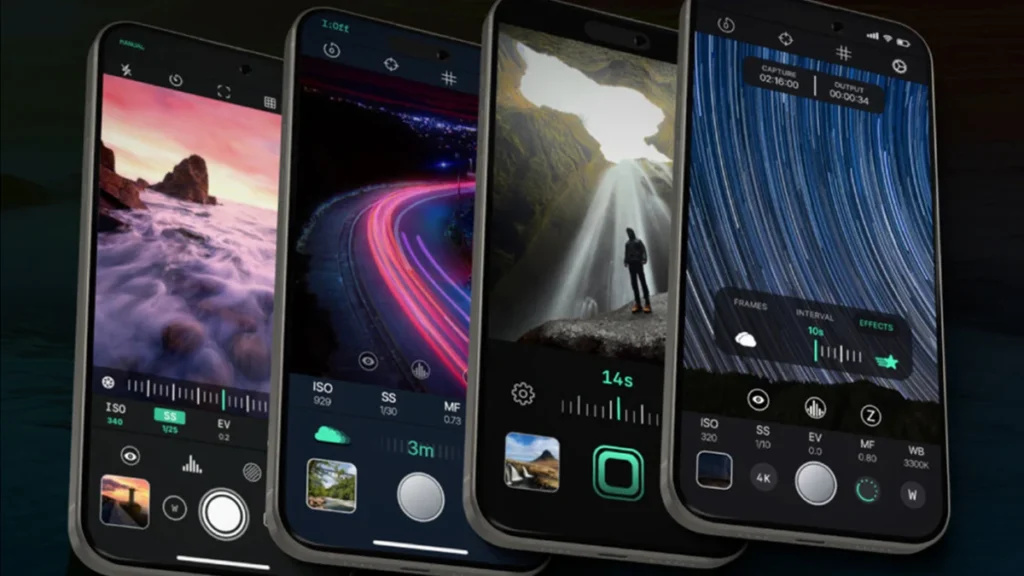
    The most immediate change in version 3 is the redesigned user interface (UI), which has been engineered to minimize friction during the shooting process. In professional photography, the speed at which a user can adjust settings often determines whether a fleeting moment is captured or lost. Reeflex has addressed this by implementing a more ergonomic layout that places essential controls within easy reach.

    One of the standout UI enhancements is the updated histogram. In previous versions, users were often limited to a standard luminance display. Version 3 allows photographers to toggle between luminance and a full RGB histogram with a single tap. This is a critical addition for professionals who need to monitor color clipping in specific channels—such as bright reds in a sunset or deep blues in a landscape—ensuring that the data remains recoverable during the post-processing stage.

    Furthermore, the app now incorporates intuitive gesture controls. A downward swipe from the top of the viewfinder reveals a quick-access dashboard for secondary settings, including the camera flash, self-timer, and various framing guides such as the rule of thirds or the golden ratio. To assist those utilizing manual focus, Reeflex has introduced a focus loupe. This feature provides a magnified view of the focal point, allowing for pinpoint accuracy that is often difficult to achieve on a standard smartphone screen. The interface also simplifies the selection of file formats (such as RAW, ProRAW, JPEG, and HEIF) and resolutions, providing full support for the virtual lenses found on multi-camera iPhone models.

    Mastering Light through Exposure Bracketing

    Exposure bracketing is a cornerstone technique in professional landscape and architectural photography, used to overcome the dynamic range limitations of any given sensor. While modern iPhone sensors are remarkably capable, they can still struggle with high-contrast scenes, such as a dark interior with a brightly lit window.

    Reeflex Pro Camera V3 automates this process. When the shutter is triggered in bracketing mode, the app captures three distinct images in rapid succession: a "base" exposure, an underexposed frame to preserve highlight detail, and an overexposed frame to recover shadow information. Users are granted significant flexibility, with the ability to set the offset for the under and overexposed shots anywhere from 0.5 to 4.0 stops.

    At present, version 3 requires users to merge these three frames using external software like Adobe Lightroom, Photoshop, or specialized HDR tools. However, Reeflex has indicated that an integrated merging algorithm is currently in development. This feature would allow the app to generate a single high-dynamic-range (HDR) image directly on the device, further streamlining the workflow for mobile-first creators.

    Precision Focus Stacking for Macro and Landscapes

    Perhaps the most technically impressive addition to version 3 is the focus stacking tool. Focus stacking is a technique where multiple images are taken at different focal planes and then blended to create a final image with a deeper depth of field than would be optically possible in a single shot. This is particularly vital in macro photography, where the extremely close proximity to a subject results in a razor-thin area of sharpness.

    The implementation in Reeflex Pro Camera V3 is designed for precision. The user defines a "near" focus point and a "far" focus point. The app then calculates the necessary increments and captures a sequence of images—the number of which is user-definable—as it "walks" the focus through the scene. Much like the bracketing feature, these images currently require external processing to be merged into a single "ticked" file.

    The inclusion of focus stacking is a direct response to the physical limitations of smartphone optics. Because iPhones use relatively wide-angle lenses with fixed apertures, achieving a deep depth of field in close-up shots often results in optical diffraction or requires software-based "portrait mode" blurring which can look artificial. Physical focus stacking provides a genuine optical solution that preserves the integrity of the image data.

    High-Speed Performance and Burst Mode Optimizations

    Speed is a recurring theme in the V3 update. Reeflex has undergone a series of under-the-hood optimizations to reduce shutter lag to near-zero levels. In earlier iterations of third-party camera apps, the delay between pressing the button and the sensor capturing the frame was a common complaint. Version 3 feels significantly more responsive, aligning it more closely with the performance of the native Apple camera.

    To complement this speed, the app introduces a new high-speed burst mode. By holding down the shutter button, users can capture a continuous stream of images, with a real-time counter displaying the frame count on the screen. Additionally, a "Burst On Tap" feature allows users to pre-set a specific number of captures—ranging from 2 to 20—triggered by a single tap. This is an invaluable tool for sports photography or capturing unpredictable subjects like wildlife and children, where the "perfect" frame often occurs in a fraction of a second.

    Technical Evolution and Chronology

    The development of Reeflex Pro Camera V3 is part of a broader trend in the iOS ecosystem where software developers are reclaiming "pro" features that have been obscured by Apple’s push toward automation. Since its initial launch, Reeflex has followed a steady trajectory of updates:

    1. V1.x Era: Focused on manual ISO, shutter speed, and white balance controls, establishing the foundation of the app.
    2. V2.x Era: Introduced support for ProRAW and improved the integration with external lenses (such as anamorphic or macro clip-ons).
    3. V3.0 Launch: The current milestone, moving beyond simple manual controls into complex computational photography workflows like stacking and bracketing.

    This chronology mirrors the evolution of the iPhone hardware itself. With the introduction of the 48-megapixel sensor on the iPhone 14 Pro and 15 Pro series, the sheer volume of data available to developers has increased, necessitating more robust apps to manage that information effectively.

    Market Context and Implications

    The professional mobile photography market is currently dominated by a few key players, including Halide, Moment, and Obscura. Reeflex Pro Camera V3 positions itself as a direct competitor by offering a high degree of technical sophistication at a competitive price point.

    The decision to remain iOS-exclusive is a strategic one, albeit a limitation for the broader market. The consistency of Apple’s API (Application Programming Interface) for camera hardware allows developers like Reeflex to optimize their code for specific sensor behaviors and ISP (Image Signal Processor) pipelines. On Android, the fragmentation of hardware makes this level of granular control significantly more difficult to achieve across multiple manufacturers.

    Industry analysts suggest that the rise of such apps is changing the "carrying cost" of professional photography. For many journalists, social media managers, and even some commercial photographers, the ability to perform focus stacking or bracketed exposures on a device that fits in a pocket reduces the need for heavy gear bags on certain assignments.

    Official Positioning and Availability

    Reeflex has positioned V3 as a "professional’s companion." While the app is accessible to hobbyists, its full potential is realized when used in conjunction with a tripod or a stable mounting system, particularly for the bracketing and stacking features where frame alignment is paramount.

    In terms of business model, Reeflex has adopted a hybrid approach that has become common in the App Store. The app is available on the Apple App Store with two primary tiers:

    • Annual Subscription: $15 USD per year, providing access to all premium features and future updates.
    • Lifetime Purchase: $26 USD, a one-time payment for those who prefer to avoid recurring costs.

    To lower the barrier to entry, Reeflex offers a free trial period, allowing users to test the new interface and the efficacy of the manual controls before committing to a purchase.

    Final Analysis: The Future of Mobile Stills

    Reeflex Pro Camera V3 is a testament to the fact that the smartphone is no longer just a device for casual snapshots; it is a legitimate tool for the photographic arts. By implementing exposure bracketing and focus stacking, Reeflex is providing users with the mathematical and optical tools to overcome the physical constraints of small-sensor photography.

    The primary drawback remains the lack of video support. Users looking for an all-in-one solution for both cinema and stills will still need to look elsewhere or use Reeflex alongside a dedicated video app like Blackmagic Cam or Filmic Pro. Additionally, the current requirement for external merging software for HDR and focus stacks adds a step to the workflow, though the promise of in-app merging in future updates suggests that Reeflex is committed to a truly "end-to-end" mobile professional experience.

    As mobile processors continue to rival desktop performance, the line between "computational" photography and "traditional" photography continues to blur. Reeflex Pro Camera V3 sits firmly at the center of this intersection, offering a glimpse into a future where the most powerful camera is indeed the one that is always with you.

Grafex Media
Privacy Overview

This website uses cookies so that we can provide you with the best user experience possible. Cookie information is stored in your browser and performs functions such as recognising you when you return to our website and helping our team to understand which sections of the website you find most interesting and useful.