Tag: fintech

  • Navigating the New Frontier of Fintech AI Search Visibility and Brand Accuracy

    Navigating the New Frontier of Fintech AI Search Visibility and Brand Accuracy

    The financial technology sector is currently navigating a fundamental shift in how consumers discover and evaluate products, as artificial intelligence search engines implement significantly stricter verification thresholds for fintech brands compared to other industries. Because financial services fall under the critical "Your Money or Your Life" (YMYL) category, large language models (LLMs) and generative search engines are programmed to apply rigorous filters before mentioning, citing, or recommending specific fintech products. This evolution in search behavior—where 54% of Americans now utilize tools like ChatGPT for financial research—has forced a reimagining of digital presence, moving beyond traditional search engine optimization (SEO) toward a more complex framework of "Generative Engine Optimization" (GEO).

    Fintech in AI Search: How to Be the Trusted & Featured Brand

    For fintech companies, the risk of misrepresentation in AI search results is a primary concern. Unlike traditional search engines that provide a list of links, AI search draws from a brand’s own website as well as the wider web, including forums, news sites, and regulatory records. When these sources provide conflicting information, AI systems may hallucinate, provide outdated fee structures, or pair a brand’s name with negative sentiment gathered from unverified third-party sources. Consequently, the goal for modern fintech marketing is no longer just appearing in search results, but ensuring that the brand is represented with absolute accuracy across the three primary types of AI visibility: brand mentions, citations, and product recommendations.

    Fintech in AI Search: How to Be the Trusted & Featured Brand

    The Three Pillars of AI Visibility in the Financial Sector

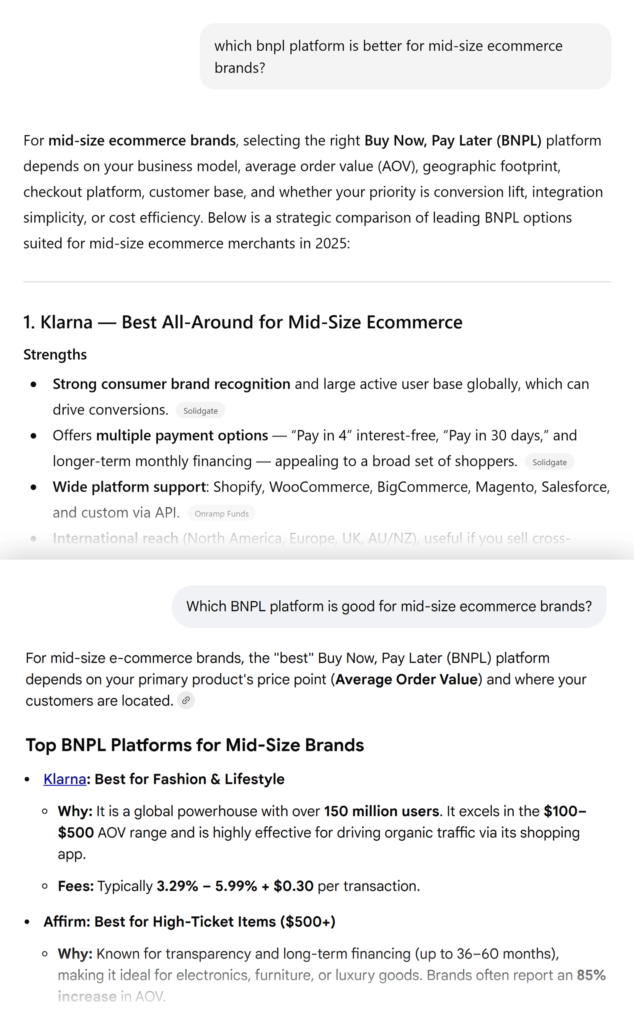
    Visibility in the AI era is segmented by the level of intent and trust the model assigns to a brand. The first pillar, brand mentions, occurs when an AI system includes a company’s name in a general answer. This typically happens during the awareness stage of the consumer journey. For instance, when a user asks about the benefits of "Buy Now, Pay Later" (BNPL) services, the AI might mention platforms like Klarna or Affirm to illustrate the category. While not an explicit endorsement, these mentions utilize the "mere exposure effect," building familiarity so that by the time a user reaches a decision point, the brand is already a recognized entity in their mental landscape.

    Fintech in AI Search: How to Be the Trusted & Featured Brand

    The second pillar, citations, represents a higher tier of value. This occurs when an AI uses a brand’s specific pages or documentation to support its answer, often appearing as footnotes, inline links, or source thumbnails. In the fintech space, being cited by an LLM serves as an implied endorsement of the brand’s authority and expertise. When an AI pulls data directly from a company’s technical documentation or help center, it allows the brand to influence the technical narrative of the response. However, market data suggests that while citations boost credibility, they do not always drive direct traffic, as many users prefer to continue their dialogue within the AI interface rather than clicking through to the source.

    Fintech in AI Search: How to Be the Trusted & Featured Brand

    The third and most impactful pillar is product recommendations. This is where the AI provides a curated shortlist of products for high-intent queries, such as "best budgeting apps" or "top-rated international transfer services." These recommendations are the ultimate goal for fintech brands because they directly influence the final selection process. Appearing in these lists requires the AI to have a high level of confidence in the brand’s legitimacy and current standing.

    Fintech in AI Search: How to Be the Trusted & Featured Brand

    The Logic of LLM Selection: Consensus and Consistency

    To decide which fintech brands to feature, AI systems rely on two primary signals: consensus and consistency. This methodology acts as a digital filter, protecting users from potentially fraudulent or unstable financial services.

    Fintech in AI Search: How to Be the Trusted & Featured Brand

    Consensus is achieved when multiple reputable, high-authority sources mention a brand and its products in a positive or neutral context. LLMs assess social proof by scanning editorial reviews from major financial publications, user feedback on platforms like G2 or Trustpilot, and discussions in specialized communities like Reddit or the myFICO Forum. The stronger the consensus across these diverse nodes, the more likely the AI is to recommend the brand. Conversely, if major news outlets consistently highlight regulatory hurdles or service outages, the AI will likely incorporate those warnings into its summary.

    Fintech in AI Search: How to Be the Trusted & Featured Brand

    Consistency, the second signal, refers to the alignment of facts across the internet. For a fintech brand to be trusted by an AI, its core details—such as pricing, interest rates, security features, and withdrawal limits—must be uniform across its own website and all third-party coverage. Inconsistencies, such as a review site listing a 3% fee while the brand’s homepage lists 2%, create a "trust gap." When faced with such contradictions, AI models often become cautious, either omitting the brand entirely or adding qualifying language like "reports vary on current fee structures," which can significantly undermine consumer trust.

    Fintech in AI Search: How to Be the Trusted & Featured Brand

    Content Categories That Drive AI Trust

    Market analysis indicates that three types of content carry the most weight in the fintech AI ecosystem. The first is owned content, which includes the brand’s website, technical documentation, and help centers. AI systems treat these as the "primary source of truth" for product mechanics. Fintech leaders like Intuit and TurboTax have optimized this by creating extensive landing pages that detail every aspect of their guarantees, security protocols, and filing processes. By providing structured, easy-to-parse data, they ensure the AI has a reliable foundation for its answers.

    Fintech in AI Search: How to Be the Trusted & Featured Brand

    The second category is earned media and reviews. LLMs use these to cross-check a brand’s internal claims against the reality of the user experience. A significant trend in the industry is the use of original research to drive earned media. For example, KPMG’s "Pulse of Fintech" reports are frequently cited by journalists at Bloomberg and CNBC. These citations create a ripple effect: when reputable news organizations cite a brand’s research, the AI model registers that brand as a high-authority source in the financial sector.

    Fintech in AI Search: How to Be the Trusted & Featured Brand

    The third and perhaps most critical category for fintech is official records. These are public documents that confirm a brand’s legal authorization to operate, such as FDIC membership, licenses from the Federal Reserve, or filings with the Consumer Financial Protection Bureau (CFPB). When a user asks about the safety of a platform like Wise, AI systems like Perplexity scan regulatory databases to verify that the company is a licensed money transmitter. For fintech brands, making these regulatory details explicit and easy for AI bots to retrieve is a vital trust-building exercise.

    Fintech in AI Search: How to Be the Trusted & Featured Brand

    Strategic Implications for Fintech Leadership

    The shift toward AI-driven financial research presents both a challenge and a massive opportunity. A study by Microsoft found that AI-referred traffic converts at three times the rate of other channels, including traditional search and social media. This high conversion rate is attributed to the fact that users arriving via AI have often already been "pre-sold" by the model’s synthesis of the brand’s value proposition.

    Fintech in AI Search: How to Be the Trusted & Featured Brand

    To capitalize on this, fintech brands are increasingly investing in "Trust Centers" and structured FAQ sections. These hubs serve as a central repository for the facts the brand wants the AI to prioritize. Furthermore, proactive reputation management has become a technical necessity. Brands must now monitor not just what the media says, but what the AI thinks the media is saying. This involves auditing AI responses for "narrative drivers"—the specific questions and sentiments that appear most frequently in LLM outputs.

    Fintech in AI Search: How to Be the Trusted & Featured Brand

    Industry analysts suggest that the "long tail" of the internet is becoming more relevant for fintech brands. Because AI models do not "forget" old information, outdated forum posts or expired PDF brochures can continue to haunt a brand’s AI profile for years. Effective AI strategy now requires a "clean-up" phase, where companies aggressively redirect or remove outdated documentation and participate directly in community conversations on platforms like Reddit to provide current, accurate information.

    Fintech in AI Search: How to Be the Trusted & Featured Brand

    Conclusion: The Future of Fintech Discovery

    As artificial intelligence continues to integrate into the daily financial lives of consumers, the barrier to entry for fintech visibility will only grow higher. The "Your Money or Your Life" designation ensures that only the most consistent, transparent, and verified brands will survive the filter of generative search.

    Fintech in AI Search: How to Be the Trusted & Featured Brand

    The transition from traditional SEO to AI-centric visibility represents a move from keyword-matching to narrative-influence. Fintech brands that succeed in this new era will be those that treat their digital footprint as a holistic ecosystem—one where owned data, third-party reviews, and regulatory transparency work in unison to provide a single, undeniable story of reliability. In a world where an AI-generated answer is often the first and most influential touchpoint, accuracy is no longer just a compliance requirement; it is the most powerful marketing tool a fintech brand possesses.

Grafex Media
Privacy Overview

This website uses cookies so that we can provide you with the best user experience possible. Cookie information is stored in your browser and performs functions such as recognising you when you return to our website and helping our team to understand which sections of the website you find most interesting and useful.