Tag: principles

  • The Indispensable Role of Design Principles in Navigating Modern Product Development and AI Innovation

    The Indispensable Role of Design Principles in Navigating Modern Product Development and AI Innovation

    Design principles, often perceived as rigid guidelines, are in fact a powerful strategic asset for organizations, serving as a unifying force to rally teams around a shared purpose and to articulate the core values and beliefs that define an enterprise. In an increasingly complex and rapidly evolving technological landscape, these principles align teams, inform critical decision-making, and provide a steadfast anchor amidst the relentless hype cycles, ambitious assumptions, pressures for faster delivery, and the emergent challenges posed by AI-driven development. The critical question for many organizations is not whether to adopt design principles, but how to effectively select and implement those that truly resonate with their mission and user needs.

    Historical Evolution: From Industrial Aesthetics to Digital Ethics

    The concept of design principles is not new, tracing its roots back to the early 20th century with movements like the Bauhaus, which championed functionalism and the integration of art and technology. However, it was perhaps Dieter Rams, the influential German industrial designer for Braun, who codified their modern relevance with his "10 Principles of Good Design" in the late 1970s. Rams’ principles, such as "Good design is innovative," "Good design makes a product useful," and "Good design is as little design as possible," offered a humble, practical, and profoundly human-centered framework for industrial product development. These tenets emphasized clarity, utility, and longevity over fleeting trends, significantly influencing generations of designers.

    As technology evolved from physical products to abstract digital interfaces, so too did the application and scope of design principles. The advent of graphical user interfaces (GUIs) in the 1980s and the subsequent rise of the internet in the 1990s necessitated new guiding philosophies for interaction design. Pioneers in user experience (UX) like Don Norman and Jakob Nielsen began articulating principles focused on usability, learnability, and user satisfaction, laying the groundwork for what would become the cornerstone of digital product design. Companies like Apple, with its Human Interface Guidelines (HIG), and later Google, with Material Design, formalized extensive sets of principles that dictated the look, feel, and behavior of their software ecosystems, ensuring consistency and a recognizable brand experience across diverse applications. This evolution underscores a critical shift: design principles moved from being primarily aesthetic and functional considerations for physical goods to encompassing complex user interactions, psychological factors, and ultimately, the ethical implications of digital experiences.

    A Practical Guide To Design Principles — Smashing Magazine

    Defining the Unseen: What Design Principles Truly Are

    At their core, design principles are not prescriptive rules but rather adaptable guidelines and considerations that designers and product teams apply with discretion. They serve as a foundational agreement, allowing teams to proceed with decisions on what has already been established without the need for endless debate. In essence, they are the documented values and beliefs that an organization embodies through its products and services.

    In an era where passable designs and code can be generated within minutes, the focus shifts from how to design to what is worth designing and building, and crucially, what values those creations should embody. Without a clear set of principles, company initiatives often appear random, sporadic, and ad-hoc, resulting in vague, inconsistent, or uninspiring user experiences. Just as a company’s voice and tone might be unintentionally defined by end-users if not consciously crafted, so too will a product’s underlying values be perceived through its design, whether intentional or not.

    Resources such as Ben Brignell’s Principles.design, which compiles over 230 pointers for design principles and methods spanning language, infrastructure, hardware, and organizational structures, highlight the vast scope and applicability of these guidelines. They provide a comprehensive repository for understanding how various entities have articulated their design philosophy, offering invaluable inspiration for those looking to establish their own.

    The Business Imperative: Data and Impact

    The implementation of robust design principles extends far beyond mere aesthetic coherence; it yields tangible business benefits, impacting everything from operational efficiency to market perception and user loyalty. Studies and industry observations consistently suggest that organizations with clearly defined and consistently applied design principles often report higher user satisfaction, improved product-market fit, and accelerated development cycles.

    A Practical Guide To Design Principles — Smashing Magazine
    • Consistency and Trust: Principles foster consistency across a product ecosystem, reducing cognitive load for users and building trust. When interactions are predictable and aligned with user expectations, users feel more in control and are more likely to engage repeatedly with a product or service. This consistency is a hallmark of strong brands and contributes directly to customer retention.
    • Efficiency and Scalability: For development teams, principles act as a shared language and decision-making framework, significantly streamlining the design and development process. They reduce the need for constant re-evaluation of basic design choices, minimizing rework and accelerating time-to-market. This efficiency is particularly critical in large organizations or for products with extensive feature sets, enabling scalable growth without sacrificing quality.
    • Brand Differentiation: Beyond functional consistency, design principles infuse products with a distinct personality and voice, reinforcing brand identity. They articulate what an organization stands for beyond profits, stock prices, or fleeting trends, creating a unique market position that resonates with target audiences. This differentiation is invaluable in competitive landscapes, making products memorable and desirable.
    • Innovation with Purpose: Principles provide a strategic lens through which new ideas and innovations can be evaluated. Instead of pursuing every novel concept, teams can assess potential features or product directions against their core design values, ensuring that innovation serves a greater purpose and aligns with the organization’s overarching mission. This prevents feature creep and ensures that resources are allocated to initiatives that genuinely enhance the user experience and brand value.
    • Team Alignment and Collaboration: Perhaps one of the most significant internal benefits, design principles act as a powerful tool for aligning cross-functional teams. By documenting shared values and beliefs, they reduce subjective debates rooted in personal preferences, fostering a collaborative environment where decisions are guided by a common vision. This unity empowers teams to make autonomous decisions that are consistent with the organizational direction.

    Crafting Your Compass: Establishing Design Principles

    Establishing effective design principles is a collaborative endeavor that transcends the design department. Given that the user experience encompasses every touchpoint—from performance and functionality to customer support and service—it is crucial for participants in the principle-setting process to represent these diverse areas. While the abstract nature of principles can make them challenging to define and agree upon, a structured approach, often in the form of a workshop, can navigate these complexities.

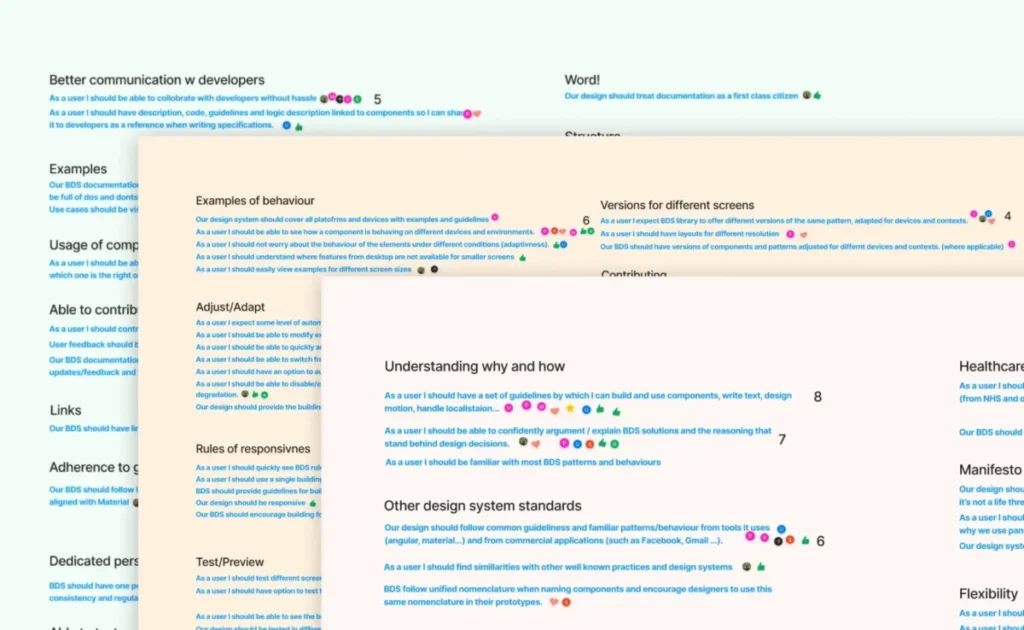
    A practical eight-step workshop framework, inspired by methodologies from design thought leaders such as Marcin Treder, Maria Meireles, and Better, can guide teams through this process:

    1. Preparation and Research: Begin by gathering existing company values, mission statements, user research, competitive analyses, and any previous design guidelines. This provides a foundational understanding of the organization’s identity and market position.
    2. Individual Brainstorming: Each participant independently generates a list of potential principles, focusing on what the product or service should and should not embody. This encourages divergent thinking and prevents groupthink.
    3. Sharing and Grouping: Participants share their ideas, and similar concepts are grouped together. This phase helps identify common themes and areas of consensus, moving from individual thoughts to collective understanding.
    4. Keyword Extraction: From the grouped ideas, extract core keywords or phrases that encapsulate the essence of each cluster. These keywords form the basis for the principle statements.
    5. Drafting Statements: For each keyword, draft a concise, actionable statement that articulates the principle. Each principle should ideally be memorable and easily understood, often accompanied by a brief explanation or an example of its application.
    6. Critique and Refinement: Review the drafted principles for clarity, distinctiveness, and relevance. Are they inspiring? Do they have a clear point of view? Do they differentiate the product? This iterative phase is crucial for honing the language and ensuring each principle is robust.
    7. Prioritization and Selection: Teams vote on the most impactful and relevant principles. Aim for a manageable number (e.g., 5-7) to ensure they are all memorable and actionable. This convergent phase ensures the focus remains on the most critical guiding tenets.
    8. Socialization and Integration Plan: Develop a strategy for effectively sharing, communicating, and embedding the finalized principles across the organization. This plan should include how principles will be referenced in daily work, design critiques, and future product decisions.

    The challenge of principles being "abstract and fluffy" can be mitigated by grounding them in concrete scenarios and examples, demonstrating how they apply to real design challenges. Utilizing workshop kits, readily available on platforms like Figma Community, can further streamline this process, providing templates and structured activities to facilitate productive discussions and decision-making.

    Principles in Action: Exemplary Frameworks

    Examining established design principles from leading organizations offers valuable insights into their practical application and enduring relevance:

    A Practical Guide To Design Principles — Smashing Magazine
    • Dieter Rams’ 10 Principles of Good Design: Though developed for industrial products, Rams’ principles remain profoundly influential in digital design. Examples include "Good design is innovative" (encouraging forward-thinking solutions), "Good design makes a product useful" (prioritizing functionality), and "Good design is aesthetic" (emphasizing visual appeal without sacrificing utility).
    • Apple’s Human Interface Guidelines (HIG): Emphasize principles like "Clarity," "Deference," and "Depth." Clarity means interfaces are clear and unambiguous; Deference means the UI supports the user experience without competing with content; Depth means providing layers of content and functionality for rich interaction. These principles guide the design of all Apple software, ensuring a consistent and intuitive user experience across its ecosystem.
    • Google’s Material Design Principles: Built around "Metaphor," "Bold, graphic, intentional," and "Motion provides meaning." Material Design aims to create a unified system of visual, motion, and interaction design across platforms and devices, drawing inspiration from the physical world while embracing technological possibilities.
    • IBM Design Language: Centers on principles like "User focus," "Craft," and "Purpose." This comprehensive system aims to foster consistency and quality across IBM’s vast portfolio of products and services, ensuring that every interaction reflects IBM’s commitment to thoughtful design and meaningful solutions for enterprise users.

    These examples illustrate that effective principles are not just visionary; they offer a clear point of view, defining not only what an organization does but also what it does not do, thereby clarifying its stance in the world beyond commercial objectives.

    Guiding AI Innovation: Principles in the Age of Intelligent Interfaces

    The rapid proliferation of Artificial Intelligence (AI) technologies introduces a new frontier for design, making robust design principles more critical than ever. AI interfaces, from chatbots and recommendation engines to autonomous systems, present unique challenges related to ethics, transparency, bias, control, and trust. Without clear guiding principles, AI solutions risk being perceived as opaque, unreliable, or even harmful, undermining user adoption and public confidence.

    In this context, design principles for AI must extend beyond traditional usability to encompass considerations such as:

    • Transparency and Explainability: Users should understand how an AI system works, why it made a particular decision, and what data it used. Principles emphasizing clear communication of AI’s capabilities and limitations are paramount.
    • User Control and Agency: While AI can automate tasks, users must retain a sense of control over their interactions and data. Principles should ensure that AI acts as an assistant, empowering users rather than dictating their actions.
    • Fairness and Bias Mitigation: AI systems can inadvertently perpetuate or amplify societal biases present in their training data. Design principles must actively address fairness, ensuring equitable outcomes for all users and preventing discriminatory practices.
    • Predictability and Reliability: AI’s probabilistic nature can lead to unpredictable behavior. Principles should aim to make AI interactions as predictable and reliable as possible, setting clear expectations for users.
    • Privacy and Security: With AI often relying on vast amounts of data, principles must prioritize robust privacy protections and data security, building user trust in the handling of their personal information.

    The growing demand for expertise in this domain is highlighted by resources like Vitaly’s "Design Patterns For AI Interfaces," a video course offering practical UX guidelines and real-life examples for designing AI features. Such initiatives underscore the industry’s recognition of the urgent need for structured approaches and principled thinking in developing intelligent interfaces that are not only functional but also ethical, trustworthy, and user-centered.

    A Practical Guide To Design Principles — Smashing Magazine

    Embedding and Sustaining Principles

    While the creation of design principles is a significant achievement, it represents only a fraction of the overall effort. The greater challenge lies in effectively sharing, embedding, and sustaining these principles within the daily fabric of an organization. Principles must transition from being a document to becoming a default mode of operation.

    Strategies for successful integration include:

    • Continuous Communication: Regularly communicate principles through internal newsletters, team meetings, and dedicated presentations, ensuring they remain top-of-mind for all employees.
    • Integration into Workflows: Incorporate principles into existing design and development workflows. This could involve using them as a checklist during design reviews, referencing them in project briefs, or making them a mandatory part of new employee onboarding and training.
    • Visible Reinforcement: Display principles prominently in workspaces, on internal wikis, or within design system documentation. Visual reminders help to normalize their presence and importance.
    • Leadership Endorsement: Active support and advocacy from leadership are crucial. When leaders consistently reference and uphold the principles, it signals their strategic importance and encourages broader adoption.
    • Iterative Review and Adaptation: Design principles should not be static. Periodically review and, if necessary, adapt them to reflect evolving user needs, technological advancements, and organizational strategies. This ensures their continued relevance and efficacy.
    • Templates and Tools: Integrate principles into design system templates, naming conventions, and output formats. For instance, component documentation can include notes on how specific elements adhere to certain principles.

    By consistently revisiting settings, templates, and conventions, organizations can make design principles an ingrained part of their culture, thereby avoiding endless discussions that often stem from personal preferences or subjective taste. True design, especially in complex product development, should be guided by clearly articulated goals and values, not mere opinion.

    Conclusion: The Enduring Power of Principled Design

    In an era defined by rapid technological change and increasing complexity, design principles stand as indispensable strategic assets. They transcend their traditional role as aesthetic guidelines, evolving into fundamental frameworks that align teams, inform decision-making, and articulate the core values of an organization. From the industrial aesthetics championed by Dieter Rams to the intricate ethical considerations demanded by AI, these principles provide a crucial compass, guiding development towards consistency, efficiency, and profound user trust.

    A Practical Guide To Design Principles — Smashing Magazine

    By fostering a shared understanding of what truly matters, design principles enable organizations to navigate the pressures of accelerated delivery and the allure of fleeting trends. They ensure that products and services are not only functional but also meaningful, ethical, and reflective of a deliberate, human-centered approach. The ongoing effort to embed and sustain these principles is what transforms them from abstract ideals into tangible drivers of innovation and success, ultimately shaping more coherent, valuable, and impactful experiences for users worldwide.

Grafex Media
Privacy Overview

This website uses cookies so that we can provide you with the best user experience possible. Cookie information is stored in your browser and performs functions such as recognising you when you return to our website and helping our team to understand which sections of the website you find most interesting and useful.