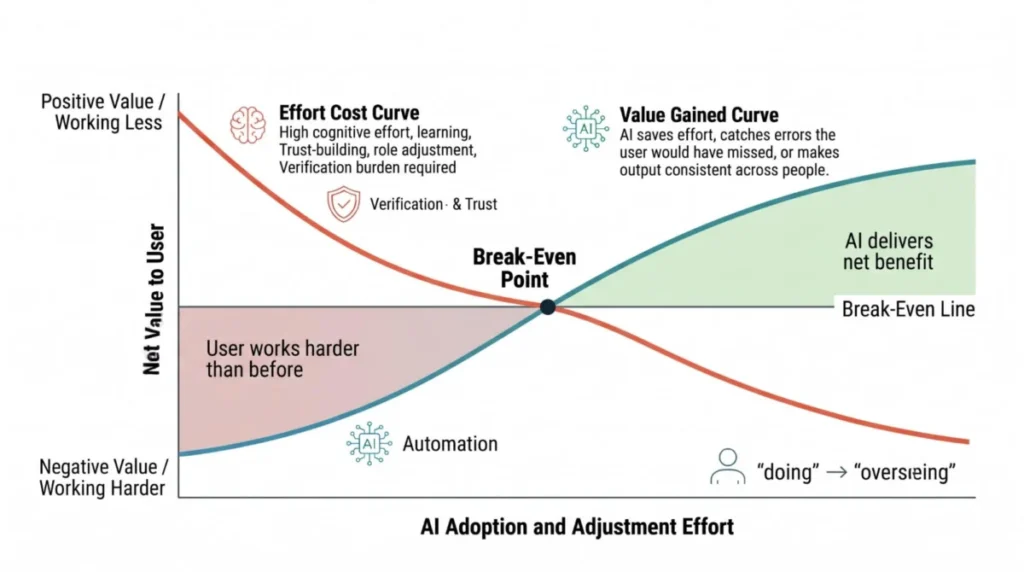

The integration of artificial intelligence into enterprise software is often marketed as a panacea for operational inefficiency, yet a recurring pattern has emerged: AI features frequently save users time on a singular task, only for them to spend that recovered time meticulously auditing the machine’s output. For product development teams, the challenge is no longer about what the technology can do, but where it earns its place in a human-centric workflow. As organizations scramble to implement generative AI, the focus must shift from pure capability to the "break-even line"—the precise threshold where the value of an AI-driven output outweighs the mental and temporal cost of verification.
The Anatomy of an AI Misstep
The risk of over-automating is best illustrated by a recent case study involving a large health insurer. The organization sought to streamline the benefits appeals process by deploying an AI model capable of drafting entire written determinations for specialists. On paper, the technology functioned perfectly, producing coherent, structured documents. However, user adoption cratered. When specialists were forced to integrate the AI into their workflows, those who used it actually spent more time on each case than those who relied on manual processes.
The post-mortem revealed a fundamental flaw in human-computer interaction: reading an AI-generated document with enough scrutiny to assume professional liability for its contents is as cognitively demanding as writing the document from scratch. Because the AI frequently included subtle inaccuracies—mistakes the specialists would never have made themselves—the users were forced to spend their time "error-checking" rather than "creating." The AI, intended to be a productivity booster, had inadvertently demoted the specialists from skilled authors to secondary proofreaders.
This led to a pivot in strategy. Instead of generating the full determination, the team rescoped the tool to act as a research assistant. The second version of the feature simply surfaced relevant policy provisions and historical precedents, leaving the actual composition of the determination to the human specialist. The result was a dramatic decrease in search time, a maintenance of high-quality output, and a restoration of specialist engagement. The underlying technology remained identical, but the point of intervention had shifted from execution to enablement.
The Cognitive Cost of Automation
To understand why such failures occur, one must look at the constraints of human working memory. Research, most notably the work of psychologist Nelson Cowan in 2001, suggests that humans can hold only about four items in their mind at once. Every interface change—even a simple redesign—imposes a "cognitive tax" on the user, who must learn the new tool, understand its capabilities, and calibrate their level of trust.
When AI is introduced, this tax is magnified. The user is no longer just using a tool; they are managing a peer. As noted by Sophia Ackerhans in a 2025 study, physicians who were required to sign off on AI-assisted clinical decisions experienced a significant decline in professional identity. The study found that while providing explanations for AI reasoning increased trust in the system, it simultaneously heightened the user’s perception of the task as a threat to their autonomy and professional judgment.
For an AI feature to be successful, it must clear the "break-even line." Returns to the user generally manifest in three categories: reduced time spent on repetitive tasks, increased accuracy through the detection of errors, or the synthesis of disparate data points that would be impossible for a human to aggregate manually. If the cost of the user’s adjustment—the mental energy required to verify the AI’s work—exceeds these benefits, the feature is effectively a liability.
A Framework for Strategic Deployment
To avoid the pitfalls of "pro-innovation bias"—the assumption that any new technology is inherently beneficial—product teams should subject proposed AI features to a rigorous four-part audit before a single line of code is written.
1. Total Effort Assessment
Product managers often fall into the trap of counting "clicks saved." However, fewer clicks do not always equal higher efficiency. If a feature pre-fills a field but necessitates a manual verification step, the total effort may remain stagnant or even increase. Teams must analyze the total time spent thinking, clicking, and checking. If the task is monotonous, such as data entry, automation may work; if the task requires deep domain expertise, such as legal or medical analysis, automation should assist rather than replace.
2. Competitive Advantage Over Existing Methods
An AI tool must significantly outperform the user’s current "hacky" workarounds, such as spreadsheets or manual checklists. If the user already has a reliable, fast, and practiced route to an answer, AI will likely feel like an unnecessary layer. AI earns its place where there is genuine ambiguity, high-scale data synthesis, or a need for cross-departmental consistency.
3. The Visibility of Error
The "error surface" of an AI—the specific ways in which it can be wrong—must be mapped. If an error is invisible to the user (e.g., a trip planner suggesting a closed museum), the consequence is high. To mitigate this, teams must implement "provenance displays," which show users the data sources and logic behind an AI’s suggestion. Without transparency, the user is forced into a state of blind trust or constant, exhausting skepticism.

4. Long-Term Skill Retention
The most subtle, yet critical, risk is the degradation of human expertise. If an AI handles a complex task for a year, the user will eventually lose the ability to perform that task without assistance. If that task involves high-stakes decision-making, this loss of skill is a systemic risk. Teams must build mechanisms into the workflow, such as periodic blind reviews or rotating manual tasks, to ensure that the user’s judgment remains sharp.
The Broader Implications for Enterprise AI
The current market trend toward "full-process automation" is increasingly viewed by human factors researchers as a potential point of failure. In radiology, for instance, a 2023 experiment led by Thomas Dratsch demonstrated that even highly experienced radiologists were significantly influenced by AI suggestions, even when those suggestions were incorrect. The study showed that reliance on AI did not just assist in decision-making; it fundamentally altered the accuracy of the human reader.
These findings suggest that as we move into 2026 and beyond, the most successful enterprise software companies will be those that design for "human-in-the-loop" synergy rather than total replacement. The goal is to provide a "starting point" for work, rather than a "finished product."
Conclusion: From Roadmap to Reality
For product teams, the transition from proposing a feature to shipping it requires moving away from binary "yes/no" decisions. Instead, audit results should be treated as design requirements. If a feature fails the error-visibility test, the requirement for a provenance dashboard should be non-negotiable. If it fails the effort test, the scope should be narrowed to a specific user segment, such as junior analysts who might benefit from a draft, while allowing senior staff to opt out.
By formalizing the audit process—naming the user segment, defining the error surface, and mandating verification mechanisms—teams can bypass the noise of hype and focus on building tools that actually make the workday more efficient. The ultimate measure of an AI feature is not its technical sophistication, but the quality of the work that remains once the user has finished their review. If the specialist, the analyst, or the doctor can finish their day with greater confidence and less mental strain, the AI has earned its place. If not, the feature should be scrapped, regardless of how impressive the model behind it may appear.