

In today’s hyper-competitive digital landscape, the notion that user experience (UX) design is merely a "cosmetic preference" has been definitively debunked. A growing body of data and real-world case studies affirm that every millisecond of friction-free interaction, every intuitive navigation step, and every aesthetically pleasing visual contributes directly to a company’s bottom line. Carrie Webster, a veteran UX designer, underscores this transformation, advocating for a data-driven approach that elevates UX from an artistic endeavor to a strategic imperative. The cost of a suboptimal interface extends far beyond "lost clicks," translating into millions in wasted development resources, diminished brand loyalty, and forfeited business opportunities. For businesses striving for survival and sustained growth, embracing UX as the primary engine of digital product success is no longer optional; it is a fundamental requirement.
The Evolution of UX: From Aesthetics to Analytics
The journey of UX design mirrors the broader evolution of digital products themselves. In the early mobile-first era, design was often siloed, primarily concerned with visual appeal and basic usability. However, as digital ecosystems matured and user expectations soared, the role of UX expanded dramatically. It transitioned from a visual discipline to one deeply rooted in research and analytics. UX professionals now meticulously collect and interpret data, conducting user studies, A/B tests, and analytics deep dives to understand user behavior, identify pain points, and validate design decisions. This shift has been critical in bridging the historical gap between design teams and executive boardrooms, where financial metrics reign supreme. Hard data, as Webster points out, is the only tool powerful enough to articulate the tangible return on investment (ROI) of good design, proving that UX is a non-negotiable requirement for a healthy financial outlook.
Ten Data-Backed Pillars of UX-Driven Financial Growth
The current reality of the digital world is governed by user expectations shaped by seamless experiences from industry leaders. These ten facts, commonly adopted as best practices by designers, represent clinical, data-backed pillars for financial growth in a saturated market:
1. The 1:100 Rule: Cost Efficiency Through Early Intervention
One of the most compelling financial arguments for robust UX investment is the 1:100 rule. Studies from institutions like the IBM Systems Institute and Segue Technologies consistently demonstrate that rectifying an error after a product has been developed and launched can be up to 100 times more expensive than addressing it during the initial design and prototyping phases. This principle highlights UX as a form of "engineering insurance." By validating every interaction during the design phase, businesses minimize technical debt, save invaluable developer time, and prevent revenue loss stemming from broken user flows post-launch. For instance, discovering a fundamental navigation flaw after deployment not only incurs the cost of the fix but also the indirect costs of frustrated users and reputational damage. This "shift-left" approach in development, where quality assurance and user validation occur earlier, is now a cornerstone of agile methodologies, championed by software development firms globally.
2. Performance as a Core User Experience Element
In the contemporary digital landscape, performance is not merely a technical specification but the fundamental bedrock of user experience. A visually stunning interface is rendered ineffective if users abandon it before it fully loads. Data unequivocally shows that 47% of users expect a page to load in two seconds or less, with any deviation leading to significant financial repercussions. A mere one-second delay can diminish conversions by 20% and reduce user satisfaction by 16%. Retail businesses alone face an estimated annual loss of $2.6 billion due to sluggish load times. The impact on mobile users is even more pronounced: a rise in mobile load time from one to three seconds can spike bounce rates by 32%, causing conversion rates to plummet from 40% to 29%. Conversely, even a microscopic 0.1-second improvement in load time can elevate retail conversions by 8.4% and travel site conversions by 10.1%. Optimizing metrics like Largest Contentful Paint (LCP) by 31%—a benchmark achieved by 67% of websites as of June 2025—can directly translate to an 8% increase in sales. For designers, speed is not an afterthought; it is a primary design element, integral to the very existence and effectiveness of the user interface.

3. The Critical 50 Milliseconds for First Impressions
The adage "first impressions matter" holds profound weight in the digital realm. Research indicates that users form an opinion about a website’s visual appeal and trustworthiness in approximately 50 milliseconds (0.05 seconds). This split-second "gut feeling" is a primal survival mechanism that dictates whether a user remains to explore the value proposition or navigates away immediately. In the current market, an overwhelming 94% of first impressions are strictly design-related. If an interface appears dated, cluttered, or simply "off," users subconsciously project that perceived lack of quality onto the entire product or service. The implication is clear: compelling content, innovative features, and strong branding effectively cease to exist if the initial visual design fails to capture and sustain the user’s attention for those crucial few seconds.
4. Hick’s Law: The Cost of Overwhelm and Choice Paralysis
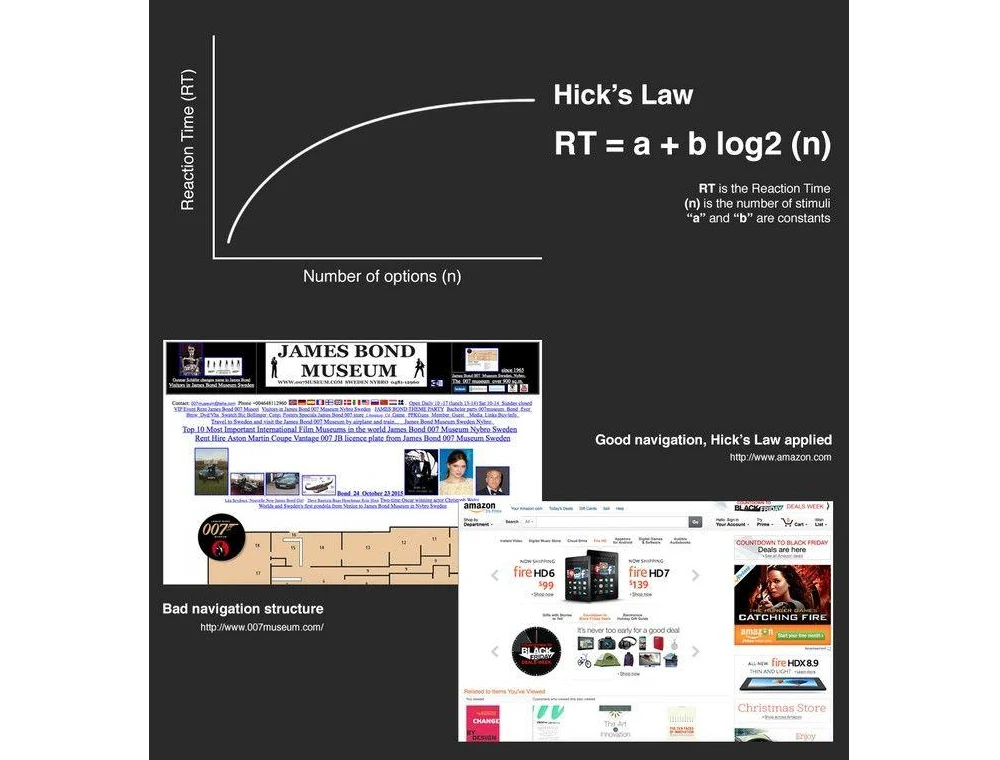
While stakeholders often mistakenly believe that "more options" equate to "more value," psychological principles, specifically Hick’s Law, prove the opposite. This law states that the time required to make a decision increases logarithmically with the number of choices available. Every additional menu item, form field, or navigational link imposes a "tax" on the user’s cognitive load. Landbase reports that top-performing websites now achieve conversion rates exceeding 11%, significantly outperforming average sites that struggle below 3%. A key differentiator for these high performers is their strategic application of personalization and optimization strategies to simplify the user experience. The implication for businesses is stark: simplifying choices, streamlining processes, and reducing cognitive load can directly translate into higher conversion rates. As Carrie Webster succinctly advises, "If you want to increase your revenue by tomorrow, find one field to delete from your checkout flow today."
5. White Space: The Strategic Tool for Enhanced Comprehension
Often perceived as "wasted real estate" by those unfamiliar with design principles, white space (or negative space) is, in reality, a powerful tool for focus and clarity. Strategic deployment of white space can significantly increase a user’s content comprehension by up to 20%. It prevents "cognitive overload" by providing visual breathing room, allowing the user’s eyes to rest and guiding them towards the most critical elements—often key calls to action like "Buy" or "Sign Up." In an era where human attention spans have reportedly dropped to roughly 8 seconds by 2026, simplicity is the ultimate luxury and a major driver of engagement. A practical example from a fintech dashboard project demonstrated that applying more white space around data components reduced analyst users’ time-on-task by 25% and boosted trial-to-paid conversions. This shows that thoughtfully placed white space is not merely aesthetic but profoundly functional, directly impacting user efficiency and business outcomes.
6. The Goal Gradient Effect: Leveraging "Fake" Progress for Motivation
One of the most surprising psychological hacks in UX design is the Goal Gradient Effect: users are more motivated and complete tasks faster if they perceive they have already made progress. A classic study involving coffee loyalty cards found that a 10-stamp card with two "pre-filled" stamps was completed significantly faster than an 8-stamp card with no initial stamps, despite requiring the same total purchases. In digital design, presenting a progress bar that starts at 15% (simply for creating an account, for example) can increase completion rates for onboarding by over 40%. This isn’t deception; it’s a clever application of behavioral psychology. UX designers aren’t just arranging pixels; they are managing the user’s sense of momentum and dopamine release, strategically nudging them towards task completion and conversion.

7. Readability: A Direct Link to User Engagement and Conversion
Contrary to the belief that cramming more text "above the fold" increases value, data proves the opposite. Proper typography, specifically optimal line spacing (leading) and paragraph width, can increase content comprehension and reading speed by up to 20%. The W3C’s Web Content Accessibility Guidelines (WCAG) emphasize the importance of visual presentation for readability. An optimal line height, generally 1.5 times the font size, minimizes "visual noise," allowing the brain to process information with less cognitive effort. When users struggle to read text due to tight spacing, small fonts, or heavy font weights, their "perceived effort" increases, leading to higher bounce rates. Legibility is a powerful conversion tool: if content is difficult to read, it becomes difficult for users to absorb information, trust the brand, and ultimately make a purchase or commitment.
8. Designing for Scanning: Acknowledging User Behavior
The reality of web usage is that users do not meticulously read content; they scan it. Studies from the Nielsen Norman Group reveal that on a typical web page, users read only about 20% to 28% of the text. Modern users primarily scan in an F-pattern or Spotted pattern, meaning they quickly skim headings, initial sentences, and highlighted keywords. Therefore, designing for traditional linear reading is a tactical error. Effective UX design for scanning requires:
- Clear and concise headings and subheadings: To break up content and provide immediate context.
- Strategic use of bullet points and numbered lists: For easy digestion of key information.
- Bolding or highlighting important keywords: To draw the eye to critical details.
- Short paragraphs: To prevent cognitive overload and encourage quick scanning.
- Visual hierarchy: Using size, color, and placement to emphasize important elements.
- Prominent calls to action: Ensuring users can quickly identify the next step.
By adopting these principles, designers can ensure that even time-constrained users grasp the core message and find what they need, improving engagement and conversion.
9. The Magic Number: Optimizing User Testing with Five Participants
Companies often fall into the trap of overspending on massive user studies, generating an overwhelming amount of data that can obscure actionable insights. The reality, as articulated by usability expert Jakob Nielsen, is that testing with just 5 users typically uncovers 85% of usability problems. This represents a mathematical sweet spot where the point of diminishing returns is reached. Beyond the fifth user, the cost-benefit ratio declines significantly, as additional testing yields fewer new bugs. The competitive advantage lies not in large, infrequent studies but in small, frequent user testing activities. Testing with five users, iterating on findings, and then testing with another five is the most cost-effective and efficient methodology for building a robust, user-friendly product. This agile approach ensures continuous improvement without excessive expenditure.
10. The Staggering Financial ROI of 9,900%
Perhaps the most staggering statistic reinforcing the value of UX is its exceptional return on investment. On average, every $1 invested in UX design yields $100 in return, translating to an astonishing 9,900% ROI. This isn’t merely a speculative figure; it’s the cumulative result of increased conversion rates and reduced support costs. A fully optimized UX design can improve conversion rates by up to 400%, as highlighted by Forrester Research. Furthermore, an intuitive and self-explanatory design significantly lowers the demand for customer support. When users can easily navigate a product or service, the need for extensive call centers or help desk interventions diminishes, freeing up resources and reducing operational costs. This dual impact—boosting revenue while cutting expenses—makes UX an unparalleled investment.

The Depth of UX Investment: Beyond Individual Metrics
Beyond these individual statistics, the cumulative effect of a mature UX practice is profound. McKinsey’s research indicates that companies demonstrating high design maturity achieve 32% higher revenue growth and 56% higher total returns to shareholders compared to their less design-focused competitors. This discrepancy arises because mature UX organizations move beyond merely "user delight" to prioritize "user efficiency." When a design improvement shaves 30 seconds off a daily workflow for a team of 1,000 employees, the annual productivity gains can translate into hundreds of thousands of dollars reclaimed—an often-overlooked internal ROI that is as vital as consumer-facing conversion rates.
Moreover, the "experience gap" presents a significant market opportunity. Bain & Company reports that while 80% of companies believe they deliver a "superior experience," only 8% of customers agree. This massive disconnect underscores a critical failure in understanding and meeting user needs. By actively bridging this gap through continuous user testing, performance optimization, and data-driven design, businesses are not just improving their products; they are actively capturing market share that competitors are inadvertently leaving on the table.
The AI Nexus: Evolving UX in an Intelligent Era

The conversation around UX today is inseparable from the burgeoning influence of Artificial Intelligence (AI). While AI hasn’t rendered these ten fundamental UX truths obsolete, it has significantly accelerated and augmented the solutions to many of them, as noted by Adobe. AI has transformed UX from a static map into a dynamic, living guide for users.
- Personalization: AI algorithms can analyze user behavior in real-time, dynamically adapting interfaces and content to individual preferences, enhancing relevance and reducing cognitive load.
- Automated Testing and Optimization: AI-powered tools can conduct A/B tests at scale, identify usability issues, and even suggest design improvements faster and more efficiently than manual methods.
- Predictive Analytics: AI can anticipate user needs and potential pain points, allowing designers to proactively optimize journeys and prevent friction before it occurs.
- Generative Design: AI can assist in generating initial design concepts, wireframes, and even content, streamlining early-stage design processes.
- Enhanced Customer Support: AI-driven chatbots and virtual assistants provide instant, personalized support, reducing reliance on human agents and improving user satisfaction.
- Accessibility: AI can help identify and rectify accessibility barriers, making digital products more inclusive for diverse user groups.
However, despite these advancements, the fundamental rules of human psychology—our 50ms judgment, our need for white space, our scanning habits—remain unchanged. AI serves as a powerful enhancer, allowing designers to apply these principles with greater precision and impact.
Conclusion: The Indisputable ROI of User-Centric Design
As we navigate deeper into the late 2020s, the distinction between "design" and "business strategy" has effectively dissolved. The data is unequivocal: companies that prioritize and lead in design consistently outperform their competitors by 1.7x in revenue growth. UX design is no longer a team hired to "make things look nice." It is the research-driven, data-backed discipline that ensures your digital product isn’t just a cost center, but a revenue-generating machine. This reality, though perhaps long understood by practitioners, must become a core tenet for every business leader. Implementing these factual design improvements yields tangible differences that intuition alone cannot replicate. We are firmly past the era of subjective opinions. The data is clear, the psychology is proven, and the ROI is undeniable. The critical question for businesses is not if to invest in UX, but how strategically and comprehensively, lest competitors seize the initiative and reap the rewards first.