
In today’s hyper-competitive digital economy, the notion of user experience (UX) design has transcended its traditional perception as a mere aesthetic consideration. What was once dismissed as a "cosmetic preference" is now unequivocally recognized as a primary engine of business survival, directly impacting revenue, customer retention, and long-term growth. Every fraction of a second of friction in a digital interface carries a measurable business cost, transforming "lost clicks" into potentially millions in wasted engineering expenditure and forfeited business value.
The evolution of UX from the early mobile-first era has seen it mature into a rigorous discipline blending research and analytics with design principles. Industry leaders and veteran UX designers alike emphasize that hard data is the only tool powerful enough to bridge the gap between design insights and boardroom decisions. Facts, rather than subjective preferences, advocate for the user while simultaneously proving that a superior UX is a non-negotiable requirement for a healthy bottom line. This data-driven approach dismantles the myth of design as purely "visual," repositioning it as a strategic imperative. For instance, a notable B2C mobile design project demonstrated an immediate 12% lift in completed transactions simply by stripping 1.2 seconds off the mobile load time through asset optimization. This case starkly illustrates that in UX, every tenth of a second is a direct lever for revenue, validating the clinical, data-backed pillars for financial growth in a saturated market.
The Economic Imperative of Proactive Design
One of the most compelling financial arguments for robust UX investment is the "1:100 rule." Extensive modern studies, including those from the IBM Systems Institute and Segue Technologies, consistently show that rectifying an error after a product has been developed and launched can be up to 100 times more expensive than addressing it during the initial design and prototyping phases. This principle positions UX as a form of "engineering insurance." By the time code is written, every user interaction should ideally be thoroughly validated. Discovering a fundamental navigation flaw post-launch incurs not only the direct cost of the fix but also significant technical debt, lost developer time, and substantial revenue losses as users struggle with a broken or inefficient flow. This cost escalation underscores the critical importance of shifting design validation left in the software development lifecycle, minimizing costly rework and accelerating time to market.
Performance as a Foundational UX Element
In the contemporary digital landscape, performance is the bedrock of user experience. A visually appealing interface holds no value if users abandon it before it fully renders. The data is stark: 47% of users expect a page to load in two seconds or less. Failing to meet this expectation represents a significant financial catastrophe. Even a mere one-second delay in page load time can reduce conversions by 20% and user satisfaction by 16%. Retail businesses, for example, are estimated to lose $2.6 billion annually due to slow load times. The impact is particularly pronounced on mobile devices, where bounce rates spike by 32% when load time increases from one to three seconds, and conversion rates typically plummet from 40% to 29% by the third second.
Conversely, this sensitivity offers a powerful lever for growth. Even a microscopic 0.1-second improvement in site speed can elevate retail conversions by 8.4% and travel site conversions by 10.1%. Furthermore, improving a website’s Largest Contentful Paint (LCP) – a key Core Web Vital – by 31% has been shown to drive an 8% increase in sales. As of June 2025, approximately 67% of websites have achieved this benchmark, indicating a growing industry focus on performance. For design strategists, speed is no longer an afterthought but a primary design element; if a site isn’t instantaneous, the design, in essence, fails to exist.
The Power of First Impressions: 50 Milliseconds to Convert
First impressions are both visceral and aesthetic, playing an outsized role in user engagement. Research indicates that users form an opinion about a website’s visual appeal in approximately 50 milliseconds (0.05 seconds). This split-second "gut feeling" is a fundamental human survival mechanism that dictates whether a user remains to explore a value proposition or immediately bounces. In today’s market, a staggering 94% of first impressions are strictly design-related. If an interface appears "off," outdated, or unprofessional, users subconsciously project that perceived lack of quality onto the entire product or service. This means that even the most compelling content effectively remains unseen if the initial design fails to capture the user’s attention for the few precious seconds required to engage with it.
Hick’s Law: The Hidden Cost of Overwhelm

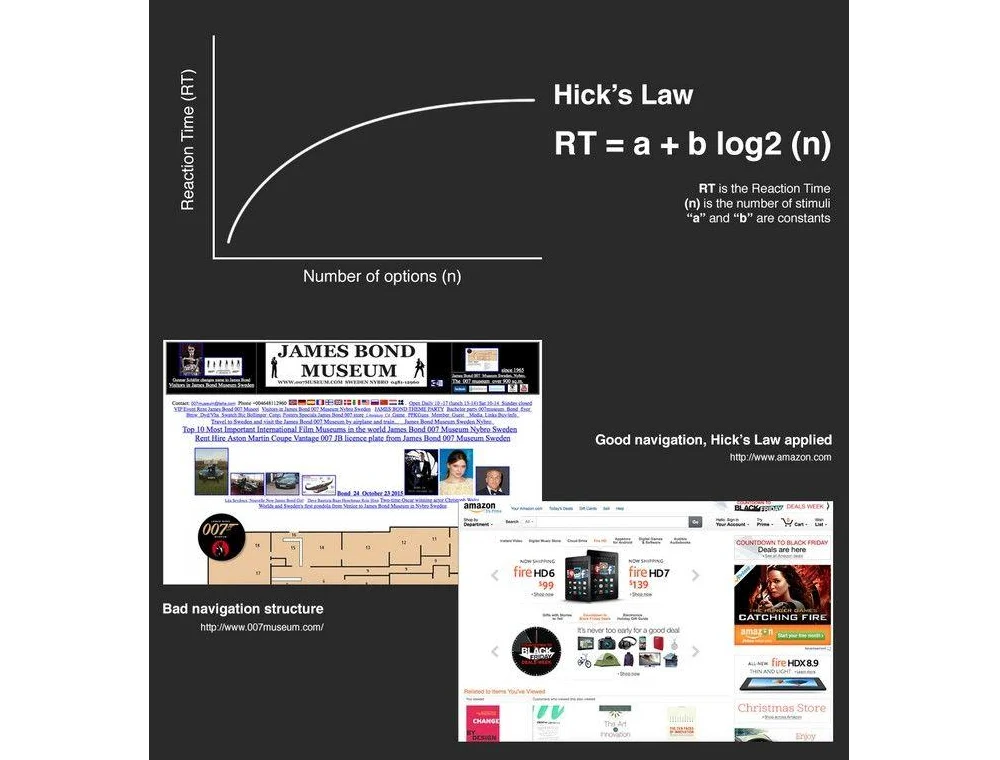
A common misconception among stakeholders is that "more options" equate to "more value." Psychological principles, however, prove the opposite. Hick’s Law postulates that the time it takes for an individual to make a decision increases proportionally with the number of available choices. Every additional menu item, form field, or navigation link imposes a "cognitive tax" on the user’s brain. Leading analytics platforms and industry reports, such as those by Landbase, reveal that top-performing websites now achieve conversion rates exceeding 11%, while average performers struggle below 3%. This significant gap is often attributed to the successful application of personalization and optimization strategies that simplify the user experience. Simplifying choices directly reduces cognitive load, leading to quicker decisions and higher conversion rates. This principle suggests that even a seemingly minor action, like removing one unnecessary field from a checkout flow, can yield immediate and tangible increases in revenue.
Strategic Use of White Space for Enhanced Comprehension
"White space," often misconstrued by non-designers as wasted screen real estate, is, in fact, a powerful tool for guiding user focus and improving information processing. Strategic application of white space can increase a user’s content comprehension by up to 20%. This seemingly simple design element is crucial in preventing "cognitive overload," allowing the user’s eyes to rest and directing their attention towards the most important elements, such as call-to-action buttons. In an era where average human attention spans have reportedly dropped to roughly eight seconds, simplicity, facilitated by ample white space, becomes the ultimate luxury and a significant driver of engagement. A practical application of this, as seen in a fintech dashboard project, involved reducing "data dump" layouts by introducing more white space around data elements. This led to a 25% decrease in time-on-task for analyst users and a notable boost in trial-to-paid conversions, demonstrating the direct link between visual clarity and business outcomes.
The Psychological Momentum of "Fake Progress"
One of the most surprising psychological hacks employed in UX design is the "Goal Gradient Effect," which states that users are more motivated to complete a task if they perceive they have already made progress. A classic study illustrated this by showing that a 10-stamp coffee card with two stamps pre-filled was completed significantly faster than an 8-stamp card with zero pre-fills, despite identical total expenditure requirements. In digital design, this translates into showing a progress bar that starts at, for instance, 15% (simply for creating an account). This subtle psychological nudge can increase completion rates for onboarding processes by over 40%. This highlights that UX designers are not merely crafting screens but actively managing users’ dopamine responses and sense of momentum, leveraging intrinsic human motivation to drive task completion.

Readability as a Conversion Catalyst
Many stakeholders mistakenly believe that cramming more text "above the fold" increases value. However, data from organizations like the W3C demonstrates the opposite. Proper typography, specifically optimal line spacing (leading) and paragraph width, can increase content comprehension and reading speed by up to 20%. An optimal line height, generally around 1.5 times the font size, significantly reduces "visual noise," enabling the brain to process information with less cognitive effort. When users struggle to read text due to tight spacing or small fonts, their "perceived effort" increases, often leading to higher bounce rates. Legibility, therefore, functions as a critical conversion tool: if content is difficult to read, it becomes difficult for users to engage with, understand, and ultimately, act upon (e.g., make a purchase). Diverse font weights, contrasts, and line lengths also play a crucial role in ensuring accessibility and reducing visual fatigue, further emphasizing that readability is a strategic design choice with tangible business impact.
Designing for the Scanner: Users Consume Only 20% of Content
This truth complements the importance of readability: users typically do not read web pages; they scan them. On an average web page, users read only about 20% to 28% of the text. Because modern users often scan in F-patterns, Z-patterns, or spotted patterns, designing for comprehensive reading is a tactical error. Effective UX necessitates designing for scannability, which requires:
- Prominent Headings and Subheadings: Breaking content into digestible chunks.
- Bullet Points and Numbered Lists: Presenting information concisely.
- Bolded Keywords: Highlighting critical information.
- Short Paragraphs: Improving visual flow and reducing intimidation.
- Inverted Pyramid Structure: Placing the most important information first.
- Meaningful Visuals: Supporting text and conveying information quickly.
By structuring content in this manner, designers ensure that users can quickly extract key information, increasing the likelihood of engagement and conversion, even with limited attention spans.
The Magic Number: Efficiency in User Testing

Companies sometimes squander substantial budgets on massive user studies involving hundreds of participants, often getting buried in superfluous data. The reality, as validated by organizations like the Nielsen Norman Group, is that testing with just five users typically uncovers approximately 85% of usability problems. This represents a mathematical sweet spot where the point of diminishing returns is reached quickly. Beyond the fifth user, the additional cost of testing yields fewer novel insights. The competitive advantage, therefore, lies in conducting small, frequent user testing activities. This iterative approach—testing with five users, implementing improvements, and then testing with five more—is consistently proven to be the most cost-effective and efficient method for building a robust, user-centric product. This agile testing philosophy ensures continuous improvement without excessive resource allocation.
The Unprecedented ROI of UX: 9,900%
Perhaps the most staggering and consistent statistic in the industry is the average return on investment for UX. For every $1 invested in UX, businesses typically see a return of $100. This astounding 9,900% ROI is not magic but the cumulative effect of increased conversion rates, enhanced user satisfaction, and significantly reduced support costs. A fully optimized UX design can improve conversion rates by up to 400%, as detailed in reports by Forrester. Furthermore, intuitive and self-explanatory design drastically lowers the need for extensive customer support infrastructure. When a product is inherently easy to use, the demand for call centers or detailed help documentation diminishes, translating directly into operational cost savings. This multi-faceted return on investment makes UX not merely a departmental expense but a powerful financial accelerator.
The Strategic Depth of UX Investment and Organizational Maturity
Beyond these individual statistics, the cumulative effect of a mature UX practice profoundly impacts overall business performance. Research by McKinsey & Company consistently demonstrates that companies with high design maturity achieve 32% higher revenue growth and 56% higher total returns to shareholders compared to their less design-focused peers. This discrepancy arises because mature UX organizations move beyond merely "user delight" to prioritize "user efficiency." When a design improvement shaves 30 seconds off a daily workflow for a team of 1,000 employees, the organization isn’t just making its workforce happier; it’s reclaiming hundreds of thousands of dollars in annual productivity. This internal ROI, often overlooked, is as vital as consumer-facing conversion rates.

Moreover, a significant "experience gap" persists in the market. While 80% of companies believe they deliver a "superior experience," only 8% of their customers agree, according to Bain & Company. This massive disconnect represents a substantial market opportunity for businesses willing to leverage hard data to bridge this chasm. By continuously investing in user testing and performance optimization, companies are not just improving a product; they are strategically capturing market share that competitors, content with their self-proclaimed "superior experience," are leaving on the table.
The Impact of AI on UX: Acceleration, Not Replacement
The discussion of modern UX is incomplete without acknowledging the transformative impact of Artificial Intelligence (AI). While AI hasn’t fundamentally altered these ten core truths of human psychology and interaction, it has dramatically accelerated the solutions for some of them. AI-powered analytics can now pinpoint friction points with unprecedented precision, enabling designers to address issues like slow load times or complex navigation more rapidly. Predictive interfaces, driven by AI, can anticipate user needs, personalize experiences, and streamline decision-making, effectively reducing the cognitive load associated with Hick’s Law. Chatbots and AI assistants can provide instant support, lowering the burden on human customer service and reinforcing the ROI of intuitive design. AI has transformed UX from a static map into a dynamic, living guide for users. However, the fundamental rules governing human perception, motivation, and interaction—such as our 50-millisecond judgments and our inherent need for visual clarity—remain unchanged, underscoring that AI serves as a powerful enhancer rather than a replacement for foundational UX principles.
Conclusion: UX as a Core Business Strategy
In summary, the key truths underpinning the indispensable value of user experience are:

- Fixing design issues pre-launch is 100 times cheaper than post-launch.
- Page performance directly dictates user experience and conversion rates.
- First impressions are formed in a mere 50 milliseconds, primarily based on design.
- Excessive choices lead to decision paralysis, hindering conversions (Hick’s Law).
- Strategic white space significantly improves content comprehension.
- "Fake progress" psychologically motivates users to complete tasks faster.
- Readability is paramount for content engagement and conversion.
- Users scan web content, reading only a fraction of available text.
- Testing with just five users uncovers the vast majority of usability issues.
- Every $1 invested in UX yields an average return of $100.
As the late 2020s unfold, the distinction between "design" and "business strategy" has effectively vanished. Data from sources like McKinsey consistently shows that companies leading in design outperform their competitors by a factor of 1.7x in revenue growth. UX design is no longer a team hired to "make things look nice." It is the research-driven, data-backed discipline that ensures a digital product is not merely a cost center but a potent revenue-generating machine. While this has arguably always been the case, the overwhelming evidence now makes it an undeniable reality for any business aiming for sustained success. The era of subjective design opinions is over. The data is clear, the psychology is proven, and the ROI is undeniable. The only remaining question for businesses is whether they are prepared to let these facts lead their design strategy or cede this critical advantage to their competitors.