
The landscape of digital interaction is undergoing a profound transformation with the rise of agentic Artificial Intelligence. Unlike conventional software, which typically executes predefined instructions, agentic AI systems possess the capacity for autonomous decision-making, planning, and execution, often engaging in complex "thinking" processes rather than mere data retrieval. This fundamental shift necessitates a re-evaluation of long-established user interface (UI) patterns, particularly those designed to communicate system latency. Traditional loading indicators, such as spinning wheels and progress bars, once sufficient for signaling bandwidth delays or file transfers, prove woefully inadequate for conveying the intricate internal workings of an intelligent agent. The inability of current UI paradigms to articulate the AI’s internal state leads to user confusion, anxiety, and a significant erosion of trust, presenting a critical challenge for designers and developers in this burgeoning field.
The Evolving Landscape of AI and User Expectations
For over three decades, interface designers have relied on a limited set of visual cues to manage user expectations during system delays. The ubiquitous spinner, the throbber, and the linear progress bar all communicate a singular technical reality: data is being fetched, processed, or transferred, and the delay is largely a function of network speed or data volume. This model, while effective for static software and client-server architectures, breaks down when confronted with agentic AI.

Agentic AI introduces a new category of wait time. When an AI agent pauses for an extended period—say, twenty seconds—it is not merely downloading information. Instead, it is actively engaged in sophisticated cognitive processes: analyzing inputs, formulating strategies, weighing probabilistic outcomes, and synthesizing new content. This "thinking time" is opaque to the user if represented by a generic spinning icon. Users are left to wonder whether the system is stalled, crashed, or simply grappling with a particularly complex task. This ambiguity can breed profound frustration and undermine confidence in the AI’s capabilities. A 2023 survey by PwC on AI readiness, for example, highlighted that trust and transparency remain significant barriers to broader AI adoption, with many users expressing concerns about the "black box" nature of AI decisions. The expectation of users is no longer just for speed, but for understanding and control, especially as AI integrates deeper into critical personal and professional workflows.
Beyond the Spinner: Crafting Meaningful Status Updates
To bridge this transparency gap, the focus must shift from purely visual indicators to clear, descriptive language—often referred to as microcopy—that illuminates the AI’s ongoing process. The goal is to transform moments of anxious waiting into opportunities for reassurance. Instead of a passive "something is happening," the interface needs to actively communicate, "Here is exactly how I am working to solve your problem."
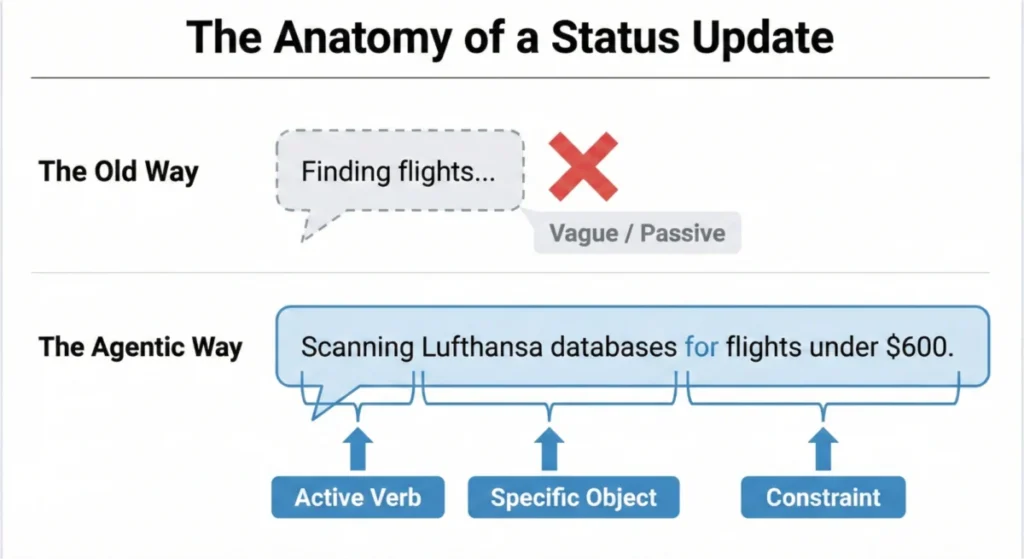
Generic placeholders like "Loading" or "Working" are vestiges of a bygone era of static software. For agentic AI, status updates must be structured using a specific formula that mirrors the system’s inherent agency. This formula typically comprises an Action Word, a Specific Item the AI is working on, and any relevant Limits or constraints.

Consider an agentic AI designed to organize calendars and schedule meetings. A vague message like "Checking availability" for an indeterminate duration provides minimal insight. Users are left unaware of whose calendars are being checked, what subsequent steps are involved, or if the AI has even retained the core purpose of the request. This lack of detail can turn a simple wait into a tense, uneasy experience.
A more effective approach, exemplified by platforms like Perplexity AI (as shown in Figure 1 of the original context), dynamically displays a list of activities as they are accomplished. This real-time feed allows users to follow the AI’s progress without guesswork. Applying the agentic update formula, the calendar agent could break down its process into granular, understandable steps:
- "Analyzing meeting request for attendees and preferred times."
- "Accessing shared calendars for John, Jane, and Sarah."
- "Identifying common availability for a 60-minute slot between 2 PM and 5 PM."
- "Drafting meeting invitation with agenda points and sending for confirmation."
This communication style grounds the technical process in the user’s real-world context, clearly articulating the AI’s actions and intentions. For an AI assisting with travel booking, a weak update would be "Searching for flights…" A more robust and transparent update using the formula would be: "Searching for direct flights to Paris within a $500 budget, departing between June 1st and June 7th." This clearly demonstrates comprehension and adherence to parameters, building immediate confidence.
Tailoring Transparency: Tone and Risk

The "personality" of an AI—whether it sounds conversational or purely functional—is not a stylistic choice but a critical design decision driven by the task’s inherent importance and risk. This determination can be guided by an Impact/Risk Matrix, often derived from a Decision Node Audit (as mentioned in the first part of this series).
For low-risk, routine tasks, a friendly, conversational tone fosters a comfortable user experience. A scheduling assistant might say, "Just checking your calendar for the best time to meet," creating an approachable interaction. However, high-stakes tasks demand precision and a more mechanical, factual tone. For instance, an AI managing a significant financial transfer or a complex database migration should avoid playful language. A message like "I am thinking hard about your money" would undoubtedly induce panic. Instead, an interface should communicate with straightforward accuracy: "Verifying account routing numbers and transaction limits" or "Initiating secure data migration protocol."
While the Impact/Risk Matrix provides a foundational framework, the ultimate determinant of appropriate AI voice and tone is rigorous user research. No set of predefined rules can perfectly predict user comfort or stress levels across all demographics and situations. User research must involve:
- Observational Studies: Watching users interact with the AI in their natural environments.
- A/B Testing: Comparing different tones and wording in live environments.
- Qualitative Interviews: Gathering direct feedback on clarity, helpfulness, and emotional response.
This empirical approach ensures the AI’s "personality" is not only comfortable but also appropriate for the specific users and contexts it serves, reinforcing trust and facilitating adoption.

A New Toolkit for AI Interfaces: Practical Patterns for Transparency
With the right words established, the next challenge lies in designing the "container" for these messages. A library of interface patterns is essential to ensure that the weight and importance of the message are matched by the visibility and prominence of its delivery.
The Living Breadcrumb: For low-importance tasks operating quietly in the background, a "Living Breadcrumb" provides subtle, non-disruptive assurance. Imagine an AI drafting an email; a disruptive pop-up is unwarranted. Instead, a small, dynamic status indicator pulses within the application’s border or menu. It seamlessly transitions between updates, perhaps from "Reading email" to "Drafting reply" to "Checking tone." This pattern offers quiet confidence that the task is progressing without demanding constant attention, allowing users to remain focused on their primary activities.
Dynamic Checklists: For critical, high-stakes tasks—such as complex financial transactions or large dataset migrations—a Dynamic Checklist is highly recommended. This pattern offers a robust anchor for user confidence by laying out every planned step the AI agent will take. It clearly highlights the current step, marks preceding steps as complete, and lists future actions as pending. For example:

- "Step 1: Validating transaction details (Completed)"
- "Step 2: Converting currency from EUR to USD (In Progress)"
- "Step 3: Applying regulatory compliance checks (Pending)"
- "Step 4: Confirming secure transfer (Pending)"
The Dynamic Checklist excels at managing unpredictable time. If currency conversion takes an unexpected ten seconds longer, users understand the delay’s context, mitigating anxiety. They know precisely where the system is in its process, fostering patience and trust. Devin AI (Figure 4 of the original context) provides a compelling example of this, offering users a clear overview of accomplished and remaining tasks. Implementing this requires a robust front-end state management system to listen for step-completion events, typically triggered by back-end webhooks, underscoring the full-stack design implications.
The Thinking Toggle: For users with higher information needs, such as expert users or developers, a "Thinking Toggle" provides deeper transparency. This progressive disclosure UI control (e.g., a chevron or "View Logs" button) allows users to expand a friendly status update into a raw, sanitized terminal view. It displays the AI agent’s logic logs, such as:
- "API Call: [External Service] /get_financial_data (Status: 200 OK)"
- "Model Inference: [Model Name] analyzing market trends (Confidence: 0.92)"
- "Rule Triggered: [Compliance Rule ID] due to transaction size"
While many users may never access this view, its mere presence signals honesty and builds trust by demonstrating that the system has nothing to conceal. Crucially, these raw logs must be meticulously sanitized and abstracted before display to prevent accidental exposure of proprietary business logic, internal data structures, or security tokens, ensuring transparency without compromising security.
Designing for Partial Success: Traditional software often presents outcomes in binary terms: success or failure. However, agentic AI operates in shades of gray. An AI might successfully plan 90% of a trip but fail to secure a specific restaurant reservation. Binary error messages like "Request Failed" are trust-killers in such scenarios, as they misrepresent the AI’s overall performance.

Instead, interfaces should clearly delineate what worked and what didn’t:
- "Your flight and hotel bookings are confirmed. However, the AI encountered an issue booking the specific restaurant requested due to full capacity. Would you like to explore alternatives?"
This granular feedback allows users to leverage the AI’s successes and efficiently address the remaining issues, preventing the perception of complete failure and reducing manual rework.
Disentangling the Tool: When an AI system underperforms, it is crucial to accurately attribute the cause of failure. Users often mistakenly blame the AI itself for issues stemming from external services or tools it relies upon. If a virtual assistant fails to access a schedule because the Google Calendar API is down, the error message should not imply the assistant’s incompetence.
- Poor message: "I failed to check your calendar."
- Better message: "I am unable to access your calendar. The Google Calendar API is currently unavailable."
This distinction preserves user faith in the AI’s core capabilities, even when external dependencies falter, ensuring that trust is maintained through precise attribution.

The Audit Trail: The Cornerstone of Post-Fact Trust
Real-time transparency, while vital, is fleeting. Users may step away from their desks, missing dynamic updates. Upon returning to a completed task, if the result seems odd or requires validation, they need a persistent record of the AI’s actions. This necessitates a persistent Audit Trail for every agentic workflow.
This "Show Work" interaction provides a link or history log on the final result screen, allowing users to replay the decision logic. For a financial transaction, it might display:
- "Transaction initiated by [User Name] at [Time/Date]."
- "AI verified account balance and flagged insufficient funds."
- "AI sent notification to [User] regarding insufficient funds."
- "Transaction cancelled by AI as per user preferences for overdraft."
This audit trail acts as an ultimate safety net, enabling users to spot-check the validity of the output. Its mere presence signals that the system stands behind its work.

The lack of such a persistent audit trail can lead to significant user frustration, as illustrated by an issue with ChatGPT’s "memory" around April 2025. Developer Simon Willison noted that ChatGPT was automatically incorporating information from past conversations into new ones without explicit user awareness or an accessible log. For instance, ChatGPT might silently infer a user’s location from previous chats and subtly include a "Half Moon Bay" sign in a generated image (Figure 8 of the original context), despite the user never requesting it. This absence of an auditable memory, disguised as personalization, eroded trust. The Audit Trail pattern directly addresses this, ensuring users can always understand the context and rationale behind an AI’s output.
The Reality of User Engagement and Enterprise Adoption
Even the most meticulously designed checklists or clearest status messages can be overlooked by busy users, particularly professionals. An insurance underwriter generating fifty quotes daily is unlikely to watch a progress bar. They initiate a task, switch tabs to other work, and only return when a result is expected. For these experts, the system is judged almost entirely on the final output. If an expected premium falls within a predictable range, trust is established quickly.
However, if the system returns a figure significantly outside expectations, the user stops. They may have missed a real-time explanation—perhaps a high-risk surcharge that briefly appeared with the progress bar. If that explanation is not persistently available, the user has no way to reconcile the discrepancy. They will not re-run the query to observe the animation; instead, they will likely resort to manual recalculation, effectively dismissing the AI’s output as useless and leading to a complete rework. This not only wastes time but severely erodes confidence. In such moments of disagreement, the user’s primary concern is validating the system’s accuracy against their own trusted methods, not understanding the "why" in real-time. The Audit Trail becomes indispensable here, providing persistent transparency that prevents the AI from creating more work, which is a primary barrier to consistent adoption, especially in enterprise settings where efficiency is paramount. If an AI tool demands ten minutes of investigation for every unexpected result, its value quickly diminishes.

Building AI as a Trusted Colleague
The objective of designing transparent AI interfaces is not to create "magic tricks" that rely on hidden mechanics, but to build reliable "colleagues." Just as a good human colleague keeps you informed, explaining their process, acknowledging delays, and highlighting obstacles, so too should an AI. This inherent honesty fosters genuine trust.
By implementing practical interface patterns—specific status updates, dynamic checklists, acknowledgments of partial success, and persistent audit trails—we move beyond treating AI as an opaque black box. Instead, we cultivate a relationship where AI is a manageable, dependable team member. This approach is not merely about explaining complex internal workings; it is about demonstrating the AI’s process and performance precisely when users need to see it. This involves clearly communicating the AI’s current status, its known limitations, and a comprehensible history of its decisions. This level of openness transforms the user experience from passive acceptance to active collaboration, empowering users to understand outcomes, intervene effectively, and guide the system toward optimal results.
Ultimately, predictability, reliability, and understanding are the true products of transparent AI design. As AI continues to integrate into every facet of life and work, the ability to foster this trust through thoughtful interface design will be a key differentiator for successful, ethically-sound, and user-centric AI systems.