
Many companies operate under the assumption that a widespread hunger exists for novel AI features, driving a relentless push for integration across products and services. However, the prevailing sentiment among a significant portion of the populace suggests a different reality: most people do not inherently desire "more AI" in their daily lives, particularly not in the disruptive, feature-centric manner often envisioned by AI industry leaders. This emerging disconnect between corporate strategy and user expectation highlights a critical juncture in the widespread adoption of artificial intelligence.
The Disconnect: Hype Versus Reality in AI Adoption
For years, the narrative surrounding artificial intelligence has been dominated by promises of revolutionary change, efficiency gains, and the magical replacement of "outdated practices." This enthusiasm has fueled massive investments in AI research and development, leading to a proliferation of AI-powered tools and functionalities across various sectors, from enterprise software to consumer electronics. Yet, despite this fervent development, reports indicate a significant "AI adoption gap." Studies, such as those cited by IBM for 2026, suggest that many AI features struggle with low user adoption and retention rates, often despite substantial development costs and the inherent risk of reputational damage should these features underperform or generate errors. This indicates that merely embedding AI does not automatically equate to value or user satisfaction.
The core issue appears to stem from a fundamental misunderstanding of user needs. Companies frequently perceive AI as a standalone value proposition, an end in itself. However, as usability experts like the Nielsen Norman Group have articulated, "powered by AI" is not a compelling value proposition on its own. New AI features, when presented as "bolt-ons" or separate tools, often force users to deviate from their established workflows, creating friction rather than fostering efficiency. This disruption can lead to a fragmented user experience, where individuals must constantly switch between disparate systems—their existing tools, and now, an additional AI interface. This added complexity frequently results in more work, not less, and often work that is perceived as unrewarding.
The Unwanted AI: Amplifying Organizational Fault Lines
Rather than being a panacea, AI often serves to amplify existing organizational shortcomings. Issues such as poor data quality, inconsistent decision-making processes, accumulated technical debt, and even dysfunctional internal politics become glaringly apparent when AI systems attempt to process and make sense of these underlying flaws. Instead of magically fixing these long-standing problems, AI frequently exposes them, pushing the burden of interpretation and correction onto the end-user. For instance, if an organization’s data is fragmented or contradictory, an AI trained on that data will likely produce inconsistent or unreliable outputs, leaving users to "make sense of the mess themselves."
A significant concern contributing to user reluctance is the well-documented phenomenon of "AI hallucinations"—instances where AI generates incorrect, nonsensical, or entirely fabricated information. While using AI to draft content might initially feel quicker than writing from scratch, the subsequent need to fact-check, verify, and correct potential errors introduces a new layer of cognitive load and time investment. Research from sources like the Nielsen Norman Group highlights that AI chatbots can actively discourage error-checking, paradoxically increasing the likelihood of uncorrected mistakes propagating through workflows. This "cost of finding and fixing AI hallucinations" can quickly negate any perceived time savings, fostering mistrust and diminishing the perceived value of AI tools.
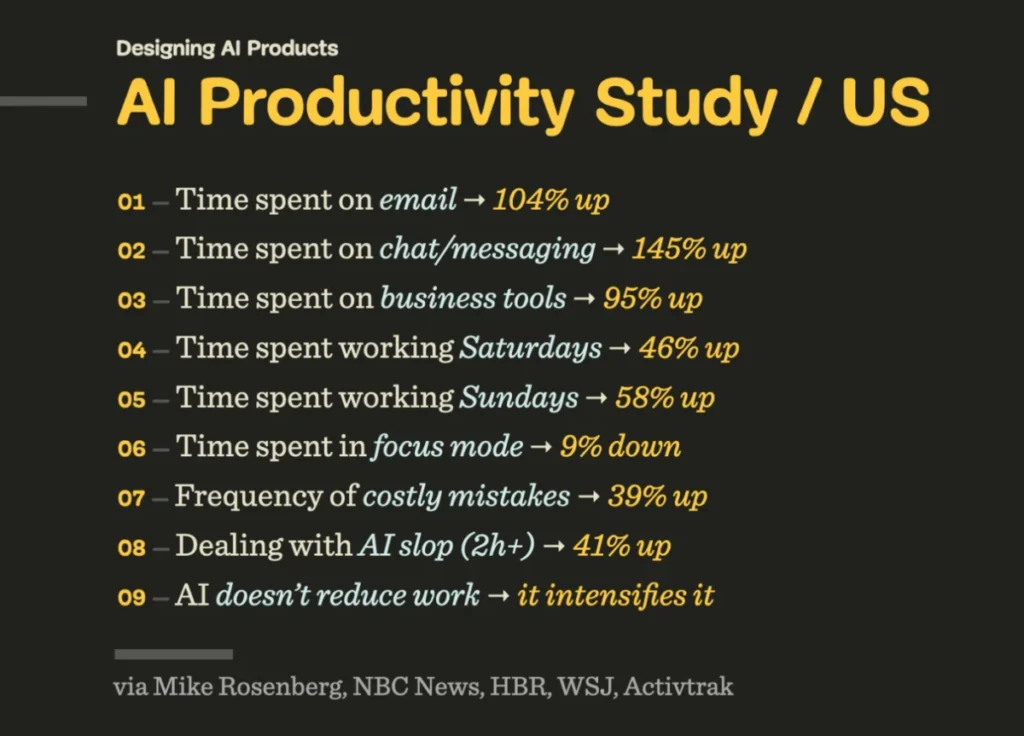
Beyond the practical challenges, a deeper psychological dimension underpins user resistance. For many, AI is not a tool they proactively choose; it is often introduced into their work environments without their direct input, dictated by corporate initiatives. This lack of agency, coupled with pervasive media narratives about AI replacing human jobs, cultivates a climate of fear and anxiety rather than excitement. Employees may perceive AI as a threat to their livelihood and professional identity, leading to resistance to change and a sense of being left behind in a rapidly evolving technological landscape. A study cited by Mike Rosenberg, NBC News, HBR, WSJ, and Activtrak even suggests that for some, AI doesn’t reduce work but "intensifies it," leading to increased time spent on emails, chats, business tools, and even working weekends, while focus time decreases. Such findings underscore that the current implementation of AI is often misaligned with genuine human needs for work-life balance and meaningful engagement.

The Desired AI: Augmentation, Reliability, and Seamless Integration
The fundamental flaw in many current AI implementations is the comparison of AI’s reliability to human fallibility. Users, however, do not typically compare software to people; they compare software features to other software features. If an AI-powered feature is unreliable, while a non-AI alternative offers consistent performance, users will invariably choose the latter. The critical differentiator is not the presence of AI, but rather the consistent delivery of reliability, predictability, and usefulness.
Many discussions around AI emphasize the acceleration of delivery and output. Yet, for a significant portion of the workforce, sheer speed is not the ultimate metric of value. Professionals often prioritize quality, thoughtful decision-making, and the enjoyment derived from their work. The intrinsic reward of crafting something well, of engaging in creative problem-solving, is gradually eroded when the focus shifts solely to speed and automation. The "vibe-coded changes" that increasingly characterize digital experiences risk diminishing the profound sense of achievement that comes from meaningful human endeavor.
What users truly seek are features that are fast, accessible, reliable, predictable, and consistently useful. Crucially, they desire tools that augment their existing ways of working, rather than entirely replacing them. The most welcome applications of AI are those that take over mundane, repetitive, and unrewarding tasks—the "boring stuff"—freeing up human intellect and creativity for more complex, engaging, and fulfilling work. This distinction is vital for fostering positive adoption. As exemplified by Bo Young Lee’s widely shared sentiment, people don’t want AI to write their books, paint their art, teach their children, or make their medical decisions. Instead, they want AI to perform the "physical and mental labor that taxes me so I can read books written by humans and go to art galleries to engage with art made by humans." This encapsulates the desire for AI that simplifies life without demanding a fundamental shift in human identity or agency.

Strategic Implications for AI Development
The implications for product development and corporate strategy are profound. For AI to achieve widespread, sustained adoption, developers must pivot from an "AI-first" mentality to an "AI-second" approach. This means designing AI that is subtle, humble, and ambient, taking a supportive role in the background. It must be deeply integrated into existing workflows, aligning with users’ established mental models rather than forcing them to adapt to the AI. The focus should be on practical, tangible use cases where AI genuinely alleviates burdens and enhances productivity, allowing users to intuitively grasp its value and even discover new applications independently.
Consider the potential for AI in automating tedious administrative tasks, data entry, report generation, or initial research—areas where human effort is often mentally exhausting but lacks creative reward. By freeing up cognitive resources, such AI applications can significantly enhance job satisfaction and overall productivity. A bubble chart illustrating jobs most and least vulnerable to AI automation, as published by The Washington Post (citing GovAI and Brookings Institution), highlights that while many roles are exposed, there often remains a unique, creative, or intuitive component that AI can augment rather than replace. This nuanced understanding is key to successful implementation.
The financial and operational costs of misdirected AI initiatives are substantial. Investments in AI features with low adoption rates represent squandered resources, not only in development but also in ongoing maintenance and the potential damage to user trust. Companies must conduct thorough user research to identify genuine pain points that AI can address, rather than simply grafting AI onto existing products because it is technologically feasible or trendy. The emphasis must shift from showcasing AI’s capabilities to demonstrating its utility in a human-centric context.

Moving Forward: A Human-Centered AI Future
The future of AI lies not in its omnipresence, but in its judicious application. The goal should be to create intelligent tools that empower humans, allowing them more time and mental space for activities that truly matter—whether that’s engaging in creative work, fostering personal relationships, or simply enjoying leisure. This vision requires a recalibration of priorities, moving beyond the technological marvels of AI to its practical, ethical, and human-centered applications.
Ultimately, people do not need more AI in their lives if "more" means additional complexity, unreliability, and anxiety. They need AI to intelligently and seamlessly automate the mundane, the tedious, and the time-consuming, thereby liberating them to pursue their passions, connect with others, and experience greater joy and fulfillment. This perspective underscores the imperative for AI development to be guided by empathy and a deep understanding of human psychology, rather than purely by technological advancement or market hype.
For those navigating this complex landscape of AI integration and user experience, resources like "Design Patterns For AI Interfaces" offer crucial guidance. Developed by Vitaly, these video courses and live UX trainings provide practical examples and frameworks for designing AI interfaces that resonate with user needs, focusing on principles that prioritize reliability, predictability, and seamless augmentation. Such educational initiatives are vital for shaping a future where AI genuinely serves humanity, rather than imposing new burdens or anxieties. The true measure of AI’s success will be its ability to enhance the human experience, making life easier and more rewarding, without demanding that humans sacrifice their agency or their fundamental desire for authentic connection and meaningful engagement.