
The architecture of modern cloud-based data storage and backup infrastructure has increasingly become a critical vulnerability point for enterprise software, particularly within sensitive sectors such as educational technology. Recent evaluations of cloud storage failures reveal that the cheapest storage tier or the lowest initial quote for bucket capacity often conceals a much higher operational cost if security protocols fail. Specifically, when multi-tenant architectures lack robust isolation, data breaches, cross-tenant leaks, and failed restoration audits can compromise entire system ecosystems. Industry experts and software engineers emphasize that building resilient backup systems requires shifting focus away from raw storage pricing toward meticulous access control, region-locked data governance, and verifiable recovery pathways.
Background Context of Cloud Backup Vulnerabilities
The challenge of securing cloud-based backups stems from the quiet, often unannounced ways in which automated jobs fail. Traditional monitoring dashboards frequently track only process-level health, reporting that a background worker is active while failing to detect silent anomalies such as duplicate deliveries, missing archive objects, or database pointers mapping to incorrect tenants. In edtech environments, these failures carry severe compliance consequences. Archives often contain immutable digital receipts, academic records, or financial audit trails that must survive strict regulatory scrutiny over extended retention windows.
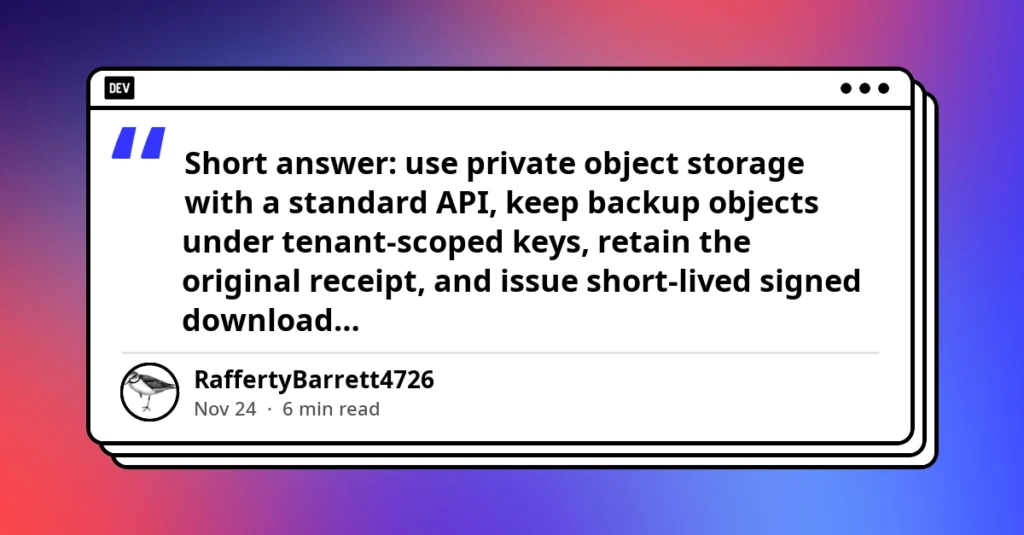
Historically, developers have treated object storage as a simple dumping ground, assuming that long, obfuscated object keys provide adequate security. However, security researchers have repeatedly demonstrated that relying on storage keys as authorization decisions is a fundamental architectural flaw. If an object key can be guessed or inadvertently exposed, private data from one tenant can be read by another. Consequently, modern engineering standards dictate that storage buckets must remain strictly private, and authorization logic must be handled exclusively at the application layer before any temporary, short-lived download links are minted.
Chronology and Evolution of Tenant Isolation Standards
The evolution of multi-tenant data governance has moved from ad-hoc folder structures to strict contract-driven schemas.
Phase 1: Deterministic Namespace Structuring
Early cloud storage methodologies relied on flat namespaces or poorly controlled bucket prefixes, leading to widespread data contamination during mass migration or restore operations. To combat this, modern protocols enforce structured, deterministic keys—such as backups/tenant_id/object_id/original—which explicitly segregate data at the routing level while ensuring that the physical business name of a tenant is never exposed to external actors.
Phase 2: Transition from Permanent URLs to Signed Temporary Access
As security standards tightened in the late 2010s, organizations eliminated permanent public URLs for sensitive assets. The industry shifted toward the implementation of time-to-live (TTL) signed download links. Under this model, an application evaluates a user’s permissions, verifies their tenant membership against a centralized database, and requests a cryptographically signed URL from the storage provider that expires within a strictly bounded window—typically five minutes.
Phase 3: Adoption of Idempotent State Machines
Recent engineering practices focus heavily on preventing duplicate deliveries and abandoned upload states. By implementing rigorous state machines where a backup transitions from a "pending" database record to a fully verified "stored" status, systems can safely handle retries from message queues without corrupting the audit trail or generating duplicate ledger entries.
Supporting Data and Comparative Storage Analysis
Evaluating object storage options requires a comprehensive comparison of failure modes, operational burdens, and compliance capabilities rather than a simple cost-benefit analysis of monthly gigabyte pricing. Engineering teams must weigh three primary architectural approaches when designing their backup and recovery pipelines:
Managed S3-Compatible Object Storage
- Good Fit: Teams seeking a familiar, highly scalable private-object workflow without the burden of maintaining physical infrastructure.
- Trade-off: Requires rigorous manual review of bucket policies, regional data residency settings, and lifecycle expiration rules to ensure compliance.
Self-Hosted S3-Compatible Storage
- Good Fit: Enterprises with dedicated infrastructure teams capable of managing physical disks, networking topology, high-availability replication, and round-the-clock on-call burdens.
- Trade-off: Storage expenses may appear lower or more predictable, but infrastructure operations become deeply intertwined with core product delivery and risk exposure.
Application Proxy Over Private Storage
- Good Fit: Scenarios where strict browser-level constraints, custom inspection filters, or advanced data loss prevention (DLP) policies require an explicit server-side inspection boundary.
- Trade-off: Large data transfers consume significant application memory, network bandwidth, and connection pools, potentially degrading overall system performance.
Statements and Industry Reactions from Software Architects
Principal infrastructure engineers and cloud security specialists have increasingly voiced concerns over the complacency surrounding automated backup routines.
"The most dangerous illusion in modern cloud engineering is the green dashboard," noted one enterprise systems architect during a recent infrastructure resilience panel. "A scheduler can execute precisely on time, every single night, while simultaneously writing corrupted state pointers or leaving buckets vulnerable to cross-tenant enumeration. If an auditor asks for an original receipt and your engineering team has to spend three hours correlating timestamps across disconnected logging systems, your recovery path has already failed."
Security analysts also emphasize the growing friction between browser security models and cloud storage endpoints. Cross-Origin Resource Sharing (CORS) configurations frequently break signed download links if storage buckets are not explicitly provisioned to accept specific request origins, headers, and methods from client applications. When misconfigurations occur, teams are often forced to route large data streams through application proxies—a practice that, while secure, places an unsustainable burden on application compute resources.
Broader Impact and Technical Implications
The implications of implementing secure, verifiable backup systems extend far beyond immediate compliance requirements. Organizations that invest in robust restoration drills—routinely testing cross-tenant read blocks, interrupted multipart uploads, and automated garbage collection of abandoned pending records—drastically reduce their mean time to recovery (MTTR) during actual security incidents.
Furthermore, standardizing data residency choices (such as explicitly locking backups to specific US or EU geographic regions within the database schema rather than relying on dynamic client inputs) ensures adherence to evolving international data privacy regulations like GDPR and CCPA. Ultimately, while managed services and compatible object storage APIs reduce the friction of data ingestion, the core responsibility of maintaining an unbroken, verifiable audit trail remains squarely with the application layer. Enterprises must continue to prioritize operational rigor, idempotent state transitions, and strict access controls over the superficial appeal of low-cost storage tiers.