
Tag: challenges

  • US Digital Advertising Revenue Hits Record $294.6 Billion in 2025 as Search Dominance Faces New Challenges from Video and AI

    US Digital Advertising Revenue Hits Record $294.6 Billion in 2025 as Search Dominance Faces New Challenges from Video and AI

    The United States digital advertising market reached a historic milestone in 2025, with total annual revenue climbing to a record-breaking $294.6 billion. According to the latest comprehensive report released by the Interactive Advertising Bureau (IAB) in collaboration with PwC, the industry demonstrated remarkable resilience and adaptability in a year defined by the rapid integration of artificial intelligence and shifting consumer behaviors. While search advertising maintained its position as the largest single force within the digital ecosystem, its growth trajectory showed signs of stabilization, allowing faster-moving formats like social media and digital video to capture a larger share of the expanding market.

    The $294.6 billion figure represents a significant leap for the industry, reflecting a market that has matured yet continues to find new avenues for monetization. Despite the absence of major cyclical drivers—such as a presidential election or the Olympic Games, which provided a substantial boost to the 2024 figures—the 2025 fiscal year saw consistent upward momentum. This growth was particularly pronounced in the latter half of the year, signaling a robust appetite for digital placements among brands ranging from global conglomerates to direct-to-consumer startups.

    The Evolution of Search Dominance

    For over two decades, search has been the undisputed anchor of the digital advertising world. In 2025, it remained the primary destination for marketing budgets, generating $114.2 billion in revenue. This accounted for 38.8% of the total digital advertising spend in the United States. However, the narrative surrounding search is changing. The report highlights a deceleration in growth for the format, which rose by 11% in 2025, a notable decrease from the 15.9% growth rate recorded in 2024.

    Industry analysts attribute this cooling of search growth to several factors. First is the maturation of the market; with nearly 40% of the total spend already allocated to search, the ceiling for exponential growth is naturally lower. Second, and perhaps more significantly, is the disruption caused by generative artificial intelligence. As consumers increasingly turn to AI-driven chatbots and discovery engines for information, the traditional "ten blue links" model of search is being challenged. Advertisers are beginning to re-evaluate how they reach users in an environment where an AI might provide a direct answer rather than a list of websites, leading to a diversification of budgets into other performance-driven channels.

    Accelerated Growth in Social Media and Digital Video

    While search saw a controlled expansion, the social media and digital video sectors experienced explosive growth. Social media advertising revenue surged by 32.6% to reach $117.7 billion. This surge effectively places social media in a neck-and-neck race with search for market supremacy. The rise is largely credited to the continued dominance of short-form video content and the sophisticated targeting capabilities of major platforms that allow brands to integrate seamlessly into user feeds.

    Digital video, as a standalone category, was the fastest-growing major format of the year. Revenue in this segment jumped 25.4% to $78 billion. The shift toward Connected TV (CTV) and the migration of traditional television budgets to digital streaming services have fundamentally altered the landscape. Brands are increasingly viewing digital video not just as a tool for top-of-funnel awareness, but as a high-performance medium capable of driving direct sales through interactive and shoppable ad units.

    U.S. search ad revenue reached $114.2 billion in 2025

    The Programmatic Powerhouse and Automation

    The 2025 data underscores the near-total transition of the industry toward automated buying. Programmatic advertising revenue increased by 20.5%, totaling $162.4 billion. This means that more than half of all digital advertising dollars are now flowing through automated systems. The continued shift toward programmatic reflects the industry’s demand for efficiency, real-time optimization, and data-driven precision.

    The rise of programmatic is inextricably linked to the advancements in machine learning and AI. Throughout 2025, "black box" advertising solutions—where algorithms determine the best placement, timing, and creative version for an ad—became the standard rather than the exception. While this has improved performance metrics for many advertisers, it has also raised concerns regarding transparency and the ability of human marketers to audit the decision-making processes of these automated platforms.

    A Chronology of Growth: 2025 Quarterly Performance

    The trajectory of the 2025 market was characterized by a steady acceleration as the year progressed. The first quarter of the year began with a respectable 12.2% growth rate, as businesses navigated the early-year economic outlook. By the second and third quarters, confidence in consumer spending remained high, and the integration of AI tools began to show tangible ROI for early adopters.

    The fourth quarter of 2025 was particularly remarkable, bringing in $85 billion in revenue—a 15.4% increase compared to the same period in the previous year. This performance is noteworthy because Q4 2024 had been bolstered by record-breaking political spending. The fact that 2025 surpassed those figures without a similar political stimulus suggests a deep-seated structural growth in the digital economy. The holiday shopping season proved to be a major catalyst, with retail media networks and social commerce platforms capturing a significant portion of the "Golden Quarter" spend.

    Market Concentration and the "Big Tech" Advantage

    One of the most striking revelations in the IAB/PwC report is the increasing concentration of wealth within the digital advertising sector. The top 10 companies now control 84.1% of all U.S. digital ad revenue. This is an increase from 80.8% in 2024, indicating that the largest players are not only maintaining their lead but actively pulling away from the rest of the market.

    This concentration is driven by the "walled garden" effect. The companies at the top—including Google, Meta, Amazon, and Microsoft—possess vast troves of first-party data that have become indispensable in a privacy-centric era. As third-party cookies have faced deprecation and privacy regulations have tightened, advertisers have flocked to the platforms that can provide verified user identities and closed-loop measurement. Furthermore, these companies have the capital to lead the AI revolution, offering proprietary tools that smaller competitors struggle to replicate.

    The AI Paradigm Shift

    In 2025, artificial intelligence transitioned from a buzzword into the foundational architecture of the advertising industry. It is no longer a secondary tool used for minor optimizations; it is the primary engine driving discovery, media buying, and measurement.

    U.S. search ad revenue reached $114.2 billion in 2025

    For consumers, AI has fragmented the journey. A purchase that once began with a simple Google search might now start with a conversation with an AI assistant, a discovery on a social media algorithm, or a recommendation within a retail app. For advertisers, this fragmentation requires a more holistic approach to media planning. The report suggests that the most successful brands in 2025 were those that moved away from siloed channel management and toward "fluid" budgeting, where AI dynamically allocates spend across platforms based on real-time performance.

    Industry Reactions and Strategic Implications

    The reaction from the marketing community to these findings has been a mixture of optimism and caution. Industry leaders note that while the record-breaking revenue is a sign of a healthy ecosystem, the slowing growth of search and the rise of automated buying create new challenges for accountability.

    "Search is still the most scalable intent-based medium we have," noted one digital agency executive in response to the data. "But we are entering an era where ‘intent’ is being captured in more places. If a user discovers a product on TikTok and then buys it through an Amazon ad, the traditional search model loses that credit. Marketers are now obsessed with proving ‘incrementality’—ensuring that their ad spend is actually driving new sales rather than just claiming credit for sales that would have happened anyway."

    The shift toward video and social also necessitates a change in creative strategy. Brands are being forced to produce higher volumes of content to satisfy the "content-hungry" algorithms of social and video platforms. This has led to an explosion in the use of generative AI for creative assets, allowing brands to test thousands of variations of an ad to see which resonates best with specific audience segments.

    Broader Impact and Future Outlook

    The 2025 IAB/PwC report serves as a roadmap for the future of the digital economy. The data suggests that the market is moving toward a state of "constant optimization," where the lines between different ad formats continue to blur. Retail media, for instance, often straddles the line between search and display, while social commerce blurs the line between entertainment and shopping.

    As the industry looks toward 2026, the focus will likely remain on privacy-compliant data strategies and the further refinement of AI tools. The high concentration of revenue among the top 10 players may also invite further regulatory scrutiny, as policymakers examine the competitive landscape of the digital age.

    For now, the $294.6 billion milestone stands as a testament to the central role that digital advertising plays in the American economy. It is the primary engine of growth for small businesses and global brands alike, and its evolution continues to mirror the fundamental changes in how humans interact with technology and each other. The slowing of search and the surge of video and social are not merely shifts in budget; they are reflections of a world that is becoming more visual, more automated, and more integrated with artificial intelligence.

  • The Silent Observer of Manhattan: How the Rediscovered Archive of Angelo Rizzuto Challenges the Legacy of Street Photography

    The Silent Observer of Manhattan: How the Rediscovered Archive of Angelo Rizzuto Challenges the Legacy of Street Photography

    The history of 20th-century American photography is often defined by those who sought the spotlight, yet some of its most profound contributions have emerged from the shadows of anonymity and reclusion. For decades, a man named Angelo Antonio Rizzuto walked the streets of Manhattan with a camera, capturing the shifting soul of New York City with a persistence that bordered on the obsessive. His work, consisting of approximately 60,000 images, remained largely unexamined for over half a century, only gaining significant scholarly attention in recent years. Rizzuto’s life and legacy offer a striking parallel to the posthumous discovery of Vivian Maier, yet his story is uniquely shaped by a complex personal history of mental illness, legal battles, and a deliberate, albeit posthumous, attempt to secure his place in the American canon through the Library of Congress.

    The Other Vivian Maier: The Street Photography of Angelo Rizzuto

    The Formative Years: From the Plains to the Ivy League

    Angelo Antonio Rizzuto was born in 1906 in South Dakota to Sicilian immigrant parents, a background that placed him at the intersection of the burgeoning American Dream and the challenges of the immigrant experience. His family eventually moved to Omaha, Nebraska, where he was raised in a stable, middle-class environment. Rizzuto was intellectually gifted, eventually securing admission to Harvard Law School. However, the trajectory of his life took a sharp turn when he failed to complete his studies, a failure that would haunt his later years and contribute to a growing sense of alienation.

    The pivotal moment in Rizzuto’s descent into reclusion occurred following the death of his father. A bitter and protracted dispute over the family estate fractured his relationships with his siblings and left him emotionally devastated. This period of turmoil culminated in a suicide attempt in 1941, leading to his institutionalization. Following his release, Rizzuto attempted to find purpose through military service during World War II, but his tenure was brief; he received a medical discharge, likely due to his ongoing struggles with mental health. For several years, he lived a transient existence, moving across the United States before finally settling in New York City in the late 1940s.

    The Other Vivian Maier: The Street Photography of Angelo Rizzuto

    The Manhattan Routine: 1952–1964

    By the time Rizzuto established himself in Manhattan, he had adopted a lifestyle characterized by extreme isolation. He resided in a small, cramped rented room where he avoided social interaction. Despite this self-imposed solitude, Rizzuto possessed significant financial resources, likely derived from his inheritance. He used these funds to purchase a brownstone on East 51st Street, which he utilized not as a residence, but as a private studio and darkroom.

    For eighteen years, Rizzuto adhered to a rigid, almost ritualistic daily schedule. Every afternoon at precisely 2:00 p.m., he would emerge from his home equipped with his camera to document the city. His objective was nothing less than a comprehensive visual census of Manhattan, a project he titled "Little Old New York." Between 1952 and 1964, Rizzuto’s output was staggering. He was not merely a hobbyist; he was a methodical documentarian who worked with bulk film, often carrying multiple cameras to ensure he never missed a moment of light or shadow.

    The Other Vivian Maier: The Street Photography of Angelo Rizzuto

    Themes and Artistic Methodology

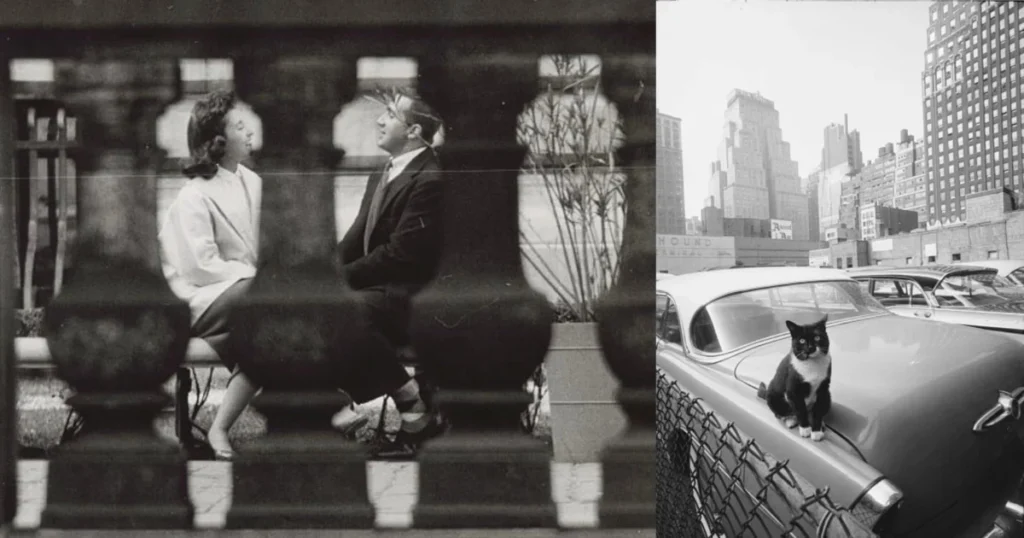
    Rizzuto’s work is characterized by a sophisticated understanding of geometry and urban scale. While many street photographers of the era focused on the grit of the city, Rizzuto appeared equally fascinated by its structural elegance. His archive is filled with images of skyscrapers, bridges, and the intricate patterns of fences and railings. These architectural elements often served as frames for his human subjects, creating a sense of distance and voyeurism that mirrored his own social isolation.

    Jan Grenci, a reference specialist in the Prints and Photographs Division of the Library of Congress, has noted several recurring motifs in Rizzuto’s collection. These include:

    The Other Vivian Maier: The Street Photography of Angelo Rizzuto
    • Animals in the Urban Landscape: Frequent depictions of cats and dogs, often captured in moments of stillness amidst the city’s chaos.
    • The Transit Experience: Candid shots of commuters on subways and in train stations, capturing the exhaustion and anonymity of mid-century New York life.
    • Religious Imagery: A recurring fascination with nuns, often photographed against the backdrop of secular storefronts or city streets.
    • Childhood and Innocence: Images of children playing in parks or on sidewalks, providing a soft contrast to the rigid geometry of the surrounding architecture.

    Perhaps the most revealing aspect of Rizzuto’s methodology was his use of self-portraiture. After 1953, he began a practice of ending almost every roll of film with a portrait of himself. These images were rarely flattering; they often showed a man looking directly into the lens with a piercing, sometimes troubled gaze. By including himself in the archive, Rizzuto transformed his project from a simple documentation of a city into a psychological map of his own existence within that city.

    A Chronology of the Anthony Angel Collection

    The journey of Rizzuto’s archive from a private darkroom to a public institution was fraught with legal complications.

    The Other Vivian Maier: The Street Photography of Angelo Rizzuto
    • 1906: Angelo Antonio Rizzuto is born in South Dakota.
    • 1941: Suicide attempt and subsequent institutionalization following family estate disputes.
    • 1940s (Late): Rizzuto moves to New York City and begins his photographic explorations.
    • 1952: The formal commencement of his daily 2 p.m. photographic routine.
    • 1964: Rizzuto ceases his intensive daily documentation as his health begins to fail.
    • 1967: Rizzuto dies of cancer. In his will, he leaves his vast archive and the proceeds from the sale of his brownstone to the Library of Congress. He requests that the collection be named "The Anthony Angel Collection," using the Americanized pseudonym he frequently employed.
    • 1967–2001: The will is contested by Rizzuto’s surviving family members. The legal battle leaves the archive in a state of limbo for decades.
    • 2001: The Library of Congress officially takes full possession of the 60,000 photographs and associated materials.
    • 2021: After years of preservation and cataloging, the archive is made fully available for public research and digital viewing.

    Comparative Analysis: Rizzuto vs. Maier

    The comparison between Angelo Rizzuto and Vivian Maier is inevitable. Both were reclusive figures who produced tens of thousands of world-class photographs while working in total obscurity. However, their legacies differ significantly in their intentionality.

    Vivian Maier’s work was discovered by chance at an estate auction after she failed to keep up with storage locker payments. Her rise to fame was driven by the commercial market and documentary filmmakers. In contrast, Rizzuto was acutely aware of the value of his work. His decision to bequeath his archive to the Library of Congress, along with the funds necessary to maintain it, suggests a man who was deeply concerned with his posthumous reputation. He did not want his work to be found by accident; he wanted it to be preserved as a formal contribution to the history of the United States.

    The Other Vivian Maier: The Street Photography of Angelo Rizzuto

    Furthermore, while Maier’s work often feels warm and empathetic, Rizzuto’s images frequently carry an undercurrent of tension. His use of architectural barriers—railings, glass, and tracks—often separates the photographer from the subject, highlighting the isolation that defined his life.

    Data and Archival Scope

    The Anthony Angel Collection at the Library of Congress is one of the most comprehensive single-artist records of mid-century New York. The data points regarding the collection underscore its importance:

    The Other Vivian Maier: The Street Photography of Angelo Rizzuto
    • Total Images: Approximately 60,000.
    • Format: Primarily 35mm black-and-white film, supplemented by contact sheets and some color transparencies.
    • Organization: Unlike most photographers who organize by date, Rizzuto organized his contact sheets by theme, indicating a high level of intentionality in how he wanted his work to be interpreted.
    • Financial Legacy: The sale of his East 51st Street brownstone provided the Library of Congress with the capital needed to process the collection, a rare occurrence in the world of archival acquisitions.

    Broader Impact and Implications for Art History

    The "rediscovery" of Angelo Rizzuto raises fundamental questions about the nature of artistic genius and the role of the archive. In the digital age, where images are shared instantaneously, the idea of a photographer working in total isolation for eighteen years seems almost impossible. Rizzuto’s work serves as a reminder that significant portions of our cultural history may still be hidden in attics, basements, and institutional storage.

    Art historians and sociologists are now using the Rizzuto archive to study the "micro-history" of New York City. Because Rizzuto photographed the same areas at the same time of day for years, his work provides a unique data set for observing the subtle changes in urban life, fashion, and infrastructure during the post-war boom.

    The Other Vivian Maier: The Street Photography of Angelo Rizzuto

    Moreover, Rizzuto’s story challenges the stigma surrounding mental illness and creativity. While his reclusion and paranoia were symptoms of his struggles, they were also the catalysts for his unique perspective. His camera was both a shield and a bridge, allowing him to engage with a world he found otherwise overwhelming.

    As the Library of Congress continues to digitize the Anthony Angel Collection, the public perception of 1950s New York is being subtly reshaped. Angelo Rizzuto may have lived as a ghost in the city he loved, but through his meticulous documentation, he has ensured that neither he nor his "Little Old New York" will be forgotten. His archive stands as a testament to the power of the individual observer and the enduring importance of the public institutions that protect our collective memory.

Grafex Media
Privacy Overview

This website uses cookies so that we can provide you with the best user experience possible. Cookie information is stored in your browser and performs functions such as recognising you when you return to our website and helping our team to understand which sections of the website you find most interesting and useful.