
Tag: clarity

  • Beyond the Black Box: Designing for Trust and Clarity in Autonomous AI Systems

    Beyond the Black Box: Designing for Trust and Clarity in Autonomous AI Systems

    The rapid proliferation of agentic artificial intelligence (AI) systems, designed to perform complex tasks autonomously, has introduced a critical challenge for developers and users alike: maintaining transparency and fostering trust. As AI agents execute intricate multi-step processes, the traditional dichotomy of either a completely opaque "black box" or an overwhelming "data dump" of technical logs has proven inadequate. A more thoughtful, structured approach is essential to reveal the right moments for building user confidence through clarity, not noise.

    This imperative has driven the development of methodologies such as the Decision Node Audit and the Impact/Risk Matrix, which empower design and engineering teams to map an AI system’s internal logic to user-facing explanations. These tools aim to demystify AI actions, transforming moments of potential anxiety into opportunities for connection and understanding.

    The Rise of Agentic AI and the Transparency Dilemma

    Agentic AI systems represent a significant leap in automation, capable of handling complex, multi-stage tasks with minimal human intervention. From processing financial claims to managing supply chains, these agents promise unparalleled efficiency. However, this autonomy often comes at the cost of user understanding. When an AI system takes a complex task and, after a period of internal processing, returns a result, users are left questioning its journey: "Did it work correctly? Did it hallucinate? Were all necessary compliance checks performed?"

    This "algorithmic fog" stems from the inherent complexity of modern AI, particularly large language models (LLMs) and other advanced machine learning architectures. Unlike traditional software with predictable, rule-based logic, agentic AI often operates with probabilistic reasoning, making decisions based on confidence scores rather than absolute certainties. This fundamental difference necessitates a new paradigm for transparency. According to a recent survey by PwC, only 35% of consumers trust companies to use AI responsibly, highlighting a significant trust deficit that opaque systems exacerbate. The global AI market is projected to reach over $1.8 trillion by 2030, underscoring the urgency for effective trust-building mechanisms to ensure widespread adoption and ethical deployment.

    Historically, responses to this transparency challenge have swung between two extremes. The "Black Box" approach, favored for its simplicity, hides all internal workings, often leading to user frustration, powerlessness, and a profound lack of trust. Conversely, the "Data Dump" floods users with every technical detail, from log lines to API calls, causing "notification blindness." Users ignore this constant stream of information until an error occurs, at which point they lack the contextual understanding to diagnose or rectify the problem, negating the efficiency gains the agent was meant to provide. Neither extreme adequately serves the user’s need for informed agency.

    Identifying Necessary Transparency Moments In Agentic AI (Part 1) — Smashing Magazine

    Mapping Internal Logic: The Decision Node Audit

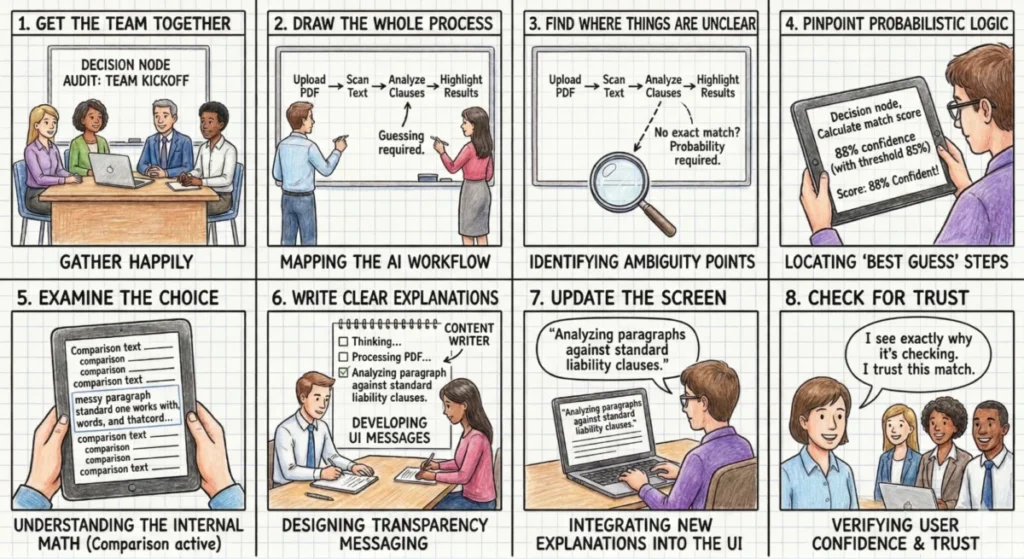
    To navigate this nuanced landscape, the Decision Node Audit emerges as a crucial first step. This collaborative process brings together designers, engineers, product managers, and business analysts to meticulously map an AI system’s backend logic to its user interface. The core objective is to identify "ambiguity points"—moments where the system diverges from set rules to make a probabilistic choice or estimation. By exposing these decision points, creators can provide specific, reliable reports about how the AI arrived at its conclusion, rather than vague status updates.

    Consider the case of Meridian (a hypothetical insurance company), which deployed an agentic AI to process initial accident claims. Users uploaded photos and police reports, after which the system displayed a generic "Calculating Claim Status" message for a minute before presenting a risk assessment and payout range. This black box approach generated significant distrust, with users uncertain if the AI had even reviewed crucial documents like the police report.

    A Decision Node Audit revealed that the AI performed three distinct, probability-based steps, each with numerous smaller embedded processes:

    1. Damage Assessment: Analyzing uploaded photos to estimate vehicle damage severity.
    2. Report Cross-Referencing: Verifying details against the police report and other submitted documents.
    3. Policy Compliance & Payout Recommendation: Checking coverage, deductible, and legal precedents to propose a settlement.

    By transforming these internal steps into transparent moments, Meridian’s interface was updated to a sequence of explicit messages: "Assessing Vehicle Damage…", "Reviewing Police Report for Mitigating Circumstances…", and "Verifying Coverage and Calculating Payout Range…". While the processing time remained unchanged, this explicit communication restored user confidence. Users understood the AI’s complex operations and knew precisely where to focus their attention if the final assessment seemed inaccurate. This shift transformed a moment of anxiety into a moment of connection, reinforcing the value of the AI’s work.

    Another example involves a procurement agent designed to review vendor contracts and flag risks. Initially, users were presented with a simple "Reviewing contracts" progress bar, which generated anxiety, particularly regarding potential legal liabilities. The Decision Node Audit identified a key ambiguity point: the AI’s probabilistic assessment of liability terms against company rules. When a clause was, for instance, a "90% match" but not a perfect one, the AI had to make a judgment. Exposing this node allowed the interface to update to "Liability clause varies from standard template. Analyzing risk level." This specific update provided users with confidence, context for any delay, and clarity on where to focus their review of the agent-generated contract.

    Prioritizing Transparency: The Impact/Risk Matrix

    Identifying Necessary Transparency Moments In Agentic AI (Part 1) — Smashing Magazine

    While the Decision Node Audit identifies all potential transparency moments, not all warrant exposure. AI systems can generate dozens, if not hundreds, of internal events for a single complex task. Displaying every detail would lead back to the "data dump" problem. This is where the Impact/Risk Matrix becomes indispensable, helping teams prioritize which decision nodes to highlight.

    The matrix categorizes decisions based on two axes:

    • Impact: The potential consequence of the AI’s action (e.g., financial, legal, operational, reputational).
    • Risk/Reversibility: How difficult or impossible it is to undo the AI’s action.

    Low Stakes / Low Impact decisions often involve minor, easily reversible actions. For example, an AI renaming a file or archiving a non-critical email. These can typically be auto-executed with passive notifications (e.g., a small toast message or a log entry) or a simple undo option.

    High Stakes / High Impact decisions, however, demand greater transparency. Consider a financial trading bot. Executing a $5 trade might require minimal transparency, but a $50,000 trade demands a pause and explicit review. The solution might be to introduce a "Reviewing Logic" state for transactions exceeding a specific dollar amount, allowing the user to examine the factors driving the decision before execution.

    The matrix can then be used to map specific design patterns to these prioritized transparency moments:

    Reversible Irreversible
    Low Impact Type: Auto-Execute
    UI: Passive Toast / Log
    Ex: Renaming a file
    Type: Confirm
    UI: Simple Undo option
    Ex: Archiving an email
    High Impact Type: Review
    UI: Notification + Review Trail
    Ex: Sending a draft to a client
    Type: Intent Preview
    UI: Modal / Explicit Permission
    Ex: Deleting a server

    This structured approach prevents "alert fatigue" by reserving high-friction patterns like "Intent Previews" (where the system pauses, explains its intent, and requires confirmation) only for truly irreversible, high-stakes actions. For high-stakes but reversible actions, an "Action Audit & Undo" pattern (e.g., notifying the user and offering an immediate undo button) can maintain efficiency while providing safety.

    Qualitative Validation: The "Wait, Why?" Test

    Identifying Necessary Transparency Moments In Agentic AI (Part 1) — Smashing Magazine

    Identifying potential transparency nodes on a whiteboard is only the first step; validation with actual human behavior is critical. The "Wait, Why?" Test is a powerful qualitative protocol for this purpose. Users are asked to observe the AI completing a task while speaking their thoughts aloud. Any questions like "Wait, why did it do that?", "Is it stuck?", or "Did it hear me?" are timestamped. These moments of confusion signal a breakdown in the user’s mental model and highlight missing transparency moments.

    For instance, in a study for a healthcare scheduling assistant, users observed the agent booking an appointment. A four-second static screen consistently prompted the question, "Is it checking my calendar or the doctor’s?" This revealed a critical missing transparency moment. The system needed to split that wait into two distinct steps: "Checking your availability" followed by "Syncing with provider schedule." Crucially, these messages must connect the technical process to the user’s specific goal. A message like "Checking your calendar to find open times" followed by "Syncing with the provider’s schedule to secure your appointment" grounds the technical action in the user’s real-world objective, significantly reducing anxiety.

    Operationalizing Transparency: A Cross-Functional Imperative

    Implementing these transparency strategies demands deep cross-functional collaboration. Transparency cannot be designed in isolation. It requires a seamless integration of technical capabilities, content strategy, and user experience design.

    The process begins with a Logic Review involving lead system engineers. Designers must confirm that the system can indeed expose the desired states. Often, engineers initially report a generic "working" status. Designers must push for granular updates, ensuring the system can signal precisely when it moves from, for example, text parsing to rule checking. Without this technical hook, the design is impossible to build.

    Next, the Content Design team becomes invaluable. While engineers provide the "what," content designers articulate the "how" in a human-friendly, trust-building manner. A developer might propose "Executing function 402," which is technically accurate but meaningless to a user. A content strategist translates this into something like "Scanning for liability risks" – specific enough to convey action without technical jargon, aligning with the user’s mental model and alleviating concerns.

    Finally, rigorous Qualitative Testing is paramount. Designers conduct comparison tests using simple prototypes, varying only the status messages. For example, one group might see "Verifying identity" while another sees "Checking government databases." This reveals how specific wording impacts user perception of safety and trustworthiness. This iterative testing ensures that the final interface language is not only accurate but also effective in building confidence.

    Identifying Necessary Transparency Moments In Agentic AI (Part 1) — Smashing Magazine

    This integrated approach culminates in a "transparency matrix"—a shared spreadsheet where engineers map technical codes to user-facing messages, edited collaboratively with content designers. This fosters shared understanding and accountability. Teams learn to navigate friction points, such as when an engineer’s "Error: Missing Data" becomes a designer’s "Missing receipt image" after negotiation, leading to more actionable user feedback. Ultimately, operationalizing the audit strengthens team communication and ensures users have a clearer, more trustworthy understanding of their AI-powered tools.

    Trust as a Design Choice: Implications for the Future

    Viewing trust as a mechanical result of predictable communication, rather than an abstract emotional byproduct, empowers designers to actively engineer it into AI systems. This proactive approach to transparency has profound implications:

    • Enhanced User Adoption: Users are more likely to embrace and regularly use AI tools they understand and trust.
    • Regulatory Compliance: With evolving regulations like the EU AI Act emphasizing explainable AI (XAI), structured transparency becomes a critical component of legal and ethical compliance.
    • Reduced Errors and Faster Recovery: When users understand the AI’s decision points, they can more quickly identify and correct errors, minimizing potential financial or operational damages.
    • Competitive Advantage: Companies that prioritize transparent AI experiences will differentiate themselves in a rapidly crowding market, building stronger brand loyalty.
    • Improved Human-AI Collaboration: By demystifying AI’s actions, humans can better collaborate with agents, leveraging their strengths while maintaining oversight and control.

    The era of opaque AI is drawing to a close. The Decision Node Audit and Impact/Risk Matrix provide a robust framework for designing AI experiences that are not only efficient but also inherently trustworthy. By systematically identifying ambiguity points, prioritizing based on impact and reversibility, and crafting clear, contextual explanations, designers can ensure that AI systems truly augment human capabilities, fostering a future where intelligent agents are partners, not black boxes. The next step will involve delving into the specifics of designing these transparency moments, including crafting effective copy, structuring intuitive UI, and handling the inevitable errors when agents fall short.

Grafex Media
Privacy Overview

This website uses cookies so that we can provide you with the best user experience possible. Cookie information is stored in your browser and performs functions such as recognising you when you return to our website and helping our team to understand which sections of the website you find most interesting and useful.