
Tag: cosmic

  • Chasing the Cosmic Frontier: How Matt Suess Mastered the Art and Science of Modern Astrophotography

    Chasing the Cosmic Frontier: How Matt Suess Mastered the Art and Science of Modern Astrophotography

    The transition from a curious teenager in a New England basement to a world-renowned astrophotography educator represents a four-decade journey through the evolution of imaging technology. For Matt Suess, an OM SYSTEM Ambassador and veteran landscape photographer, the path to capturing the heavens was paved with both technical rigor and a profound personal connection to the night sky. Today, as astrophotography faces new challenges from light pollution and satellite interference, Suess’s work serves as both a masterclass in technical precision and a call to document the celestial sphere while it remains visible to the naked eye.

    8 Astrophotography Lessons the Beginner Guides Leave Out

    The Genesis of a Celestial Fascination

    The foundation of Suess’s career was laid long before the advent of digital sensors. At the age of 12, he constructed his first darkroom, a move that allowed him to experiment with the fundamental chemistry of light. Growing up in Connecticut, the heavy veil of light pollution common to the American Northeast obscured the Milky Way, leaving the young photographer to wonder what lay beyond the hazy glow of suburban streetlights. Despite these limitations, Suess began experimenting with star trails on color slide film during his teenage years.

    This early interest in the stars was not merely artistic; it was academic. Suess initially pursued a degree in mechanical engineering with the specific intent of designing rockets for the National Aeronautics and Space Administration (NASA). While his professional trajectory eventually pivoted toward full-time photography, the engineering mindset—characterized by a need to understand the "how" and "why" behind technical failures—remained a core component of his methodology. This analytical approach proved essential when he eventually moved to the darker skies of the American West, where he encountered the Milky Way for the first time in Joshua Tree National Park. His initial attempts to capture the galactic core resulted in soft, out-of-focus images, a failure that prompted a decades-long quest to refine the mechanics of night shooting.

    8 Astrophotography Lessons the Beginner Guides Leave Out

    The Chronology of Technical Evolution

    The history of astrophotography is defined by the struggle to overcome three primary obstacles: focus, noise, and the Earth’s rotation. Suess’s career spans the transition from chemical film to the current era of computational photography, a timeline that highlights the rapid democratization of the craft.

    In the era of film, photographers were forced to wait days or weeks to see the results of a long exposure. The digital revolution introduced the LCD screen, allowing for immediate feedback, but it also introduced the problem of thermal noise—grainy artifacts caused by the sensor heating up during long exposures. Suess spent years mastering the "manual stacking" method, a process involving taking multiple shorter exposures and blending them in post-processing software to cancel out noise while retaining signal from the stars.

    8 Astrophotography Lessons the Beginner Guides Leave Out

    A significant turning point in Suess’s technical chronology occurred during one of his workshops. A student demonstrated a feature known as "Live Composite," a tool specific to OM SYSTEM (formerly Olympus) cameras. Unlike traditional long exposures that gather all light over time, Live Composite only records new light signatures—such as moving stars—onto a base exposure. This allowed Suess to watch star trails form in real-time on the camera’s back screen, effectively eliminating the guesswork of long-duration night photography. This moment shifted Suess’s focus toward the potential of specialized hardware to simplify the complex mathematics of the night sky.

    The Mechanics of Modern Astrophotography

    To achieve professional-grade results, Suess emphasizes that photographers must move beyond the "500 Rule." This traditional formula—dividing 500 by the 35mm equivalent focal length to determine the maximum shutter speed before stars begin to trail—is increasingly viewed as an oversimplification for modern high-resolution sensors. Instead, Suess advocates for empirical testing and the use of specialized autofocus systems.

    8 Astrophotography Lessons the Beginner Guides Leave Out

    One of the most significant hurdles in night photography is achieving critical focus on a point of light millions of light-years away. Suess traditionally taught a manual method: magnifying a bright star in live view and micro-adjusting the focus ring until the star reached its smallest possible diameter. However, the introduction of "Starry Sky AF" has largely automated this process. This computational algorithm analyzes the contrast of celestial bodies to lock focus with a degree of precision that often surpasses human capability, particularly in cold environments where manual dexterity is compromised.

    The equipment used by Suess reflects a shift toward portability without sacrificing optical quality. His standard kit includes the OM-1 Mark II and OM-5, paired with fast primes like the M.Zuiko Digital ED 17mm F1.2 PRO. The 34mm equivalent field of view is wide enough to capture the arc of the Milky Way while maintaining a natural perspective for foreground elements. The F1.2 aperture is particularly critical; it allows for lower ISO settings, which directly correlates to a higher dynamic range and cleaner data in the RAW file.

    8 Astrophotography Lessons the Beginner Guides Leave Out

    Deep-Sky Exploration and the Astro-Modified Sensor

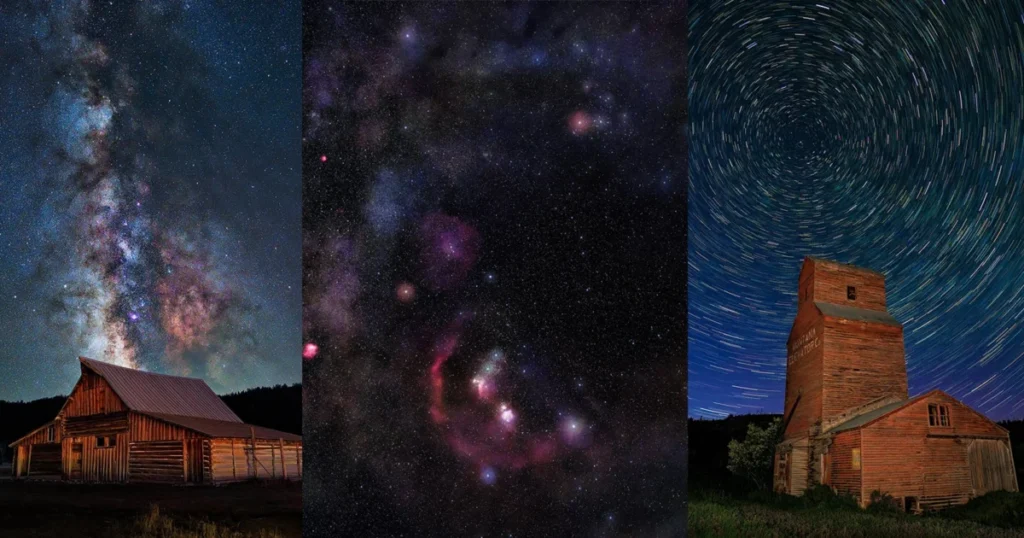
    In recent years, Suess has expanded his repertoire into deep-sky photography, a discipline that requires tracking the Earth’s rotation to allow for multi-minute exposures. Using a portable star tracker like the Move Shoot Move NOMAD, Suess counteracts the planetary spin, enabling him to capture the Andromeda Galaxy and the Orion Nebula in vivid detail.

    However, standard camera sensors are inherently limited for this work. Most consumer cameras are equipped with an internal filter designed to block infrared light, which also inadvertently suppresses the Hydrogen-alpha (H-alpha) wavelength (656.28 nm). This specific wavelength is responsible for the vibrant red and pink hues found in nebulae. Suess’s adoption of the OM-3 ASTRO—a camera factory-modified to allow H-alpha light to reach the sensor—marks a new chapter in his work. This modification increases the sensitivity to nebular emissions by approximately 400% compared to a standard sensor, allowing for the capture of deep-space structures that are otherwise invisible.

    8 Astrophotography Lessons the Beginner Guides Leave Out

    Furthermore, Suess utilizes a body-mount light pollution filter (BMF-LPC01). Positioned behind the lens, this filter neutralizes the yellow and orange wavelengths emitted by sodium-vapor and LED streetlights. By filtering light at the source before it reaches the sensor, Suess can shoot in "suburban" dark zones that would otherwise be unusable for deep-sky work.

    Environmental Implications and the Future of the Dark Sky

    Suess’s urgency in teaching astrophotography is fueled by the rapid degradation of the global night sky. Data from the "New World Atlas of Artificial Night Sky Brightness" indicates that more than 80% of the world’s population lives under light-polluted skies, and one-third of humanity can no longer see the Milky Way.

    8 Astrophotography Lessons the Beginner Guides Leave Out

    Beyond terrestrial light pollution, the rise of satellite "mega-constellations" poses a new threat. Astronomers and photographers alike have noted an increase in "satellite streaks" across long-exposure images. Suess notes that while software can often remove these artifacts, the sheer volume of orbital traffic is fundamentally altering the visual landscape of the heavens. "We’re in a really good era right now," Suess warns, "but that window’s not going to stay open forever." This environmental shift has led to the growth of "astrotourism," with photographers traveling to designated International Dark Sky Parks to capture what remains of the pristine night.

    Post-Processing and the Philosophy of the "Honest Result"

    Suess’s workflow concludes with a rigorous post-processing routine that prioritizes data integrity over "brute-force" editing. He utilizes DxO PureRAW for initial demosaicing and noise reduction, a step he describes as essential for Micro Four Thirds sensors operating at high ISOs. By using artificial intelligence to distinguish between noise and fine star detail, he can produce clean files that rival full-frame counterparts.

    8 Astrophotography Lessons the Beginner Guides Leave Out

    For deep-sky stacking, Suess is currently exploring PixInsight, an industry-standard software for astrophotography that offers advanced tools for star reduction and nebulosity enhancement. Despite these powerful tools, his philosophy remains grounded in the quality of the initial exposure. He cautions against "pulling harder on data that isn’t there," noting that over-processed images often result in a "mottled" appearance that lacks the organic beauty of the cosmos.

    Conclusion: The Therapeutic Power of the Stars

    The most recent chapter of Suess’s life has been defined by a personal battle with HPV-positive squamous cell oropharyngeal cancer. Throughout his treatment, the act of photographing the night sky provided a necessary anchor. Even when physical fatigue made long treks impossible, the arrival of the OM-3 ASTRO prompted him to engage with the stars from his immediate surroundings.

    8 Astrophotography Lessons the Beginner Guides Leave Out

    For Suess, the value of astrophotography transcends the final image. It is a discipline that requires patience, a tolerance for failure, and a willingness to stand in the cold, quiet dark. As he continues his recovery, Suess views the night sky not just as a subject for technical mastery, but as a reminder of the vast, enduring universe that exists beyond human struggle. His work stands as a testament to the importance of documenting the celestial frontier, ensuring that even as the world grows brighter, the memory of the stars remains clear.

Grafex Media
Privacy Overview

This website uses cookies so that we can provide you with the best user experience possible. Cookie information is stored in your browser and performs functions such as recognising you when you return to our website and helping our team to understand which sections of the website you find most interesting and useful.