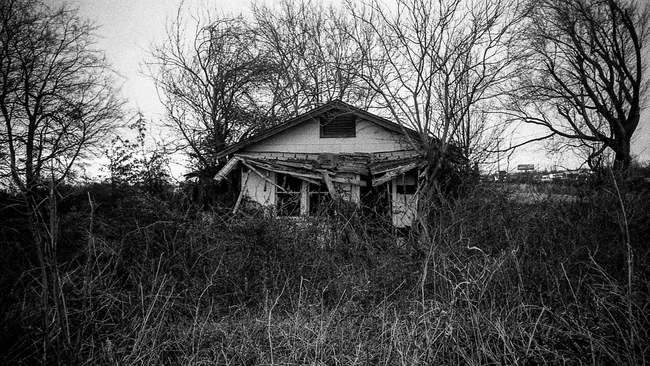

The intersection of psychological projection and architectural decay has found a new focal point in the "Monster House" photography series, a project centered on a collapsing residential structure along Highway 69 near Muskogee, Oklahoma. What began as a routine transit through the rural American landscape evolved into a significant study of how photographers use intent and narrative archetypes to transform inanimate ruins into emotive characters. This project highlights a growing shift in the 2026 photography landscape, where technical perfection is increasingly bypassed in favor of "visual dialogue" and the intentional use of anthropomorphism to engage viewers.
The Muskogee Context: Rural Decay and the Highway 69 Corridor
The subject of the series is a dilapidated house situated on a stretch of Highway 69, a major north-south artery that serves as a critical commercial link through eastern Oklahoma. Historically, this region has been defined by its agricultural and industrial contributions, but like many rural corridors in the United States, it bears the visible scars of economic shifts and depopulation. The structure in question—described not as a "rustic farmhouse" but as a "collapsing monster"—represents a broader phenomenon of rural abandonment.
According to data from the U.S. Census Bureau and rural development studies, eastern Oklahoma has seen fluctuating population densities over the last three decades. As younger generations migrate toward urban centers like Tulsa or Oklahoma City, ancestral homes are frequently left to the elements. These structures undergo a multi-stage process of decay: initial structural failure, the encroachment of invasive vegetation, and eventually, a total loss of architectural integrity. The "Monster House" caught the photographer’s attention at a specific point in this timeline—where the roofline had buckled and the porch had begun to detach, creating a silhouette that mimics organic, predatory movement.
The Psychology of Pareidolia in Visual Arts
The core appeal of the "Monster House" series lies in the human brain’s innate tendency toward pareidolia—the tendency to perceive meaningful images, particularly faces, in random or ambiguous visual patterns. Evolutionary biologists suggest that this "survival hardware" allowed early humans to quickly identify predators or allies in low-light environments.
In the context of architectural photography, pareidolia is leveraged to create anthropomorphism. By framing windows as eyes and doors as mouths, the photographer shifts the viewer’s perception from a "property listing" to a "portrait." This psychological "handle" allows the audience to participate in the image rather than merely observing it. Research in visual communication indicates that viewers spend 40% more time engaging with images that feature recognizable "faces" or character-driven narratives compared to abstract or purely technical compositions.
Technical Execution: A Hybrid Approach to Narrative
The "Monster House" series utilized a specific technical "recipe" designed to enhance the atmospheric tension of the subject. Moving away from the high-resolution, stabilized digital standards of 2026, the project employed a combination of vintage analog equipment and modern digital "sketching."
The Argus C-44 and the Role of Mechanical Grit
The primary tool for the final images was the Argus C-44, a 35mm rangefinder produced in the mid-1950s. Known for its rugged, "brick-like" construction and Cintagon lenses, the C-44 provides a tactile, mechanical experience that slows the photographic process. In documentary work, the use of such equipment is often a deliberate choice to match the "grit" of the subject. The 35mm focal length was selected to provide an environmental perspective—capturing the surrounding brush and the "dead winter sky" while maintaining the house as the central protagonist.
Digital Sketching with the Canon EOS 6D
Before committing to film, the photographer utilized a Canon EOS 6D to "sketch" the scene. This hybrid workflow allowed for real-time experimentation with angles and light without the immediate cost and delay of film processing. By testing how different elevations affected the "menace" of the house, the photographer could identify the exact point where the architecture transitioned into a character.
The Chemistry of the "Monster": Pushing Ilford HP5 Plus
The most significant technical decision in the series was the choice to "push" Ilford HP5 Plus film to ISO 3200. This chemical process involves underexposing the film and then over-developing it to compensate. The results are threefold:
- Extreme Contrast: The shadows are rendered as "voids," preventing the viewer from seeing inside the house and creating a sense of the unknown.
- Structural Grain: At 3200 ISO, the silver halide grain becomes a prominent texture, giving the house a "skin" that feels rough and present rather than smooth and dead.
- Silhouette Dominance: The jagged roofline is emphasized against the pale Oklahoma sky, creating a graphic, almost illustrative quality reminiscent of mid-century horror aesthetics.
Chronology of the Project
The development of the "Monster House" series followed a structured progression:
- Discovery Phase: The photographer identified the site during a transit of Highway 69. Initial observation noted the house was "half-swallowed by brush," distinguishing it from typical "eyesore" ruins.
- The "Sketch" Phase: Utilizing the Canon EOS 6D, the photographer explored multiple points of view (POV). This phase determined that a low-angle perspective was necessary to establish the house’s dominance.
- The Analog Execution: The Argus C-44 was deployed during specific lighting conditions—likely overcast or low-winter sun—to maximize the atmospheric potential of the pushed HP5 film.
- Post-Processing and Sequencing: The final series was curated not as a collection of single shots, but as a narrative sequence. This included an "establishing frame" for context, the "portrait" for identity, and "detail frames" to provide evidence of the ruin’s "teeth" (splintered wood and broken beams).
Industry Trends: The Return to Intent in 2026
The "Monster House" series arrives at a pivotal moment in the photography industry. As of 2026, the market is saturated with AI-generated imagery and hyper-perfect digital files. Industry analysts suggest that the value of photography is shifting from "technical excellence" to "interpretive intent."
"We are seeing a rejection of the ‘clean’ file," says Marcus Thorne, a visual culture analyst. "When anyone can generate a perfectly lit, perfectly sharp image of a ruin using a prompt, the human photographer’s value lies in their ability to translate a feeling—to tell a story that feels uncomfortable or urgent. The ‘Monster House’ works because it isn’t trying to be a perfect record; it’s trying to be a perfect interpretation."
This sentiment is reflected in the resurgence of film sales. According to 2025 industry reports, the demand for black-and-white film stocks like Ilford HP5 and Kodak Tri-X has grown by 15% annually among photographers aged 18–35, driven by a desire for the "unpredictable character" that analog processes offer.
Archetypes and Narrative Frameworks
The series encourages photographers to categorize ruins into specific archetypes to better guide their technical choices. The "Monster" is only one of several roles a structure can play:
- The Ghost: A ruin characterized by nostalgia and absence. Photographed at eye level with softer contrast, it focuses on remnants of domesticity (e.g., curtains, furniture).
- The Skeleton: A ruin that serves as evidence of structural or industrial failure. These are typically shot with flatter light and wide angles to emphasize "the ribs" of the construction.
- The Monster: A ruin that exerts power over the viewer. This requires low angles, high contrast, and a focus on "predatory" silhouettes.
By assigning these roles, the photographer moves from "collecting" shots to "casting" characters. This methodological approach ensures that every technical decision—from lens choice to developer ratio—serves the overarching story.
Broader Impact and Implications
The "Monster House" project serves as a case study for the "visual dialogue" between the creator and the audience. It challenges the observer to reconsider the "ordinary" landscapes they encounter daily. In a broader socio-cultural sense, the series documents the slow decay of rural America, not as a tragedy to be pitied, but as a persistent, almost sentient presence that demands attention.
The project also highlights the importance of the "release" in visual storytelling. By ending the series with a wide-angle shot that lets the "monster" settle back into the landscape, the photographer creates a sense of lingering unease. The implication is that the "monster" was always there, hidden in plain sight, and will remain long after the viewer has moved on.
As photography continues to evolve in an era of automation, projects like "Monster House" emphasize that the real "upgrade" for a photographer is not a newer camera body, but a more refined ability to perceive and interpret narrative. The ruins of Highway 69 are more than wood and nails; they are a cast of characters waiting for a photographer with the intent to see them.