
The burgeoning field of agentic artificial intelligence is poised to redefine human-computer interaction, yet its widespread adoption hinges on a fundamental shift in interface design. Traditional loading indicators, such as spinners and progress bars, are proving inadequate for the complex, often non-linear "thinking" processes of AI agents, leading to user confusion, anxiety, and a profound erosion of trust. This article delves into why conventional loading patterns fail in the era of agentic AI and presents a suite of innovative interface patterns designed to foster transparency, reveal system processes, and build enduring user confidence.
The Evolution of AI Interaction: Beyond the Spinner
For decades, interface designers have relied on a limited repertoire of visual cues to communicate system latency. The ubiquitous spinning wheel, the throbber, or the linear progress bar effectively signaled a technical reality: data was being retrieved, a file was downloading, or a simple computation was underway. The delay was typically attributable to bandwidth, file size, or processor speed. Users understood this reality; the system was merely performing a known, finite task.
However, agentic AI introduces an entirely new paradigm of wait time. When an AI agent pauses for an extended period – be it five seconds or fifty – it is not simply fetching data. It is actively engaged in complex cognitive processes: parsing requests, formulating strategies, evaluating probabilities, weighing multiple options, accessing external tools, and generating novel content or solutions. This "thinking time" is inherently less predictable and more opaque than traditional data retrieval. When confronted with a generic spinner during such a critical phase, users are left in the dark, unable to discern if the system is genuinely working on a complex problem, stalled, or has simply crashed. This ambiguity breeds frustration and undermines the perception of reliability, posing a significant barrier to the effective integration of AI into daily workflows.

The foundational work for addressing this challenge begins with a meticulous internal examination of the AI system itself. As explored in the first part of this series, the Decision Node Audit maps the internal workings of an AI to pinpoint the precise moments where decisions are made based on probabilities. This audit informs the Transparency Matrix, which then identifies specific behind-the-scenes API calls or internal computations that necessitate a visible status update. With engineers aligned on the technical requirements, the critical next step involves designing the user-facing visual and textual containers for these updates, transforming moments of potential anxiety into opportunities for reassurance.
Crafting Clarity: The Power of Microcopy in AI Status Updates
Often, transparency is mistakenly perceived as solely a visual design problem. In reality, the efficacy of AI transparency largely rests on the words used to communicate the system’s actions. Simple, clear explanations – the microcopy – are paramount in building trust and distinguishing a reliable AI from one that feels unpredictable or broken.
Generic placeholders like "Loading…" or "Working…" are remnants of static software. They offer no insight into the AI’s agency or the nature of its task. To truly build trust, these vague terms must be retired in favor of status updates that mirror the system’s active, intentional engagement. A well-constructed status update should tell the user precisely how the AI is working to solve their problem, grounding the technical process in the user’s real-world context.
Consider an agentic AI designed to manage team calendars and plan recurring meetings. A message like "Checking availability…" for an indeterminate duration provides insufficient information. Users remain unaware of whose calendars are being checked, what subsequent steps are involved, or if the AI has even retained the core parameters of the scheduling request. This ambiguity creates a tense, uneasy waiting experience, akin to anticipating a crucial outcome with no visibility into its progression.

A compelling example of effective status updates comes from Perplexity AI. When a user poses a question, the interface dynamically displays a real-time list of activities. Users observe the AI actively "Searching for [topic]," "Analyzing sources," or "Synthesizing information." This granular, step-by-step disclosure eliminates guesswork, offering immediate clarity on the AI’s investigative process and building confidence in its methodical approach.
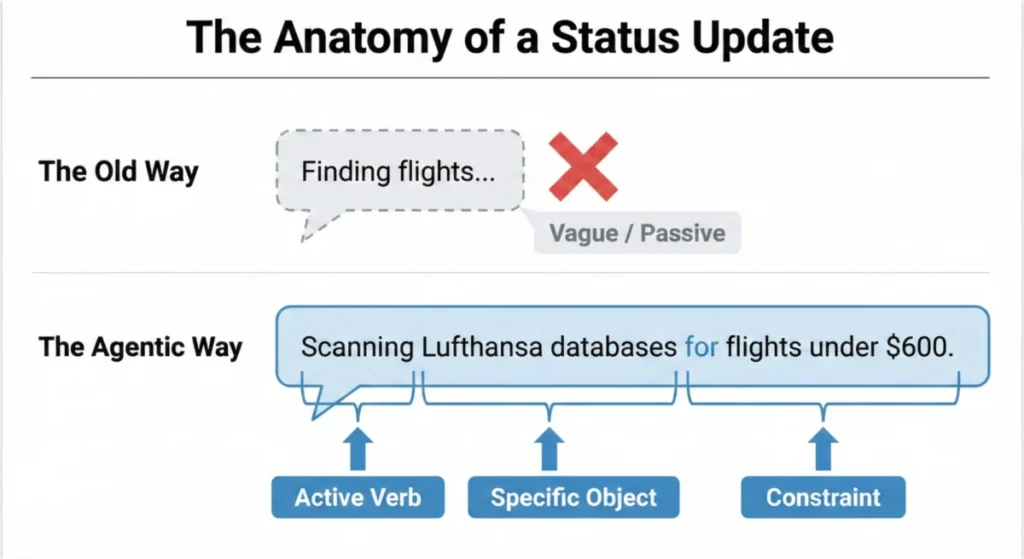
To replicate this level of informative transparency, an effective agentic update formula is crucial. This formula connects what the system is doing with why it is doing it, providing a three-part structure: a strong Action Word, the Specific Item the AI is working on, and any relevant Limits or rules guiding its action.
For instance, instead of a vague "Searching for flights…", an AI assisting with travel booking could display:
- Action Word: Searching
- Specific Item: for direct flights to Paris
- Limits: within your budget of $800
This approach immediately communicates to the user that the AI has understood their request, is actively processing it, and is operating within the specified constraints. Such precise microcopy transforms a passive wait into an informed observation, allowing users to track progress and feel reassured that their intent is being addressed.
Tailoring Transparency: Tone and Risk Alignment

The "personality" of an AI – whether it sounds like a human or acts like a robot – should not be arbitrary. The appropriate tone is directly correlated with the task’s importance, a determination facilitated by the Impact/Risk Matrix derived from the Decision Node Audit.
For low-risk, routine tasks, a friendly, conversational tone can enhance user comfort. A scheduling assistant, for example, can reassuringly state, "I’m checking your calendar for the best time to meet." This fosters an easygoing, collaborative user experience.
Conversely, high-stakes tasks demand unvarnished, mechanical accuracy. If an AI is orchestrating a substantial financial transfer or a complex database migration, users prioritize precision over playfulness. An interface declaring, "I am thinking hard about your money," would likely induce panic. Instead, clear, factual language like "Verifying account routing numbers" or "Confirming database schema integrity" is essential. By meticulously adjusting the AI’s "voice" to match the inherent risk level of the task, designers can deliver precisely the experience users require at that critical moment.
While the Impact/Risk Matrix provides an essential framework, the ultimate arbiter of appropriate AI voice and tone is rigorous user research. No set of predefined rules can infallibly predict the exact words or tone that will build trust or cause stress across diverse user groups and contexts. Hands-on research is indispensable, involving:
- Qualitative Interviews: Engaging target users in conversations about their expectations and anxieties regarding AI interaction.
- A/B Testing: Presenting different linguistic styles and tones to user segments to measure their impact on perceived trustworthiness and usability.
- Usability Studies: Observing users interacting with AI prototypes to identify points of confusion or reassurance related to status messaging.
This iterative research process ensures that the AI’s "personality" is authentically comfortable, appropriate, and genuinely helpful for the actual individuals who will engage with the system within their specific operational contexts.

A Toolkit for Transparency: Essential Interface Patterns for Agentic AI
Beyond compelling microcopy, the interface must provide the right "container" for delivering these crucial messages. The key lies in matching the message’s informational weight to the pattern’s visibility and persistence. A minor background task, such as an AI silently organizing files, requires a subtle indicator. Conversely, a high-stakes, multi-step process like a financial transaction demands a more robust, attention-grabbing container. By developing a library of these interface patterns, designers can ensure that the optimal level of transparency is delivered at the precise moment it is needed, transforming anxious waiting into informed confidence.
-
The Living Breadcrumb: AI Working in the Background
For low-importance, asynchronous tasks, a persistent yet unobtrusive indicator is required. The Living Breadcrumb serves this purpose. Imagine an email application where an AI drafts a reply. A disruptive pop-up would be counterproductive. Instead, a small, subtle status indicator might pulse within the application’s border or a dedicated menu area. This isn’t a static icon; it smoothly transitions between textual updates, perhaps shifting from "Reading email…" to "Drafting reply…" to "Checking tone…". It offers quiet assurance that the task is progressing, available for quick checks but never demanding immediate, disruptive attention. This pattern is ideal for enhancing user peace of mind in environments where multiple background AI tasks might be running concurrently without overwhelming the user interface. -
The Dynamic Checklist: Guiding Through Complex Processes
When confronting critical, high-stakes tasks—such as processing a multi-currency financial transaction or migrating an intricate dataset—the Dynamic Checklist is invaluable. This pattern acts as a robust anchor, providing users with explicit clarity and confidence regarding the process’s progress. Unlike a generic progress bar, the Dynamic Checklist explicitly enumerates every planned step the AI agent will undertake. It distinctly highlights the currently active step, marks all preceding steps as complete, and clearly lists future actions as pending.For example, in a financial transfer scenario, the checklist might display:

- ✓ Initiating secure connection to bank API.
- ✓ Validating recipient account details.
- ▶︎ Converting currency from USD to EUR.
- □ Executing transfer via SWIFT network.
- □ Generating transaction confirmation receipt.
A significant advantage of the Dynamic Checklist is its ability to expertly manage unpredictable durations. If the currency conversion (Step 3) unexpectedly requires an additional ten seconds due to external market volatility or API lag, the user remains calm. They possess full visibility into the system’s exact location in the workflow, understanding that the delay is occurring during a potentially complex action. This transparency naturally fosters patience and trust, minimizing anxiety even during prolonged waits.
The implementation of a Dynamic Checklist transforms the task into a full-stack design requirement. Unlike a simple loading flag, it necessitates a robust front-end state management system capable of listening for step-completion events, typically triggered by back-end webhook structures. This technical sophistication ensures the interface consistently reflects the AI agent’s real-time position within the workflow, reinforcing trust through accuracy and responsiveness. Devin AI provides a strong illustration of this, explicitly showing users the sequence of tasks it has completed and those remaining, offering unparalleled transparency in complex coding and development workflows.
-
The Thinking Toggle: Unveiling Raw Logic for Experts
For users with a higher information need or a profound demand for transparency—such as developers, data scientists, or compliance officers—a simple summary may be insufficient. These users desire insight into the system’s raw processing. The Thinking Toggle addresses this by offering a progressive disclosure UI control (e.g., a chevron or a "View Logs" button) that expands a friendly status update into a raw, sanitized terminal view. This view displays abstracted logic logs of the AI agent, detailing actions such as:- Tool call:
CalendarAPI.get_availability(team_members) - Reasoning: Identified scheduling conflict for ‘Project Alpha’ meeting.
- Action: Proposing alternative time slots.
While many users may never activate this view, its mere presence acts as a powerful signal of trust, reassuring the user that the system conceals nothing. Crucially, with this deep transparency comes a critical technical and security responsibility. Even for expert audiences, these raw logs must be meticulously sanitized and abstracted before display. This is non-negotiable to prevent accidental exposure of proprietary business logic, internal data structure names, or security tokens. This process ensures trust is built through honesty, not through security vulnerability.
- Tool call:
-
Designing for Partial Success: Embracing the Grey Areas
Traditional software often operates in binary: a file saves or it doesn’t; a transaction completes or it fails. Agentic AI, however, frequently inhabits a spectrum of outcomes. An agent might flawlessly plan 90% of a complex itinerary but struggle to secure a reservation at a highly sought-after restaurant.
Standard, binary error messages ("Request Failed") are trust-killers in this context, implying complete failure even when substantial work has been accomplished. If an agent completes the vast majority of a task but misses a final, minor step, a prominent red "Request Failed" banner is misleading and disheartening.
Instead, the interface must clearly articulate what succeeded and what did not:
- "Your travel itinerary has been successfully planned, including flights and accommodation. However, I was unable to book the ‘Le Bernardin’ restaurant due to full capacity. Would you like me to try alternatives or book it manually?"
This granular feedback allows users to quickly identify and address the specific unmet requirements, leveraging the agent’s completed work rather than discarding the entire effort. It transforms perceived failure into a manageable partial success, enhancing efficiency and preserving trust.
-
Pinpointing Problems: Disentangling Tool Failures from AI Limitations
When an AI system falters, it is paramount to clearly attribute the true cause of the failure. Users often mistakenly blame the AI itself for issues originating from an external service or tool upon which the AI relies.For example, if a virtual assistant attempts to access a user’s schedule but the connection to the Google Calendar API is down, the error message should precisely pinpoint the external fault rather than making the assistant appear incompetent.

- Poor Message: "I failed to retrieve your schedule." (Implies AI failure)
- Better Message: "I encountered an issue connecting to the Google Calendar API. Please check your internet connection or Google Calendar status. I can try again when the connection is restored." (Clarifies external tool failure)
This distinction is crucial for maintaining user faith in the AI’s capabilities, even when external dependencies cause disruptions. It prevents users from losing confidence in the AI agent itself, fostering a more accurate understanding of system limitations.
The Imperative of Persistence: The Audit Trail for Post-Task Verification
Real-time transparency, while critical, is inherently fleeting. If a user steps away from their desk while an agent completes a complex task, they miss the dynamic checklist and real-time updates. Upon returning to a finalized screen, if the result appears unexpected or incorrect, they lack any immediate means to verify the work or understand the decision-making process. This underscores the necessity of a persistent Audit Trail for every agentic workflow.
Designers must incorporate a "Show Work" interaction. On the final result screen, provide a readily accessible link or a detailed history log that allows the user to replay the agent’s decision logic and actions. This audit trail could include:
- "Audit Log:
- Step 1: Retrieved user preferences for ‘budget travel.’
- Step 2: Queried Flight API for routes under $800 to Paris.
- Step 3: Filtered results for direct flights between [Date A] and [Date B].
- Step 4: Selected lowest-cost direct flight (Flight #XYZ) on [Airline]."
This "receipt" of work serves as the ultimate safety net, empowering users to spot-check the validity of the output. Even if never clicked, the mere presence of an accessible audit trail signals that the system stands behind its work, promoting accountability and confidence.

The challenges posed by a lack of auditability are starkly illustrated by previous iterations of ChatGPT’s memory feature. As noted by developer Simon Willison in April 2025, ChatGPT’s memory at the time automatically fed into new conversations without explicit user awareness or control. The problem was the absence of a visible log, a timeline, or a plain-language summary of what the AI remembered and how it influenced subsequent outputs. Users might notice subtle, unprompted details in generated content—like a "Half Moon Bay" sign appearing in an image because ChatGPT silently cross-referenced a user’s location from a previous, unrelated conversation. This exemplifies the absence of audit transparency disguised as personalization, a dangerous combination that erodes trust. The Audit Trail pattern is the definitive solution to such memory audit problems, ensuring users can always understand the provenance of an AI’s output.
Overcoming User Disengagement: The Reality of Enterprise Adoption
Even the most meticulously designed checklist or the clearest status message may go unnoticed by a significant segment of users, particularly professionals operating under high cognitive load. Consider an insurance underwriter processing fifty quotes daily; they are unlikely to observe a progress bar in real-time. Their workflow involves initiating a "Generate" command, switching tabs to address emails, and returning only when the task is complete.
Research with such expert users consistently reveals that their judgment of an AI system rests almost entirely on the final result. They possess an internal benchmark for what the answer should be. If a salesperson anticipates a premium between $500 and $600, and the system returns $550, immediate acceptance and trust are established. The AI becomes an efficient accelerator for monotonous yet mandatory tasks.
However, if the system returns $900, the user halts. This output misalignment with expectations constitutes a significant problem. The user, who had switched tabs, missed the real-time explanation about a high-risk surcharge or the specific rule that triggered it. If that explanation vanishes with the progress bar, they have no mechanism to reconcile the discrepancy between expectation and outcome. They will not re-run the query merely to re-watch an animation.

Instead, they will revert to manual calculation, effectively rendering the AI’s output useless and initiating a complete rework. This manual recalculation is perceived as a waste of time, further eroding confidence. At this juncture, the user is not interested in why the system chose $900; they are focused purely on validating or invalidating the system’s accuracy against their own trusted methods. This critical lack of persistent transparency, especially in moments of disagreement, is a primary barrier to adoption and consistent use in enterprise environments. The Audit Trail, therefore, is not merely a feature; it is a mechanism that prevents AI from inadvertently creating more work and actively sustains user engagement and trust.
Building Trust, Not Magic: The Future of Agentic AI User Experience
The objective of designing agentic AI experiences is not to create "magic tricks" that rely on misdirection and hidden mechanics. Instead, we are building intelligent colleagues. A good colleague operates transparently: they communicate their actions, explain delays, and articulate challenges. This fundamental honesty fosters trust.
We must apply this principle rigorously to AI. By adopting the practical interface patterns discussed—providing specific, granular status updates, deploying dynamic checklists for complex workflows, acknowledging partial successes, and maintaining a comprehensive audit trail—we move beyond perceiving AI as a mysterious black box that simply requires a superficial polish. Instead, we begin to treat AI as a reliable, manageable team member, cultivating both trust and clear understanding.
The overarching purpose of these interface design principles is to achieve genuine transparency that transcends merely explaining the AI’s intricate inner workings. Here, transparency signifies revealing the AI’s process and performance precisely when the user needs to understand it. This encompasses plainly communicating the AI’s current status, its known limits, and an easy-to-follow history of its decisions. This profound level of openness transforms the user interaction from passive acceptance to active collaboration, enabling users to comprehend the rationale behind an outcome and to effectively intervene or guide the system towards optimal results. As AI agents become increasingly autonomous, designing for predictability, reliability, and understanding will not just be a best practice; it will be the product itself, ensuring responsible development and widespread, confident adoption.