Tag: frontier

  • Navigating the New Frontier of Fintech AI Search Visibility and Brand Accuracy

    Navigating the New Frontier of Fintech AI Search Visibility and Brand Accuracy

    The financial technology sector is currently navigating a fundamental shift in how consumers discover and evaluate products, as artificial intelligence search engines implement significantly stricter verification thresholds for fintech brands compared to other industries. Because financial services fall under the critical "Your Money or Your Life" (YMYL) category, large language models (LLMs) and generative search engines are programmed to apply rigorous filters before mentioning, citing, or recommending specific fintech products. This evolution in search behavior—where 54% of Americans now utilize tools like ChatGPT for financial research—has forced a reimagining of digital presence, moving beyond traditional search engine optimization (SEO) toward a more complex framework of "Generative Engine Optimization" (GEO).

    Fintech in AI Search: How to Be the Trusted & Featured Brand

    For fintech companies, the risk of misrepresentation in AI search results is a primary concern. Unlike traditional search engines that provide a list of links, AI search draws from a brand’s own website as well as the wider web, including forums, news sites, and regulatory records. When these sources provide conflicting information, AI systems may hallucinate, provide outdated fee structures, or pair a brand’s name with negative sentiment gathered from unverified third-party sources. Consequently, the goal for modern fintech marketing is no longer just appearing in search results, but ensuring that the brand is represented with absolute accuracy across the three primary types of AI visibility: brand mentions, citations, and product recommendations.

    Fintech in AI Search: How to Be the Trusted & Featured Brand

    The Three Pillars of AI Visibility in the Financial Sector

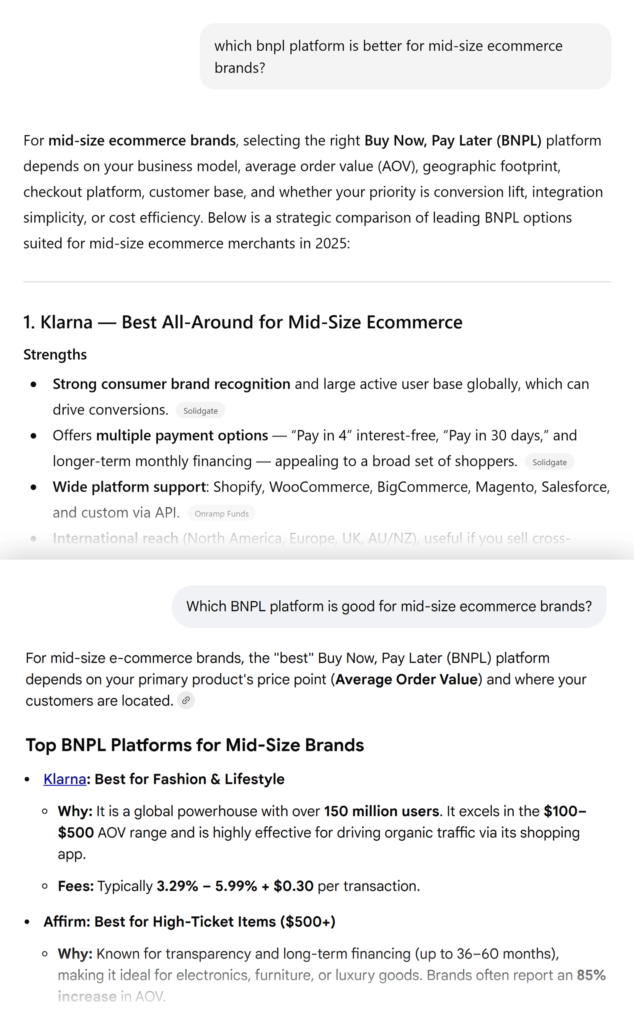
    Visibility in the AI era is segmented by the level of intent and trust the model assigns to a brand. The first pillar, brand mentions, occurs when an AI system includes a company’s name in a general answer. This typically happens during the awareness stage of the consumer journey. For instance, when a user asks about the benefits of "Buy Now, Pay Later" (BNPL) services, the AI might mention platforms like Klarna or Affirm to illustrate the category. While not an explicit endorsement, these mentions utilize the "mere exposure effect," building familiarity so that by the time a user reaches a decision point, the brand is already a recognized entity in their mental landscape.

    Fintech in AI Search: How to Be the Trusted & Featured Brand

    The second pillar, citations, represents a higher tier of value. This occurs when an AI uses a brand’s specific pages or documentation to support its answer, often appearing as footnotes, inline links, or source thumbnails. In the fintech space, being cited by an LLM serves as an implied endorsement of the brand’s authority and expertise. When an AI pulls data directly from a company’s technical documentation or help center, it allows the brand to influence the technical narrative of the response. However, market data suggests that while citations boost credibility, they do not always drive direct traffic, as many users prefer to continue their dialogue within the AI interface rather than clicking through to the source.

    Fintech in AI Search: How to Be the Trusted & Featured Brand

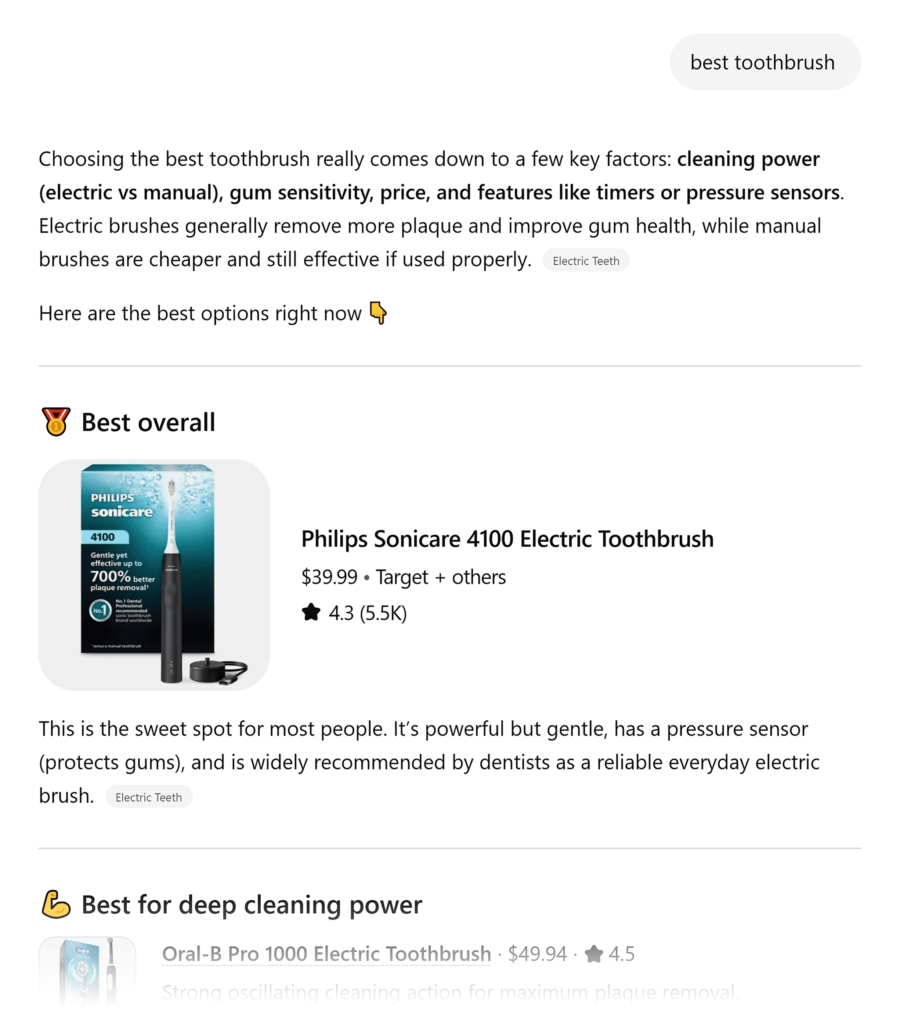
    The third and most impactful pillar is product recommendations. This is where the AI provides a curated shortlist of products for high-intent queries, such as "best budgeting apps" or "top-rated international transfer services." These recommendations are the ultimate goal for fintech brands because they directly influence the final selection process. Appearing in these lists requires the AI to have a high level of confidence in the brand’s legitimacy and current standing.

    Fintech in AI Search: How to Be the Trusted & Featured Brand

    The Logic of LLM Selection: Consensus and Consistency

    To decide which fintech brands to feature, AI systems rely on two primary signals: consensus and consistency. This methodology acts as a digital filter, protecting users from potentially fraudulent or unstable financial services.

    Fintech in AI Search: How to Be the Trusted & Featured Brand

    Consensus is achieved when multiple reputable, high-authority sources mention a brand and its products in a positive or neutral context. LLMs assess social proof by scanning editorial reviews from major financial publications, user feedback on platforms like G2 or Trustpilot, and discussions in specialized communities like Reddit or the myFICO Forum. The stronger the consensus across these diverse nodes, the more likely the AI is to recommend the brand. Conversely, if major news outlets consistently highlight regulatory hurdles or service outages, the AI will likely incorporate those warnings into its summary.

    Fintech in AI Search: How to Be the Trusted & Featured Brand

    Consistency, the second signal, refers to the alignment of facts across the internet. For a fintech brand to be trusted by an AI, its core details—such as pricing, interest rates, security features, and withdrawal limits—must be uniform across its own website and all third-party coverage. Inconsistencies, such as a review site listing a 3% fee while the brand’s homepage lists 2%, create a "trust gap." When faced with such contradictions, AI models often become cautious, either omitting the brand entirely or adding qualifying language like "reports vary on current fee structures," which can significantly undermine consumer trust.

    Fintech in AI Search: How to Be the Trusted & Featured Brand

    Content Categories That Drive AI Trust

    Market analysis indicates that three types of content carry the most weight in the fintech AI ecosystem. The first is owned content, which includes the brand’s website, technical documentation, and help centers. AI systems treat these as the "primary source of truth" for product mechanics. Fintech leaders like Intuit and TurboTax have optimized this by creating extensive landing pages that detail every aspect of their guarantees, security protocols, and filing processes. By providing structured, easy-to-parse data, they ensure the AI has a reliable foundation for its answers.

    Fintech in AI Search: How to Be the Trusted & Featured Brand

    The second category is earned media and reviews. LLMs use these to cross-check a brand’s internal claims against the reality of the user experience. A significant trend in the industry is the use of original research to drive earned media. For example, KPMG’s "Pulse of Fintech" reports are frequently cited by journalists at Bloomberg and CNBC. These citations create a ripple effect: when reputable news organizations cite a brand’s research, the AI model registers that brand as a high-authority source in the financial sector.

    Fintech in AI Search: How to Be the Trusted & Featured Brand

    The third and perhaps most critical category for fintech is official records. These are public documents that confirm a brand’s legal authorization to operate, such as FDIC membership, licenses from the Federal Reserve, or filings with the Consumer Financial Protection Bureau (CFPB). When a user asks about the safety of a platform like Wise, AI systems like Perplexity scan regulatory databases to verify that the company is a licensed money transmitter. For fintech brands, making these regulatory details explicit and easy for AI bots to retrieve is a vital trust-building exercise.

    Fintech in AI Search: How to Be the Trusted & Featured Brand

    Strategic Implications for Fintech Leadership

    The shift toward AI-driven financial research presents both a challenge and a massive opportunity. A study by Microsoft found that AI-referred traffic converts at three times the rate of other channels, including traditional search and social media. This high conversion rate is attributed to the fact that users arriving via AI have often already been "pre-sold" by the model’s synthesis of the brand’s value proposition.

    Fintech in AI Search: How to Be the Trusted & Featured Brand

    To capitalize on this, fintech brands are increasingly investing in "Trust Centers" and structured FAQ sections. These hubs serve as a central repository for the facts the brand wants the AI to prioritize. Furthermore, proactive reputation management has become a technical necessity. Brands must now monitor not just what the media says, but what the AI thinks the media is saying. This involves auditing AI responses for "narrative drivers"—the specific questions and sentiments that appear most frequently in LLM outputs.

    Fintech in AI Search: How to Be the Trusted & Featured Brand

    Industry analysts suggest that the "long tail" of the internet is becoming more relevant for fintech brands. Because AI models do not "forget" old information, outdated forum posts or expired PDF brochures can continue to haunt a brand’s AI profile for years. Effective AI strategy now requires a "clean-up" phase, where companies aggressively redirect or remove outdated documentation and participate directly in community conversations on platforms like Reddit to provide current, accurate information.

    Fintech in AI Search: How to Be the Trusted & Featured Brand

    Conclusion: The Future of Fintech Discovery

    As artificial intelligence continues to integrate into the daily financial lives of consumers, the barrier to entry for fintech visibility will only grow higher. The "Your Money or Your Life" designation ensures that only the most consistent, transparent, and verified brands will survive the filter of generative search.

    Fintech in AI Search: How to Be the Trusted & Featured Brand

    The transition from traditional SEO to AI-centric visibility represents a move from keyword-matching to narrative-influence. Fintech brands that succeed in this new era will be those that treat their digital footprint as a holistic ecosystem—one where owned data, third-party reviews, and regulatory transparency work in unison to provide a single, undeniable story of reliability. In a world where an AI-generated answer is often the first and most influential touchpoint, accuracy is no longer just a compliance requirement; it is the most powerful marketing tool a fintech brand possesses.

  • Chasing the Cosmic Frontier: How Matt Suess Mastered the Art and Science of Modern Astrophotography

    Chasing the Cosmic Frontier: How Matt Suess Mastered the Art and Science of Modern Astrophotography

    The transition from a curious teenager in a New England basement to a world-renowned astrophotography educator represents a four-decade journey through the evolution of imaging technology. For Matt Suess, an OM SYSTEM Ambassador and veteran landscape photographer, the path to capturing the heavens was paved with both technical rigor and a profound personal connection to the night sky. Today, as astrophotography faces new challenges from light pollution and satellite interference, Suess’s work serves as both a masterclass in technical precision and a call to document the celestial sphere while it remains visible to the naked eye.

    8 Astrophotography Lessons the Beginner Guides Leave Out

    The Genesis of a Celestial Fascination

    The foundation of Suess’s career was laid long before the advent of digital sensors. At the age of 12, he constructed his first darkroom, a move that allowed him to experiment with the fundamental chemistry of light. Growing up in Connecticut, the heavy veil of light pollution common to the American Northeast obscured the Milky Way, leaving the young photographer to wonder what lay beyond the hazy glow of suburban streetlights. Despite these limitations, Suess began experimenting with star trails on color slide film during his teenage years.

    This early interest in the stars was not merely artistic; it was academic. Suess initially pursued a degree in mechanical engineering with the specific intent of designing rockets for the National Aeronautics and Space Administration (NASA). While his professional trajectory eventually pivoted toward full-time photography, the engineering mindset—characterized by a need to understand the "how" and "why" behind technical failures—remained a core component of his methodology. This analytical approach proved essential when he eventually moved to the darker skies of the American West, where he encountered the Milky Way for the first time in Joshua Tree National Park. His initial attempts to capture the galactic core resulted in soft, out-of-focus images, a failure that prompted a decades-long quest to refine the mechanics of night shooting.

    8 Astrophotography Lessons the Beginner Guides Leave Out

    The Chronology of Technical Evolution

    The history of astrophotography is defined by the struggle to overcome three primary obstacles: focus, noise, and the Earth’s rotation. Suess’s career spans the transition from chemical film to the current era of computational photography, a timeline that highlights the rapid democratization of the craft.

    In the era of film, photographers were forced to wait days or weeks to see the results of a long exposure. The digital revolution introduced the LCD screen, allowing for immediate feedback, but it also introduced the problem of thermal noise—grainy artifacts caused by the sensor heating up during long exposures. Suess spent years mastering the "manual stacking" method, a process involving taking multiple shorter exposures and blending them in post-processing software to cancel out noise while retaining signal from the stars.

    8 Astrophotography Lessons the Beginner Guides Leave Out

    A significant turning point in Suess’s technical chronology occurred during one of his workshops. A student demonstrated a feature known as "Live Composite," a tool specific to OM SYSTEM (formerly Olympus) cameras. Unlike traditional long exposures that gather all light over time, Live Composite only records new light signatures—such as moving stars—onto a base exposure. This allowed Suess to watch star trails form in real-time on the camera’s back screen, effectively eliminating the guesswork of long-duration night photography. This moment shifted Suess’s focus toward the potential of specialized hardware to simplify the complex mathematics of the night sky.

    The Mechanics of Modern Astrophotography

    To achieve professional-grade results, Suess emphasizes that photographers must move beyond the "500 Rule." This traditional formula—dividing 500 by the 35mm equivalent focal length to determine the maximum shutter speed before stars begin to trail—is increasingly viewed as an oversimplification for modern high-resolution sensors. Instead, Suess advocates for empirical testing and the use of specialized autofocus systems.

    8 Astrophotography Lessons the Beginner Guides Leave Out

    One of the most significant hurdles in night photography is achieving critical focus on a point of light millions of light-years away. Suess traditionally taught a manual method: magnifying a bright star in live view and micro-adjusting the focus ring until the star reached its smallest possible diameter. However, the introduction of "Starry Sky AF" has largely automated this process. This computational algorithm analyzes the contrast of celestial bodies to lock focus with a degree of precision that often surpasses human capability, particularly in cold environments where manual dexterity is compromised.

    The equipment used by Suess reflects a shift toward portability without sacrificing optical quality. His standard kit includes the OM-1 Mark II and OM-5, paired with fast primes like the M.Zuiko Digital ED 17mm F1.2 PRO. The 34mm equivalent field of view is wide enough to capture the arc of the Milky Way while maintaining a natural perspective for foreground elements. The F1.2 aperture is particularly critical; it allows for lower ISO settings, which directly correlates to a higher dynamic range and cleaner data in the RAW file.

    8 Astrophotography Lessons the Beginner Guides Leave Out

    Deep-Sky Exploration and the Astro-Modified Sensor

    In recent years, Suess has expanded his repertoire into deep-sky photography, a discipline that requires tracking the Earth’s rotation to allow for multi-minute exposures. Using a portable star tracker like the Move Shoot Move NOMAD, Suess counteracts the planetary spin, enabling him to capture the Andromeda Galaxy and the Orion Nebula in vivid detail.

    However, standard camera sensors are inherently limited for this work. Most consumer cameras are equipped with an internal filter designed to block infrared light, which also inadvertently suppresses the Hydrogen-alpha (H-alpha) wavelength (656.28 nm). This specific wavelength is responsible for the vibrant red and pink hues found in nebulae. Suess’s adoption of the OM-3 ASTRO—a camera factory-modified to allow H-alpha light to reach the sensor—marks a new chapter in his work. This modification increases the sensitivity to nebular emissions by approximately 400% compared to a standard sensor, allowing for the capture of deep-space structures that are otherwise invisible.

    8 Astrophotography Lessons the Beginner Guides Leave Out

    Furthermore, Suess utilizes a body-mount light pollution filter (BMF-LPC01). Positioned behind the lens, this filter neutralizes the yellow and orange wavelengths emitted by sodium-vapor and LED streetlights. By filtering light at the source before it reaches the sensor, Suess can shoot in "suburban" dark zones that would otherwise be unusable for deep-sky work.

    Environmental Implications and the Future of the Dark Sky

    Suess’s urgency in teaching astrophotography is fueled by the rapid degradation of the global night sky. Data from the "New World Atlas of Artificial Night Sky Brightness" indicates that more than 80% of the world’s population lives under light-polluted skies, and one-third of humanity can no longer see the Milky Way.

    8 Astrophotography Lessons the Beginner Guides Leave Out

    Beyond terrestrial light pollution, the rise of satellite "mega-constellations" poses a new threat. Astronomers and photographers alike have noted an increase in "satellite streaks" across long-exposure images. Suess notes that while software can often remove these artifacts, the sheer volume of orbital traffic is fundamentally altering the visual landscape of the heavens. "We’re in a really good era right now," Suess warns, "but that window’s not going to stay open forever." This environmental shift has led to the growth of "astrotourism," with photographers traveling to designated International Dark Sky Parks to capture what remains of the pristine night.

    Post-Processing and the Philosophy of the "Honest Result"

    Suess’s workflow concludes with a rigorous post-processing routine that prioritizes data integrity over "brute-force" editing. He utilizes DxO PureRAW for initial demosaicing and noise reduction, a step he describes as essential for Micro Four Thirds sensors operating at high ISOs. By using artificial intelligence to distinguish between noise and fine star detail, he can produce clean files that rival full-frame counterparts.

    8 Astrophotography Lessons the Beginner Guides Leave Out

    For deep-sky stacking, Suess is currently exploring PixInsight, an industry-standard software for astrophotography that offers advanced tools for star reduction and nebulosity enhancement. Despite these powerful tools, his philosophy remains grounded in the quality of the initial exposure. He cautions against "pulling harder on data that isn’t there," noting that over-processed images often result in a "mottled" appearance that lacks the organic beauty of the cosmos.

    Conclusion: The Therapeutic Power of the Stars

    The most recent chapter of Suess’s life has been defined by a personal battle with HPV-positive squamous cell oropharyngeal cancer. Throughout his treatment, the act of photographing the night sky provided a necessary anchor. Even when physical fatigue made long treks impossible, the arrival of the OM-3 ASTRO prompted him to engage with the stars from his immediate surroundings.

    8 Astrophotography Lessons the Beginner Guides Leave Out

    For Suess, the value of astrophotography transcends the final image. It is a discipline that requires patience, a tolerance for failure, and a willingness to stand in the cold, quiet dark. As he continues his recovery, Suess views the night sky not just as a subject for technical mastery, but as a reminder of the vast, enduring universe that exists beyond human struggle. His work stands as a testament to the importance of documenting the celestial frontier, ensuring that even as the world grows brighter, the memory of the stars remains clear.

Grafex Media
Privacy Overview

This website uses cookies so that we can provide you with the best user experience possible. Cookie information is stored in your browser and performs functions such as recognising you when you return to our website and helping our team to understand which sections of the website you find most interesting and useful.