Tag: recommendations

  • Navigating the AI Landscape: How Your Brand’s Digital Footprint Influences Artificial Intelligence Recommendations

    Navigating the AI Landscape: How Your Brand’s Digital Footprint Influences Artificial Intelligence Recommendations

    The burgeoning influence of Artificial Intelligence (AI) on how consumers discover and evaluate brands presents a critical challenge for businesses. As prospective clients increasingly turn to AI-powered tools for research, the sources that AI relies upon to generate recommendations are becoming paramount. This article delves into the intricate relationship between a brand’s online presence, its off-site signals, and the way AI models, such as those powering search engines and chatbots, surface and prioritize information. Understanding this dynamic is no longer a niche SEO concern; it is a fundamental aspect of modern digital strategy.

    The fundamental premise is straightforward: when a potential customer researches a product or service category using AI, the AI’s recommendations are not generated in a vacuum. While a company’s own website serves as a primary training ground for AI to understand its offerings, the AI’s broader knowledge base is built upon the entirety of the web. This means that external sources play a significant, often decisive, role in shaping AI-driven recommendations.

    Data from industry analysis platforms, such as that provided by Profound, indicates a significant reliance on various web sources by AI models. While platforms like Reddit are frequently cited in AI responses, suggesting a broad impact, the true influence of any given source is highly context-dependent. This data underscores a crucial point: not all external citations are created equal, and their relevance is intrinsically tied to the specific search query and the category being investigated.

    What Shapes AI Recommendations for Your Vertical? Peek Inside AI Sources with 3 Prompts (Off-Site AI Search Optimization)

    The Nuance of AI Recommendations: Beyond General Popularity

    The common misconception is that widespread popularity of a platform, such as Reddit, automatically translates to its importance in AI recommendations for every business. However, the reality is far more nuanced. AI models are trained to identify relevant information based on the specific intent and keywords within a user’s prompt. Therefore, a source only matters if the AI actively consults it when a buyer is searching for brands within a particular industry or for specific solutions.

    This principle can be analogized to social media marketing. While a broad social media presence is beneficial, not every platform is equally effective for every business. The notion that every brand needs a dedicated Reddit strategy simply because it’s a commonly cited source is akin to asserting that every business requires a Facebook page due to its user base – an approach that overlooks strategic relevance.

    The key takeaway is that businesses should not indiscriminately pursue every visible citation source. Instead, the focus must be on identifying which external sources consistently inform AI answers for the specific use cases of their target buyers. This targeted approach allows for a more efficient and effective allocation of resources towards channels that can realistically be influenced. The starting point for this strategic endeavor should not be the sources themselves, but rather the prompts that buyers are likely to use.

    What Shapes AI Recommendations for Your Vertical? Peek Inside AI Sources with 3 Prompts (Off-Site AI Search Optimization)

    A Methodical Approach to Uncovering AI’s Information Ecosystem

    To effectively understand which off-site sources shape AI responses, a systematic, four-step process can be employed. This methodology aims to provide actionable insights into the AI’s information-gathering habits within a specific industry context.

    Step 1: Generating Buyer-Specific Commercial-Intent Prompts

    The first critical step involves crafting prompts that accurately reflect how a potential buyer would inquire about solutions or vendors within a particular category. These prompts should embody genuine commercial intent, mimicking the language and considerations of someone actively evaluating options. The accuracy of these prompts is heavily dependent on the quality of input provided, including detailed buyer personas, industry specifics, and existing keyword research.

    For businesses struggling to define these buyer profiles, a supplementary prompt can be utilized: "Visit [website] and infer the most likely ICP. Then list the buyer profile, industry and additional context. Keep the total response under 90 words, use compact phrases (no paragraphs) and skip the explanation and commentary." This aids in extracting essential details to refine the core buyer-specific prompt generator.

    What Shapes AI Recommendations for Your Vertical? Peek Inside AI Sources with 3 Prompts (Off-Site AI Search Optimization)

    The subsequent prompt, designed for tools like ChatGPT, aims to generate ten distinct buyer-style prompts. These prompts are intentionally designed to be short, natural, and commercially specific, typically under 12-15 words. They should span various buying stages, from initial discovery and shortlist creation to comparison, validation, and considerations around implementation risk and return on investment (ROI). Crucially, these prompts are designed to exclude purely educational, exploratory, or trend-based queries, focusing instead on the decision-making process. Each generated prompt is accompanied by an instruction to utilize current web information and subsequently include a list of cited sources and the brands identified in the AI’s response.

    The output of this step is a set of realistic prompts that simulate a buyer’s journey, providing the foundation for subsequent AI interactions. The prompts are structured to elicit responses that include explicit references to the sources AI uses, making the analysis of its information ecosystem possible.

    Step 2: Executing AI "Prompt Runs"

    With a curated list of buyer-specific prompts, the next stage involves running these queries through AI models. Google’s AI Mode and Gemini are recommended due to Google’s market dominance and the increasing integration of AI into search. However, the methodology is adaptable to other large language models (LLMs).

    The process requires executing each of the ten generated prompts sequentially within the same AI conversation. This approach is crucial for maintaining context and ensuring that the AI’s responses build upon each other, providing a more comprehensive view of its information retrieval patterns. Each prompt execution will yield a response, ideally including the brands identified and the sources AI consulted.

    What Shapes AI Recommendations for Your Vertical? Peek Inside AI Sources with 3 Prompts (Off-Site AI Search Optimization)

    While this process might seem tedious, it is essential for gathering empirical data. The iterative nature of these "prompt runs" helps to mitigate the inherent non-deterministic nature of AI outputs, where the same prompt can yield different results. By conducting multiple runs, a more reliable directional signal regarding influential sources can be obtained. As industry expert Britney Muller notes, "The ’10/10 runs’ approach is a solid instinct, because AI outputs as you know are non-deterministic. The same prompt can give you different answers each time. Ten runs give you a better, but still a very crude directional signal. It’s really not statistical certainty."

    Step 3: Archiving Responses and Sources

    Following the prompt execution phase, the collected data needs to be systematically organized. A dedicated prompt is used to distill the essential information from each AI response: the original prompt, the brands identified, and the specific off-site sources cited.

    This prompt, when executed within the same AI conversation after the final prompt run, generates a plain text archive. This archive is designed to be easily copied and pasted for subsequent analysis. It meticulously lists each prompt run, the brands that appeared in the AI’s response, and the URLs of the sources it referenced. This structured output eliminates extraneous conversational elements, providing a clean dataset focused on the core information required for analysis.

    The prompt for this step is carefully worded to ensure that only the requested data is extracted, including preserving all links and formatting. This ensures that the archived data is ready for the final analytical phase. The output is typically presented within a code block for ease of use.

    What Shapes AI Recommendations for Your Vertical? Peek Inside AI Sources with 3 Prompts (Off-Site AI Search Optimization)

    Step 4: Analyzing Off-Site Source Influence and Prioritizing Actions

    The final and most crucial step involves analyzing the archived data to identify patterns and determine the most influential off-site sources for a given category. This analysis is best conducted using a robust AI model, such as ChatGPT, by pasting the generated archive along with a comprehensive audit prompt.

    This prompt instructs the AI to act as an auditor, identifying recurring themes in sources, source types, and brand visibility. It emphasizes that the analysis should be based on observed patterns rather than definitive pronouncements, acknowledging the inherent variability in AI outputs. The audit prompt also directs the AI to consider the presence and visibility of the user’s own brand within the generated responses, using this as a secondary lens for interpretation.

    The output of this analysis is multifaceted, providing:

    1. Key Patterns: A summary of the most significant recurring source types and brand mentions.
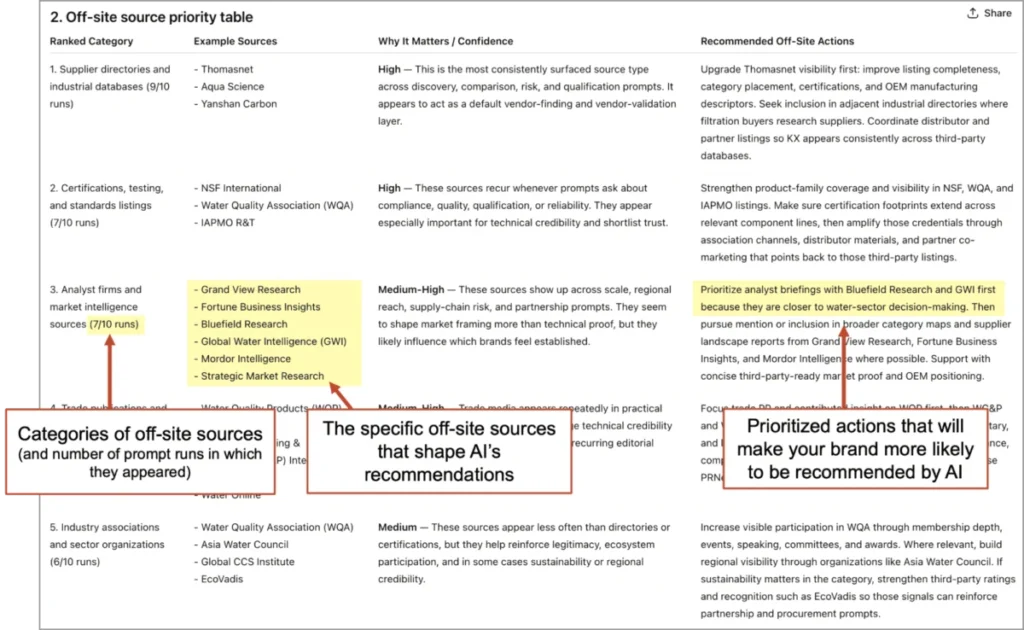
    2. Off-Site Source Priority Table: A markdown table ranking the top five off-site source categories most likely to influence AI answers. This table includes example sources, justification for their importance, and recommended off-site actions. The ranking is based on recurring visibility and influence across the prompt runs.
    3. Competitive Readout: An overview of which brands appear most frequently, which seem to have strong third-party support, and which smaller brands might be outperforming.
    4. Brand Gap Readout: An assessment of the user’s own brand’s visibility, its supporting sources, areas of underrepresentation compared to competitors, and opportunities for improvement.
    5. Evidence Quality Notes: Observations on factors that might affect the confidence of the analysis, such as the prevalence of brand-owned citations or low-quality sources.
    6. Prioritized Action Plan: A concise list of the top three highest-impact off-site actions to improve brand visibility in AI recommendations, including expected benefits and dependencies.

    This comprehensive analysis provides a strategic roadmap, highlighting actionable steps to enhance a brand’s presence within the AI-driven information ecosystem.

    What Shapes AI Recommendations for Your Vertical? Peek Inside AI Sources with 3 Prompts (Off-Site AI Search Optimization)

    The Role of "Memory" in AI Recommendations

    Beyond the data gathered through active searching, AI models also possess a form of "memory" derived from their pre-training data. This pre-training is the foundation upon which models like ChatGPT are built, and it means that AI can sometimes recommend brands based on its existing knowledge without conducting a live web search.

    This "pre-trained" knowledge base often heavily favors established brands and entities that have a significant presence in major publications, news outlets, and other high-authority websites. The rationale is that these sources are more likely to be included in the vast datasets used for training AI models. Consequently, traditional public relations (PR) and media outreach remain crucial components of an AI search strategy.

    To gauge what an AI model "remembers" about a brand without performing a live search, a custom GPT can be created with the "Web Search" function disabled. This specialized tool, such as the "Orbit’s No-Search Brand Visibility GPT," allows for a clean test of the AI’s pre-trained knowledge. By inputting a brand name, industry, and geography, businesses can ascertain what information the AI has retained from its foundational training data.

    What Shapes AI Recommendations for Your Vertical? Peek Inside AI Sources with 3 Prompts (Off-Site AI Search Optimization)

    If the AI’s memory of a brand is limited, it underscores the importance of traditional PR efforts. High-profile press placements and compelling storytelling through credible sources are vital for embedding a brand within the AI’s knowledge base. In this context, reputable media outlets are often weighted more heavily than company-owned websites during the training process, making them instrumental in building brand recognition within AI models.

    Conclusion

    In an era where AI is increasingly shaping consumer discovery, businesses must adopt a strategic approach to their online presence. The effectiveness of AI recommendations hinges on a nuanced understanding of how AI sources information. By moving beyond generalized assumptions about platform popularity and focusing on category-specific, query-driven analysis, brands can identify and prioritize the off-site signals that truly matter.

    The four-step methodology outlined provides a practical framework for this analysis, enabling businesses to uncover the AI’s information ecosystem and develop targeted strategies. Coupled with an awareness of AI’s pre-trained knowledge, a robust approach that integrates both active SEO tactics and traditional PR can ensure that a brand is not only discoverable but also favorably recommended when potential customers turn to artificial intelligence for their needs. This strategic foresight is no longer optional; it is essential for navigating the evolving landscape of digital commerce and brand perception.

Grafex Media
Privacy Overview

This website uses cookies so that we can provide you with the best user experience possible. Cookie information is stored in your browser and performs functions such as recognising you when you return to our website and helping our team to understand which sections of the website you find most interesting and useful.