
Tag: tinywins

  • TinyWins Forges Joby Aviation’s Brand Identity, Rooting Emotional Trust in Mid-Century Aviation Aesthetics for the Electric Air Taxi Era

    TinyWins Forges Joby Aviation’s Brand Identity, Rooting Emotional Trust in Mid-Century Aviation Aesthetics for the Electric Air Taxi Era

    California-based design studio TinyWins has completed a monumental undertaking, crafting the comprehensive brand identity for Joby Aviation, a pioneer in the electric vertical take-off and landing (eVTOL) aircraft sector. This ambitious project transcended a mere corporate rebranding, venturing into the uncharted territory of establishing a consumer-facing identity for an entirely new category of transportation – the electric air taxi. The core challenge, as identified by TinyWins, was to cultivate emotional trust and public acceptance for a service with no pre-existing user behavior or established infrastructure, such as skyports, before a single passenger ever booked a seat. To achieve this, the studio strategically drew profound inspiration from the "golden age" of aviation design, infusing the Joby Aviation brand with a sense of historical gravitas, reliability, and aspirational elegance.

    The project’s scope was extensive, encompassing strategy, identity development, website design, mobile application interface, intricate wayfinding systems for future skyports, and the distinctive aircraft livery. This holistic approach was critical for Joby Aviation, a company at the forefront of a nascent industry poised to redefine urban and regional mobility. The eVTOL market, projected by Morgan Stanley to reach $1 trillion by 2040 and $9 trillion by 2050, demands not only technological innovation and stringent safety certifications but also a compelling narrative and visual language that can bridge the gap between futuristic concept and everyday reality. Building consumer confidence and an emotional connection is paramount for a sector introducing a mode of transport previously confined to science fiction.

    The Genesis of a New Aviation Era: Joby Aviation’s Vision

    Joby Aviation, founded in 2009 by JoeBen Bevirt, has been a quiet but persistent force in the development of eVTOL aircraft for over a decade. The company’s vision is to provide fast, quiet, and emissions-free air transportation services, significantly reducing travel times in congested urban environments and connecting communities previously underserved by conventional aviation. Their proprietary aircraft is designed for piloted, five-person journeys (one pilot, four passengers) at speeds up to 200 mph, with a range of over 150 miles on a single charge. This technological leap represents a significant departure from traditional aviation, requiring novel approaches to engineering, manufacturing, regulatory compliance, and, crucially, public perception.

    Joby’s journey has been marked by significant milestones, including substantial investment from strategic partners like Toyota, and the acquisition of Uber Elevate in 2021, which brought with it a team of experienced professionals and a robust software platform for air taxi operations. The company has also made considerable progress in its certification pathway with the Federal Aviation Administration (FAA), receiving its G-1 certification basis and a Part 135 Air Carrier Certificate, essential steps toward commercial operations. Despite these technical achievements, the ultimate success of Joby and the broader eVTOL industry hinges on widespread public acceptance and the establishment of a trusted, recognizable brand. This is where TinyWins’ contribution becomes invaluable.

    The Branding Imperative: Cultivating Trust in an Unknown Future

    TinyWins Defines Joby Aviation Brand Identity for Air Taxi Era

    For any disruptive technology, the initial hurdle is often not technical feasibility but societal adoption. Electric air taxis, while offering immense potential benefits, also confront inherent human anxieties associated with flying, new technologies, and the perceived safety of autonomous or semi-autonomous systems. Traditional aviation has had over a century to build its safety record and cultural iconography. eVTOL companies, by contrast, must compress this trust-building process into a condensed timeframe.

    TinyWins recognized that the brand identity needed to serve as an emotional anchor, providing familiarity and reassurance amidst radical innovation. The decision to reference aviation’s "golden age" was a strategic masterstroke. This period, roughly from the 1930s to the 1960s, is often romanticized for its pioneering spirit, the glamour of air travel, and the sleek, optimistic design language that characterized everything from aircraft interiors to airport architecture. By tapping into this collective memory, TinyWins aimed to imbue Joby Aviation with a sense of established reliability and aspirational wonder, bypassing the skepticism often directed at entirely novel concepts.

    Early conversations within TinyWins explicitly referenced iconic examples of mid-century design excellence. Eero Saarinen’s TWA Flight Center at JFK Airport, a masterpiece of fluid concrete forms, symbolized the optimism and futuristic vision of air travel. Swissair’s meticulous guidelines, developed by Rudolf Bircher, exemplified precision, clarity, and a commitment to passenger experience. Lufthansa’s identity, emanating from the influential HfG Ulm school of design, showcased systematic thinking and timeless functionality. The British Airports Authority system, crafted by Jock Kinneir and Margaret Calvert, set the gold standard for clear, intuitive wayfinding. These historical touchstones provided a rich lexicon of design principles that emphasized clarity, elegance, human scale, and an unwavering focus on the user experience – qualities that are as relevant to a modern air taxi service as they were to post-war jet travel.

    TinyWins’ Holistic Approach: From Strategy to Skyport Concepts

    TinyWins’ engagement with Joby Aviation was comprehensive, reflecting the complexity of launching a new category. The studio’s methodology began with foundational brand strategy, likely involving in-depth market analysis, competitive landscape mapping (even if nascent), and precise definition of Joby’s target demographic and core values. This strategic bedrock informed every subsequent creative decision.

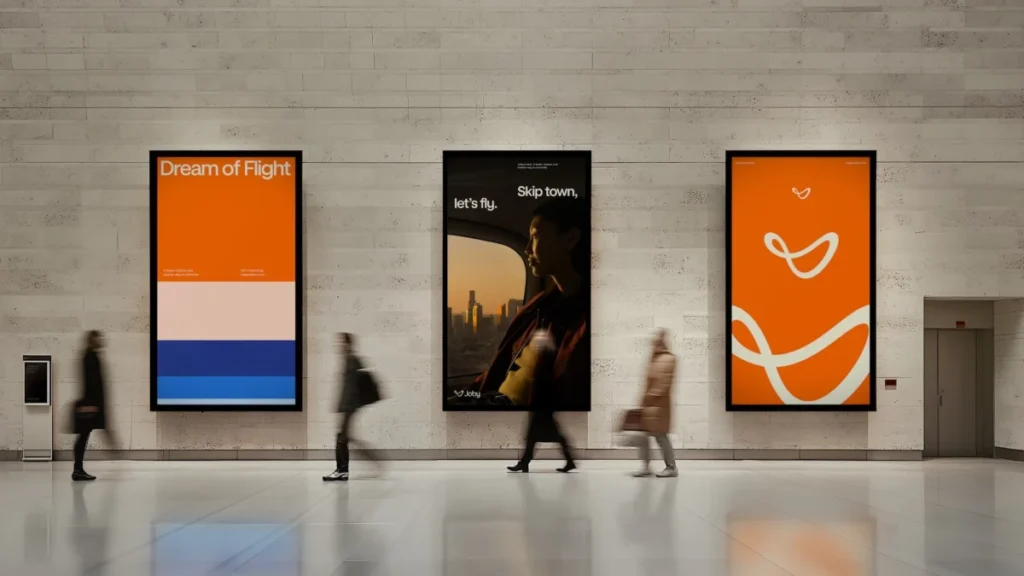
    The creative direction, under the leadership of Creative Director May Kodama, meticulously translated the "golden age" inspiration into contemporary relevance. This heritage shaped every detail of the Joby Aviation identity, ensuring a cohesive and compelling brand presence across all touchpoints.

    Core Identity Elements: Crafting a Visual Language of Trust

    TinyWins Defines Joby Aviation Brand Identity for Air Taxi Era
    • Custom Typeface: A bespoke typeface, developed in collaboration with Family Type, forms a critical component of Joby’s visual language. Custom typography offers exclusivity and allows for precise control over readability and emotional resonance. A typeface inspired by mid-century aesthetics would typically feature clean lines, balanced proportions, and a sense of enduring quality, avoiding ephemeral trends. This choice reinforces the brand’s commitment to precision and timelessness, crucial for an aviation company.
    • Color Palette: The decision to derive the color palette "from Californian skies" is deeply symbolic. It grounds Joby Aviation in its geographical origins while evoking a sense of lightness, freedom, and the natural beauty of flight. Such a palette might feature serene blues, soft grays, and perhaps warm golden tones, communicating calmness, aspiration, and environmental consciousness – aligning perfectly with Joby’s sustainable mission.
    • The "Smile" Device: This signature graphic element emerged serendipitously during a presentation when May Kodama observed the inherent warmth of rounded photo frames, remarking, "It feels so Joby." The name stuck, and the "Smile" became a distinctive visual motif. This accidental discovery speaks to the organic nature of creative development and the power of intuitive insight. The "Smile" likely adds a human, approachable, and optimistic touch to the brand, counterbalancing the high-tech nature of the aircraft and fostering a sense of welcome and ease for potential passengers. It functions as a subtle, friendly invitation into the future of flight.

    Designing for the Non-Existent: Wayfinding and Skyport Concepts

    One of the most innovative aspects of TinyWins’ project was designing wayfinding systems for Joby Aviation skyports that have not yet been built. This required foresight, imagination, and a deep understanding of user experience principles, drawing from the masters of information design. Principles from Massimo Vignelli, renowned for his systematic clarity and "design is common sense" philosophy; Otl Aicher, whose iconic pictograms for the Munich Olympics epitomized universal understanding; and Saul Bass, celebrated for his powerful graphic simplicity and emotional impact, were sourced.

    This proactive approach ensures that when skyports do materialize, the passenger journey will be intuitive, stress-free, and branded consistently. Wayfinding in an aviation context is critical for safety and efficiency, and by designing it alongside the core identity, TinyWins guarantees a seamless physical and digital experience. This foresight demonstrates an understanding of the end-to-end customer journey, from booking an air taxi on an app to navigating a skyport and boarding an aircraft.

    Extending the Brand: Aircraft Livery and Digital Presence

    The brand identity system developed by TinyWins is robust enough to cover an expansive range of applications. The aircraft livery, the exterior design of the eVTOL aircraft itself, required careful consideration of aesthetics, aerodynamics, and brand visibility from both the ground and the air. The design would need to convey Joby’s brand attributes while also being visually striking and memorable.

    The digital interfaces, including a mobile app and a "cinematic website" developed with INK Studio, are crucial for passenger interaction, booking, and information. These platforms must be intuitive, highly functional, and visually consistent with the broader brand, translating the physical elegance of the aircraft and skyports into a digital realm. The "cinematic" approach for the website suggests a rich, immersive experience designed to tell Joby’s story and evoke the dream of flight.

    Photography themes further enrich the brand’s narrative. "Shot from Above" frames the experience from an aspirational, future-oriented perspective, highlighting the unique vantage point of air travel. "Head in the Clouds" grounds the brand in relatable human experience, perhaps showcasing passengers enjoying the journey or the feeling of freedom. Together, these themes balance the technological novelty with everyday life, pointing toward a credible and desirable future.

    TinyWins Defines Joby Aviation Brand Identity for Air Taxi Era

    Broader Implications and Industry Impact

    TinyWins’ comprehensive branding work for Joby Aviation carries significant implications for both the company and the nascent eVTOL industry.

    • For Joby Aviation: This strong, well-conceived brand identity positions Joby as a mature, trustworthy leader in a market that is still largely conceptual for the general public. It provides a distinct competitive advantage, fostering investor confidence, attracting top talent, and laying the groundwork for widespread public acceptance. A clear, emotionally resonant brand can accelerate market adoption by making the unfamiliar feel familiar and desirable. It also allows Joby to differentiate itself from a growing field of eVTOL competitors, many of whom are still focused primarily on engineering challenges.
    • For the eVTOL Industry: TinyWins’ project sets a high benchmark for branding in new, disruptive categories. It underscores the critical role that design and brand strategy play in shaping public perception and accelerating the commercialization of advanced technologies. As more eVTOL companies approach commercialization, they will face similar challenges in building trust and creating a relatable identity. Joby’s brand, by successfully leveraging historical aviation aesthetics while embracing modern design principles, offers a compelling case study for navigating this complex landscape. It demonstrates that visionary technology requires an equally visionary brand to achieve its full potential.
    • For Brand Identity Agencies: The Joby Aviation project showcases the expanded scope and strategic importance of design studios. They are no longer just tasked with refreshing existing brands but are becoming integral partners in the creation of entirely new categories and industries. This type of project demands a deep understanding of technological innovation, regulatory environments, human psychology, and cultural narratives, pushing the boundaries of traditional branding.

    The Future Takes Flight

    While TinyWins has successfully provided Joby Aviation with a compelling visual language for the dream of flight, the journey for electric air taxis is far from over. Significant hurdles remain, including full FAA type certification, scaling manufacturing to meet projected demand, establishing robust operational logistics, and navigating the evolving regulatory landscape globally. The competitive field is also intensifying, with numerous companies vying for market share.

    However, with a meticulously crafted brand identity that evokes trust, aspiration, and a connection to aviation’s storied past, Joby Aviation is exceptionally well-equipped to navigate these challenges. TinyWins has not just rebranded a company; it has helped to define the aesthetic and emotional blueprint for an entire category, ensuring that as electric air taxis transition from concept to reality, they arrive not just as technological marvels, but as trusted, desirable, and familiar elements of our future transportation ecosystem. The "Smile" device, simple yet profound, encapsulates the optimism and human-centric approach that will be essential for the widespread adoption of this exciting new mode of travel.

Grafex Media
Privacy Overview

This website uses cookies so that we can provide you with the best user experience possible. Cookie information is stored in your browser and performs functions such as recognising you when you return to our website and helping our team to understand which sections of the website you find most interesting and useful.