The lifespan of a corporate website follows a predictable, often terminal, trajectory: it reaches its zenith on launch day, only to begin a slow, inevitable decline into obsolescence. This decay is rarely the result of catastrophic technical failure. Rather, it is a byproduct of the friction between rapid market evolution and the static nature of human-maintained digital assets. As messaging shifts, design trends evolve, and competitors iterate, a website that remains untouched quickly becomes a period piece—a legacy of a company that existed months ago. Pierre Burgy, co-founder of the autonomous web platform Fimo, suggests that this stagnation is not an immutable law of nature, but a design failure that can be rectified through the implementation of autonomous, agent-based infrastructure.
The core premise of an autonomous website is simple: a system that performs continuous, incremental optimizations without requiring manual intervention from developers or designers. In this vision, intelligent agents operate in the background—much like automated maintenance crews—to propagate design system updates, optimize uncompressed media assets, and identify accessibility regressions. By delegating these repetitive, rule-bound tasks to autonomous agents, teams can ensure their digital presence evolves in real-time, effectively eliminating the "launch-day decay" that plagues modern web development.
The Chronology of Digital Decay
Industry analysts have long tracked the "content drift" phenomenon. In the early stages of a website’s lifecycle—typically the first 30 to 90 days post-launch—engagement metrics are often at their highest. During this period, the site is perfectly aligned with the brand’s current messaging and design language. However, data from web performance monitoring firms indicate that after the six-month mark, site relevance begins to plummet.
A retrospective analysis of typical web maintenance cycles reveals a clear chronology of decline:
- Months 0–3: The "Perfect State." The site is fully synchronized with the brand’s design system, and all assets are optimized for performance.
- Months 3–6: The "Drift Phase." Minor inconsistencies begin to appear. Design tokens are updated in internal repositories but fail to propagate to secondary pages. Small, unoptimized assets are uploaded by content teams under time pressure.
- Months 6–12: The "Legacy Period." Technical debt accumulates as new browser standards emerge, and legacy code remains in place. The site begins to feel "stale," leading to a measurable decrease in conversion rates as the user experience diverges from contemporary expectations.
This decay is not the result of incompetence but of the sheer cognitive load required to maintain a modern, multi-page digital environment. According to developer surveys, approximately 40% of a frontend team’s time is dedicated to maintenance tasks that are purely administrative—updating meta tags, checking link integrity, and ensuring compliance with evolving accessibility standards.
The Human-Agent Equilibrium: Defining the Boundary
While the theoretical promise of "full autonomy" is appealing, the practical reality of enterprise web management reveals a significant psychological and operational hurdle: stakeholders are fundamentally uncomfortable with a website that possesses the agency to change itself entirely without oversight.
When Fimo first introduced the concept of fully autonomous web management, they encountered resistance. The hesitation did not stem from a lack of technical capability, but from the realization that websites are collaborative ecosystems owned by multiple stakeholders. A designer, a content strategist, and a lead engineer each possess different "zones of influence."
The solution, according to current research into autonomous systems, is not to automate every function, but to establish a clear, granular boundary between "chore-based" tasks and "judgment-based" tasks.
1. The Rule-Bound 80%: The Case for Delegation
The vast majority of website maintenance—roughly 80%—consists of work that is defined by objective rules rather than subjective taste. This includes:
- Accessibility Compliance: Automatically ensuring all images have descriptive alt text and that navigation structures meet WCAG standards.
- Asset Optimization: Automatically compressing images, converting formats to modern standards like WebP or AVIF, and purging unused CSS.
- Consistency Audits: Monitoring for broken links and ensuring design tokens are applied uniformly across the site.
These tasks are, by definition, joyless. Automating them does not replace human judgment; it restores human potential by allowing developers to focus on high-value creative and strategic work.
2. The Subjective 20%: Protecting Brand Integrity
The remaining 20% of website management requires human intuition. This includes aesthetic decisions, the nuance of brand voice, and the strategic positioning of call-to-action buttons. No autonomous agent can, as of yet, replicate the "taste" required to understand whether a design change feels "on-brand." Consequently, resistance to autonomous systems is often a rational defense of this small but critical domain. The failure of earlier automation attempts was the assumption that the entire site should be treated as a single, uniform category of work.
Practical Implications and Operational Challenges
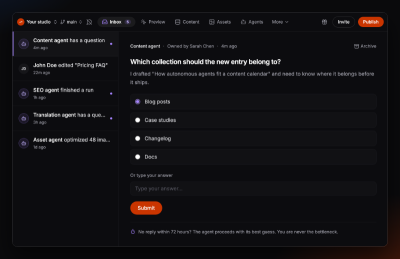
The transition to an autonomous model requires a move away from the "all-or-nothing" approach to settings. Instead, teams must adopt a "compositional" approach to agent management. In this model, agents are not static tools but configurable entities with defined scope.
A real-world example of this conflict is the implementation of a "Dark Mode" default. For a developer, this is a technical implementation of a CSS media query—a task easily delegated to an agent. For a brand designer, however, the default theme is a fundamental expression of the company’s identity. If an agent unilaterally changes the default, it bypasses the designer’s strategic intent. This conflict proves that the "correct" setting is not a function of the task itself, but of the person’s role in the organization.
Broader Impact on the Industry
The shift toward autonomous web infrastructure represents a broader movement in the software industry known as "Autonomous Operations." Similar to how CI/CD (Continuous Integration/Continuous Deployment) pipelines revolutionized the way code is shipped, autonomous agents are beginning to revolutionize how code is maintained.
The implications for the industry are profound:
- Shift in Resource Allocation: As agents handle the maintenance "eighty percent," agencies and internal departments will likely pivot their staffing models. There will be a higher premium placed on brand strategists and senior architects who can define the parameters within which agents operate, rather than junior developers focused on manual maintenance tasks.
- Risk Mitigation: A frozen, static site is a security and performance liability. Automated agents can act as a constant monitoring layer, catching vulnerabilities (such as expired SSL certificates or outdated dependencies) in real-time, significantly reducing the attack surface of a corporate domain.
- Evolving Trust Models: The most successful implementations of these systems will be those that prioritize observability. The ability for a human to review the "before-and-after" state of any autonomous change is critical to gaining organizational buy-in. When a team can see that an agent has saved them four hours of manual work while maintaining perfect adherence to the style guide, trust is earned incrementally.
Moving Toward a Dynamic Future
The goal of an autonomous website is not to remove human oversight, but to remove the decay that prevents a website from reflecting the current state of a business. In an era where digital presence is the primary interface between a company and its customers, a static website is essentially a broken one.
As the technology matures, the definition of a "web developer" will likely evolve into that of a "system curator." By setting the boundaries and defining the rulesets for autonomous agents, these professionals can ensure that their work remains as vibrant and accurate as it was on the day it shipped. The future of the web belongs to those who view their digital infrastructure not as a static artifact to be protected from change, but as a dynamic, evolving asset that improves through constant, intelligent optimization. The challenge moving forward will not be the technical capability of the agents, but the organizational willingness to define where their own value ends and the machine’s efficiency begins.