
Jim Parkinson, a celebrated lettering artist, type designer, and painter whose masterful hand-crafted lettering graced countless iconic brands, publications, and logos for over half a century, passed away on June 26, 2025, at his home in Oakland, California. He was 83. His death followed a prolonged battle with Alzheimer’s disease. Parkinson is survived by his wife, the esteemed book artist Dorothy A. Yule, who served not only as his life partner since 2010 but also as his devoted caregiver throughout his years of declining health.
Born in Oakland on October 23, 1941, Parkinson’s artistic journey began in his childhood, influenced by a remarkable neighbor, Abraham Lincoln Paulsen. Known as the "Wizard Penman," Paulsen possessed an extraordinary skill: the ability to write the Gettysburg Address upside down and backward using only the numeral "2." This early exposure to the intricate art of lettering ignited a lifelong passion in young Jim. He voraciously consumed historical lettering manuals and correspondence-school textbooks, often delving into materials decades old. This deep engagement with historical styles and his unique ability to reinterpret them would become a defining characteristic of his prolific career.
Parkinson pursued formal design and painting education at the California College of Arts and Crafts, graduating in 1963. His professional path led him to Kansas City, Missouri, where he joined the staff artists at Hallmark Cards. Initially tasked with drawing whimsical characters, Parkinson soon discovered his true calling when he was transitioned to the lettering department. It was here that he realized his profound aptitude for hand-rendering letters, not just as a professional skill but as a life’s purpose. His ability to capture the essence of any letter style with his own hand proved invaluable. This realization spurred his return to Oakland to establish a freelance career that would span an extraordinary fifty years, cementing his reputation as a preeminent figure in the field of lettering.

A Career Defined by Versatility and Prolific Output
Parkinson’s dedication to the craft of letters was unwavering, yet his mastery encompassed an astonishing breadth of application. His skill set was so refined that he could tackle virtually any lettering project, from intricate logo designs to the creation of complete typefaces. His career, in essence, comprised multiple distinct yet interconnected artistic pursuits. Over five decades, Parkinson’s distinctive lettering became a ubiquitous presence, appearing on a vast array of projects.
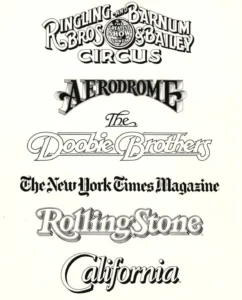
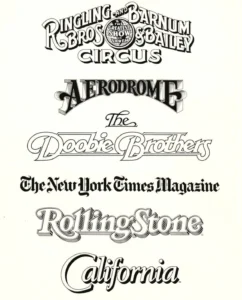
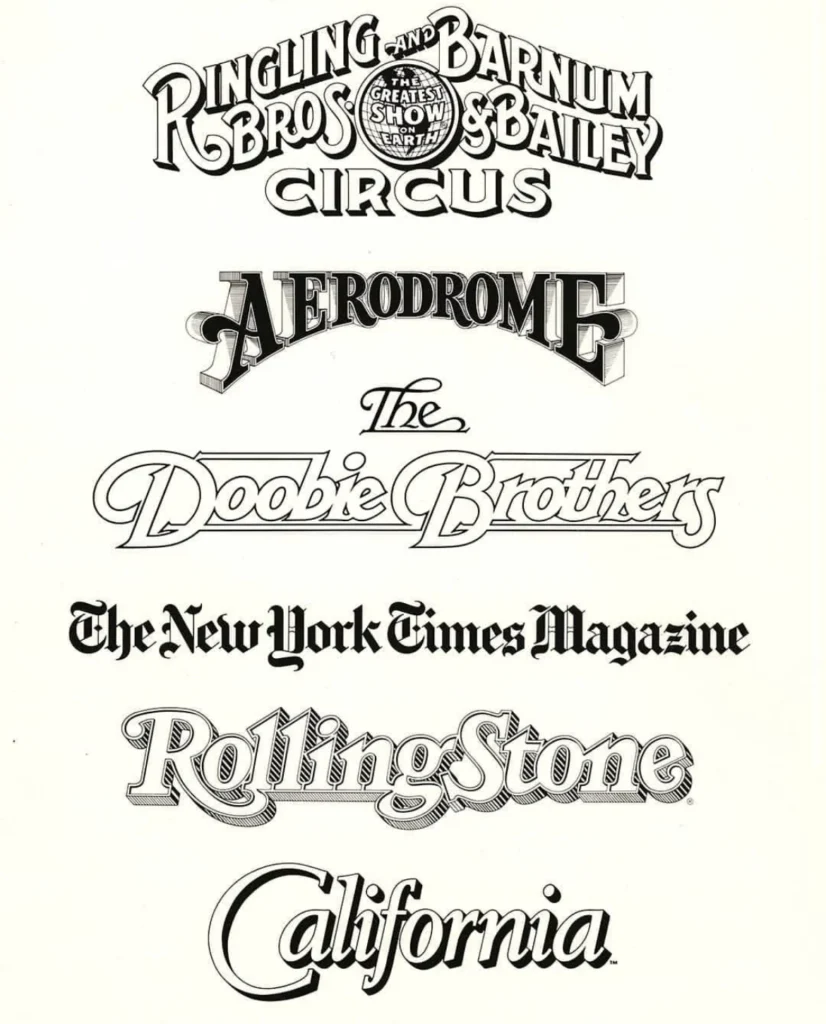
He meticulously crafted headlines for advertising campaigns, designed memorable logos for influential musical groups such as The Doobie Brothers, and lent his talent to the legendary Ringling Bros. and Barnum & Bailey Circus. His contributions extended to the creation of dozens of custom and retail typefaces, each imbued with his unique sensibility. Furthermore, Parkinson was responsible for countless nameplates for prominent magazines, including the iconic masthead for Rolling Stone, and newspapers, such as the Los Angeles Times. The sheer volume of his output meant that even listing these few examples barely scratches the surface of his immense influence. A visit to any newsstand in the United States, and indeed some internationally, would invariably reveal Parkinson’s handiwork on multiple covers, often serving as the preferred choice for art directors seeking to refresh and revitalize publication identities. He repeatedly redrew and refined mastheads over the years, demonstrating his enduring relevance and adaptability.
Parkinson’s influence can be quantified by the sheer volume of his commissioned work. While precise figures are difficult to ascertain due to the nature of freelance and often uncredited work in advertising and editorial design, his logos and mastheads appeared in circulation for decades. For instance, the Ringling Bros. and Barnum & Bailey Circus logo he designed is estimated to have been seen by hundreds of millions of people globally over its tenure. Similarly, his work for Rolling Stone and the Los Angeles Times represented significant contributions to the visual identity of influential media outlets, impacting public perception and brand recognition for extended periods. The estimated number of distinct projects he undertook likely numbers in the thousands, a testament to his prolific nature and the consistent demand for his exceptional skills.
Beyond Lettering: A Passion for Painting and Preservation
In his later years, when not engrossed in logo design or typeface creation, Parkinson channeled his artistic energies into painting. His particular passion was depicting vintage neon signage as fine art. This hobby evolved from his extensive travels throughout the American West, where he meticulously documented roadside attractions and fading commercial landscapes. His personal photo albums became the source material for dozens of large-scale paintings that adorned the walls of his home. These works captured the nuanced details of peeling paint, the subtle degradation of metal, and the broken glass tubes of forgotten signs with a fidelity that often surpassed even his original photographs, imbuing the subjects with a haunting beauty and a profound sense of nostalgia.

A Welcoming Mentor and a Joyful Spirit
Stephen Coles, the author of this commentary and a close acquaintance of Parkinson, shared his personal experiences, stating, "I was lucky to know Jim over the past twenty years. When I moved to Oakland in 2004, he was one of the first people to connect with me. He welcomed anyone to his home to visit his personal collection of ephemera, type books, and archive of his own work." Coles fondly recalls the delight of bringing friends to Parkinson’s studio, witnessing their awe as he revealed flat files filled with original artwork.
Parkinson was a consistent and cherished presence at semiregular gatherings of design enthusiasts, where he "always radiated joy and wisdom." His demeanor was characterized by a "casual silliness" that, despite his immense talent, kept him grounded and approachable. This humility reflected a core philosophy, beautifully articulated by Margot Fonteyn’s mantra: "Take your work seriously, but never yourself." This wry levity was evident throughout his personal website, a domain he wisely secured in the early days of the internet, and in a video interview conducted in 2010, which captured his engaging personality and profound insights.
Preserving a Legacy Through Memoir and Archive
Beyond his visual artistry, Parkinson possessed a remarkable gift for storytelling. Letterform Archive, a non-profit organization dedicated to the preservation and study of the art of lettering and typography, is set to publish his memoir in 2026. This forthcoming publication will offer a comprehensive account of his life and career, providing invaluable insight for those who did not have the privilege of knowing him personally. The memoir promises to illuminate his creative process, his influences, and his personal reflections on a life dedicated to the art of the letter. Interested individuals are encouraged to sign up for notifications from Letterform Archive to stay informed about its release.
A Community Mourns and Honors a Legend
Jim Parkinson’s passing is a significant loss to the design community and beyond. His influence on the visual landscape of the late 20th and early 21st centuries is undeniable. A memorial service will be held by his family and friends in the fall, offering an opportunity for those who knew and admired him to gather and celebrate his life. In lieu of flowers, the family requests that donations be made to the Alzheimer’s Association, a cause that directly impacted Parkinson’s final years. The broader implications of his work extend to the ongoing appreciation of analog craft in a digital age. Parkinson’s dedication to hand-lettering served as a vital reminder of the artistry and human touch that underpins much of our visual culture, inspiring a new generation of designers to explore traditional techniques. His legacy will undoubtedly continue to inform and inspire through his extensive body of work, his published memoir, and the enduring impact of his unique artistic vision.