
The landscape of web development is undergoing a significant transformation with the introduction of two groundbreaking CSS functions, sibling-index() and sibling-count(). These new capabilities, now shipping in major browser stable releases, promise to revolutionize how developers approach dynamic layouts, staggered animations, and responsive component design, eliminating the long-standing reliance on cumbersome JavaScript workarounds or repetitive :nth-child() rules. This advancement empowers CSS to directly access information about an element’s position and its peers within the Document Object Model (DOM) tree, a fundamental shift that has been eagerly anticipated by the developer community.
For years, creating a visually appealing staggered cascade effect, where elements animate into view one after another, has been a common design request but a surprisingly complex technical challenge. Developers frequently encountered a dilemma: either generate a multitude of :nth-child() rules, manually assigning unique delays for each element, or resort to JavaScript to iterate through elements and inject inline styles. Both methods presented significant drawbacks. The :nth-child() approach, while pure CSS, quickly became unmanageable for lists exceeding a handful of items, leading to bloated stylesheets and brittle code that required constant updates as the number of items changed. A list of 10 items necessitated 10 separate rules; scaling to 50 or 100 items meant hundreds of lines of repetitive CSS, often generated via Sass loops at build time. While ingenious O(√N) strategies, such as those proposed by engineers like Roman Komarov, offered more efficient ways to cover a large number of elements, they still involved a substantial number of static rules.
Alternatively, developers turned to JavaScript, looping through elements to dynamically assign custom properties (e.g., style="--index: 3"). While functional, this approach blurred the lines between presentation and behavior, scattering layout concerns across JavaScript files and introducing potential points of failure. A refactor in a JavaScript component could inadvertently break a CSS-dependent animation, creating hidden dependencies that were difficult to track and maintain. The core frustration for many developers was the inherent redundancy: the browser already possessed this information, having constructed the DOM tree and knowing the precise position of every element. The limitation was CSS’s inability to access and utilize this data directly.
A New Era of CSS Native Capabilities
The arrival of sibling-index() and sibling-count() addresses this fundamental gap, offering a remarkably elegant solution. With a single line of CSS, developers can now achieve complex staggered animations and dynamic layouts that previously demanded extensive manual effort or JavaScript intervention. For instance, a staggered animation delay can now be expressed as simply:
li
  animation-delay: calc(sibling-index() * 100ms);
This concise declaration works seamlessly for any number of list items, from a mere five to thousands, without requiring event listeners, mutation observers, or costly re-renders. The elegance lies in its directness: CSS now queries the DOM for contextual information as part of its rendering pipeline, a capability that significantly enhances its power and expressiveness.
These functions are formalized within Section 9 of the CSS Values and Units Module Level 5 specification. Their proposal garnered substantial discussion within the CSS Working Group (CSSWG) before being approved via issue #4559, underscoring their importance and the careful consideration given to their design. Crucially, both sibling-index() and sibling-count() return an actual <integer> value, not a string. This distinction is vital, as it allows them to be seamlessly integrated into CSS calc(), min(), max(), round(), mod(), and even trigonometric functions like sin() and cos(). Unlike counter(), which yields a string primarily useful for pseudo-element content, sibling-index() and sibling-count() provide numerical values that CSS can perform calculations with directly, eliminating the need for type coercion or complex workarounds.
It is important to clarify the difference between these new functions and the long-standing :nth-child() selector. While :nth-child() is a selector used to target specific elements based on their position, it does not produce a value that can be used in declarations. One cannot write calc(:nth-child() * 10px) because :nth-child() serves a different purpose. sibling-index() and sibling-count(), conversely, are functions that resolve to a numerical value within CSS declarations, enabling dynamic computations. Historically, :nth-child() was often pressed into service for tasks it wasn’t designed for, leading to the convoluted solutions that sibling-index() and sibling-count() now elegantly replace.
Transformative Patterns for Web Development
The implications of these integer-returning functions are far-reaching, enabling a wealth of dynamic CSS patterns previously thought impossible without JavaScript.
-
Reverse Staggered Animations: Achieving an animation where the last item appears first is now trivial. By subtracting the
sibling-index()from thesibling-count(), developers can reverse the animation order:.card animation: fade-in 0.4s ease both; animation-delay: calc((sibling-count() - sibling-index()) * 80ms);This ensures that the animation begins immediately upon page load, rather than waiting for the first element’s delay, improving perceived performance and user experience.
-
Automatic Equal Widths: Responsive grid layouts no longer require manual calculations or JavaScript for evenly distributed items. Tabs or grid cells can automatically adjust their widths based on the number of siblings:
.tab
  width: calc(100% / sibling-count());
This single rule makes a component inherently responsive. Five tabs will each occupy 20% width; adding a sixth automatically adjusts them to 16.66% without any media queries, resize observers, or JavaScript. While highly flexible, developers should consider scenarios where too many items might make individual elements too narrow, potentially requiring a fallback to Flexbox wrapping or a minimum width constraint.
-
Dynamic Hue Distribution: Creating visually harmonious color palettes that adapt to the number of elements is now possible directly in CSS.
.swatch
  background-color: hsl(
    calc((360deg / sibling-count()) * sibling-index()) 70% 50%
  );
Three color swatches would be distributed 120° apart on the HSL color wheel, while twelve would get 30° increments. This dynamic palette generation, previously a task for JavaScript color libraries, is now a pure CSS capability.
-
Circular and Radial Layouts: The combination of tree-counting functions with native CSS trigonometric functions (
sin(),cos()) unlocks powerful capabilities for arranging elements in circles or arcs..radial-item --angle: calc((360deg / sibling-count()) * sibling-index()); --radius: 120px; position: absolute; left: calc(50% + var(--radius) * cos(var(--angle))); top: calc(50% + var(--radius) * sin(var(--angle))); transform: rotate(calc(var(--angle) * -1));This enables the creation of perfectly distributed radial menus or hexagonal/octagonal arrangements that automatically adapt when items are added or removed, without a single line of JavaScript for coordinate computation. Juan Diego Rodríguez’s excellent walkthroughs on CSS trigonometric functions provide further insight into their practical applications.
-
Dynamic Z-Index Stacking: For visual effects like a fanned stack of cards,
z-indexcan be dynamically assigned:.card z-index: calc(sibling-count() - sibling-index());This rule ensures the first card in the DOM stacks highest, while the last card receives a
z-indexof 0. The math can be easily flipped to reverse the stacking order.
Critical Considerations and Gotchas
While immensely powerful, sibling-index() and sibling-count() come with specific behaviors and limitations that developers must understand to avoid unexpected results.
-
Shadow DOM Scoping: These functions operate strictly on the DOM tree, not the flattened visual tree. This distinction is crucial for Web Components. If a custom element has a Shadow DOM structure like
<section><slot></slot><div class="internal"></div></section>, styling.internalwithsibling-index()will always return2, regardless of how many elements are projected into the<slot>. The function only "sees" the direct children of the<section>within the Shadow DOM itself. Furthermore, light DOM stylesheets attempting to use these functions via::part()to probe the internal structure of a component will receive a0, a deliberate security measure to prevent external CSS from inspecting third-party component internals. -
Pseudo-Elements Do Not Count:
::beforeand::afterpseudo-elements are not considered real DOM nodes and therefore do not contribute tosibling-count()nor do they possess their ownsibling-index(). However, these functions can be used within pseudo-element declarations. When used in::beforeor::after,sibling-index()andsibling-count()evaluate against the originating element. For example,#target::before width: calc(sibling-index() * 10px);will evaluatesibling-index()based on#target‘s position among its siblings, not the pseudo-element itself. This behavior also applies to::slotted(*)::before, which checks the slotted element’s index within the light DOM. -
display: noneElements Still Count: This is a common pitfall. Elements withdisplay: noneare removed from the layout tree and are visually hidden, but they remain part of the DOM tree. Consequently,sibling-index()andsibling-count()will still count them. If a list contains a hidden item:<ul> <li>Apple</li> <!-- sibling-index() = 1 --> <li style="display:none">Banana</li> <!-- sibling-index() = 2, invisible --> <li>Cherry</li> <!-- sibling-index() = 3, NOT 2 --> </ul>"Cherry" will report an index of
3, not2. This behavior is particularly problematic for dynamic UIs like search filters that hide non-matching items. For layouts requiring continuous, sequential indexing (e.g., radial menus, proportional widths), filtered nodes must be removed from the DOM rather than merely hidden, or a JavaScript-managed index must be used as a fallback.visibility: hiddenandopacity: 0also count, which is generally more intuitive as these elements still occupy space in the layout. -
Custom Properties Evaluate Immediately: A subtle but important nuance is how custom properties interact with these functions. If a parent element defines
--idx: sibling-index();, this--idxwill resolve to the parent’s sibling index at the point of declaration. All child elements inheriting this--idxwill receive the same fixed value, which is almost certainly not the desired behavior. The correct approach is to define the custom property on the elements that require the unique index:.child --idx: sibling-index(); animation-delay: calc(var(--idx) * 100ms);While the CSSWG has discussed potential future additions like
inherits: declarationfor@propertyto address this, no such mechanism currently exists. Developers must apply the functions directly to the elements needing their own dynamic values.
-
Performance at Scale: While significantly more performant than JavaScript-based inline style injection, DOM mutations (adding, removing, reordering children) that affect sibling counts will trigger a style recalculation for all affected siblings. This process occurs during the browser’s cascade phase, prior to layout and paint, making it efficient for most common use cases like navigation, card grids, or tab bars. However, for extremely large, frequently mutating lists (e.g., infinite-scroll feeds with thousands of constantly churning nodes or live stock tickers), the cost of recalculating 10,000 sibling indices upon an insertion at the beginning could become noticeable. In such high-frequency, large-scale scenarios, JavaScript-managed indexes within a virtualization window might still be the optimal approach. These functions are fast, but not entirely zero-cost.
Browser Adoption and the Standardization Journey
The journey of sibling-index() and sibling-count() from proposal to stable release highlights the collaborative nature of web standards development. After substantial discussion and refinement within the CSS Working Group, the proposal was formally approved. Implementation quickly followed in leading browser engines. As of June 2025, Chrome/Edge 138 shipped these functions in their stable releases, closely followed by Safari 26.2. This rapid adoption by the Chromium and WebKit engines, which together command approximately 75-80% of the global browser market share, immediately makes these functions highly relevant for web developers.
Firefox, powered by the Gecko engine, has not yet shipped these functions in its stable release, but Mozilla’s standards position is unequivocally positive, indicating strong support for the specification. Active implementation work is underway, tracked under Bugzilla issue #1953973. Developers can monitor the latest browser support status via caniuse.com/wf-sibling-count.
Given Firefox’s current absence, a robust progressive enhancement strategy is essential for production-ready deployments today. The @supports CSS at-rule is the ideal tool for this:
/* Baseline styles for all browsers */
.item
  width: 25%;
  animation-delay: 0ms;


/* Progressive enhancement for browsers that support tree-counting functions */
@supports (z-index: sibling-index())
  .item
    width: calc(100% / sibling-count());
    animation-delay: calc(sibling-index() * 80ms);
This pattern ensures a static, functional fallback for browsers without native support (like current Firefox versions), while providing the full dynamic capabilities to supporting browsers. No user encounters a broken page. For more advanced progressive enhancement, especially for staggered animations, Juan Diego Rodríguez’s article "How to Wait for the sibling-count() and sibling-index() Functions" on CSS-Tricks offers valuable insights, suggesting the use of existing CSS counting hacks as a bridge until full native support is widespread, rather than resorting to a full JavaScript polyfill that would negate the purpose of these new functions.
Accessibility Notes and Best Practices
It is paramount to remember that sibling-index() and sibling-count() are purely visual tools. They influence the presentation and layout of elements but do not alter their semantic meaning or their order within the DOM’s accessibility tree. If these functions are used to visually reorder a list (e.g., via order in Flexbox or Grid placement), screen readers will still interpret the elements in their original source order. Keyboard navigation will also follow the DOM structure, potentially creating a disconnect between visual appearance and interactive behavior. Such discrepancies constitute an accessibility failure.
For interactive components like data grids, radial menus, or custom listboxes that rely heavily on tree-counting for their visual arrangement, JavaScript remains necessary to synchronize ARIA attributes (e.g., aria-posinset, aria-setsize) with the visual presentation. Assistive technologies depend on these attributes to convey structural and positional information accurately. If CSS indicates an element is "visually item 3 of 7" but ARIA conveys different or no information, users of assistive technologies will experience a confusing or broken interface.
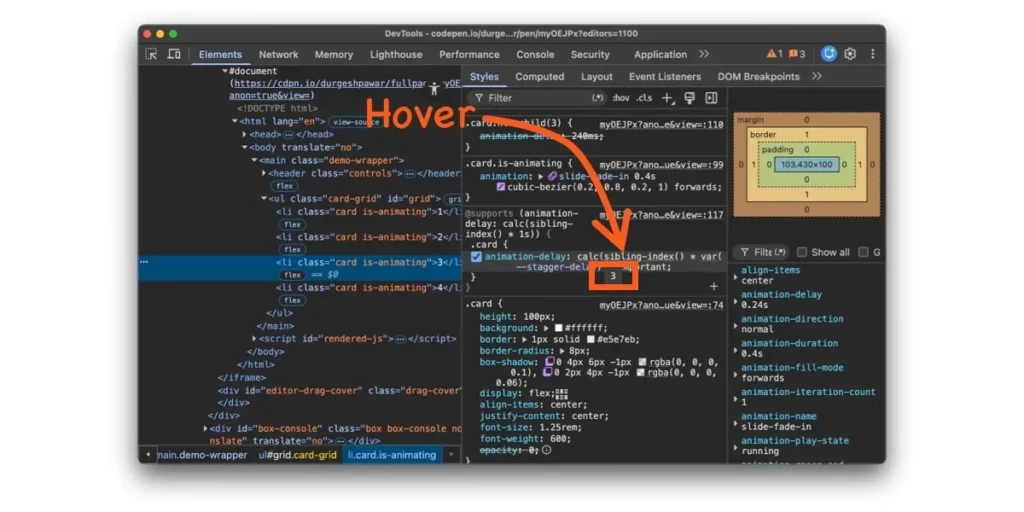
On the debugging front, recent versions of Chrome DevTools have integrated support for inspecting the computed values of sibling-index() and sibling-count() directly within the Elements panel. This invaluable feature aids developers in understanding how these functions resolve in real-time and troubleshooting any unexpected calculations.
The Horizon: Future CSS Tree-Counting Enhancements
The current iteration of sibling-index() and sibling-count() counts all element siblings. However, the CSS Working Group is already exploring extensions to further enhance their utility. Issue #9572 documents a planned of <selector> argument, mirroring the functionality of :nth-child(). This would enable counting only siblings that match a specific selector, such as sibling-index(of .active). An element that is the eighth child overall but the third .active child would then return 3. This enhancement would be transformative for dynamic UIs with filtering or toggling, allowing indexes to remain sequential even if other siblings are hidden or irrelevant, thereby reducing the need for DOM manipulation.
Further discussions within the CSSWG revolve around the potential introduction of children-count() (issue #11068) and descendant-count() (issue #11069) functions. children-count() would return the number of direct children an element possesses, useful for parent-driven layouts and conditional styling. descendant-count() would recursively count all descendants, offering a comprehensive view of an element’s sub-tree. While still in the proposal stage, these functions would complete the CSS tree-counting story, providing both horizontal (sibling-index, sibling-count) and vertical (children-count, descendant-count) perspectives on the DOM structure.
The initial frustration of crafting repetitive :nth-child() rules or relying on JavaScript to achieve dynamic, responsive layouts and animations stemmed from a fundamental limitation in CSS itself. The browser held the data, but CSS couldn’t access it. With the advent of sibling-index() and sibling-count(), that limitation has been overcome, marking a pivotal moment in the evolution of CSS. These functions represent more than just new syntax; they embody a philosophical shift towards a more capable and expressive CSS, empowering developers to build richer, more performant, and maintainable web experiences with fewer workarounds and a clearer separation of concerns. The future of web development, increasingly driven by native browser capabilities, looks significantly more dynamic and efficient.