
In today’s fiercely competitive digital economy, the notion that user experience (UX) design is a mere aesthetic embellishment has been decisively disproven by hard data. Every fraction of a second of user friction, every moment of confusion, translates directly into measurable business costs—from lost conversions and wasted engineering resources to diminished brand loyalty. Industry veterans, like UX designer Carrie Webster, who have witnessed the evolution of digital products since the nascent mobile-first era, emphasize a crucial paradigm shift: design is no longer a cosmetic preference but the primary engine of business survival. This article delves into ten critical, data-backed UX facts, examining their profound implications for revenue, customer retention, and sustainable growth, offering a compelling argument for UX as a non-negotiable strategic requirement.
The Evolution of UX as a Strategic Pillar
For decades, digital product development often prioritized functionality and feature sets over the nuanced interaction experience. Design was frequently relegated to the final stages, tasked with "making things look nice." However, as digital interfaces became ubiquitous and consumer expectations soared, a profound shift began. The early 2010s saw the rise of dedicated UX roles, moving beyond traditional graphic design to encompass rigorous research, psychological principles, and data analytics. This chronological evolution reflects a growing understanding that the interface is not just a portal to content, but the product itself in the user’s mind. Today, in the late 2020s, the design discipline operates at the intersection of psychology, technology, and business strategy, using empirical evidence to bridge the gap between user needs and corporate objectives. Business leaders are increasingly recognizing that neglecting UX is akin to neglecting core business functions, with tangible financial repercussions.
1. The 1:100 Rule: Mitigating Costs Through Early Intervention

One of the most compelling financial arguments for robust UX investment lies in the "1:100 rule." Modern studies from institutions like the IBM Systems Institute and reports by Segue Technologies consistently demonstrate that the cost of rectifying an error escalates dramatically as a product progresses through its lifecycle. Fixing a design flaw during the initial conceptualization or prototyping phase can be up to 100 times cheaper than addressing it after development and launch. This exponential cost increase is not merely due to the immediate bug fix. Post-launch corrections involve extensive technical debt—re-coding, re-testing, redeploying, and often, managing negative user feedback and brand damage. A fundamental navigation flaw discovered after deployment can necessitate significant re-engineering, diverting valuable developer resources and incurring substantial opportunity costs from lost revenue while users struggle with a suboptimal experience. UX, therefore, acts as a crucial form of "engineering insurance," validating interactions and user flows before a single line of costly code is written.
2. Performance as the Unseen Foundation of User Experience
In the contemporary digital landscape, a website or application’s performance is not a secondary feature but the foundational element of user experience. An aesthetically pleasing interface is rendered entirely ineffective if the user abandons the site before it even loads. The data on performance is uncompromising: nearly half of all users (47%) expect a web page to load in two seconds or less. Failing to meet this expectation is a financial catastrophe. A mere one-second delay in page load time can result in a 20% reduction in conversions and a 16% drop in user satisfaction. For retail businesses, slow load times collectively contribute to an estimated $2.6 billion in annual losses. The impact on mobile users is even more pronounced; a shift from a one-second to a three-second mobile load time causes bounce rates to spike by 32%, with conversion rates plummeting from 40% to 29% by the third second.
Conversely, optimizing performance presents a significant lever for growth. Even a microscopic 0.1-second improvement in load time can lift retail conversions by 8.4% and travel site conversions by 10.1%. Furthermore, enhancing key performance indicators like Largest Contentful Paint (LCP) by 31% – a benchmark achieved by 67% of websites as of June 2025 – can directly drive an 8% increase in sales. These statistics underscore that speed is a critical design element; if a digital interface isn’t instantaneous, its design effectively ceases to exist in the user’s perception.
3. The Millisecond Moment: First Impressions and Visual Appeal

The adage "you never get a second chance to make a first impression" holds particularly true in the digital realm. Research consistently shows that users form an opinion about a website’s visual appeal in approximately 50 milliseconds (0.05 seconds). This rapid, almost visceral "gut-feeling" is a primal survival mechanism that dictates whether a user remains to explore a product’s value proposition or bounces immediately. A staggering 94% of these critical first impressions are strictly design-related. If an interface appears dated, cluttered, or simply "off," users subconsciously project that perceived lack of quality onto the entire product or service. In essence, a product’s content and underlying value proposition remain undiscovered if its design fails to earn the initial few seconds of attention required to engage the user. This phenomenon, often referred to as the "halo effect," means that aesthetic judgments profoundly influence perceptions of usability and trustworthiness.
4. Hick’s Law: The Perilous Cost of Overwhelm
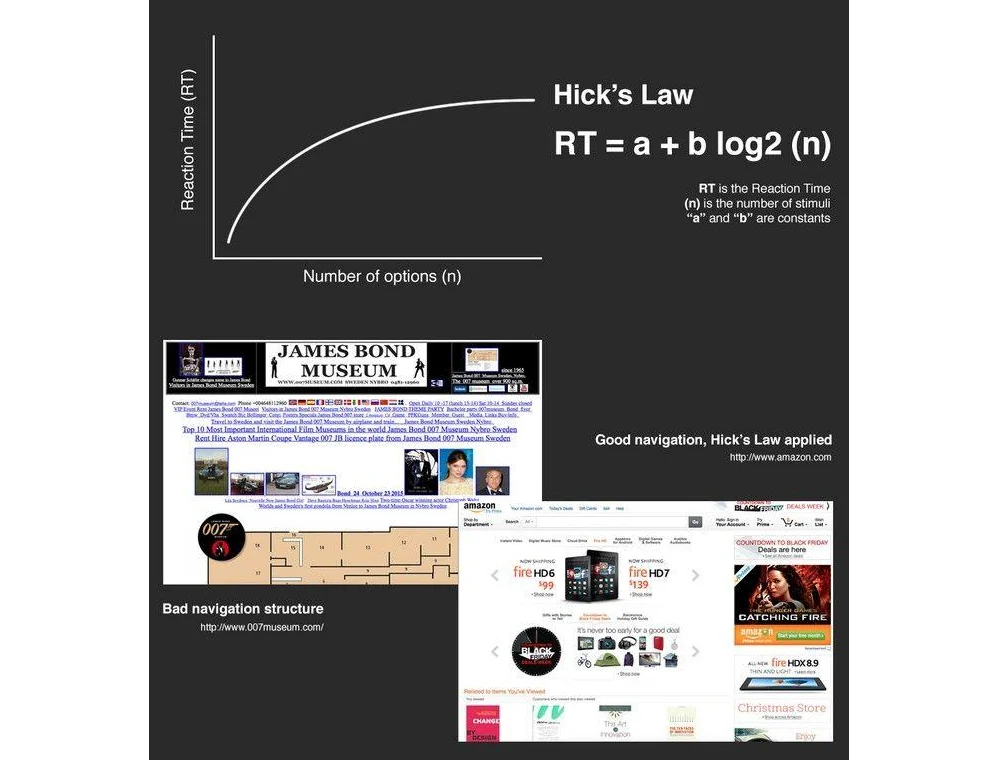
A common misconception among stakeholders is that offering "more options" inherently equates to "more value." Psychological principles, however, prove the opposite. Hick’s Law, a fundamental concept in human-computer interaction, states that the time it takes for a person to make a decision increases logarithmically with the number of options available. Every additional menu item, form field, or navigational choice imposes a cognitive "tax" on the user’s brain, leading to decision fatigue and increased abandonment rates. Top-performing websites, according to Landbase, now achieve conversion rates exceeding 11%, significantly outperforming average performers who often struggle below 3%. A key differentiator for these high-performing sites is their strategic application of personalization and optimization to simplify the user experience. The implication is clear: streamlining choice, even by deleting a single unnecessary field from a checkout flow, can directly and immediately impact conversion rates and revenue.
5. White Space: The Art of Focused Attention
Often perceived by non-designers as "wasted real estate," strategic white space (or negative space) is, in fact, a powerful tool for enhancing user focus and comprehension. Its judicious application can increase a user’s content comprehension by up to 20%. White space prevents "cognitive overload" by providing visual breathing room, allowing the user’s eyes to rest and directing their attention towards the most critical elements on a page, such as call-to-action buttons like "Buy" or "Sign Up." In an era where human attention spans have reportedly dropped to roughly eight seconds, simplicity has become the ultimate luxury and a significant driver of engagement. For instance, in a fintech dashboard redesign, applying more white space around data components reduced analyst users’ time-on-task by 25% and notably boosted trial-to-paid conversions, demonstrating its direct impact on efficiency and business metrics.

6. The Goal Gradient Effect: Harnessing "Fake Progress"
One of the more intriguing psychological hacks leveraged in UX design is the Goal Gradient Effect: users are demonstrably more motivated and complete tasks faster if they perceive they have already made progress. A classic study on coffee loyalty cards revealed that a 10-stamp card with two stamps pre-filled was completed significantly faster than an 8-stamp card with zero pre-fills, despite identical total expenditure required. In digital design, this translates into showing a progress bar that begins at 15% (e.g., simply for creating an account) which has been shown to increase completion rates for onboarding processes by over 40%. This principle underscores that UX designers are not merely arranging pixels; they are expertly managing the user’s dopamine response and sense of momentum, guiding them through complex workflows with psychological nudges.
7. Legibility as a Conversion Catalyst
The misconception that cramming more text "above the fold" increases value is frequently disproven by user data. Proper typography, specifically optimal line spacing (leading) and paragraph width, can increase content comprehension and reading speed by up to 20%. An optimal line height, generally around 1.5 times the font size, significantly reduces "visual noise," enabling the brain to process information with less cognitive effort. When users struggle to read text due to tight spacing, small fonts, or insufficient contrast, their "perceived effort" increases, leading to higher bounce rates and reduced engagement. Legibility is, therefore, a direct conversion tool: if content is difficult to read, it becomes difficult to process, trust, and ultimately, to act upon.
8. Designing for the Scanner: The F-Pattern and Spotted Pattern

Contrary to popular belief, users rarely read web content word-for-word; they scan it. Research indicates that on a typical web page, users read only about 20% to 28% of the available text. Modern users primarily scan content in distinct patterns, notably the F-pattern (focusing on the top and left side of the content area) and the Spotted pattern (jumping to keywords and visual cues). This behavioral reality means that designing for traditional linear reading is a tactical error. Effective UX necessitates designing for scanning, which involves strategic use of headings, subheadings, bullet points, short paragraphs, bold text, and clear calls-to-action to guide the user’s eye rapidly to key information.
9. The Magic Number: Efficiency of 5-User Testing
Many organizations waste substantial budgets on large-scale user studies involving hundreds of participants, often becoming buried in extraneous data. The reality, validated by extensive research from the Nielsen Norman Group, is that testing with just five users typically uncovers approximately 85% of usability problems. This "magic number" represents a mathematical sweet spot, where the returns begin to diminish significantly after the fifth participant. Beyond this point, the cost of recruiting and conducting additional tests often outweighs the value of discovering incrementally fewer new bugs. The competitive advantage in UX belongs to organizations that embrace small, frequent, and iterative user testing activities. Testing with five users, iterating on findings, and then repeating the process with another five users is the most cost-effective and agile methodology for developing a robust, user-centric product.
10. The Staggering ROI: A 9,900% Return on UX Investment
Perhaps the most compelling statistic for business leaders is the average return on investment for UX: every $1 invested in UX yields approximately $100. This astounding 9,900% ROI is not a magical anomaly but the cumulative effect of increased conversion rates, reduced customer support costs, and enhanced brand loyalty. A fully optimized UX design can improve conversion rates by up to 400%. Furthermore, intuitive and self-explanatory design significantly lowers the demand for customer support. When users can effortlessly navigate and utilize a product, the need for extensive call centers and help desks diminishes, resulting in substantial operational savings. This dual benefit of increased revenue and decreased costs makes UX one of the most financially impactful investments a business can make.

The Depth of UX Investment and Strategic Implications
Beyond these individual statistics, the cumulative effect of a mature UX practice is transformative. Leading consultancies like McKinsey have shown that companies with high design maturity outperform their less design-focused peers by 1.7 times in revenue growth and achieve 56% higher total returns to shareholders. This discrepancy arises because mature UX organizations move beyond merely "user delight" to prioritize "user efficiency." Optimizing workflows, even by shaving 30 seconds off a routine task for a team of 1,000 employees, can reclaim hundreds of thousands of dollars in annual productivity. This internal ROI, though often overlooked, is as vital as consumer-facing conversion rates.
Furthermore, a significant "experience gap" persists in the market. Bain & Company reports that while 80% of companies believe they deliver a "superior experience," only 8% of customers agree. This massive disconnect represents a critical market opportunity for businesses willing to embrace data-driven UX. By consistently bridging this gap through continuous user testing, performance optimization, and user-centric design principles, companies can not only improve their products but actively capture market share that competitors are inadvertently leaving on the table.
The Impact of AI on User Experience
The advent of Artificial Intelligence (AI) has significantly impacted the field of UX, but crucially, it has not rendered these fundamental data-backed truths obsolete. Instead, AI has acted as an accelerator, enhancing and automating solutions for many of these principles. AI-powered analytics can now provide deeper insights into user behavior patterns, facilitating more precise optimization of load times and content presentation. Generative AI tools can rapidly prototype design variations, accelerating the iterative testing process and making it easier to apply principles like Hick’s Law by suggesting simplified interfaces. AI-driven personalization engines dynamically adapt interfaces, offering tailored experiences that naturally reduce cognitive load and enhance the goal gradient effect. Chatbots and virtual assistants powered by AI streamline support, indirectly validating the investment in intuitive design that minimizes user confusion. While AI has transformed UX from a static map into a living, breathing, adaptive guide, the core rules of human psychology—our rapid judgments, our need for clarity, our desire for progress—remain unchanged. AI amplifies the effectiveness of these principles, making data-backed UX even more potent.

Conclusion: UX as Business Strategy
As the late 2020s unfold, the distinction between "design" and "business strategy" has effectively dissolved. The empirical evidence is overwhelming: companies that prioritize and excel in design consistently outperform their competitors in both revenue growth and shareholder returns. UX design is no longer a team hired to "make things look nice"; it is the research-driven, data-backed discipline that ensures a digital product is not merely a cost center, but a dynamic, revenue-generating machine.
The journey from viewing design as a subjective preference to recognizing it as a critical business imperative has been long, but the data has made the case undeniable. Implementing factual, data-driven design improvements yields tangible, replicable results that intuition alone cannot achieve. We have moved beyond an era of subjective opinions into one where the data is clear, the psychological principles are proven, and the return on investment is undeniable. The ultimate question for businesses today is not whether to invest in UX, but how swiftly they are prepared to let these facts lead their design strategy, lest their competitors seize the advantage first.