
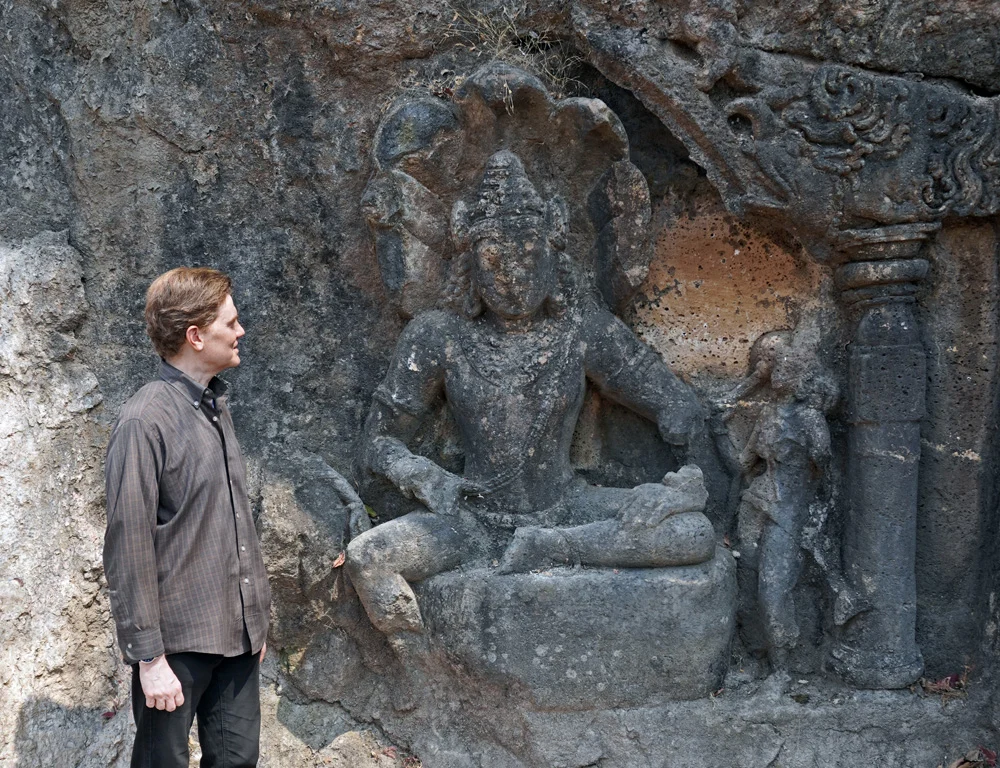

For over twenty-five years, Dr. David S. Efurd—a two-time Fulbright recipient, associate professor, and chair of art and art history—has dedicated his academic career to mapping, photographing, and analyzing the ancient rock-cut architecture of western India. Armed with little more than a handheld camera, a notebook, and an unwavering commitment to architectural anthropology, Efurd has explored more than 80 cave sites across the region. His comprehensive documentation has yielded an unprecedented archive of over 10,000 photographs, now accessible to scholars, students, and the public via Artstor. This extraordinary digital repository illuminates meticulously preserved monasteries, sprawling prayer halls, complex religious iconography, and intricate monuments carved directly into towering volcanic basalt cliffs, with origins tracing back as far as the second century BCE.
The Genesis of a Lifelong Scholarly Pursuit
Efurd’s academic journey into the subterranean world of early Buddhist architecture began under the mentorship of Walter Spink, widely recognized as the world’s foremost authority on the Ajanta Caves. Spink maintained a lifelong dedication to the region, famously renting a room year-round at a local hotel near the Ajanta site to facilitate his continuous research. Every July, Spink hosted intensive site seminars for select students, guiding them through the complex chronological layers of Ajanta and Ellora.

During one such excursion roughly a quarter-century ago, Spink and his students ventured off the beaten path to explore Pitalkhora, a ruined monastic complex largely overlooked by mainstream travelers. Dating back to the second or first century BCE, Pitalkhora stands among the earliest surviving cave groups in western India. Captivated by the haunting remnants of antiquity and the profound architectural narrative they suggested, Efurd embarked on a trajectory of study that would define the next two decades of his professional life, transforming a single exploratory seminar into a lifelong scholarly endeavor.
Geology, Geography, and the Socio-Economic Matrix of the Ghats

The selection of India’s western coastal mountain range—known as the Western Ghats—for these colossal architectural undertakings was far from arbitrary. The region is defined by massive, stable outcroppings of volcanic basalt, a durable geological medium that permitted ancient master builders to excavate expansive, multi-tiered halls and residential cells with minimal risk of structural collapse.
These enduring basalt formations provided vital shelter for monks during the vassa, the traditional three-month monsoon retreat. During this period of heavy seasonal rainfall, monastic populations suspended their peripatetic lifestyle to take up fixed residency, utilizing the dry, rock-cut chambers for meditation, study, and communal living.

However, these monasteries were engineered to balance spiritual isolation with social connectivity. Rather than locating the sites in absolute wilderness, ancient planners strategically positioned them along vital commercial trade routes and within viable walking distances from thriving urban centers and agrarian villages. This geographic placement fostered a symbiotic socio-economic relationship between the monastic orders and the local laity. Monks offered spiritual guidance, education, and opportunities for lay practitioners to generate religious merit, while surrounding communities provided essential physical sustenance through daily alms-giving and logistical support.
The Art of Slow Looking and Architectural Precision

A foundational element of Efurd’s methodology is the practice of "slow looking"—a contemplative approach traditionally reserved for museum art appreciation, adapted here to the monumental scale of rock-cut architecture. While casual tourists frequently traverse these complex sites in a matter of minutes, Efurd spends days, and occasionally successive return trips, observing how spatial geometry, lighting, and decorative programs interact.
Because rock-cut architecture inherently lacks the rigid, exacting plumb and straight lines dictated by conventional masonry, studying these spaces requires meticulous measurement and an appreciation for volumetric sculpture. Efurd’s research places particular emphasis on the mathematical proportions governing structures such as the monumental caitya hall at Karle, one of the most significant early Buddhist complexes in the subcontinent. By analyzing the structural rhythms, pillar alignments, and decorative moldings without imposing Western architectural preconceptions, Efurd argues that modern scholarship is only beginning to fully comprehend the deliberate, highly sophisticated intent of ancient Indian builders.

Celestial Alignment and Engineering Marvels
Among the most astonishing revelations emerging from Efurd’s ongoing documentation is the sophisticated integration of solar astronomy into the sacred design of select cave interiors. Research originally pioneered by Walter Spink revealed that specific caitya halls at Ajanta were meticulously engineered to align with the winter solstice. On this specific day annually, a precise beam of sunlight floods through a massive, horseshoe-shaped window carved into the cliff face, illuminating the sculpted image of the Buddha housed within the central relic monument, or stupa.

A parallel phenomenon occurs at Ellora, where a smaller architectural aperture filters a narrow band of sunlight onto the face of a central Buddha sculpture twice a year. This solar event, celebrated annually in March, is known regionally as Kirnotsav, or the festival of the sun’s rays. These alignments demonstrate a high degree of ancient astronomical knowledge and technical execution, proving that the interplay of natural light and shadow was a vital, active component of the spiritual architecture long before sunset cast dramatic, shifting shadows across the basalt walls.
Iconography, Evolution, and Transition of Sacred Spaces

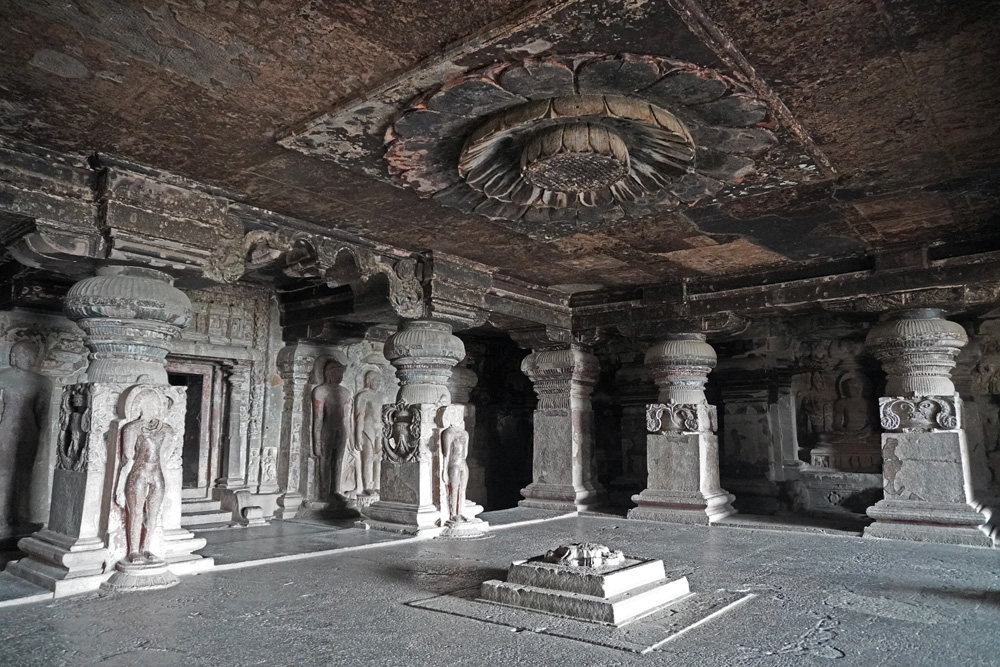
The artistic programs within these caves reflect significant theological evolutions across centuries. The earliest sites, dating to the pre-Christian era, are characterized by an aniconic tradition. Rather than depicting the Buddha in human form, these spaces utilize sacred symbols—such as railings denoting sanctity, the Triratna (representing the Triple Gem of Buddhism: the Buddha, the Dharma, and the Sangha), and representations of nature spirits known as yakshas. Interestingly, these early sites also feature mithuna motifs, depicting amorous couples in close physical contact. While seemingly incongruous within monastic contexts, these figures were viewed in antiquity as auspicious symbols of fertility, abundance, and cosmic harmony, ultimately subordinated within the broader ideological program to the authority of the Dharma.
By the fourth and fifth centuries CE, theological shifts led to the widespread incorporation of anthropomorphic imagery, with artisans carving monumental statues of Buddhas and Bodhisattvas directly into previously unadorned walls.

As Buddhism gradually declined in influence across the Indian subcontinent, the operational destiny of these rock-cut complexes shifted dramatically. Remote sites, such as Ajanta, were largely abandoned and swallowed by surrounding forests, preserved largely through local memory until their rediscovery during the colonial era. Conversely, more accessible complexes—such as Karle—were systematically appropriated by Hindu and Brahmanical communities. Ancient Buddhist assembly halls were rededicated to regional deities, and numerous statues of Buddhist figures were integrated into the Hindu pantheon as objects of ongoing devotional worship.
Preservation, Living Traditions, and Modern Protocols

Today, the vast majority of these rock-cut sanctuaries are recognized as historical monuments under the administrative protection of the Archaeological Survey of India (ASI) or regional archaeological departments. Management policies strive to strike a delicate, ongoing balance between the rigorous demands of material preservation and the accommodation of living religious expression.
For researchers like Efurd, conducting fieldwork requires navigating formal governmental channels, including obtaining specialized research visas through programs such as the Fulbright initiative and petitioning regional ASI circles for permissions to conduct prolonged photography and architectural measurement.

Beyond their status as historical artifacts, many of these caves continue to function as living spiritual spaces. A long-standing cultural tradition persists in which contemporary gurus, ascetics, and pilgrims inhabit remote caves or utilize them for meditation, chanting, and ritual gatherings. Observing visitors kneeling in prayer or listening to the resonant acoustics of vaulted stone chambers provides researchers with a vital, multi-sensory understanding of how these spaces were originally conceived to function—not merely as cold stone monuments, but as vibrant environments for human spiritual transformation.
Implications for Future Archaeological Research

Efurd’s archive on Artstor represents more than a static catalog of historical imagery; it serves as a critical resource for the future of archaeological and art historical scholarship. As natural weathering, monsoon runoff, and modern environmental pressures continue to impact exposed stone surfaces, high-resolution digital documentation ensures that ephemeral details—such as newly uncovered rock-cut sculptures like the nagaraja (serpent king) discovered at Ghatotkacha—are permanently preserved for international study.
Ultimately, Efurd’s decades of slow looking challenge scholars to abandon rigid Eurocentric frameworks when evaluating ancient architecture. By recognizing the profound mathematical rigor, celestial alignment, and acoustic mastery embedded within India’s volcanic basalt cliffs, contemporary research continues to peel back the layers of time, revealing a sophisticated ancient world where engineering, art, and spirituality were inextricably forged into living stone.