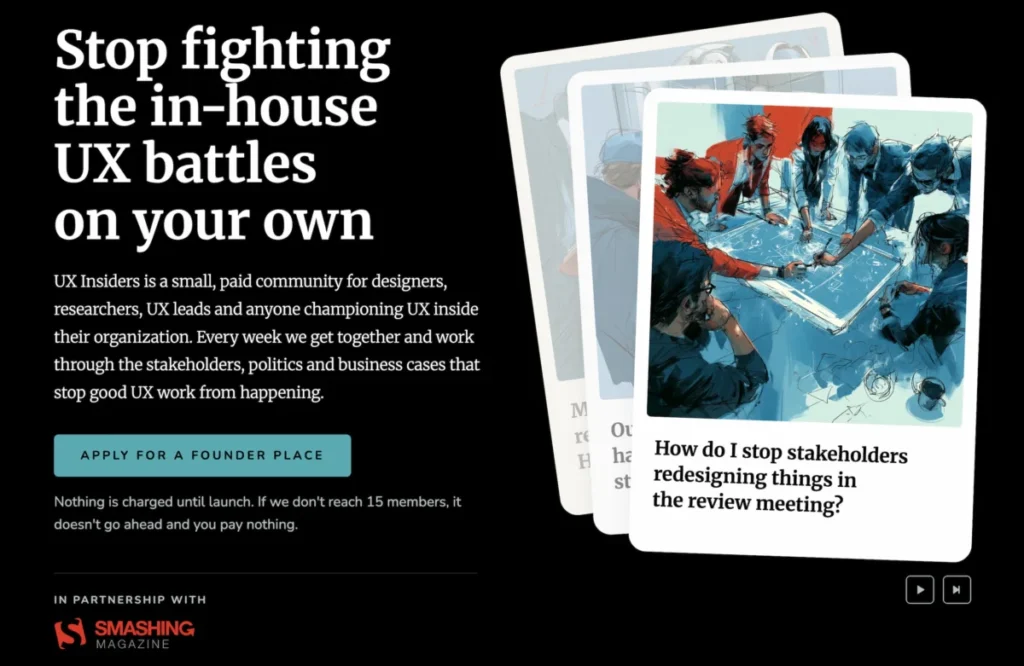

The landscape of User Experience (UX) design is undergoing a significant shift as the profession moves from being a specialized service to an integrated, in-house necessity within larger organizations. Despite this integration, professionals operating within corporate structures frequently face systemic hurdles that remain largely unaddressed by conventional design resources. In response, industry veteran Paul Boag, in partnership with Smashing Magazine, has announced the launch of UX Insiders, a specialized professional community designed to provide peer support, strategic templates, and collaborative problem-solving for in-house UX practitioners.
The Evolution of the In-House UX Role
For many years, the UX discipline was primarily housed within external agencies, where designers could rely on a collective of peers for mentorship and process refinement. However, as companies increasingly bring design capabilities in-house to reduce costs and maintain tighter control over product roadmaps, the isolation of the "team of one" or small internal design units has become a common professional struggle.
Recent industry surveys suggest that over 60% of UX designers now work primarily in-house, yet these professionals report higher levels of burnout and professional stagnation compared to their agency counterparts. The core challenge is not the technical execution of design tasks, but rather the navigation of corporate bureaucracy. Practitioners are frequently tasked with justifying design investments, managing stakeholders who may not understand the UX lifecycle, and integrating rapidly evolving technologies like Artificial Intelligence (AI) into workflows without clear organizational guidance.
The Structural Shift in Professional Support
The announcement of UX Insiders represents a pivot toward niche, outcome-oriented networking. Scheduled for a tentative launch on January 5, 2027, the community is specifically designed to exclude agencies and freelancers, creating a "safe harbor" where internal stakeholders can discuss sensitive organizational roadblocks without the presence of service providers looking to secure contracts.

Paul Boag, a longtime contributor to Smashing Magazine with a history of 77 published articles and three industry-standard books, noted that the impetus for this platform stems from years of consulting with designers who are struggling to find a common language for business stakeholders. The community model centers on three pillars: weekly synchronous calls to discuss real-time hurdles, a curated library of battle-tested business cases and research plans, and a persistent digital forum for ongoing peer-to-peer consultation.
Chronology and Launch Requirements
The rollout of this initiative follows a structured, risk-mitigated approach. Key milestones for the project include:
- November 2024: Commencement of the recruitment phase for founding members.
- December 11, 2026: A critical viability threshold deadline. If fewer than 15 members have enrolled by this date, the project will be canceled, and no financial transactions will be processed.
- January 5, 2027: Official launch date for the inaugural cohort.
By implementing this "all-or-nothing" threshold, the organizers aim to ensure that the community begins with a baseline level of engagement sufficient to sustain the intended collaborative environment. Founding members are offered a legacy pricing structure—either £49 per month billed annually or £59 per month billed monthly—which remains locked for the duration of their membership.
Data-Driven Challenges in the UX Sector
The necessity for such a community is underscored by the current volatility in the tech sector. With the integration of AI into user research, many senior managers are operating under the misconception that qualitative research can be fully automated in a matter of hours. This reductionist view of UX creates a pressure-cooker environment for in-house designers, who are often forced to choose between producing high-quality, evidence-based work and meeting expedited, unrealistic deadlines.
Data from recent design management reports indicate that the most common reason for project failure in large enterprises is not poor design, but rather the "stalled project" phenomenon—where research sits in an inbox or a business case is ignored due to lack of stakeholder buy-in. UX Insiders intends to bridge this gap by providing templates and strategies that have been proven to move stakeholders from skepticism to adoption. This practical application of "business-side" knowledge is arguably the most significant value proposition for the community.
Comparative Analysis: The Agency Model
Recognizing that the needs of agency owners and freelancers differ significantly from those of in-house employees, the initiative operates in parallel with an existing program, the Agency Academy. While UX Insiders focuses on navigating corporate politics and internal team dynamics, the Agency Academy serves a distinct segment of the market, focusing on business growth, client acquisition, and work-life balance for those running their own firms.
Both communities leverage a similar infrastructure—weekly calls and moderated communication channels—yet the separation between the two is deliberate. By segmenting the audience, the organizers ensure that the conversations remain relevant to the specific environmental pressures faced by each group. For instance, while an in-house designer needs to know how to influence a product manager, an agency owner needs to know how to price a service effectively.
Broader Industry Implications
The creation of specialized, gated communities like UX Insiders suggests a maturing of the digital design industry. As the field moves beyond the "hype" phase of the 2010s, practitioners are increasingly seeking high-signal, low-noise environments where they can access specialized knowledge.
For employers, the existence of such a community presents an opportunity for professional development. Many organizations have training budgets that go underutilized because traditional seminars often lack the granular, daily-operations focus required by modern UX teams. By positioning UX Insiders as a tool that can be funded through corporate training budgets, Boag and the Smashing team are signaling that professional support is an operational necessity, not merely a personal perk.
Official Stance and Future Outlook
The partnership between an independent expert and a major publication like Smashing Magazine provides a layer of institutional stability that is often missing from independent online communities. According to industry analysts, this type of hybrid model—where expert-led curation is supported by a legacy brand—is likely to become the standard for professional development in the digital age.
If the launch of UX Insiders proves successful, it could signal a broader trend of "peer-to-peer professionalization," where the primary source of truth for industry best practices shifts from static textbooks to active, moderated communities. As the digital landscape continues to fragment under the influence of new technologies, the ability to rapidly share successful strategies across organizational boundaries will likely become the primary differentiator for successful UX departments.
Prospective members are currently being vetted through an application process, a move that the organizers state is vital for maintaining the integrity of the community. By ensuring that all members are verified in-house practitioners, they aim to create an environment where radical candor regarding internal business failures is possible, providing a level of support that is rarely accessible within the vacuum of a single company.
For those in the UX space, the coming months represent a window of opportunity to influence the formation of this collective. Whether the project achieves its threshold by December 11 remains to be seen, but the high level of interest from the professional community underscores a clear, persistent demand for a more structured approach to navigating the complexities of modern, in-house digital work.