
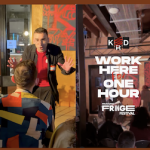
Independent creative agency Kill Boring Dead recently executed one of the most unconventional public engagement experiments of the 2026 Melbourne Fringe festival season, inviting everyday citizens to step inside their Collingwood headquarters for a fleeting, high-stakes taste of the advertising industry. Titled Work Here For One Hour, the activation blurred the lines between immersive theatre, fringe performance, and agency culture, offering participants a compressed, sixty-minute simulation of a high-pressure corporate creative pitch. Far from a conventional recruitment drive or client acquisition funnel, the experiment was designed as an open-ended exploration of creative problem-solving, testing how untrained minds react when thrown into the deep end of a fictional major account pitch.
The activation ran from Tuesday, October 13, to Friday, October 16, 2026, welcoming evening crowds beginning at 6:00 PM. Promoted with the cheeky hook, “Fancy a career in advertising but prefer to commit to a short time first?”, the experience promised attendees a front-row seat to the energetic chaos of an independent agency. Participants were told that the agency had miraculously landed a massive new account, that an urgent brief needed cracking immediately, and that every person in the room would be expected to play an active role in shaping the campaign. Blending genuine creative collaboration with the eccentricities expected of a Melbourne Fringe event, the initiative sparked widespread curiosity across the local marketing and arts communities, prompting questions about its true underlying motives.
A Departure From Traditional Agency Marketing
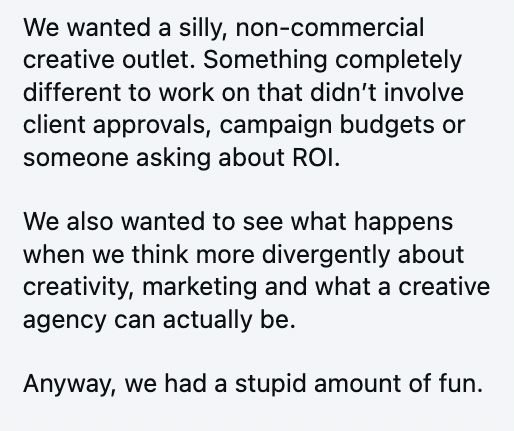
In an industry heavily reliant on predictable recruitment campaigns, employer branding exercises, and self-congratulatory case study reels, Kill Boring Dead’s intervention stood out for its deliberate lack of corporate utility. When queried about the strategic goals behind the event, agency CEO Marcus Willis offered a refreshingly candid perspective that upended traditional agency PR logic. Clarifying that the project was neither a lead-generation tool nor a clandestine headhunting mission, Willis emphasized that the primary objective was simply to embrace experimentation and observe what unfolded.
By treating the activation as an unmonetized creative outlet, the agency freed itself from the constraints of return-on-investment metrics and talent acquisition KPIs. This philosophy aligns closely with Kill Boring Dead’s broader brand positioning, which champions continuous experimentation across non-traditional formats. In an agency ecosystem frequently dominated by risk-aversion and safe, data-driven optimizations, staging an entirely improvised, fictional agency adventure within a fringe arts festival offered a rare playground for pure, unadulterated creative play.
The Chronology and Behind-the-Scenes Realities
The genesis of Work Here For One Hour followed a remarkably compressed and organic timeline, reflecting the chaotic energy of the fringe festival circuit itself. According to Willis, the concept materialized organically rather than through months of meticulous strategic planning. When the agency initially registered the event for the Melbourne Fringe program, the core architecture consisted of little more than the provocative title.
The actual narrative structure, mechanics, and experiential flow of the one-hour career simulation remained undefined until roughly two weeks prior to opening night. It was during this eleventh-hour sprint that the various thematic elements locked into place, transforming a loose concept into a cohesive, fast-paced simulation. Despite the late development window, public demand proved exceptionally strong, resulting in a completely sold-out run across all four evenings. This enthusiastic uptake underscored a latent public fascination with the inner workings of creative agencies—a world that is typically obscured behind closed boardroom doors and polished pitch decks.
Blending Commercial Creativity With Fringe Culture
Participating in the Melbourne Fringe allowed Kill Boring Dead to bridge two worlds that rarely intersect under a single roof: corporate commercial problem-solving and avant-garde festival culture. While Willis has a documented history of producing shows across major Australian fringe circuits—including iterations in Melbourne, Adelaide, and Perth—this marked his first endeavor merging professional agency operations with the fringe arts paradigm.
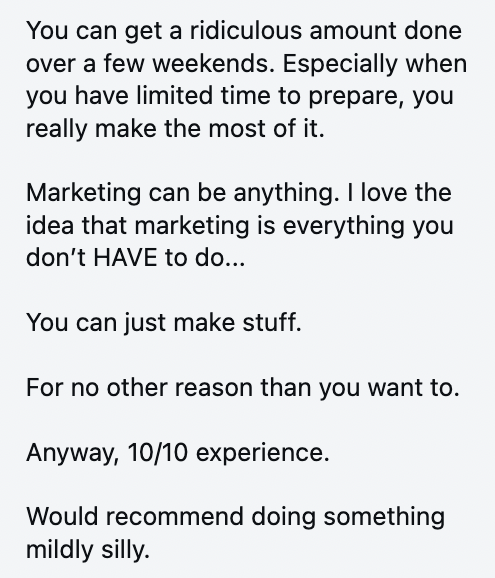
The fusion proved mutually beneficial. For the arts-curious public, the activation demystified the often-opaque process of advertising ideation, demonstrating how creative professionals dissect a brief, debate concepts, and synthesize disparate ideas under strict time constraints. For the agency team, stepping outside the bounds of conventional client service work provided a revitalizing jolt of spontaneous energy. The injection of fringe absurdity into a corporate environment ensured that the exercise avoided the dry, overly earnest tone that frequently plagues corporate workshops or university guest lectures.
Broader Industry Implications and Public Reception
The success and public reception of Work Here For One Hour offer intriguing implications for how creative agencies might approach community engagement and employer branding in the future. In an era where modern workers increasingly value transparency, authenticity, and experiential workplaces over static job listings, immersive activations that invite public participation can foster deeper emotional connections than traditional PR strategies.
Furthermore, the experiment highlighted a broader societal appetite for participatory experiences. Rather than passively consuming advertising or viewing agency work through a digital portfolio, the participants in Kill Boring Dead’s Collingwood headquarters became active co-creators of a temporary narrative. They experienced firsthand the adrenaline, friction, and eventual camaraderie of collaborative ideation.
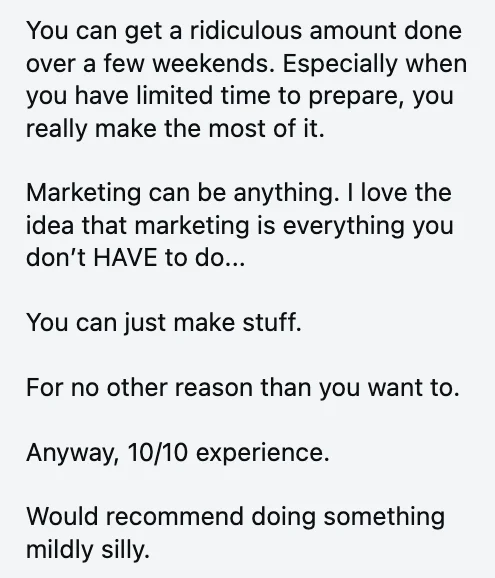
As captured in post-event reflections shared across digital platforms, the exercise resonated deeply with both industry insiders and laypeople alike. By stripping away the formalities of the corporate hiring process and replacing them with a theatrical, high-tempo creative challenge, Kill Boring Dead demonstrated that the best way to explain the value of advertising is not to talk about it, but to let people live it—if only for sixty minutes.