
In the modern landscape of digital media creation, video editors and content producers constantly grapple with the time-intensive challenge of combing through hours of recorded raw footage to find the most engaging highlights. Traditionally, this process has relied heavily on human intuition, manual scrubbing through timelines, or the implementation of costly, resource-intensive machine learning models and large language APIs. However, recent technical insights from desktop video editing software osFoundry reveal an elegant, highly efficient alternative: when a transcript is paired with precise word-level timestamps, identifying compelling short clips requires no predictive AI model whatsoever. Instead, developers can rely on straightforward algorithmic windowing techniques to isolate areas of dense speech rapidly and economically.
The Mechanics of Algorithmic Highlight Detection
At the core of this approach is a fixed-length temporal window that scans across a sequence of transcribed words. Rather than forcing the audio into an arbitrary grid—such as rigid one-second intervals—the algorithm anchors each candidate window to the exact beginning of a spoken word. This ensures that video clips never awkwardly clip mid-syllable, preserving the natural cadence of human speech.
To evaluate the density of a given segment, the algorithm calculates how many words fit within the predefined window. Words are counted if their completion timestamp falls within the boundaries of the active window. Once all potential windows are mapped, the system scores them based on word density. Furthermore, because the scoring metric divides the word count by the fixed window length rather than actual speech duration, trailing windows at the very end of a recording naturally receive lower scores without requiring specialized edge-case handling.
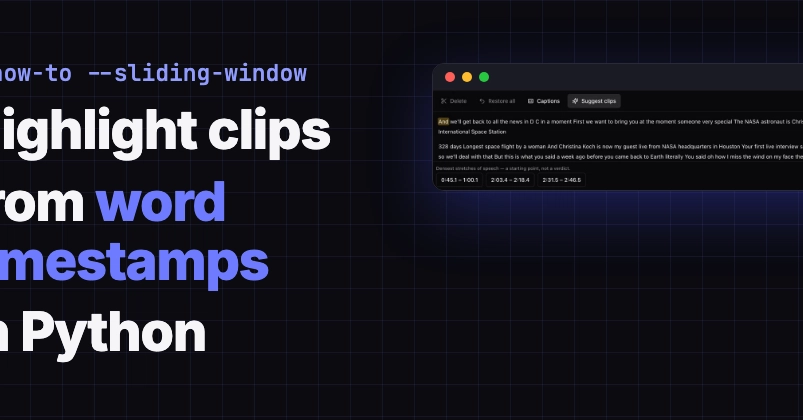
To examine the practical performance of this method, engineers implemented the algorithm in Python, testing it against a standardized five-minute and seven-second NASA interview featuring astronaut Christina Koch. Generated via OpenAI’s Whisper speech-to-text engine, the raw transcript comprised 1,007 words spread across 306.97 seconds, averaging approximately 3.28 words per second. Operating without punctuation, the dataset provided solely the necessary temporal parameters: word index, textual content, start millisecond, and end millisecond.
Empirical Testing and Window Length Variables
When executed with a standard configuration of a 15-second window and a target of three distinct clips, the Python script successfully mirrored the exact output produced by the native Rust implementation (find_highlights within canvas_transcript.rs) embedded in the osFoundry desktop application. The resulting clips showcased remarkable conversational density, yielding rates between 4.27 and 4.47 words per second—significantly higher than the overall interview average.
A critical finding from the performance analysis is the profound impact of window sizing on final output selection. Testing multiple durations revealed distinct behavioral patterns:
- 10-Second Windows: Shorter durations favor rapid, energetic bursts of speech, resulting in higher peak word-density scores.
- 15-Second Windows: This duration strikes a balance, successfully identifying sustained conversational highlights such as a recurring focal point around the 2:31 timestamp.
- 30-Second to 60-Second Windows: Longer durations tend to average out momentary pauses and interviewer prompts, shifting the selected segments closer to the transcript’s baseline speaking rate of 3.28 words per second.
Interestingly, empirical cross-testing demonstrated that segments appearing across multiple window lengths—such as the recurring highlight near the 2:31 mark—represent genuinely robust conversational topics rather than fleeting rapid-fire sentences. By running parallel evaluations across multiple window lengths, software developers can implement multi-metric ranking without incurring computational bloat.

Evaluating Greedy Selections Versus Dynamic Programming
In the initial implementation, the algorithm employs a greedy approach: it sorts candidate windows by score in descending order and iteratively selects the highest-scoring segments while filtering out overlapping timeframes. While efficient for generating a short list of top highlights, this greedy methodology is not always globally optimal.
To test the limitations of the greedy approach, engineers compared its output against an exact solution derived via dynamic programming. While a greedy algorithm successfully matched the exact optimal word count for short lists (such as selecting 3 or 10 clips from 15-second windows), discrepancies emerged when window sizes expanded to fill the entire duration of the recording. For instance, when processing 30-second windows across 10 requested clips, the greedy approach yielded 764 words across 8 clips, whereas the exact dynamic programming algorithm successfully integrated 989 words across 10 clips. This variance occurs because initial greedy selections can prematurely truncate available gaps, preventing subsequent optimal placements. Consequently, while greedy algorithms remain ideal for quick highlight generation, comprehensive chapter segmentation benefits from dynamic programming structures.
Algorithmic Optimization: Transitioning from Re-scanning to Two-Pointer Architecture
Performance scalability is a primary concern for developers handling long-form podcasts, lectures, or interviews spanning several hours. The initial naive candidate-generation loop rescans words for every single window, yielding a time complexity proportional to the window length multiplied by the total word count.
By recognizing that both start and end times progress monotonically through the transcript, developers can optimize the evaluation phase using a two-pointer architecture. In this optimized approach, the ending pointer moves strictly forward in tandem with the starting pointer. Benchmarks conducted using Python 3.9 on an Apple M1 processor illustrate the dramatic performance gains of this optimization:
- 5-Minute Transcript (1,007 words): Re-scanning required 2.9 milliseconds, whereas the two-pointer approach reduced execution time to 0.4 milliseconds.
- 1-Hour Transcript (12,084 words): Re-scanning scaled up to 190.5 milliseconds, while the two-pointer algorithm completed the evaluation in just 5.4 milliseconds.
This optimization ensures that desktop video editing software can process extensive media assets instantaneously, maintaining a responsive user experience.
Industry Implications and the Philosophy of Algorithmic Curation
The broader industry implications of lightweight, heuristic-based transcript curation touch upon cost efficiency and user autonomy in software design. Modern video production workflows increasingly incorporate artificial intelligence, but heavy reliance on cloud-based LLMs for basic administrative tasks introduces recurring operational costs and subscription dependencies.
By demonstrating that mathematical windowing and basic heuristics can effectively solve highlight detection locally, developers offer a compelling privacy-centric and cost-free alternative. Representatives from the osFoundry development team emphasize that word-per-second metrics measure conversational density rather than qualitative editorial value. Automated tools serve strictly as a preliminary starting point—a navigational aid rather than a definitive editorial verdict.
As content creators continue to navigate the demands of high-volume digital publishing, the integration of transparent, client-side algorithmic tools represents a vital shift toward empowering users with efficient workflows that respect both computational budgets and creative oversight.