
Replacing traditional JavaScript functionality with modern CSS features is a practice that has gained significant momentum in the web development industry. On the surface, the allure is undeniable: reducing a codebase by dozens of lines, replacing imperative scripts with declarative style rules, and achieving a cleaner pull request (PR) diff. However, this transition often conceals a shift in technical debt rather than its elimination. While modern CSS tools like Container Queries, the :has() selector, and native nesting offer powerful capabilities, they fundamentally alter the architecture of a web application, often creating complex, difficult-to-debug side effects within the existing ecosystem of the browser’s rendering engine and the CSS cascade.
The fundamental tension lies between local simplicity and system-wide complexity. When a developer replaces a ResizeObserver-based layout toggle with a CSS container query, they are not merely performing a refactor; they are changing how the browser manages component state. The new CSS feature must interact with existing legacy code, global styles, and layout behaviors. If the developer fails to map these interactions, the application can suffer from unpredictable regressions, such as unexpected layout shifts, broken component states, or performance degradation.
The Chronology of Modern CSS Adoption
The evolution of CSS over the past several years has been rapid. Following the widespread adoption of CSS Grid and Flexbox, the industry moved toward more sophisticated features. Container Queries, which allow components to respond to the size of their parent rather than the viewport, were introduced to solve the "component-based responsive design" problem. Simultaneously, the :has() selector—often dubbed the "parent selector"—provided developers with the ability to style an element based on its children or siblings, a task previously reserved for JavaScript.
However, historical data from developer forums and technical discussions indicates that this migration often follows a predictable pattern of failure. In April 2026, industry analyst Igor Roztropiński published a pivotal essay, "Modern Frontend Complexity: Essential or Accidental?" in which he challenged the assumption that newer, native features are inherently simpler. His work sparked an intense debate within the developer community, highlighting that while native features reduce the number of lines of code, they often obscure the "behavioral ownership" of a component.
Behavioral Ownership and the Two-Owner Trap
One of the most frequent causes of post-migration bugs is the "dual-ownership" problem. In a typical scenario, a developer might introduce a CSS container query to handle responsive layout changes but fail to fully excise the legacy JavaScript that previously handled the same functionality. When the JavaScript and CSS logic overlap, they create a silent conflict.

If a developer updates the CSS breakpoint—for instance, changing a trigger from 480px to 600px—but forgets that an orphaned JavaScript observer is still monitoring the 480px threshold, the component enters a "limbo state." Between these two values, the component may display inconsistent styling. This is not a bug in the new CSS, but a failure in the migration process. It underscores the necessity of a "clean-sweep" approach, where the removal of redundant logic is as rigorously tested as the introduction of new features.
The Impact of Block Formatting Contexts
Modern CSS features often come with implicit behavior changes that developers may not anticipate. A prime example is the use of container-type: inline-size. While the primary purpose of this property is to enable container queries, it also forces the element to establish a new block formatting context (BFC).
The implications of this are significant:
- Margin Collapsing: An element that previously allowed its child margins to collapse with the parent will, upon receiving a container-type declaration, trap those margins internally. This can cause unexpected shifts in vertical spacing across a page.
- Float Interaction: Elements that previously ignored floating objects may now be forced to sit adjacent to them, potentially breaking established grid layouts.
- Content-Sized Collapse: If an element is set to
container-type: inline-sizewithout an explicit width, it may collapse to a width of zero if its parent does not provide a definitive constraint.
These side effects represent "accidental complexity"—where a single line of CSS, intended to solve a specific UI problem, inadvertently forces a change in how the browser calculates the entire layout of a page.
The Cascade and the Specificity War
The introduction of the :has() selector and native CSS nesting has similarly changed the dynamics of the cascade. Because these features allow for more concise selector lists, developers often inadvertently create selectors with high specificity that impact broader portions of the DOM than intended.
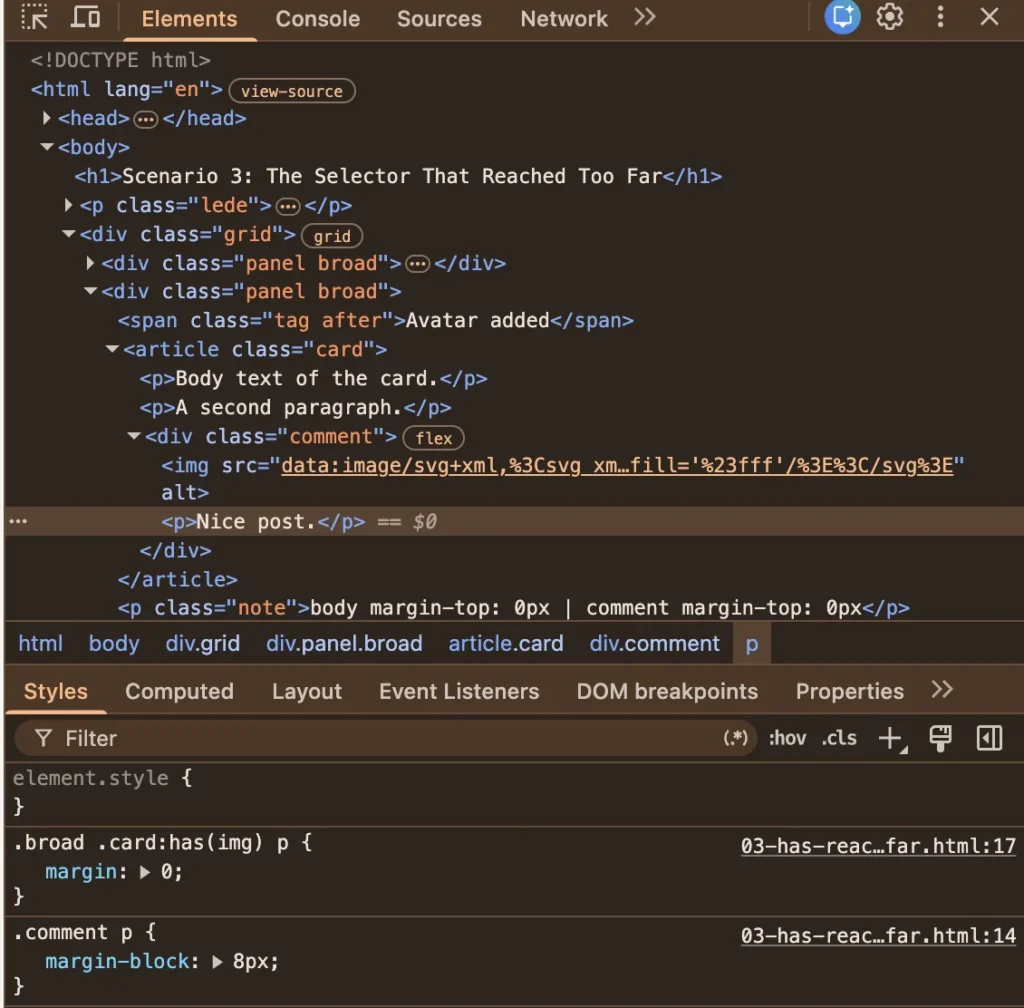
Consider a rule such as .card:has(img) p margin: 0; . While this appears to target paragraphs within image-containing cards, it can override styles for nested components, such as a comment section within that card, even if the comment has no image. The result is a "specificity war" where developers attempt to fix cascading issues by adding increasingly specific rules or using the !important flag, ultimately making the codebase more fragile.

Furthermore, industry experts have noted that cascade layers, while intended to provide a mechanism for managing priority, do not automatically resolve these issues in partially migrated codebases. If a legacy stylesheet is unlayered and the new styles are placed within a layer, the unlayered styles will continue to take precedence, leading to frustrating scenarios where CSS updates simply fail to render.
Performance Implications: The Hidden Cost of :has()
Perhaps the most significant, yet least understood, impact of modern CSS is its performance cost. A common misconception is that CSS is always faster than JavaScript. While this is often true for simple tasks, complex selectors like :has() can lead to significant performance bottlenecks if they are overused or poorly structured.
Benchmarking conducted on high-volume DOM structures (e.g., lists with 5,000+ items) has shown that multiple :has() rules—even if each is simple in isolation—can interact to force the browser to restyle the entire DOM tree whenever a single class is toggled. In some extreme cases, this can result in frame drops that exceed the 16.7ms threshold required for 60Hz smoothness. The browser engine must perform massive recalculations, and because these dependencies are often hidden within the CSS, they do not appear in traditional JavaScript performance profiles.
Best Practices for Migration
To mitigate these risks, organizations must move beyond the "greenfield" mindset. Most developers read about new CSS features in the context of a fresh project, but most real-world work involves migrating complex, existing systems. A professional migration strategy should include:
- Behavioral Auditing: Before implementation, identify all existing logic (JavaScript or legacy CSS) that governs the component’s behavior.
- Scoped Testing: Use visual regression testing tools to compare the UI before and after the migration, ensuring that layout, spacing, and interaction remain consistent.
- Selector Hygiene: Utilize
:where()to lower the specificity of nested rules and child combinators to ensure selectors do not "leak" into unintended components. - Performance Benchmarking: For high-traffic or dynamic pages, use browser DevTools to measure the cost of new CSS selectors during state changes, specifically checking for excessive restyles.
- System-Wide Analysis: Assess how new properties, such as
container-type, affect surrounding block formatting contexts and existing margin-collapse patterns.
Conclusion: A Disciplined Path Forward
Modern CSS is a transformative force in web development, offering unprecedented control over UI responsiveness and interactivity. However, the true value of these features is only realized when they are deployed with a deep understanding of the surrounding system. The "simplification" promised by a shorter codebase is a mirage if it introduces hidden complexity in the form of cascade conflicts, layout regressions, or performance bottlenecks.
Ultimately, the goal of a professional developer is not merely to write less code, but to write maintainable code. By treating every migration as an architectural change rather than a simple stylistic swap, teams can leverage the power of modern CSS without falling into the traps of accidental complexity. A migration is only complete when the new feature is fully integrated, the old logic is purged, and the performance and behavioral impacts are fully accounted for. As the web platform continues to evolve, the most successful developers will be those who balance the enthusiasm for new capabilities with a rigorous, evidence-based approach to system stability.