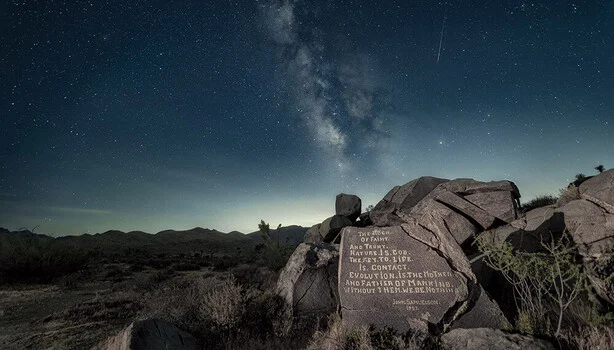

The pursuit of exceptional astrophotography often demands stepping far beyond established infrastructure, sacrificing the comfort of maintained trails, and navigating the unpredictable variables of remote wilderness. In Joshua Tree National Park, where daytime summer temperatures frequently breach the 100-degree Fahrenheit threshold, undertaking a nocturnal cross-country trek requires meticulous preparation, strict adherence to safety protocols, and calculated risk management. For one photographer working on assignment for Yucca Brevifolia Magazine, a combination of historical intrigue, celestial timing, and extreme environmental conditions culminated in a rare capture of a Perseid meteor streaking directly above the historic Samuelson’s Rocks.
Main Facts and Environmental Challenges
Samuelson’s Rocks stands as one of the Mojave Desert’s most unusual and isolated cultural landmarks. Located deep within the interior of Joshua Tree National Park, the site features seven massive granitic boulders bearing eight distinct political and philosophical inscriptions carved by John Samuelson, an eccentric Swedish immigrant and prospector who lived in the area during the 1920s. Crucially, the location possesses no official trailhead, signage, or maintained footpaths, requiring visitors to navigate entirely by GPS and geographical line-of-sight across rugged terrain populated by sharp cacti and abrasive desert flora.
The primary operational hurdle for the expedition was the extreme seasonal climate. During early August, daytime temperatures in the park regularly exceed 104°F (40°C). The National Park Service strongly discourages recreational hiking on routes longer than two miles during the summer months due to the severe risk of heat-related illnesses, including heat exhaustion and heatstroke. Mitigating these hazards necessitated a strict temporal shift in operations: all physical movement toward the boulders was postponed until after sunset, and the photographer packed 1.5 gallons of hydration specifically for the trail, supplementing this supply with additional reserves stored securely in an air-conditioned vehicle.
Chronology of the Expedition
The expedition unfolded over a precise operational timeline designed to balance environmental safety with optimal astronomical alignment:
- August 5, 2026, Late Afternoon: Arrival at the staging area near the park boundary. Ambient temperatures remained dangerously high, hovering near 104°F. Equipment checks were conducted, ensuring that an REI Lookout 40 backpack securely housed camera bodies, intervalometers, heavy-duty tripods, flashlights, emergency rations, and the essential 1.5-gallon water supply.
- Post-Sunset (approx. 8:30 PM): Departure from the vehicle once solar radiation ceased and surface temperatures began a gradual descent. The initial phase of the hike emphasized heavy hydration to build physiological reserves before exertion.
- Night Navigation (8:30 PM – 9:15 PM): Traversing 1.5 miles of trackless desert in total darkness. Navigation relied on the Garmin Explore application operating offline via internal smartphone GPS sensors, cross-referenced against the visible silhouettes of distant mountain ranges positioned directly behind Samuelson’s Rocks. Flashlight beams were kept low to the ground to preserve night vision, protect nocturnal wildlife, and avoid hazards like cholla cacti.
- Arrival and Setup (9:15 PM): Reaching the historic boulders after a 42-minute transit. Equipment deployment involved embedding tripod legs deep into the sandy substrate to counteract strong desert wind gusts. An intervalometer was configured to automate a continuous sequence of exposures, targeting the galactic core of the Milky Way and anticipating the early activity of the Perseid meteor shower.
- Observation and Departure (Midnight): Monitoring the automated camera sequence while observing stellar rotation and managing intermittent wind interference. Operations concluded as a rising half-moon penetrated the horizon clouds, washing out the celestial contrast. The return transit utilized the same GPS-guided cross-country route.
- August 6, 2026 (Post-Processing): Reviewing captured digital files in Adobe Lightroom Classic, resulting in the identification of a targeted frame featuring a Perseid meteor vectoring directly toward the historical inscriptions.
Background Context and Cultural Significance
The historical context of Samuelson’s Rocks adds a distinct layer of human narrative to the natural and astronomical elements of the photograph. John Samuelson arrived in the Mojave Desert in 1926, eventually finding employment with local pioneer and rancher Bill Keys. Living a largely isolated existence, Samuelson utilized hammer and chisel to etch his worldview onto the desert stone before eventually disappearing from the region. Today, the site is recognized by historians and park historians as a unique physical archive of early-20th-century desert prospecting culture.
Simultaneously, the astronomical timing intersected with the early stages of the annual Perseid meteor shower. While the shower’s peak activity typically occurs mid-August, Earth’s trajectory through the debris stream left by Comet Swift-Tuttle produces sporadic precursor meteors in early August. Capturing these transient phenomena requires high-frequency continuous shooting—a technique where automated intervalometers fire the camera shutter hundreds of times consecutively to secure a single overlapping frame of a fleeting atmospheric event.
Safety Protocols and Technological Reliance
Executing a desert trek of this magnitude without cellular connectivity underscores the growing reliance on offline topographic mapping software in modern wilderness exploration. While traditional compass and paper map skills remain vital, applications capable of utilizing GLONASS and GPS satellite constellations independently of cellular towers provide critical real-time positioning data.
Park safety officials emphasize that off-trail desert travel carries inherent liabilities, particularly concerning botanical hazards such as the Cylindropuntia (cholla) cactus, whose barbed joints easily penetrate heavy leather footwear and clothing upon contact. The photographer’s decision to wear durable trousers and thick boots, despite oppressive ambient heat, proved essential in preventing physical injury during the nocturnal transit across washes and uneven terrain.
Broader Impact and Implications
The resulting image bridges cultural heritage, environmental conservation, and scientific documentation. Commissioned as part of a visual portfolio for Yucca Brevifolia Magazine, the photograph highlights the delicate balance public land management agencies must maintain: permitting public access to fragile desert antiquities while discouraging inexperienced visitors from attempting dangerous off-trail excursions during extreme weather events.
As interest in night sky photography and dark sky preservation continues to grow within Joshua Tree National Park—which holds official International Dark Sky Park status—incidents of night hiking are expected to rise. Observers, conservationists, and park administrators continue to advocate for responsible visitation, stressing that while the intersection of historical artifacts, the Milky Way, and meteors offers unparalleled creative potential, it demands rigorous preparation, respect for park regulations, and an uncompromised commitment to personal safety in extreme environments.