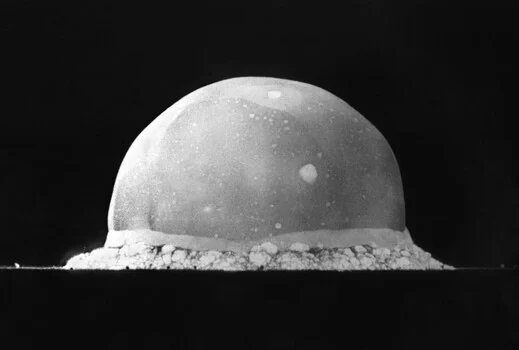

In the scorching early morning of July 16, 1945, the world’s first nuclear device—code-named Trinity—detonated over the remote expanses of the New Mexico desert. The resulting 21-kiloton blast forever altered human history, introducing the atomic age with a blinding flash and an immense, rising column of radioactive debris. While government officials and Manhattan Project scientists sought to maintain absolute secrecy over the successful weapon test, nature itself began broadcasting the event across the American continent. Just weeks later, thousands of miles away in the industrial heartland, microscopic remnants of that desert explosion made their presence unmistakably known not through seismic instruments or government bulletins, but through an unexpected and highly sensitive medium: commercial photographic packaging board.
The bizarre chain of events began on August 6, 1945, when a routine batch of industrial packaging board was manufactured at a mill situated along the Wabash River. Roughly two weeks later, workers at Eastman Kodak discovered that X-ray film stacked against this newly minted cardboard had mysteriously fogged, ruined by dozens of inexplicable dark spots. This inadvertent finding set off a quiet scientific investigation that ultimately traced the contamination back to the New Mexico test site, revealing that atomic debris had traveled roughly 1,000 miles on wind currents and descended in local rainfall.
The Scientific Intersection of Photography and Radiation
To understand how a cardboard box could act as a nuclear detector, one must look at the fundamental chemistry of photography. Photographic emulsion is, by its very nature, a radiation detector that happens to produce images. Silver halide grains are entirely indifferent to the origin of the energy that triggers them; whether an exposure arrives as a photon of visible light, an energetic X-ray, or a beta particle emitted by a decaying radioactive atom, the chemical reaction remains fundamentally the same.
When sensitized film is left in proximity to even mildly radioactive material for an extended period, the ionizing radiation will inevitably record the presence of that energy as chemical fog or localized spots, completely bypassing the camera lens. This exact physical principle was how French physicist Henri Becquerel serendipitously discovered radioactivity in 1896, utilizing uranium salts and wrapped photographic plates.
For major film manufacturers like Kodak, this inherent vulnerability posed a severe operational challenge, one that had escalated dramatically during the Second World War. As part of a nationwide wartime paper salvage program, recycling plants frequently mixed industrial scrap—including discarded paper stock from facilities where luminous radium-painted instrument dials were manufactured—into general paper supplies. As a result, microscopic specks of radium paint routinely turned up in commercial packaging paper, silently ruining sensitive photographic film stored in warehouses.
To combat this industrial hazard, Kodak proactively arranged for a specialized mill in Indiana to produce packaging board from meticulously selected, uncontaminated raw materials. The chosen material was strawboard—a cheap, rigid paperboard pressed from cereal straw that served as an interleaving stiffener between sheets of film. This tight quality control framework inadvertently created a highly sensitive baseline. Kodak possessed a clean supply chain, a known baseline of purity, and dedicated researchers whose job was to measure any deviation from that standard.
Chronology of a Quiet Discovery
The anomaly materialized in August 1945, when X-ray film stored against the Indiana strawboard emerged from chemical development marred by ten to several hundred small dark spots on individual 14-by-17-inch sheets. The radiation had possessed enough energy to punch cleanly through multiple layers of film and cardboard alike.
Julian H. Webb, a senior physicist in Kodak’s research laboratories in Rochester, New York, was tasked with deconstructing the problem. Webb quickly determined that the defect originated not within the photographic emulsion itself, but from the packaging board pressed directly against it. He narrowed the contamination to a single production run manufactured on August 6, 1945, at a mill in Vincennes, Indiana, along the Wabash River.
A comprehensive radiation survey swiftly eliminated the most obvious industrial suspects. The contaminant emitted relatively strong beta radiation, measurable gamma rays, and zero detectable alpha particles—a profile entirely inconsistent with radium or natural uranium. Webb calculated a maximum beta energy of approximately 0.6 MeV alongside a decay period of roughly 30 days. Preliminary radiochemical analysis indicated the material belonged to the rare earth series of elements, pointing strongly toward cerium-141, a known nuclear fission product with a half-life of 32.5 days. Because nothing growing natively in an Indiana agricultural field could generate cerium-141, the isotopic signature pointed unequivocally toward nuclear fission reactors or atomic detonations.
The investigation expanded when a second contaminated production run was discovered at an entirely different strawboard mill located in Tama, Iowa—hundreds of miles away and drawing from a completely separate watershed. When Webb tested the raw straw itself, he found it was not the vector; straw stored indoors for extended periods exhibited the exact same contamination as straw left standing in open fields.
The common denominator proved to be the industrial process water. Both Midwestern mills drew their water from river systems that had received heavy local rainfall. The radioactive particulate matter had been washed out of the upper atmosphere by precipitation, channeled into the rivers, filtered out during the pulp processing phase, and ultimately pressed directly into the strawboard packaging material.
Despite unravelling this mechanism within months of the event, Webb and Kodak exercised extreme discretion. Webb waited four years before publishing his findings in the October 1949 issue of Physical Review, in an article titled "The Fogging of Photographic Film by Radioactive Contaminants in Cardboard Packaging Materials." In the paper, he explicitly named the source: "The most likely explanation of the source of this radioactive contaminant appears to be that it consisted of wind-borne radioactive fission products derived from the atom-bomb detonation in New Mexico on July 16, 1945."
Corporate Awareness and Government Collaboration
While Kodak’s findings predated open public awareness of continental fallout transport, the company did not discover the existence of the atomic bomb itself through these packaging anomalies. The Trinity test on July 16, 1945, was initially publicly explained as an accidental ammunition magazine explosion at the Alamogordo Army Air Base, but the true nature of the weapon was officially revealed to the world following the atomic bombing of Hiroshima on August 6, 1945.
Instead, Kodak’s discovery established something far more alarming to military planners: the expansive geographic reach of nuclear debris. A single 21-kiloton device detonated in the New Mexico desert had successfully lofted measurable fission products into the upper atmosphere, where they were carried approximately 1,000 miles downwind and precipitated in sufficient concentrations across the Midwest to contaminate an industrial supply chain.
The scientific community quickly caught on to the implications. General Electric’s Chauncey Suits and MIT’s Robley Evans independently hypothesized the dual mechanisms of high-altitude atmospheric transport via rainout and riverine silt contamination. Recognizing the continuous threat to its commercial inventory, Kodak took aggressive practical measures, installing advanced air samplers in the intake systems of its building ventilation units in Rochester to monitor ambient radiation levels—effectively turning a commercial film manufacturing plant into a private fallout monitoring station.
As atmospheric nuclear testing shifted in the early 1950s to the Nevada Test Site, the scale of contamination expanded. Following the "Able" shot of Operation Ranger—a 1-kiloton air-dropped device detonated over Frenchman Flat on January 27, 1951—radioactive snow fell on Rochester, located some 2,000 miles to the east. Geiger counters at the Kodak facility registered radiation levels 25 times higher than normal background baselines.
Faced with ongoing disruptions to its manufacturing processes, Kodak approached the Atomic Energy Commission (AEC). Recognizing the economic necessity of protecting sensitive industrial materials, the federal agency agreed to provide the company with advance information regarding upcoming nuclear tests. According to historical congressional records, this arrangement included sharing the "expected distribution of radioactive material in order to anticipate local contamination." This protective information sharing was soon extended to the broader photographic manufacturing industry, supplying companies with detailed maps and predictive fallout forecasts to safeguard sensitive inventory in warehouses and transit.
Implications, Public Health, and Historical Legacy
Decades later, the stark disparity between the government’s treatment of commercial industry and the general public became a matter of intense legislative scrutiny. The issue burst back into the national spotlight in 1997, following the long-awaited release of a landmark National Cancer Institute (NCI) study regarding the public health impacts of iodine-131 fallout from atmospheric testing.
The NCI study estimated that radioactive fallout across the United States may have contributed to between 11,300 and 212,000 excess lifetime cases of thyroid cancer, with a central estimate of roughly 49,000 cases—disproportionately affecting children who consumed milk contaminated by pasture-grazing livestock.
During an October 1, 1997, hearing before a Senate Appropriations subcommittee, Senator Tom Harkin of Iowa seized upon the historical precedent set by the Kodak archives. Harkin highlighted the documented fact that the federal government had actively provided predictive contamination maps and advance warnings to photographic manufacturing conglomerates to protect rolls of film, while failing to issue similar health warnings or dietary guidance to dairy farmers or parents raising children directly beneath the fallout plumes.
"The Government protected rolls of film, but not the lives of our kids," Senator Harkin remarked during the proceedings, drawing a sharp contrast between corporate asset protection and public welfare during the height of the Cold War. While historians and legal analysts note that photographic film reacts to radiation levels far below those immediately dangerous to human health, the fundamental informational asymmetry remains a striking historical reality: federal agencies possessed sophisticated deposition forecasts and selectively distributed them to safeguard industrial inventory while maintaining public silence regarding potential health risks.
The Enduring Sensitivity of Photographic Emulsion
The physical vulnerabilities that troubled Julian Webb in 1945 continue to resonate in modern technology and manufacturing. For decades, the standard personal dosimeter worn by industrial and medical radiation workers was the film badge—a small device utilizing photographic emulsion behind specialized metal filters to measure cumulative radiation exposure.
Furthermore, the nuclear age left a subtle but pervasive mark on global materials science. High-precision radiation detectors and medical spectrometers must be constructed using "low-background steel"—metal smelted prior to July 1945 and salvaged from shipwrecks predating the atmospheric testing era. Steel produced in the post-war era inherently incorporates trace atmospheric radioactivity absorbed during the oxygen-blown manufacturing process.
Even in the contemporary digital era, the intersection of modern security systems and analog photography underscores these enduring physical principles. Modern airport computed tomography (CT) scanners used for carry-on baggage security deploy high-intensity X-ray imaging that can severely fog or ruin undeveloped photographic film. Major film producers, including Kodak Alaris and Ilford, explicitly warn consumers against passing unprocessed film through checkpoint CT scanners, advising manual hand inspections instead.
Similarly, modern digital astrophotography contends with stray high-energy particles on CMOS sensors, requiring complex frame-stacking algorithms to eliminate random cosmic-ray strikes.
Ultimately, Julian Webb and the researchers at Eastman Kodak did not stumble upon the atomic age by accident; they simply operated the most sensitive unshielded instrument network in the United States at the exact moment history caught up with them. The silver halide crystals in a roll of film have never required a government clearance to record the reality of what passes through the atmosphere—they register the physical universe precisely as it is, without exception and without compromise.