
The digital discovery landscape is undergoing its most profound structural shift since the advent of traditional search engines. With millions of consumers increasingly bypassing standard search engine results pages in favor of direct, synthesized answers from platforms like ChatGPT, Perplexity, and Google AI Overviews, digital marketing strategies are pivoting rapidly. Traditional search engine optimization (SEO), which historically focused on securing a spot within a list of blue links, is now complemented—and occasionally superseded—by Answer Engine Optimization (AEO). This emerging discipline ensures that a brand’s products, services, and content are actively cited, referenced, and correctly contextualized within the generative text produced by artificial intelligence systems.
As zero-click searches become the prevailing user experience, visibility is no longer guaranteed by high keyword rankings alone. Instead, companies face a new challenge: understanding whether AI systems recognize their authority, accurately represent their value propositions, or mistakenly route potential buyers to competitors. To navigate this opaque environment, a new category of enterprise software known as AEO checkers has emerged, transforming how organizations measure, audit, and optimize their presence across generative search models.
![AEO checker tools that measure answer engine visibility [2026]](https://53.fs1.hubspotusercontent-na1.net/hubfs/53/aeo-checker-1-20260903-3858273.webp)
The Mechanics of Answer Engine Optimization and the Shift in Consumer Behavior
The core philosophy of AEO rests on how modern language models process information. Unlike legacy search engines that index web pages and rank them using algorithms based on keyword density, metadata, and backlinks, generative AI models synthesize information from multiple disparate sources. When a user asks a complex question, the engine reads across web pages, technical documentation, and customer reviews to craft a single, cohesive response. If a brand is fortunate, its website is cited via an inline link or named directly within the prose.
This shift has fundamentally altered consumer journeys. Industry data indicates that a significant percentage of informational queries are now fully resolved within the AI interface, meaning the user never visits an external website. Consequently, classic traffic metrics have begun to decouple from actual brand awareness and consideration.
![AEO checker tools that measure answer engine visibility [2026]](https://no-cache.hubspot.com/cta/default/53/9dd5e54b-fbef-4dd0-bc44-1689feb1ea18.png)
While SEO continues to lay the foundational groundwork—providing the technical crawlability, structured schema data, and topical authority that AI models rely on for verification—AEO operates at a higher semantic level. It targets the "citation layer." To win in this space, content must be meticulously structured, directly answer specific consumer questions, and rely on verifiable primary sources that machine-learning crawlers can easily parse and trust.
Manual Auditing vs. Automated Intelligence: Tracking AI Overviews and Chatbots
For many digital marketing teams, the initial foray into AEO begins with manual audits. Tracking brand visibility across Google AI Overviews, ChatGPT, and Perplexity requires systematic query testing, yet this approach quickly hits operational bottlenecks due to the dynamic nature of generative AI.
![AEO checker tools that measure answer engine visibility [2026]](https://53.fs1.hubspotusercontent-na1.net/hubfs/53/aeo-checker-2-20260903-852936.webp)
Google’s AI Overviews, which launched globally to summarize complex informational queries, do not appear for every search; they trigger only when Google’s algorithms determine that a synthesized summary adds value to the traditional results. Furthermore, because these overviews are generated dynamically per session, results can vary wildly depending on the user’s location, search history, and real-time algorithmic updates. To manually audit an AI Overview, marketing professionals must define a core set of brand and informational queries, execute searches in incognito environments, record the presence of inline citations, and log variances over time.
A similar manual rigor is required for conversational engines like OpenAI’s ChatGPT and Perplexity. Perplexity automatically attaches citations to nearly every response, complete with a dedicated source panel, while ChatGPT integrates web search dynamically based on the temporal relevance of the prompt. Auditing these platforms requires distinguishing between a mere brand "mention"—where a company is named in the text without attribution—and an authoritative "citation," where the AI links directly back to the brand’s domain as a primary source.
However, manual sampling is inherently unscalable. Because AI responses fluctuate constantly based on underlying model updates and web retrieval patterns, manual tracking creates blind spots. Recognizing this limitation, software developers have rapidly introduced automated AEO checking tools designed to continuously monitor brand visibility at scale.
![AEO checker tools that measure answer engine visibility [2026]](https://53.fs1.hubspotusercontent-na1.net/hubfs/53/aeo-checker-3-20260903-8904553.webp)
Landscape of AEO Checking Software and Analytical Criteria
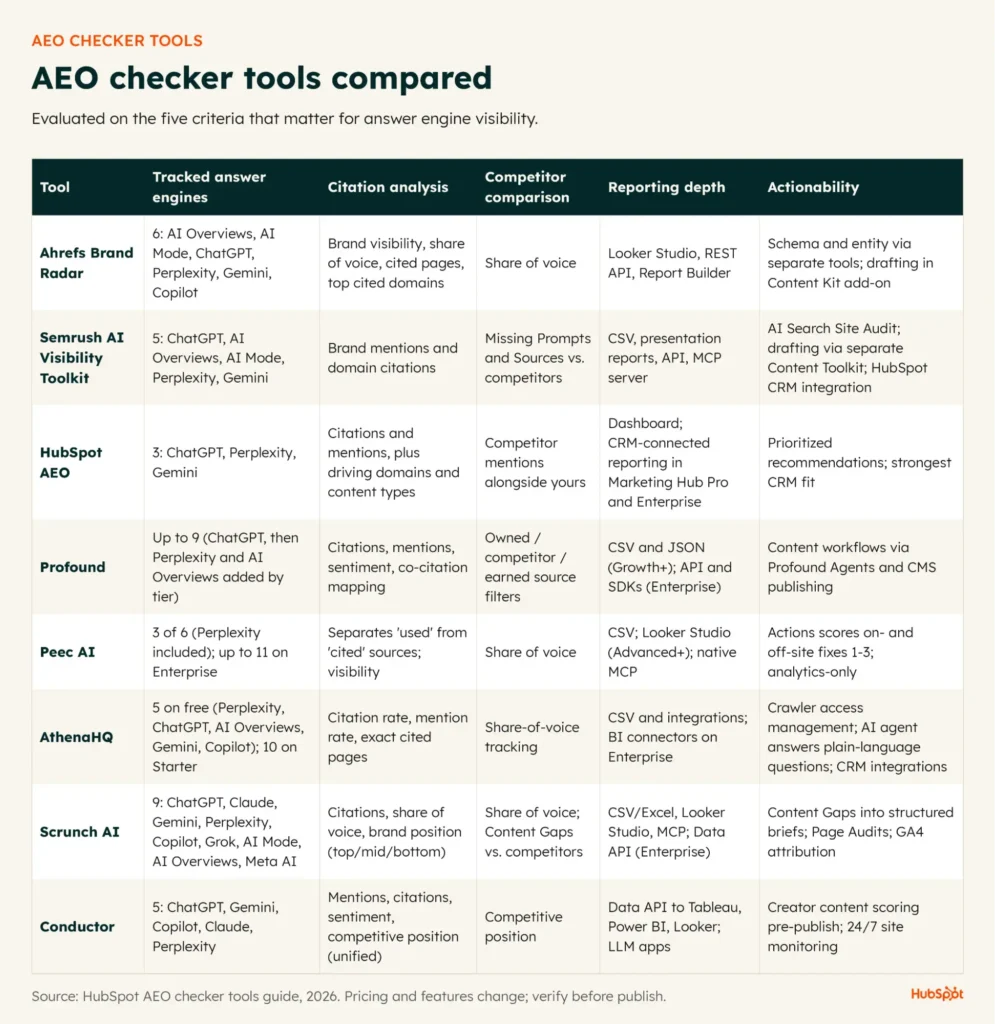
The market for AEO software has expanded to encompass a diverse array of specialized tools and established SEO platforms retrofitted with generative AI tracking capabilities. When evaluating these solutions, digital strategists typically assess several critical criteria: multi-engine coverage (tracking ChatGPT, Perplexity, Gemini, and AI Overviews simultaneously), sentiment analysis, citation context tracking, and integration with broader customer relationship management (CRM) ecosystems.
Among the prominent tools currently shaping the market, several platforms have carved out distinct niches:
![AEO checker tools that measure answer engine visibility [2026]](https://53.fs1.hubspotusercontent-na1.net/hubfs/53/aeo-checker-4-20260903-6212698.webp)
- Ahrefs Brand Radar leverages broad search query indexes to monitor brand presence within AI Overviews, utilizing real-world search volume data rather than purely synthetic prompts.
- Semrush AI Visibility Toolkit bridges the gap between organic search data and generative results, flagging ranking keywords that frequently trigger AI summaries.
- HubSpot AEO provides comprehensive tracking across major conversational engines, distinguishing between citations and mentions while feeding visibility scores directly into CRM pipelines to measure downstream impact on pipeline and revenue.
- Specialized startups like Profound, Peec AI, AthenaHQ, and Scrunch AI offer granular insights into citation sentiment, technical schema readiness, and crawler accessibility, ensuring that technical roadblocks do not prevent AI models from ingesting brand content.
Key Metrics Driving the New Era of Search Measurement
As organizations adopt these automated monitoring solutions, a new lexicon of performance metrics is taking root in the corporate boardroom. Traditional metrics such as click-through rates and average position are being supplemented by specialized AEO Key Performance Indicators (KPIs):
- Visibility Share: The percentage of target industry queries where a brand is either cited or mentioned by name within AI-generated responses, benchmarked against key competitors.
- Citation-to-Mention Ratio: A metric that evaluates whether a brand is receiving authoritative, traffic-driving links or merely passive text references that do not facilitate user acquisition.
- Sentiment and Accuracy Scoring: An assessment of how the AI frames the brand—measuring whether product descriptions are accurate, up-to-date, and positively positioned relative to alternatives.
- AI-Attributed Pipeline Value: In advanced deployments connected to enterprise CRMs, this metric tracks inbound traffic and subsequent sales conversions originating from sessions explicitly referred by AI answer engines.
Industry analysts emphasize that these metrics must be evaluated longitudinally. Because generative models are probabilistic and inherently volatile, single-point-in-time snapshots offer limited strategic value. Consistent, week-over-week trend analysis is required to measure the true return on investment of content restructuring and technical optimization efforts.
![AEO checker tools that measure answer engine visibility [2026]](https://53.fs1.hubspotusercontent-na1.net/hubfs/53/aeo-checker-5-20260903-8938354.webp)
Strategic Implications and the Future of Digital Marketing
The maturation of AEO checking tools signals a permanent evolution in how businesses approach digital visibility. As search engines increasingly evolve into answer engines, the boundary between technical SEO, content marketing, and public relations continues to blur. Winning the AI citation layer requires a synchronized approach: technical teams must ensure flawless schema markup and crawler accessibility; content creators must produce authoritative, deeply researched material that AI models deem trustworthy; and leadership must monitor brand perception across conversational interfaces with the same vigilance historically reserved for traditional media monitoring.
Ultimately, organizations that fail to adapt to this zero-click paradigm risk digital obscurity, as their target buyers receive competitor recommendations and industry summaries without ever encountering the brand’s primary digital properties. By integrating robust AEO monitoring into their marketing tech stacks, forward-thinking enterprises are reclaiming control over their digital footprint, ensuring they remain authoritative voices in the age of conversational artificial intelligence.