
The digital marketing landscape is undergoing its most profound structural shift since the advent of the search engine, driven by the rapid evolution of artificial intelligence and generative search technologies. Platforms such as OpenAI’s ChatGPT, Perplexity, Google Gemini, and the widespread deployment of Google AI Overviews have fundamentally altered how users consume information. Rather than navigating a traditional search engine results page (SERP) populated by a list of blue links, modern consumers increasingly rely on conversational interfaces that synthesize multi-source data into a single, cohesive answer. This behavioral shift has triggered a massive decline in direct click-through traffic for top-of-funnel queries, giving rise to an entirely new optimization discipline: Answer Engine Optimization (AEO).
As zero-click searches dominate the digital ecosystem, brand visibility is no longer just about ranking on page one of a search engine; it is about whether generative models explicitly cite, recommend, or mention a brand within their synthetic outputs. Because these answers are often generated dynamically without requiring the user to visit an external website, traditional analytics tools—such as Google Search Console—have historically struggled to isolate and report on this activity. To bridge this data gap, a new class of enterprise and mid-market software known as an AEO checker has emerged. These specialized tools enable marketing teams to monitor brand visibility, track citations across multiple conversational engines, identify content gaps, and execute data-driven remediation strategies.
Understanding the Mechanics of Answer Engine Optimization
![AEO checker tools that measure answer engine visibility [2026]](https://53.fs1.hubspotusercontent-na1.net/hubfs/53/aeo-checker-1-20260903-3858273.webp)
To fully grasp the utility of an AEO checker, digital marketers must first understand the fundamental differences between Search Engine Optimization (SEO) and Answer Engine Optimization (AEO). While traditional SEO focuses heavily on securing high rankings through keywords, backlink profiles, and technical page optimization to win clicks, AEO targets the retrieval-augmented generation (RAG) systems that power AI platforms. Answer engines read vast corpuses of web content, synthesize the information, and reply with direct, synthesized answers.
Google’s rollout of AI Overviews in May 2024 marked a watershed moment for this behavior, bringing summary-first results directly to the world’s most dominant search engine. When a user asks a complex question, Google’s systems determine whether an AI-generated summary adds value to the classic search experience. If triggered, the system provides an overview complete with inline citations, previewing source websites via desktop hover cards or mobile touch elements.
Despite their operational differences, SEO and AEO are fundamentally complementary rather than competing strategies. Answer engines do not invent facts out of a vacuum; they crawl, parse, and cite established web pages that demonstrate high authority, structural clarity, and verifiable primary-source data. Consequently, robust foundational SEO remains a prerequisite for effective AEO. Without clean technical architecture, well-implemented schema markup, and clear content structures, a brand’s digital assets cannot be efficiently parsed or trusted by AI crawlers.
The Core Functions of an AEO Checker
![AEO checker tools that measure answer engine visibility [2026]](https://no-cache.hubspot.com/cta/default/53/9dd5e54b-fbef-4dd0-bc44-1689feb1ea18.png)
As manual spot-checking of conversational queries becomes increasingly unsustainable due to AI output volatility, automated AEO checkers have become indispensable assets for digital marketing teams. A comprehensive AEO checker performs several vital functions designed to safeguard and enhance a brand’s digital footprint:
- Visibility Measurement: The software tracks how frequently a brand is mentioned or cited across major generative platforms, including ChatGPT, Perplexity, Gemini, and Google AI Overviews.
- Sentiment and Context Analysis: Advanced tools evaluate the qualitative context of a mention, determining whether the brand is portrayed positively, neutrally, or negatively, and identifying what specific attributes are associated with it.
- Competitor Benchmarking: Checkers map out which rival domains are capturing citations for critical industry queries, highlighting precisely where competitors are winning market share in zero-click environments.
- Content Gap Identification: By comparing the queries that successfully trigger brand citations against those that reward competitors, the software generates prioritized task lists for content creation and structural optimization.
- Technical Readiness Auditing: Some platforms assess whether AI bots, user-agent scrapers, and large language model crawlers can successfully access, render, and index a website’s underlying code and schema markup.
Evaluating Manual vs. Automated Checking Methods
While enterprise-grade software provides continuous, automated monitoring, many organizations begin their AEO journey through manual audits. Executing a manual check across Google AI Overviews, ChatGPT, and Perplexity requires a structured, repeatable methodology to account for the dynamic nature of conversational AI.
To execute a manual Google AI Overview check, marketers must first compile a definitive list of priority queries, including brand names, proprietary product terminology, and core informational questions relevant to their buyer personas. These searches must be conducted in signed-out or incognito browsing sessions to eliminate personalized search bias. Analysts must record three distinct data points: whether an AI Overview is triggered, whether the target domain appears among the inline citations, and the exact claims made by the generative engine. Because AI Overviews fluctuate dynamically between sessions, a single absence should be treated as a prompt for re-testing rather than definitive proof of lost visibility.
![AEO checker tools that measure answer engine visibility [2026]](https://53.fs1.hubspotusercontent-na1.net/hubfs/53/aeo-checker-2-20260903-852936.webp)
Checking citations within ChatGPT and Perplexity follows a similar protocol. Perplexity automatically attaches inline citations to every response, accompanied by a dedicated source panel on the right-hand side of the interface. ChatGPT displays inline citations when web search protocols are activated or manually selected. Marketers must phrase prompts to intentionally trigger live web retrieval—typically by asking current, comparative questions such as "best software solutions for enterprise resource planning"—and run these prompts multiple times across fresh sessions to establish a reliable baseline pattern.
Landscape of AEO Checking Tools and Software Solutions
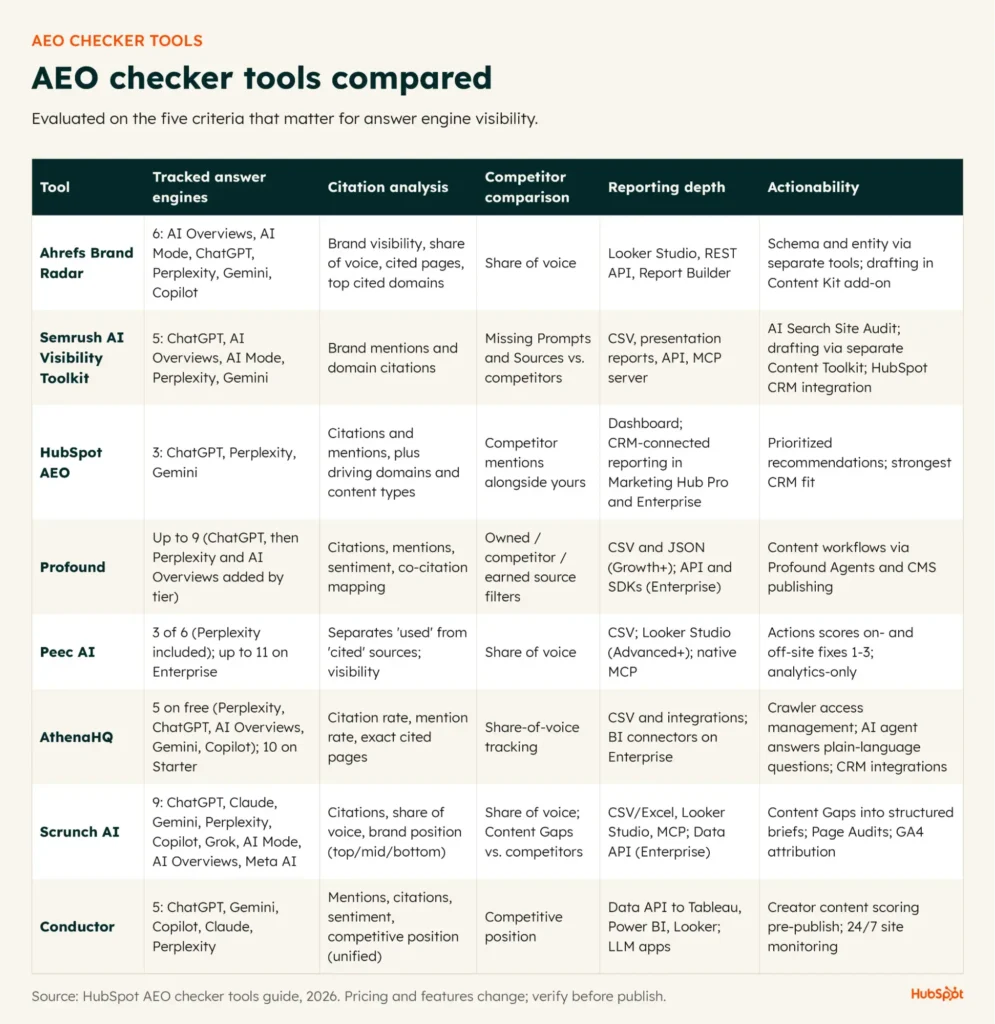
The market for AEO software has expanded rapidly, offering specialized platforms tailored to different aspects of generative engine monitoring. Organizations can select tools based on their specific tracking requirements, ranging from broad search overview trackers to specialized citation analysis engines.
Tools with AI Overviews Tracking
![AEO checker tools that measure answer engine visibility [2026]](https://53.fs1.hubspotusercontent-na1.net/hubfs/53/aeo-checker-3-20260903-8904553.webp)
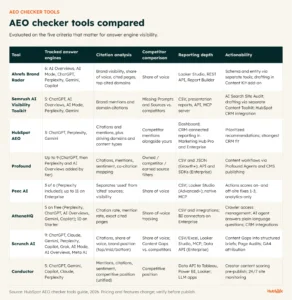
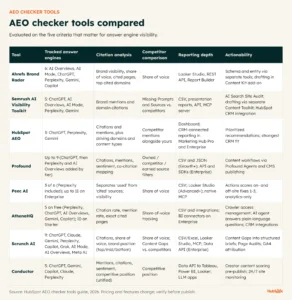
- Ahrefs Brand Radar: Leveraging a massive index built on real search queries rather than synthetic prompts, Brand Radar excels at tracking visibility within Google AI Overviews, providing marketers with deep insights into how organic search rankings intersect with generative summaries.
- Semrush AI Visibility Toolkit: This toolkit integrates directly with organic research data, flagging specific ranking keywords that currently trigger AI Overviews. This allows SEO and content teams to prioritize optimization efforts on pages sitting on the cusp of inclusion.
Tools with ChatGPT Citation Detection
- HubSpot AEO: Offering a holistic approach to generative visibility, HubSpot AEO distinguishes clearly between citations (answers that link back to a domain) and unlinked brand mentions. It tracks dominating domains and content types across ChatGPT, Perplexity, and Gemini, translating raw visibility metrics into actionable, prioritized content recommendations.
- Profound: Moving beyond basic binary citation detection, Profound delivers advanced contextual analysis, including sentiment scoring, flagging of uncited prompts, and a granular breakdown of citations categorized by source type (owned, competitor, or earned media).
Tools with Perplexity Monitoring
- Peec AI: Designed as a pure-play analytics platform, Peec AI focuses on delivering clean, unadulterated performance data specifically dedicated to Perplexity monitoring.
- AthenaHQ: Providing accessibility across multiple tiers—including a functional free plan—AthenaHQ tracks Perplexity performance consistently while incorporating a conversational assistant to help users query their visibility data.
Tools for Schema and Entity Readiness
- Scrunch AI: This platform specializes in the technical underpinnings of AEO, auditing whether AI crawlers can successfully access, read, and render a website’s infrastructure.
- Conductor: Combining around-the-clock technical monitoring with sophisticated content scoring capabilities, Conductor helps enterprise organizations align their technical SEO foundations with the entity-recognition requirements of modern search engines.
Key Metrics That Matter in Answer Engine Optimization
![AEO checker tools that measure answer engine visibility [2026]](https://53.fs1.hubspotusercontent-na1.net/hubfs/53/aeo-checker-4-20260903-6212698.webp)
Evaluating the success of an AEO strategy requires tracking a specialized suite of performance indicators that extend far beyond traditional keyword rankings. Marketing leaders should focus on the following core metrics:
- Brand Citation Share: The percentage of target industry queries in which a brand is explicitly cited or linked within an AI-generated response compared to key competitors.
- Unlinked Mention Volume: The frequency with which a brand name appears in conversational answers even when no direct hyperlink is provided, reflecting brand salience and entity authority within the LLM’s training data and real-time retrieval set.
- Sentiment and Positioning Score: An evaluation of how AI models describe the brand’s use cases, product strengths, and market positioning relative to competitors.
- Referral Traffic and Zero-Click Proxies: While many AI interactions result in zero-click outcomes, marketers must closely monitor AI-referred web sessions, branded search lift, and direct traffic spikes as downstream indicators of generative influence.
Implications and Future Outlook for Digital Marketing
The rise of answer engines and the corresponding adoption of AEO checkers signify a permanent maturation of the digital search ecosystem. As conversational AI agents become the primary gatekeepers between businesses and consumers, the traditional race for absolute keyword dominance is giving way to a more sophisticated pursuit of entity authority, factual accuracy, and structural transparency.
Organizations that fail to adapt to this paradigm risk disappearing into the blind spots of zero-click search results, ceding critical mindshare to competitors who actively optimize for generative visibility. Conversely, brands that integrate continuous AEO monitoring into their marketing stacks will be uniquely positioned to diagnose visibility gaps, remediate technical and content deficiencies, and secure their standing as trusted authorities in the age of artificial intelligence.