
The rapid integration of generative artificial intelligence into software development workflows has fundamentally transformed how engineers write, refactor, and maintain codebases. However, this shift toward AI-driven development—utilizing advanced autonomous agents such as Claude Code, Cursor, Codex, and GitHub Copilot—has concurrently exposed severe performance bottlenecks within traditional compilation and testing toolchains. When an autonomous coding agent modifies a .NET repository, it typically verifies the structural integrity of its modifications by executing standard command-line instructions like dotnet build and dotnet test. Because these agents operate without human intuition regarding code stability, they frequently invoke these diagnostic commands dozens, or even hundreds, of times throughout the completion of a single development task.
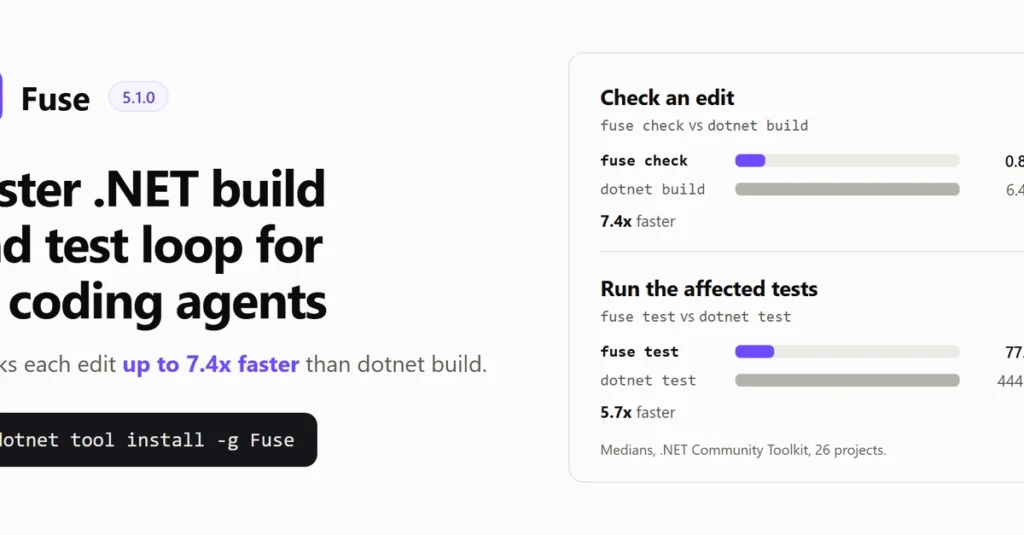
Historically, this repetitive verification cycle has introduced immense computational latency. Standard .NET compilation tools are engineered to perform comprehensive, end-to-end evaluations of an entire solution, scanning projects, dependencies, and metadata from scratch. When executed repeatedly by an automated agent, this process drains computational resources, inflates developer token consumption, and significantly slows down overall workflow velocity. To address this friction point, software engineering teams have increasingly turned toward localized optimization layers. Entering this market is Fuse v5, a specialized .NET utility explicitly designed to bridge the operational gap between fast-moving AI coding agents and heavy enterprise build pipelines. By maintaining a continuously loaded, warm Roslyn compilation state in the background, Fuse v5 dramatically accelerates the feedback loop for AI agents, achieving up to a 7.4-fold acceleration in build verification and a 5.7-fold improvement in targeted test execution across complex multi-project repositories.
The Structural Bottlenecks of AI Code Verification
To understand the magnitude of the performance gains delivered by Fuse v5, it is necessary to examine the operational mechanics of traditional .NET development tooling when coupled with autonomous AI agents. A human software engineer typically exercises considerable discretion before invoking a compilation check. Developers generally write extensive blocks of code, execute mental walkthroughs of their logic, and run dotnet build only when they believe a cohesive unit of work has been successfully completed.
Conversely, autonomous AI coding agents operate on a trial-and-error paradigm. Lacking the subjective confidence of a human developer, an agent will frequently execute dotnet build after modifying just a single line of code. This frequent invocation triggers several distinct operational inefficiencies:
- Redundant Solution-Wide Scanning: Traditional compilers evaluate the entire solution structure, parsing code files and metadata that remain entirely unaffected by the agent’s localized edit.
- Noise and Legacy Errors: A standard build output reports every existing error across the entire codebase, including pre-existing technical debt or legacy compilation warnings that predated the agent’s current task. Consequently, the AI agent often wastes valuable processing turns attempting to resolve errors for which it bears no responsibility.
- Severe Context Window Bloat: Lengthy build logs consume significant context window capacity within the Large Language Model (LLM) driving the agent, reducing its effective memory for code comprehension and task execution.
These compounding inefficiencies create an environment where the slowest tools in a developer’s toolkit are precisely the ones being utilized with the highest frequency. This realization formed the foundational catalyst for the development of the Fuse optimization framework.
Chronology and Evolution of the Fuse Architecture
The release of Fuse v5 represents a comprehensive architectural overhaul compared to its predecessor iterations in the 4.x product line. Development on the Fuse utility began as an experimental approach to mitigating the latency associated with continuous integration loops running locally on developer workstations. Early versions focused primarily on basic file-watching capabilities and incremental compilation heuristics. However, as the adoption of agentic coding workflows surged throughout late 2023 and 2024, the demands placed upon local verification tools evolved rapidly.

The subsequent evolution of the tool culminated in the recent launch of version 5.0.0—and its immediate iterative refinement, version 5.1.0. Rather than serving as a simple script wrapper around standard MSBuild commands, Fuse v5 was re-engineered as a dedicated background engine utilizing the Roslyn compiler platform. By keeping a live, warm compilation session resident in memory, the engine can instantaneously evaluate differences between the current working tree and the last committed state (HEAD).
The timeline of recent updates highlights a strong commitment to stability and multi-agent compatibility. Version 5.1.0 introduced critical concurrency safeguards, implementing a per-repository locking mechanism. This ensures that subagents operating concurrently within the same workspace do not collide or corrupt each other’s temporary build files. Furthermore, the latest iteration refined error isolation protocols, appending contextual cause lines to errors discovered in files outside the agent’s immediate editing scope.
Empirical Benchmarks and Performance Analysis
The performance claims surrounding Fuse v5 are supported by rigorous benchmarking conducted across a diverse array of open-source and generated .NET repositories. Evaluative testing was performed on standard Windows hardware, comparing native execution times against Fuse-accelerated workflows across four distinct codebases: a small generated solution comprising 5 projects and 22 tests; NodaTime, featuring 15 projects and 42,700 tests; Jellyfin, scaling to 40 projects and 2,535 tests; and the .NET Community Toolkit, encompassing 26 projects and 12,449 tests.
The benchmark results demonstrate profound efficiency gains, particularly in compilation checking:
- Small Solution: Achieved a check time of 0.18 seconds via
fuse checkcompared to 1.14 seconds viadotnet build, representing a 6.2x speedup. Affected test execution ran in 1.23 seconds versus 4.00 seconds (3.2x). - NodaTime: Recorded check times of 0.58 seconds against 1.71 seconds (2.9x faster), with affected test suites running in 23.4 seconds compared to 36.3 seconds (1.6x faster).
- Jellyfin: Demonstrated a 7.0x improvement for build checks, dropping from 4.20 seconds down to 0.60 seconds, while test execution improved from 208.3 seconds to 150.0 seconds (1.4x).
- .NET Community Toolkit: Achieved the highest build verification speedup in the study, executing checks in 0.87 seconds compared to 6.45 seconds for a standard build—a 7.4x acceleration. Affected test execution showed an equally dramatic improvement, dropping from 444.6 seconds to 77.6 seconds, representing a 5.7x performance multiplier.
Beyond raw speed, diagnostic accuracy remains paramount in automated development environments. Evaluation suites comprising 120 generated cases and 168 individual edits revealed that Fuse maintained near-perfect fidelity. Across the entire test matrix, the utility missed only a single compiler error that a full native build subsequently reported—an edge case involving an access modifier change in NodaTime—while introducing zero false positives.
Integration Ecosystem and Setup Protocol
A critical factor in the adoption of developer tooling is the friction required for initial configuration. Fuse v5 approaches this challenge through a streamlined, automated setup mechanism that integrates natively with nearly all major AI coding assistants and integrated development environments.
The installation process requires the .NET 10 SDK, a pre-existing Git repository containing at least one commit, and a fully restored project state. Developers can install the global .NET tool via the standard command-line interface:

dotnet tool install -g FuseFollowing installation, executing the initialization command within the root directory of the target repository:
fuse initautomatically detects active AI development agents and registers the appropriate hooks. Fuse v5 provides out-of-the-box integration support for a broad spectrum of platforms, including Claude Code, Cursor, the Gemini CLI, Codex, the GitHub Copilot CLI, OpenCode plugins, and Model Context Protocol (MCP) servers designed for VS Code agent modes.
Once configured, the system operates transparently. When an AI agent modifies code, Fuse intercepts the verification request, isolates the exact compiler errors generated by the specific edit, and presents a concise, structured output to the agent. This targeted response eliminates extraneous log data, dramatically reduces token expenditure, and allows the AI model to correct syntactical or logical discrepancies in significantly fewer operational turns.
Broader Industry Implications and Economic Impact
The introduction of specialized compilation accelerators like Fuse v5 reflects a broader maturation phase within the AI-assisted software engineering sector. As enterprises move beyond initial proof-of-concept deployments of generative coding tools, operational costs—measured both in raw compute latency and proprietary LLM API token consumption—have emerged as significant budget considerations.
By cutting down build verification times by up to 7.4 times and reducing unnecessary test suite overhead by up to 5.7 times, tools like Fuse directly lower the economic barrier to running autonomous coding agents at scale. Furthermore, by shielding models from irrelevant legacy compilation errors and bloated log files, the utility enhances the cognitive focus of the AI agent, leading to higher-quality code generation, fewer regressions, and accelerated software delivery lifecycles for .NET development teams worldwide.