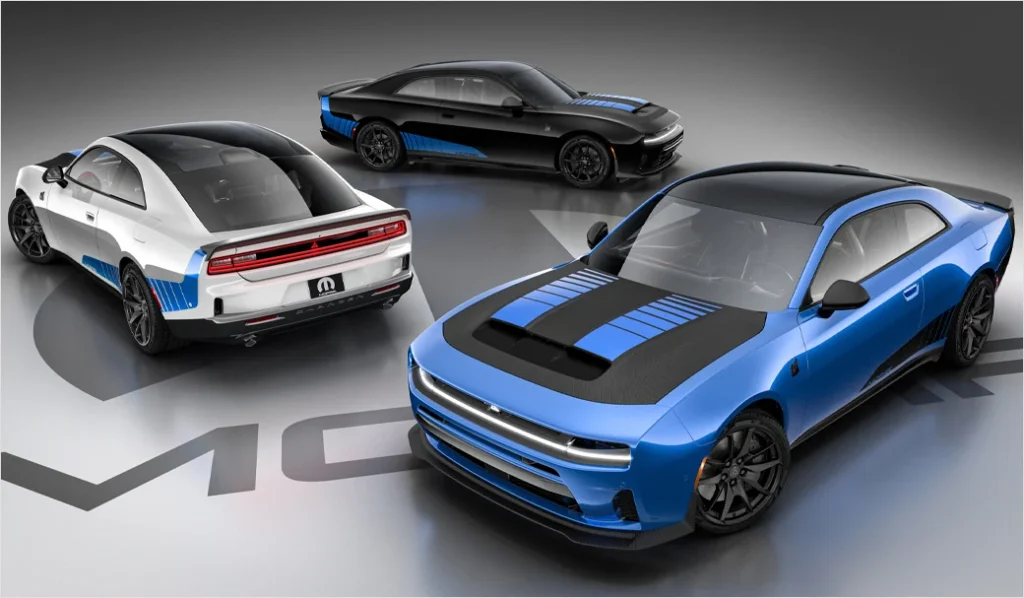

American automotive aftermarket icon Mopar has officially unveiled a special, commemorative logo to celebrate its landmark 90th anniversary, tying the milestone directly to the debut of the upcoming limited-edition Mopar ’27 Dodge Charger. The new celebratory branding honors nearly a century of automotive heritage, bridging the gap between Chrysler’s early days as a modest parts supplier and its modern-day identity under the global automotive conglomerate Stellantis. The special-edition logo will make its physical debut on a numbered, under-bonnet plaque affixed to the radiator of the Mopar ’27 Dodge Charger, which is scheduled to be showcased at the upcoming SEMA Show in Las Vegas.
The unveiling marks a significant chapter for a brand that has spent decades defining American automotive performance, culture, and engineering ingenuity. As the automotive industry transitions rapidly toward electrification and new mobility models, the celebration of Mopar’s 90-year legacy serves as a timely reminder of the enduring passion for internal combustion, high-performance tuning, and enthusiast car culture.
A Century of Evolution: The Chronology of Mopar
To understand the weight of Mopar’s 90th-anniversary milestone, one must look back at the brand’s extensive historical evolution, which closely mirrors the trajectory of the American automotive industry itself.
The etymology of the name "Mopar" is a portmanteau combining the words "motor" and "parts." The entity’s roots trace back to the 1920s when the Chrysler Corporation established a dedicated parts division to support its growing vehicle manufacturing operations. However, the official birth of the Mopar brand name occurred in 1937, when it was designated as the trademark for the company’s new line of chemical products, starting with antifreeze.
Throughout the late 1930s and early 1940s, the scope of operations expanded dramatically. With the onset of the Second World War, the industrial might of American automakers was redirected toward the war effort. Mopar played a vital role during this period, manufacturing essential components, military vehicles, and weaponry for Allied forces.
Following the conclusion of the war and the post-war economic boom, Mopar returned to civilian automotive support, supplying mechanical components, maintenance supplies, and accessories not only for Chrysler vehicles but also for sibling marques such as Dodge, De Soto, and Plymouth.
The definitive turning point for the brand came during the 1960s muscle car golden era. As youth culture and street racing exploded in popularity, Chrysler capitalized on the trend by launching a dedicated high-performance aftermarket parts sector under the Mopar banner. This era saw the introduction of legendary race-ready components, high-output engines like the iconic 426 Hemi, and comprehensive factory-backed racing programs. Mopar-supported vehicles dominated both NASCAR tracks and quarter-mile dragstrips, piloting legendary nameplates including the Dodge Charger, Dodge Challenger, and Plymouth Barracuda.
By the end of the 196
0s, the brand had transcended its corporate identity. Enthusiasts across North America colloquially referred to their high-performance builds simply as "Mopar cars," cementing the brand name as a cultural touchstone. It was also during this golden era that Chrysler introduced the highly recognizable "rolling M" logo, designed by George Robinson, a marketing manager and trained industrial designer, which remains a pillar of automotive iconography to this day.
In the decades that followed, Mopar navigated corporate mergers, economic shifts, and changing consumer preferences. Today, as part of the Stellantis portfolio, the brand serves as the global umbrella for service, parts, and customer-care operations, while continuing to produce low-volume, high-performance vehicle variants that pay homage to its storied past.
The Commemorative Design and the Mopar ’27 Dodge Charger
The newly revealed 90th-anniversary logo represents a careful synthesis of historical reverence and modern graphic design principles. While full details of the graphic geometry have been closely guarded ahead of the public reveal, brand representatives confirm that the emblem has been engineered to encapsulate nine decades of speed, engineering precision, and enthusiast loyalty.
Rather than being plastered across consumer merchandise or mainstream marketing campaigns initially, the anniversary logo is being introduced via an exclusive physical application: a serialized under-bonnet plaque. This plaque will be mounted directly to the radiator of the Mopar ’27 Dodge Charger, a limited-production vehicle created specifically to honor the 90th milestone.
The vehicle and its commemorative badge will be unveiled to the public at the 2026 SEMA (Specialty Equipment Market Association) Show in Las Vegas, an annual gathering that draws hundreds of thousands of automotive professionals, custom builders, and performance enthusiasts from around the globe.
Darren Bradshaw, Senior Vice President of Parts and Services at Stellantis North America, emphasized the strategic timing and cultural importance of the launch.
"Mopar is coming to Las Vegas ready to put performance in the spotlight," Bradshaw stated. "Race fans will be the first to get up close to our new limited-edition Mopar ’27 Dodge Charger before the action heats up on the track, bringing high horsepower, adrenaline, and an all-out drive to win that perfectly captures the spirit of our brands."
The decision to debut the car and its anniversary branding at SEMA underscores the event’s status as the premier global stage for automotive customization and aftermarket innovation—the exact ecosystem Mopar helped pioneer nearly sixty years ago.
Broader Impact and Industry Implications
The celebration of Mopar’s 90th anniversary carries deeper implications for both Stellantis and the broader automotive landscape at a time of profound industrial transformation.
As traditional automotive manufacturers pivot heavily toward electrification, software-defined vehicles, and autonomous technologies, enthusiast-focused sub-brands like Mopar face the challenge of maintaining relevance among a consumer base fiercely loyal to mechanical heritage. By leaning into milestone anniversaries and limited-edition internal combustion vehicles like the Mopar ’27 Dodge Charger, Stellantis effectively reassures the enthusiast community that its performance heritage will not be forgotten or abruptly discarded in the rush toward a zero-emission future.
Furthermore, the aftermarket and service sectors remain major revenue drivers for automotive conglomerates. Mopar’s longevity demonstrates the commercial viability of maintaining long-term lifecycle support for vehicles, offering authentic accessories, restoration parts, and performance upgrades that deepen consumer loyalty.
Industry analysts note that heritage branding plays a crucial psychological role in consumer retention. Brands that can authentically claim a history spanning nearly a century possess a distinct competitive advantage in building emotional connections with buyers. By honoring its origins as a practical parts provider before its evolution into a high-performance cultural phenomenon, Mopar reinforces its position as an enduring pillar of American automotive culture.
As the Mopar ’27 Dodge Charger takes center stage in Las Vegas next week, it will do so not merely as a new vehicle release, but as a rolling testament to 90 years of engineering adaptation, racing pedigree, and the enduring power of the enthusiast garage.