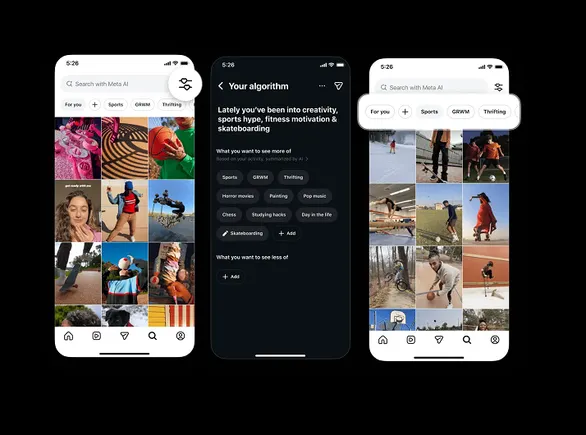
In an effort to provide users with more granular control over their digital experiences, Instagram has officially announced the expansion of its "Your Algorithm" feature, allowing individuals to actively manage the content recommendations they encounter within the Explore feed. This update represents a significant shift from the platform’s traditional reliance on passive observation of user behavior, moving toward a model that incorporates direct, intentional input from the user base. Previously limited to the Reels tab, the expansion to the Explore feed signifies Instagram’s commitment to a unified recommendation system that spans multiple surfaces within the application.
The "Your Algorithm" tool provides a straightforward interface where users can input specific topics they wish to see more frequently or, conversely, topics they would prefer to avoid. By selecting from suggested interest categories or typing in specific themes, users can theoretically fine-tune the automated systems that govern their daily scrolling. According to official statements from Instagram, any adjustments made within this tool will now carry across both Reels and the Explore feed, reinforcing the concept of a singular, cohesive algorithmic profile for every account. This "one algorithm" approach is designed to ensure that a user’s preferences are reflected consistently, regardless of which part of the app they are currently navigating.
The Evolution of Instagram’s Discovery Engine
The introduction of these controls marks a pivotal moment in the chronological history of Instagram’s development. For years, the platform operated primarily on a social graph—a system where users saw content based almost exclusively on the accounts they chose to follow. However, following the industry-wide shift toward short-form video and interest-based discovery, largely pioneered by competitors like TikTok, Instagram transitioned into what Meta executives frequently refer to as a "Discovery Engine."
In this current iteration, AI-driven recommendations account for an increasingly large percentage of the content a user sees. This shift has not been without controversy. Many long-term users have expressed frustration over the dilution of their primary feeds with "suggested" content from accounts they do not follow. The "Your Algorithm" expansion serves as a strategic response to these criticisms, offering a middle ground where the platform can maintain its AI-driven engagement levels while providing users with the perception—and the practical tools—of agency.
Instagram first began testing these manual topic controls for Reels in October. The pilot program aimed to determine whether users would engage with manual curation tools and whether such inputs would improve overall satisfaction scores. The decision to roll out the feature to the Explore feed suggests that the initial data from the Reels test was positive enough to warrant a broader application. As of the current rollout, the feature is being made available to all English-language users globally, with plans for further linguistic and regional expansions in the coming months.
Technical Mechanics and User Interface
The functionality of the "Your Algorithm" feature is integrated directly into the existing user interface to minimize friction. Within the Explore tab, users will now notice "topic pills" at the top of the screen. These are interactive labels that categorize content. By interacting with these pills, users can add or remove specific interests on the fly. Furthermore, the settings menu now includes a dedicated section for "Your Algorithm," where a comprehensive list of inferred interests is displayed.
From this dashboard, a user can see exactly what the AI thinks they are interested in based on their past likes, saves, and watch times. If the algorithm has incorrectly identified a user as an enthusiast of a specific niche—such as extreme sports or niche cooking—the user can manually delete that interest. Conversely, they can proactively add topics like "sustainable architecture" or "independent cinema" to ensure those themes are prioritized in their feed.
A unique social component has also been added to this update. Users now have the option to share their selected interests to their Instagram Stories. While seemingly a minor feature, this encourages transparency and peer-to-peer discovery of the new tool, potentially increasing the adoption rate of a feature that might otherwise remain buried in the settings menu.
Supporting Data: The Role of AI in Meta’s Growth
To understand why Instagram is introducing these controls now, it is essential to look at the underlying data regarding Meta’s performance. In recent quarterly earnings reports, Meta has consistently highlighted that AI-driven recommendations are the primary catalyst for increased time spent on both Facebook and Instagram. According to Meta’s internal metrics, the implementation of more sophisticated AI models has led to a double-digit percentage increase in the time users spend consuming Reels.
However, there is a delicate balance to maintain. Internal research across the social media industry suggests that while AI can maximize short-term engagement, it can also lead to "content fatigue" if the variety of the feed becomes too narrow or if the algorithm becomes stuck in a "filter bubble." By allowing users to manually reset or nudge their interests, Instagram is essentially creating a safety valve for its recommendation engine. This helps prevent user churn by giving people a way to "break out" of repetitive content cycles without having to leave the platform entirely.

Furthermore, industry data indicates that transparency is becoming a major factor in brand loyalty among Gen Z and Millennial demographics. A 2023 study on digital consumer behavior found that over 60% of social media users felt "manipulated" by algorithms they did not understand. By surfacing the "Your Algorithm" dashboard, Instagram is attempting to demystify its backend processes, moving away from the "black box" model of social media and toward a more collaborative relationship with its audience.
Official Responses and Strategic Implications
Adam Mosseri, the Head of Instagram, has frequently addressed the tension between user control and algorithmic efficiency in his weekly "Ask Me Anything" sessions and video updates. Mosseri has noted that while users often claim they want a purely chronological feed, engagement data shows that most users find such feeds less interesting over time because they lack the element of discovery.
"We want to make sure that the time people spend on Instagram is intentional and valuable," Mosseri stated in a recent discussion regarding platform transparency. "Giving people the ability to tell us directly what they want more of—and what they want less of—is a key part of that mission."
From a strategic standpoint, this update also serves as a preemptive measure against increasing regulatory scrutiny. In jurisdictions like the European Union, the Digital Services Act (DSA) and the Digital Markets Act (DMA) are placing immense pressure on "Very Large Online Platforms" (VLOPs) to provide users with more control over how their data is used to profile them. Features like "Your Algorithm" provide a documented way for Meta to show regulators that they are empowering users with choices regarding their data-driven experiences.
The Paradox of User Control: Analysis of Broader Impact
Despite the technical sophistication and the noble intent behind the "Your Algorithm" feature, industry analysts remain skeptical about its long-term impact on the average user’s experience. History in the social media space suggests a phenomenon known as the "Paradox of Choice." While users frequently vocalize a desire for manual controls and chronological options, the vast majority of people never actually use them.
When Instagram reintroduced the "Following" and "Favorites" chronological feed options in 2022, adoption rates were reportedly low. Most users continued to default to the main algorithmic feed because it requires the least amount of effort. The "Your Algorithm" tool faces a similar challenge: it requires manual labor from the user. For a platform built on the concept of "frictionless scrolling," any feature that requires a user to stop, think, and input data is inherently at odds with the core user behavior.
However, the value of this feature may not lie in its widespread use, but rather in its existence as a "reassurance mechanism." Even if only 5% of the user base actively manages their topic list, the fact that the option exists provides a psychological sense of agency to the other 95%. It shifts the narrative from "the algorithm is forcing this on me" to "I am choosing to let the algorithm show me this."
For creators and digital marketers, this update introduces a new layer of complexity to Search Engine Optimization (SEO) within the app. If users are now manually selecting topics, it becomes even more critical for creators to use accurate keywords, hashtags, and alt-text to ensure their content is correctly categorized by Instagram’s system. If a user manually adds "vintage fashion" to their interests, and a creator’s post is not properly tagged as such, that post may miss out on a highly motivated and intentional audience.
Conclusion and Future Outlook
The expansion of "Your Algorithm" to the Instagram Explore feed is a clear indicator of where the social media landscape is heading. We are moving toward a hybrid era where powerful AI models provide the foundation of the experience, but human curation provides the direction. This update acknowledges that while AI is excellent at predicting what we might like based on our past, it is less capable of knowing who we want to become or what new interests we wish to cultivate.
As Instagram continues to roll out this feature to non-English speaking markets, the platform will likely monitor how direct user inputs affect long-term retention. If successful, we can expect to see even more granular controls, perhaps even extending to the main feed or the "Suggested Posts" that appear between friends’ photos. For now, the "Your Algorithm" expansion stands as a significant experiment in digital sovereignty, testing whether users truly want to be the architects of their own feeds or if they are content to let the machine lead the way.