The history of 20th-century American photography is often defined by those who sought the spotlight, yet some of its most profound contributions have emerged from the shadows of anonymity and reclusion. For decades, a man named Angelo Antonio Rizzuto walked the streets of Manhattan with a camera, capturing the shifting soul of New York City with a persistence that bordered on the obsessive. His work, consisting of approximately 60,000 images, remained largely unexamined for over half a century, only gaining significant scholarly attention in recent years. Rizzuto’s life and legacy offer a striking parallel to the posthumous discovery of Vivian Maier, yet his story is uniquely shaped by a complex personal history of mental illness, legal battles, and a deliberate, albeit posthumous, attempt to secure his place in the American canon through the Library of Congress.

The Formative Years: From the Plains to the Ivy League
Angelo Antonio Rizzuto was born in 1906 in South Dakota to Sicilian immigrant parents, a background that placed him at the intersection of the burgeoning American Dream and the challenges of the immigrant experience. His family eventually moved to Omaha, Nebraska, where he was raised in a stable, middle-class environment. Rizzuto was intellectually gifted, eventually securing admission to Harvard Law School. However, the trajectory of his life took a sharp turn when he failed to complete his studies, a failure that would haunt his later years and contribute to a growing sense of alienation.
The pivotal moment in Rizzuto’s descent into reclusion occurred following the death of his father. A bitter and protracted dispute over the family estate fractured his relationships with his siblings and left him emotionally devastated. This period of turmoil culminated in a suicide attempt in 1941, leading to his institutionalization. Following his release, Rizzuto attempted to find purpose through military service during World War II, but his tenure was brief; he received a medical discharge, likely due to his ongoing struggles with mental health. For several years, he lived a transient existence, moving across the United States before finally settling in New York City in the late 1940s.

The Manhattan Routine: 1952–1964
By the time Rizzuto established himself in Manhattan, he had adopted a lifestyle characterized by extreme isolation. He resided in a small, cramped rented room where he avoided social interaction. Despite this self-imposed solitude, Rizzuto possessed significant financial resources, likely derived from his inheritance. He used these funds to purchase a brownstone on East 51st Street, which he utilized not as a residence, but as a private studio and darkroom.
For eighteen years, Rizzuto adhered to a rigid, almost ritualistic daily schedule. Every afternoon at precisely 2:00 p.m., he would emerge from his home equipped with his camera to document the city. His objective was nothing less than a comprehensive visual census of Manhattan, a project he titled "Little Old New York." Between 1952 and 1964, Rizzuto’s output was staggering. He was not merely a hobbyist; he was a methodical documentarian who worked with bulk film, often carrying multiple cameras to ensure he never missed a moment of light or shadow.

Themes and Artistic Methodology
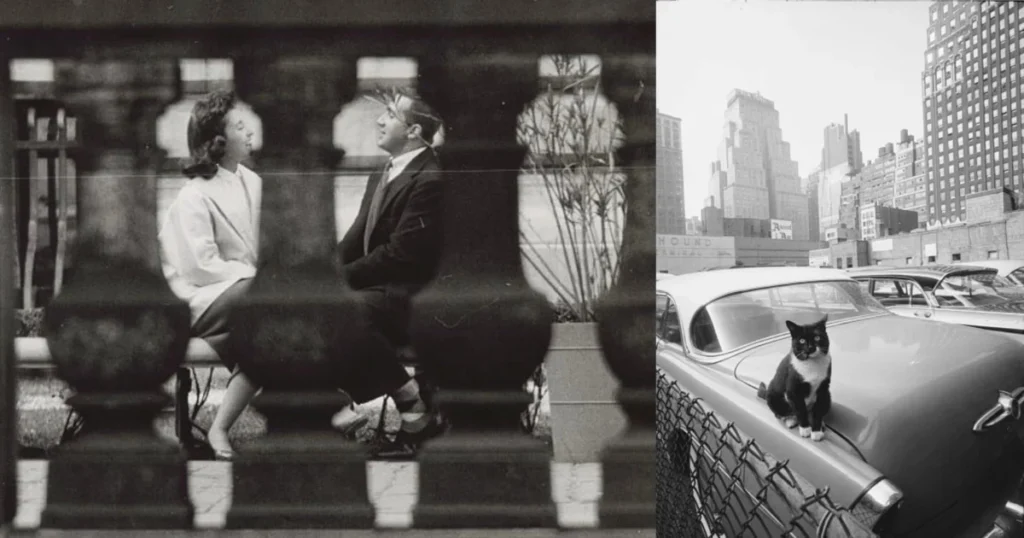
Rizzuto’s work is characterized by a sophisticated understanding of geometry and urban scale. While many street photographers of the era focused on the grit of the city, Rizzuto appeared equally fascinated by its structural elegance. His archive is filled with images of skyscrapers, bridges, and the intricate patterns of fences and railings. These architectural elements often served as frames for his human subjects, creating a sense of distance and voyeurism that mirrored his own social isolation.
Jan Grenci, a reference specialist in the Prints and Photographs Division of the Library of Congress, has noted several recurring motifs in Rizzuto’s collection. These include:

- Animals in the Urban Landscape: Frequent depictions of cats and dogs, often captured in moments of stillness amidst the city’s chaos.
- The Transit Experience: Candid shots of commuters on subways and in train stations, capturing the exhaustion and anonymity of mid-century New York life.
- Religious Imagery: A recurring fascination with nuns, often photographed against the backdrop of secular storefronts or city streets.
- Childhood and Innocence: Images of children playing in parks or on sidewalks, providing a soft contrast to the rigid geometry of the surrounding architecture.
Perhaps the most revealing aspect of Rizzuto’s methodology was his use of self-portraiture. After 1953, he began a practice of ending almost every roll of film with a portrait of himself. These images were rarely flattering; they often showed a man looking directly into the lens with a piercing, sometimes troubled gaze. By including himself in the archive, Rizzuto transformed his project from a simple documentation of a city into a psychological map of his own existence within that city.
A Chronology of the Anthony Angel Collection
The journey of Rizzuto’s archive from a private darkroom to a public institution was fraught with legal complications.

- 1906: Angelo Antonio Rizzuto is born in South Dakota.
- 1941: Suicide attempt and subsequent institutionalization following family estate disputes.
- 1940s (Late): Rizzuto moves to New York City and begins his photographic explorations.
- 1952: The formal commencement of his daily 2 p.m. photographic routine.
- 1964: Rizzuto ceases his intensive daily documentation as his health begins to fail.
- 1967: Rizzuto dies of cancer. In his will, he leaves his vast archive and the proceeds from the sale of his brownstone to the Library of Congress. He requests that the collection be named "The Anthony Angel Collection," using the Americanized pseudonym he frequently employed.
- 1967–2001: The will is contested by Rizzuto’s surviving family members. The legal battle leaves the archive in a state of limbo for decades.
- 2001: The Library of Congress officially takes full possession of the 60,000 photographs and associated materials.
- 2021: After years of preservation and cataloging, the archive is made fully available for public research and digital viewing.
Comparative Analysis: Rizzuto vs. Maier
The comparison between Angelo Rizzuto and Vivian Maier is inevitable. Both were reclusive figures who produced tens of thousands of world-class photographs while working in total obscurity. However, their legacies differ significantly in their intentionality.
Vivian Maier’s work was discovered by chance at an estate auction after she failed to keep up with storage locker payments. Her rise to fame was driven by the commercial market and documentary filmmakers. In contrast, Rizzuto was acutely aware of the value of his work. His decision to bequeath his archive to the Library of Congress, along with the funds necessary to maintain it, suggests a man who was deeply concerned with his posthumous reputation. He did not want his work to be found by accident; he wanted it to be preserved as a formal contribution to the history of the United States.

Furthermore, while Maier’s work often feels warm and empathetic, Rizzuto’s images frequently carry an undercurrent of tension. His use of architectural barriers—railings, glass, and tracks—often separates the photographer from the subject, highlighting the isolation that defined his life.
Data and Archival Scope
The Anthony Angel Collection at the Library of Congress is one of the most comprehensive single-artist records of mid-century New York. The data points regarding the collection underscore its importance:

- Total Images: Approximately 60,000.
- Format: Primarily 35mm black-and-white film, supplemented by contact sheets and some color transparencies.
- Organization: Unlike most photographers who organize by date, Rizzuto organized his contact sheets by theme, indicating a high level of intentionality in how he wanted his work to be interpreted.
- Financial Legacy: The sale of his East 51st Street brownstone provided the Library of Congress with the capital needed to process the collection, a rare occurrence in the world of archival acquisitions.
Broader Impact and Implications for Art History
The "rediscovery" of Angelo Rizzuto raises fundamental questions about the nature of artistic genius and the role of the archive. In the digital age, where images are shared instantaneously, the idea of a photographer working in total isolation for eighteen years seems almost impossible. Rizzuto’s work serves as a reminder that significant portions of our cultural history may still be hidden in attics, basements, and institutional storage.
Art historians and sociologists are now using the Rizzuto archive to study the "micro-history" of New York City. Because Rizzuto photographed the same areas at the same time of day for years, his work provides a unique data set for observing the subtle changes in urban life, fashion, and infrastructure during the post-war boom.

Moreover, Rizzuto’s story challenges the stigma surrounding mental illness and creativity. While his reclusion and paranoia were symptoms of his struggles, they were also the catalysts for his unique perspective. His camera was both a shield and a bridge, allowing him to engage with a world he found otherwise overwhelming.
As the Library of Congress continues to digitize the Anthony Angel Collection, the public perception of 1950s New York is being subtly reshaped. Angelo Rizzuto may have lived as a ghost in the city he loved, but through his meticulous documentation, he has ensured that neither he nor his "Little Old New York" will be forgotten. His archive stands as a testament to the power of the individual observer and the enduring importance of the public institutions that protect our collective memory.