Tag: strategies

  • The Unseen Hurdles: Why 90% of Aspiring Developers Discontinue Their Journey Within Six Months and the Strategies Employed by the Resilient 10%.

    The Unseen Hurdles: Why 90% of Aspiring Developers Discontinue Their Journey Within Six Months and the Strategies Employed by the Resilient 10%.

    The journey into software development, often perceived as a straightforward path to innovation and lucrative careers, presents a formidable psychological and intellectual challenge that leads a significant majority of beginners to abandon their efforts within their first six months. This high attrition rate, estimated by various industry observers to affect as many as 90% of self-taught programmers, is not primarily a result of the inherent difficulty of coding itself, but rather a widespread misunderstanding of the fundamental cognitive shifts and learning methodologies required for sustained progress. Thousands embark on this path annually, drawn by the promise of the tech industry, often commencing with online tutorials and introductory projects. While initial successes, such as replicating basic web pages or cloning simple applications, can foster a sense of accomplishment and momentum, this early confidence frequently gives way to disillusionment and stagnation around the critical three-to-six-month mark. Progress decelerates, motivation wanes, previously comprehensible tutorials become opaque, and the insidious grip of imposter syndrome takes hold, culminating in a quiet, often unacknowledged cessation of coding activities. This phenomenon is less about a lack of innate intelligence or talent and more about an unpreparedness for the predictable traps that ensnare almost every novice.

    The Initial Lure and the Abrupt Shift to Cognitive Overload

    The initial phase of learning to code is characterized by what can be described as concrete learning and immediate gratification. Beginners typically engage with foundational concepts like HTML, CSS, and basic JavaScript, where changes in a line of code translate almost instantaneously into visible alterations in a web browser. This direct feedback loop fosters a sense of linear progression, making the learning process feel manageable and rewarding. The immediate visual output reinforces understanding and builds initial confidence, creating a positive feedback cycle that encourages continued engagement. This period often involves following step-by-step guides, replicating existing interfaces, and experiencing a rapid accumulation of surface-level knowledge.

    However, this linear progression reaches an abrupt halt when learners transition beyond rudimentary concepts. The curriculum inevitably moves into more abstract domains, introducing complex data structures, algorithms, advanced JavaScript frameworks (such as React or Angular), backend technologies (like Node.js or Python with Django/Flask), database management, and version control systems. At this juncture, the brain, which was comfortably processing simple patterns and direct correlations, is suddenly confronted with multiple layers of abstraction simultaneously. This is the precise moment when cognitive overload becomes a dominant factor. Instead of merely asking "What code should I type?", the aspiring developer must now grapple with "What is happening?", "Where is it happening?", "When is it happening?", and "Why is it happening?"—questions that demand a sophisticated level of systems thinking rather than rote memorization. This transition from merely coding to understanding the intricate interplay of various system components is often unanticipated and can quickly transform initial excitement into profound frustration, leading to feelings of being utterly lost despite a foundational grasp of earlier concepts. This psychological collapse is a common and predictable hurdle for self-taught developers, often mistaken for a personal failing rather than a universal challenge in the learning curve.

    The "Valley of Abandonment": A Critical Juncture

    This period of intense cognitive strain and perceived stagnation is widely referred to as "The Valley of Abandonment." It represents a critical psychological phase where individuals possess enough knowledge to no longer feel like absolute beginners but lack the comprehensive understanding and practical experience to feel genuinely competent. This uncomfortable intermediate state is characterized by several disheartening experiences. Aspiring developers often find themselves overwhelmed by the sheer volume of information they encounter, struggling to connect disparate concepts or understand how different components of a system interact. The joy of solving simple problems gives way to the arduous task of debugging complex errors that offer little immediate feedback, leading to prolonged periods of frustration. Furthermore, the supportive scaffolding provided by structured tutorials diminishes, forcing learners to confront problems independently, a shift for which many are unprepared. This disorienting phase marks a significant turning point; those who persevere through this valley are often the ones who ultimately succeed in their programming journey.

    Beyond Memorization: The Foundational Misconception

    A core reason for the high attrition rate stems from a pervasive misconception about what it truly means to be a developer. Many beginners approach programming as a subject to be memorized, akin to learning a new language by rote or studying for a history exam. They diligently consume tutorials, memorize syntax rules, copy-paste code snippets, and attempt to recall specific commands for particular tasks. While this strategy yields initial results and can be effective for mastering basic syntax and small, isolated problems, it fundamentally fails when confronted with the dynamic and interconnected nature of real-world software development. Programming is not about remembering what to type; it is about understanding why things work, how different pieces fit together, and how to solve novel problems.

    This distinction becomes painfully evident around the six-month mark. The challenges evolve from syntax recall to debugging complex systems, integrating multiple libraries, optimizing performance, and designing scalable architectures. These tasks demand conceptual understanding, logical reasoning, and an iterative problem-solving approach, rather than mere recall. Faced with this paradigm shift, many beginners instinctively double down on their memorization strategies—seeking more tutorials, copying more code, and attempting to cram more facts—a futile effort that only deepens their frustration and reinforces the feeling of inadequacy.

    Understanding the "Why": Cognitive Shifts in Learning

    The hidden transition that every successful developer undergoes involves a fundamental shift from concrete learning to abstract thinking. Initially, learners operate in Phase 1: Concrete Learning. This involves following explicit instructions, understanding specific syntax, building small, isolated components, and receiving immediate, tangible results. The focus is on the "how-to" and the direct application of learned rules.

    However, the real transition occurs in Phase 2: Abstract Thinking. This phase demands understanding underlying principles, designing system architecture, debugging complex interactions, and integrating various components into a cohesive whole. It requires connecting seemingly unrelated concepts, anticipating consequences, and developing a mental model of how an entire system operates. This is where learners move from "what to type" to "why it works" and "how to design it." For many, this shift feels like moving from simple arithmetic to solving intricate puzzles with missing pieces—a leap for which they were not adequately prepared. The failure to make this cognitive transition, rather than a lack of capacity, is often the primary reason for abandonment.

    Industry Perspective and Supporting Data

    The high attrition rate among aspiring developers has significant implications for the global tech industry, which faces a persistent demand for skilled professionals. According to reports from organizations like Stack Overflow, while interest in learning to code remains high, the journey from beginner to proficient developer is fraught with challenges. Data often indicates that a significant percentage of individuals who begin online courses or bootcamps do not complete them, or struggle to secure employment within the field. For instance, some coding bootcamps report completion rates ranging from 70-85%, but these figures often don’t account for those who drop out before official enrollment or the long-term retention in the field. The broader "learn to code" movement, while democratizing access to education, has also inadvertently contributed to unrealistic expectations. Many online platforms emphasize quick results and simplified paths, potentially downplaying the rigorous cognitive demands and sustained effort required.

    Industry experts and educators frequently highlight the need for greater emphasis on problem-solving, critical thinking, and resilience from the outset. Dr. Angela Yu, a prominent programming instructor, often speaks about the "trough of sorrow" in learning, aligning with the "Valley of Abandonment" concept, where students face their greatest challenges. Similarly, psychological research on expertise development, such as that by K. Anders Ericsson on deliberate practice, underscores that true mastery in complex domains like programming comes from focused, effortful engagement with challenges that push learners beyond their current capabilities, rather than passive consumption of information.

    The background context here is the explosion of digital learning resources. The accessibility of free and low-cost tutorials has lowered the barrier to entry, but it has not necessarily prepared learners for the depth of understanding required. The tech industry’s rapid evolution, with new frameworks and tools emerging constantly, also contributes to the sense of overwhelm, as learners feel a perpetual need to keep up, often before they’ve mastered fundamentals. This dynamic creates a talent pipeline issue where many start, but few endure to become truly job-ready, contributing to a persistent skills gap despite a large pool of aspiring developers.

    The Path Less Travelled: What the Top 10% Do Differently

    The minority of developers who successfully navigate the initial six months and establish a solid foundation are not endowed with superhuman abilities; they simply adopt fundamentally different approaches to learning. Their strategies revolve around a proactive embrace of challenges and a deep commitment to understanding over memorization.

    Firstly, these successful learners prioritize understanding over rote memorization. Instead of merely asking "What code should I write?", they relentlessly pursue the question, "What is actually happening here?" This involves active debugging, dissecting existing codebases to grasp their underlying logic, and consistently questioning the "why" behind every line of code. They focus on internalizing core concepts, understanding data flow, and comprehending the architecture of systems, rather than just memorizing syntax or patterns.

    Secondly, the top 10% build without excessive reliance on tutorials. While beginners often find comfort and initial guidance in structured lessons, advanced learners deliberately seek out opportunities to struggle independently. This means attempting projects from scratch, even if it requires extensive research and trial-and-error, rather than following prescriptive guides. This "deliberate struggle" is crucial for developing problem-solving skills, fostering independent thinking, and building the mental resilience necessary to overcome complex technical challenges. They understand that true learning occurs when they are actively engaged in solving problems, not passively consuming information.

    Thirdly, they accept confusion as an intrinsic and necessary part of the learning process. Most aspiring developers equate confusion with failure, interpreting it as a sign that they are not smart enough or lack talent. However, successful learners reframe confusion as an indicator of growth and an opportunity for deeper understanding. They recognize that if everything were always clear and straightforward, they would not be expanding their knowledge base or developing new cognitive pathways. This mindset shift—viewing ambiguity and difficulty as stepping stones rather than roadblocks—is pivotal for sustained progress.

    Finally, these resilient individuals cultivate systems thinking, rather than merely focusing on isolated lines of code or syntax. They strive to comprehend how different components of a software application interact, how data flows through a system, and how architectural choices impact performance and scalability. This holistic perspective transforms them from mere "coders" who write instructions into "developers" who design, build, and maintain complex, functional systems. This shift enables them to anticipate problems, design robust solutions, and debug with greater efficiency, ultimately leading to more sophisticated and impactful contributions.

    Strategies for Navigating the Early Stages of Programming

    For those currently entrenched in the challenging initial phase of programming, specific strategies can significantly increase the likelihood of success. It is crucial to re-evaluate learning methodologies and adopt practices that foster deeper understanding and resilience.

    Firstly, transition from tutorial consumption to active project building. After grasping fundamental concepts, learners should immediately apply them by attempting independent projects. These projects should be challenging enough to require research and problem-solving, but not so complex as to be entirely overwhelming. This hands-on application solidifies understanding and reveals gaps in knowledge more effectively than passive learning.

    Secondly, embrace deliberate debugging as a primary learning tool. Instead of viewing errors as setbacks, interpret them as opportunities to learn about how systems fail and how to diagnose issues. Spend time understanding error messages, using debugging tools, and tracing code execution. This process is instrumental in developing a deep understanding of code logic and system behavior.

    Thirdly, seek out and engage with a supportive community. Connecting with other learners, mentors, or online forums provides invaluable resources for problem-solving, sharing experiences, and receiving encouragement. A community can offer alternative perspectives on challenges, reduce feelings of isolation, and combat imposter syndrome.

    Fourthly, cultivate a growth mindset. Understand that intelligence and ability are not fixed traits but can be developed through effort and perseverance. Frame challenges as opportunities for growth rather than insurmountable obstacles. This psychological resilience is often more critical than raw technical aptitude.

    Most importantly, individuals should resist the urge to quit precisely when the learning process transitions from superficial understanding to profound comprehension. The six-month mark is not an endpoint of failure, but rather the true beginning of the rigorous, yet ultimately rewarding, journey of becoming a proficient software developer.

    Broader Implications for the Tech Ecosystem

    The high attrition rate among aspiring developers has significant implications extending beyond individual learners. For the tech ecosystem, it represents a persistent challenge in addressing the global demand for skilled software engineers. Companies invest heavily in training and upskilling initiatives, but the early dropout rate means a substantial portion of this investment may not yield the desired return. Educational institutions, particularly coding bootcamps and online learning platforms, are increasingly recognizing this issue and adapting their curricula to emphasize problem-solving, resilience, and realistic expectations from the outset. There is a growing movement to integrate more project-based learning, peer mentorship, and psychological support into programming education to help students navigate the "Valley of Abandonment."

    Furthermore, the societal impact of a robust and diverse tech workforce is immense. A higher retention rate of aspiring developers would contribute to greater innovation, economic growth, and the creation of solutions for complex global challenges. The narrative around "learning to code" needs to evolve from one of simplistic accessibility to one that accurately portrays the intellectual rigor and sustained effort required, while simultaneously providing better structured support systems for beginners. This includes developing curricula that progressively introduce abstraction, providing clear benchmarks for cognitive development, and fostering environments where struggle is normalized and celebrated as a precursor to mastery.

    Conclusion

    The six-month mark in an aspiring developer’s journey is not where failure occurs, but rather where the real and often arduous journey truly commences. Those who discontinue their efforts often perceive difficulty as an insurmountable barrier, a definitive stop sign signaling a lack of inherent capability. Conversely, the successful minority views these same challenges as essential transitional phases, critical indicators of intellectual growth and deeper engagement with the subject matter. To feel overwhelmed, stuck, or unsure of oneself during this period is, paradoxically, a positive sign—it signifies that the learner is confronting genuine complexity and pushing the boundaries of their current understanding. This is precisely where authentic growth is initiated. The fundamental question for every aspiring developer facing this critical juncture is not whether they possess innate talent, but rather whether they will choose to persevere through the psychological wall, embracing the discomfort and rigorous demands of abstract thinking, or retreat like the majority. The future of their coding journey, and potentially their career, hinges on this pivotal decision.

  • Elevating Minority Creators: Strategies for Building Resilient Brands in the Trillion-Dollar Creator Economy

    Elevating Minority Creators: Strategies for Building Resilient Brands in the Trillion-Dollar Creator Economy

    The global creator economy, often met with skepticism, is on an undeniable trajectory, projected to surpass an astounding $1.18 trillion USD by 2032. This monumental growth represents a critical juncture, particularly for minority creators and entrepreneurs from underrepresented groups, who stand to redefine their economic futures and influence cultural landscapes. The digital age has democratized avenues for self-expression, fostering connection and community among previously niche audiences. It has simultaneously illuminated systemic pain points and untapped business opportunities, areas where creators from these very communities are uniquely positioned to innovate and lead.

    Despite this burgeoning potential, the path to success for minority creators is fraught with disproportionate challenges. While becoming a successful content creator is inherently difficult, studies consistently reveal a significant pay disparity: minority creators earn, on average, 50% less than their white counterparts. This gap is not merely anecdotal; specific data indicates that Black influencers earn 34.04% less, South Asian influencers 30.70% less, East Asian influencers 38.40% less, and Southeast Asian influencers a staggering 57.22% less. This disparity underscores the urgent need for strategic branding to help close this economic divide. The fundamental question is no longer about belonging – minority creators unequivocally deserve their space – but rather how to forge brands imbued with genuine authority, cultivate loyal audiences, and establish resilient businesses capable of thriving in a demanding and often biased environment. This article delves into actionable strategies designed to empower minority creators to achieve just that.

    8 Ways to Elevate Your Brand as a Creator or Entrepreneur (& Close the Pay Gap)

    The Evolving Landscape of the Creator Economy: Growth, Consolidation, and Disparity

    The rapid expansion of the creator economy is undeniable. HubSpot research indicates that 89% of companies engaged with content creators or influencers in 2025, with 77% planning increased investment in influencer marketing this year. The market, which includes content creators, curators, and community builders, has been fueled by accessible digital tools and platforms, transforming individual passions into viable professions. However, this growth has not translated into widespread prosperity for all. A stark reality persists: approximately 96% of creators still earn less than $100,000 annually, highlighting a substantial chasm between a small elite and the vast majority striving for sustainable income.

    Forbes contributor Jason Davis posits that this concentration of wealth signals the industry’s maturation. Brands are increasingly consolidating their investments into "proven" influencers, leading to a landscape where success is concentrated among fewer individuals. Davis draws a parallel to the early internet search engine era: "Early stages reward experimentation and specialization. When search engines emerged, Archie and Ask Jeeves held the traffic, [but] Google took market share and was rewarded through integration, scale, and disciplined execution. The creator economy has reached that same point." This consolidation means that simply "creating" is no longer sufficient; strategic branding and business acumen are paramount.

    With over 200 million creators globally, the highest earners are not merely increasing their output; they are actively diversifying across five or more revenue streams. Data from Circle reveals that only 22% of creators report earning from affiliate revenue, and a mere 18% from sponsorships, indicating a significant reliance on direct monetization strategies. This evolving environment, coupled with challenges such as algorithmic bias that can disproportionately impact content from minority creators, necessitates a multi-faceted approach for building robust brands and overcoming entrenched pay disparities. The digital divide, which often mirrors existing socio-economic inequalities, can further exacerbate these challenges, making strategic brand building an imperative rather than an option.

    8 Ways to Elevate Your Brand as a Creator or Entrepreneur (& Close the Pay Gap)

    Strategic Pillars for Minority Creators to Build Authority and Resilience

    To navigate this complex terrain, minority creators must adopt proactive strategies that build on their unique perspectives while establishing undeniable expertise.

    1. Lead with Unique Authority and Niche Expertise

    While identity is a powerful lens, true authority transcends it. Niche selection helps locate an audience, and identity can open initial doors, but sustained success and scalability demand demonstrated expertise. Many marginalized entrepreneurs feel pressure to center their personal stories or backgrounds, yet without clear, specialized knowledge in their chosen field, this attention rarely converts into long-term opportunities. Moreover, reducing one’s brand solely to identity risks it being perceived as a "gimmick" or tokenization.

    In the face of potential bias, a brand must rapidly and unequivocally communicate its value. The more specific and specialized a creator’s niche, the more recognizable and indispensable they become. The objective is to define a niche so narrow and distinct that no one can truly replicate what you offer, compelling brands and audiences to seek you out. This involves consistently showcasing what you do best, speaking passionately and expertly on topics where you possess unique experience. Your identity should serve as context, deepening your perspective and making your insights distinct, rather than being the sole foundation of your value. This strategic shift transforms a brand from merely interesting to truly indispensable.

    8 Ways to Elevate Your Brand as a Creator or Entrepreneur (& Close the Pay Gap)

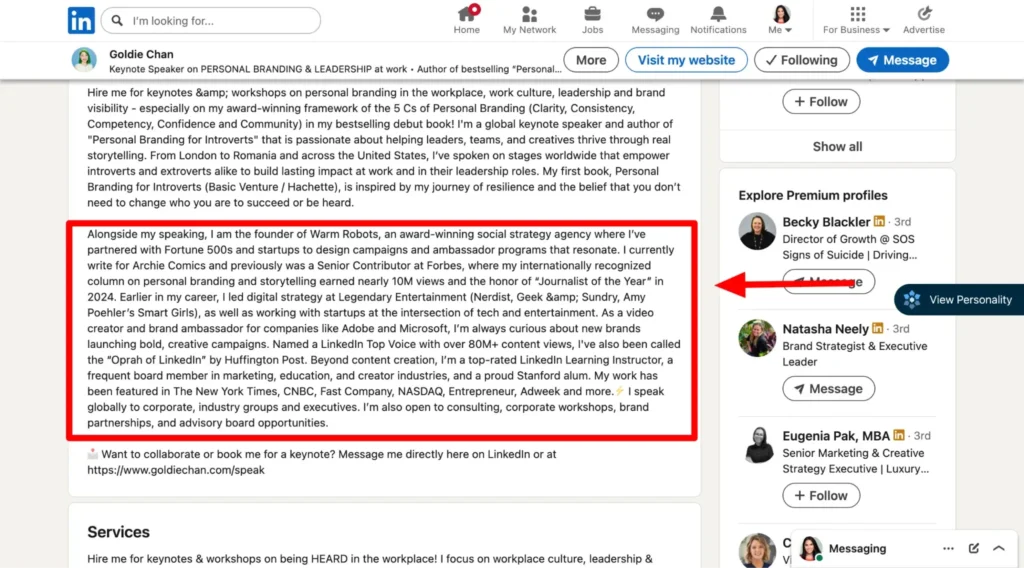
    Goldie Chan, an author, speaker, and LinkedIn Top Voice on personal branding, exemplifies this approach. Her profile prominently details her qualifications and achievements, including founding an agency, collaborating with Fortune 500 companies, and leading social strategy for diverse organizations from startups to major entities like Nerdist. Her identity enriches her narrative, but her authority rests firmly on her verifiable expertise and accomplishments, demonstrating that a powerful personal brand can integrate identity without being solely defined by it.

    2. Cultivate a Distinct and Bold Point of View

    In an oversaturated creator landscape, differentiation is key. As the adage goes, if two people always agree, one is redundant. To stand out, creators must offer what others cannot. This means developing a sharp, bold point of view – a unique opinion, belief, or strategy that challenges conventional wisdom and reframes how audiences perceive relatable problems, trending topics, or industry norms. This is what generates citations, quotes, invitations, and lasting memorability.

    Instead of merely recounting experiences, articulate what most people misunderstand or what you have done differently. For example, rather than stating, "I’ve struggled with brand consistency," a bold point of view might declare, "The common advice on brand consistency is fundamentally flawed; here’s why a flexible framework works better." However, a bold point of view doesn’t necessitate confrontation for its own sake. Marketing and Brand Speaker Chirag Nijjer explains, "People hear ‘bold point of view’ and assume it needs to be complex or contrarian. It doesn’t. The most powerful point of view is simply the lens you apply to everything you do."

    8 Ways to Elevate Your Brand as a Creator or Entrepreneur (& Close the Pay Gap)

    Nijjer’s own perspective stems from studying how brands endure periods of massive change, encapsulated in the question: "What is the story you wish to tell?" He cites Starbucks’ near-collapse in 2008 and its subsequent revival by Howard Schultz, who refocused on the brand’s narrative as a "third place" (home and work being the first two). This guided decisions like investing in ergonomic seating and smaller machines. Nijjer applies this discipline to creators: "Choices like that only made sense going back to their narrative and ‘story’ of being a third place. That one question is the POV I run every keynote, every video, and every consulting engagement from." This disciplined approach ensures that every piece of content and every interaction reinforces a consistent, powerful brand narrative, creating a distinctive voice in a crowded digital space.

    3. Build and Own Your Distribution Channels

    Over-reliance on social media platforms presents significant vulnerabilities. Research indicates that 42% of YouTube creators would lose over $50,000 annually if their account access were revoked, illustrating the immense power platforms wield over creators’ livelihoods. Therefore, building owned distribution is a crucial asset for long-term brand resilience. Brands that thrive do not solely depend on third-party visibility, which is susceptible to algorithmic shifts, platform policy changes, or even outright exclusion.

    Owned distribution involves cultivating direct relationships with your audience, allowing you to maintain control over content cadence, messaging, pricing, and intellectual property. Key strategies include:

    8 Ways to Elevate Your Brand as a Creator or Entrepreneur (& Close the Pay Gap)
    • Email Lists: A direct line to your audience, impervious to algorithm changes and providing valuable first-party data.
    • Personal Websites and Blogs: A central hub for your content, products, and services, fully under your control, acting as your digital home base.
    • Private Communities: Platforms like Discord, Circle, or Mighty Networks offer spaces for deeper engagement, exclusive content, and fostering a strong sense of belonging among your most loyal followers.
    • Direct Sales Platforms: Utilizing e-commerce sites like Shopify or Gumroad for selling products directly to consumers, bypassing platform fees and gaining full control over the customer experience.

    By owning distribution, creators reduce dependence on gatekeepers and establish a more stable, scalable path to growth, building a direct pipeline that cannot be easily disrupted, thereby mitigating risks associated with platform volatility.

    4. Productize and Monetize Knowledge Early

    While sharing valuable information is fundamental to content marketing, giving away all expertise for free can lead to burnout and undercompensation. Many creators share insights and advice for too long without effectively capturing the inherent value of their knowledge. Productizing this knowledge early on enables creators to scale their impact and income without linearly increasing their workload.

    Productization can manifest in various forms:

    8 Ways to Elevate Your Brand as a Creator or Entrepreneur (& Close the Pay Gap)
    • Online Courses and Workshops: Structured learning experiences that package your expertise into digestible, actionable modules.
    • Digital Products: E-books, templates, guides, presets, software tools, or exclusive digital content that provides immediate value.
    • Consulting and Coaching Services: Personalized expert guidance offered on a one-on-one or group basis.
    • Paid Newsletters or Exclusive Content Subscriptions: Premium access to in-depth insights, analyses, or behind-the-scenes content.
    • Merchandise: Tangible products reflecting brand identity, fostering a sense of community and loyalty.

    Bianca Byers (Bianca Bee), a media professional with extensive experience at E!, Oprah Winfrey Network, TMZ, and Paramount Pictures, exemplifies this. She has transformed her expertise into three books, a YouTube talk show, a cosmetic line, and brand collaborations. Byers states, "Working in the television industry for over a decade taught me to never rely on a single stream of income. Rather, I’m deliberate about growing my personal brand alongside my day job, creating additional revenue from channels I own and turning my voice into tangible products that genuinely serve my audience." Her advice to creators is to "monetize your knowledge early in a way that feels aligned, and not to be afraid to build multiple streams under one brand umbrella."

    Chirag Nijjer concurs, noting that many creators "wait for some imaginary threshold before they charge for what they know, but at the same time, they’re training their market to expect their expertise for free." He packaged his brand research into a keynote years before he felt "ready," which subsequently opened doors to platforms like Adobe, Shopify, and the History Channel. The key, he advises, is to recognize that "if people keep asking you the same question, the answer can likely be a product." The method of sharing information changes (social media for low effort/free, personal guidance/resources for paid), but the core knowledge remains. This strategy teaches the market to value you as an expert and a product, enabling sustainable growth.

    5. Be Selective About Visibility and Embrace Lateral Collaboration

    Momentum is built by strategically saying "yes." Before committing to any panel, partnership, or feature, creators should ask:

    8 Ways to Elevate Your Brand as a Creator or Entrepreneur (& Close the Pay Gap)
    • Does this opportunity align with my brand’s core values and long-term goals?
    • Will it genuinely expand my audience or reach a relevant new demographic that values my expertise?
    • Does it offer equitable compensation or a clear return on investment (time/effort) that justifies participation?
    • Does it position me favorably within my industry and amongst my target audience, enhancing my authority?

    Opportunities that enhance your brand’s positioning and place you in desired professional circles are worth pursuing. Those that do not compound your efforts can be politely declined, regardless of how they are initially presented. Ariel Gonzalez, a HubSpot Content Marketing Manager and "Magical Marketer," emphasizes clarity of goals: "Gaining visibility for visibility’s sake puts you in a reactive position, leaving others to define your brand instead of you. Get clear on what you want your brand to represent, what your goals are, and what success looks like for you, then let that clarity guide every yes and every no."

    Traditional networking often emphasizes building relationships with those higher up the ladder. However, for growing entrepreneurs, particularly from marginalized groups, lateral collaboration with peers at a similar stage can be more accessible and effective. These partnerships are founded on mutual respect, trust, shared experiences, and aligned goals. They allow creators to tap into complementary audiences, co-create valuable assets, and grow collectively without depending on hierarchical validation. Examples include co-hosting events, developing collaborative content (like Half-Pakistani, LGBTQ+ creators Taha Arshad and Shehzad Ali Khan), or launching joint products. This approach not only accelerates growth but also reinforces community-based support systems over competitive dynamics. Strategically, micro-creators (10,000–100,000 followers) consistently deliver higher engagement per dollar than larger accounts, making peer-to-peer collaboration both a community-building and smart business strategy for sustainable scaling.

    Navigating the Ecosystem: Support and Partnerships

    Beyond individual strategies, understanding and leveraging external support systems is crucial for minority creators.

    8 Ways to Elevate Your Brand as a Creator or Entrepreneur (& Close the Pay Gap)

    6. Apply for Grants and Programs for Minority Creators

    Access to capital and support programs remains a significant barrier for new ventures, especially for minority creators. Historical disparities in venture capital funding and traditional lending for minority-owned businesses highlight the importance of targeted support. While some funding landscapes have shifted, grants and minority-focused funds still exist and are vital resources. Notable examples include:

    • Small Business Administration (SBA) Grants: Offers various programs for small businesses, including those owned by minorities, focusing on areas like innovation and research.
    • Hello Alice Small Business Growth Fund: Provides grants and resources specifically designed to support diverse entrepreneurs and small business owners.
    • Fearless Fund: Focuses on investing in women of color-led businesses, addressing the significant underfunding these entrepreneurs face.
    • Amber Grant for Women: Specifically supports women entrepreneurs with monthly grants, recognizing their unique challenges.
    • The Build with Google Program: Offers resources, mentorship, and sometimes grants for small businesses to enhance their digital presence.
    • The Black Founder Startup Grant by Black Girl Ventures and Rare Beauty: Supports Black women entrepreneurs with non-dilutive capital and mentorship.
    • Comcast RISE: Provides grants, marketing services, and technology makeovers to small businesses owned by people of color and women.
    • **Google
  • RAG Chunking Strategies: Unveiling the Production Realities Beyond Tutorial Hype

    RAG Chunking Strategies: Unveiling the Production Realities Beyond Tutorial Hype

    The burgeoning field of Large Language Model (LLM) applications, particularly those leveraging Retrieval-Augmented Generation (RAG), hinges on a fundamental yet frequently underestimated process: chunking. This crucial step involves dividing vast swathes of source documentation into manageable, semantically coherent segments, or "chunks," which are then indexed and retrieved to inform the LLM’s responses. While countless online tutorials advocate for a seemingly straightforward approach like RecursiveCharacterTextSplitter(chunk_size=1000, chunk_overlap=200), the practical experience of teams deploying RAG systems in production reveals a far more nuanced reality, often encountering a critical "chunk size nobody talks about." This article delves into the complexities of RAG chunking, exploring six leading strategies that are actually employed by practitioners, evaluating their performance against a shared corpus, and highlighting the approach that consistently delivers superior results in real-world scenarios.

    The Foundational Challenge: Bridging the Gap Between Retrieval and Response

    Retrieval-Augmented Generation has revolutionized how LLMs interact with proprietary or domain-specific knowledge, enabling them to provide accurate, up-to-date, and attributable answers by drawing from external data sources. The efficacy of a RAG system, however, is directly proportional to the quality of its retrieval mechanism, which in turn is heavily influenced by how the underlying documents are chunked. The challenge lies in striking a delicate balance: chunks must be small enough to be precisely relevant to a query, yet large enough to provide sufficient context for the LLM to formulate a comprehensive answer.

    The "chunk size nobody talks about" refers to this often-missed sweet spot, where an ill-conceived chunking strategy can lead to significant failures. Imagine a 30-page legal contract, meticulously indexed, yet when a customer queries an indemnity clause, the system retrieves only fragmented pieces, confidently omitting crucial details. Or consider a product documentation QA bot that cites two seemingly relevant paragraphs but misses a critical table located two pages away, which holds the actual answer. Even more frustrating, a seemingly minor change like swapping an embedding model or re-chunking an entire corpus can send evaluation scores plummeting by double-digit percentages, underscoring the sensitivity and impact of this foundational choice.

    To objectively assess chunking strategies, a robust evaluation framework is indispensable. The data points presented herein are derived from a rigorous evaluation conducted on a substantial corpus: 1,200 questions posed against 2,300 pages of diverse technical-product documentation. This corpus encompassed SaaS changelogs, intricate API references, and dense contract PDFs—materials representative of complex enterprise knowledge bases. The evaluation utilized top-5 retrieval, text-embedding-3-large for embeddings, gpt-4o-2024-11-20 as the generative model, and Ragas for comprehensive scoring. Critically, only the chunking strategy varied across experiments, ensuring a direct comparison of their impact on two primary retrieval metrics: Recall (the proportion of relevant chunks successfully retrieved) and Precision (the proportion of retrieved chunks that are actually relevant).

    Evolution of Chunking Strategies: A Chronological Overview

    The landscape of RAG chunking has evolved from rudimentary methods to highly sophisticated, context-aware techniques. This progression reflects a continuous effort to overcome the limitations of simpler approaches and better align retrieved information with the nuanced requirements of LLMs.

    1. Fixed-Size Chunks: The Baseline of Simplicity

    The most basic chunking strategy, fixed-size chunking, involves slicing text into equal character windows, optionally with some overlap, without regard for linguistic or structural boundaries like sentences, paragraphs, or sections. The implementation is straightforward, often a simple loop iterating through the text.

    • Mechanism: Divides the document into segments of a predetermined character count.
    • When it Wins: Ideal for homogeneous text with minimal inherent structure, such as raw chat logs, interview transcripts, or single-author essays where semantic continuity is less dependent on explicit formatting. Its computational cheapness and predictable chunk sizes make batch-embedding trivial and cost-effective.
    • When it Loses: Its indiscriminate nature is its biggest downfall. Documents with headings, tables, or code blocks are particularly problematic. This method frequently splits mid-sentence, mid-clause, or mid-function, scattering crucial entities across multiple, disconnected chunks that a retriever may fail to reassemble. For instance, a key policy term might be severed from its definition, rendering both parts less useful.
    • Scores on Corpus: Recall 0.61, Precision 0.54. This represents the absolute floor in performance, serving as a stark reminder of the importance of more intelligent chunking.

    2. Recursive Character Splitting: The Common Default

    Recursive character splitting represents a significant step up from fixed-size chunks and is widely adopted, often being the default in popular RAG frameworks like LangChain.

    • Mechanism: This method attempts to split text using a hierarchical list of separators. It first tries the largest separator (e.g., nn for blank lines), and if the resulting chunk is still too large, it falls back to the next separator (e.g., n for newlines, then . for sentence endings, then ` for words) until the chunk fits within the specifiedchunk_size`. This approach aims to preserve paragraph and sentence boundaries where possible.
    • When it Wins: Highly effective for most prose-based documents, suchcluding articles, reports, and general descriptive text. It offers a good balance between engineering effort and retrieval performance, providing paragraph-aware splits with minimal configuration. For many initial RAG deployments, its ease of use and respectable performance make it the default choice.
    • When it Loses: While better than fixed-size, it struggles with highly structured content. Tables often get flattened into plain text, losing their inherent organization. Headings can become "orphaned," detached from the substantive sections they introduce. For example, retrieving "Pricing" without the three paragraphs detailing the pricing tiers below it severely limits the LLM’s ability to answer complex queries. The chunk_overlap parameter, while intended to mitigate boundary issues, can sometimes mask these underlying structural problems on simpler questions, only to exacerbate them on more challenging ones where precise context is paramount.
    • Scores on Corpus: Recall 0.74, Precision 0.68. This marks a substantial improvement over fixed-size chunking and is often where many development teams conclude their chunking optimization efforts.

    3. Semantic Chunking: Topic-Driven Segmentation

    Semantic chunking introduces an intelligent, meaning-aware approach to text segmentation, moving beyond mere character counts or structural delimiters.

    • Mechanism: This strategy involves embedding every sentence in a document and then iterating through these embeddings. Chunks are formed by cutting the text when the cosine distance (a measure of semantic dissimilarity) between adjacent sentences spikes past a predefined threshold. The goal is to create chunks that align with shifts in topic or meaning, rather than arbitrary length limits.
    • When it Wins: Particularly powerful for long-form narrative content characterized by clear topic changes, such as academic research papers, blog posts, or detailed interview transcripts. In such corpora, where content flows logically from one distinct subject to another, semantic chunking can yield significant recall improvements. Demos often showcase impressive recall jumps (e.g., 40%) on these specific types of documents.
    • When it Loses: Its performance degrades significantly on dense reference documents where most sentences remain "on-topic." In technical writing, the embedding-distance signal can become noisy, leading to chunks that are either excessively large (if few distance spikes are detected) or highly fragmented (if minor formatting quirks or subtle shifts trigger premature splits). Furthermore, semantic chunking is computationally intensive, typically 10 to 100 times more expensive than recursive splitting, as it requires an embedding call for every sentence. This cost is re-incurred every time the corpus changes, making it less economical for frequently updated knowledge bases.
    • Scores on Corpus: Recall 0.72, Precision 0.65. On the technical product documentation corpus, semantic chunking performed slightly worse than recursive splitting, underscoring its corpus-specific strengths and weaknesses.

    4. Hierarchical / Parent-Document Retrieval: The Production Workhorse

    Hierarchical or Parent-Document Retrieval addresses the fundamental tension between retrieval granularity and contextual completeness by separating the "matching unit" from the "answering unit."

    • Mechanism: This strategy involves splitting the document twice. First, into smaller "child" chunks (e.g., 400 characters) designed for high retrieval accuracy due to their focused content. Second, into larger "parent" chunks (e.g., 2000 characters) that provide ample context. The system then embeds the child chunks and indexes them in a vector store. At retrieval time, a query matches against these smaller child chunks, but the retriever returns the larger parent chunk that contains the matching child. This ensures that the LLM receives both precise relevance and sufficient surrounding context.
    • When it Wins: This approach consistently excels in almost every real-world document-QA workload, including complex contracts, extensive product documentation, internal knowledge bases, and operational runbooks. The small child embedding precisely identifies the relevant clause or detail, while the parent chunk provides the necessary surrounding definitions, cross-references, or explanatory text. For example, finding a specific row in a table necessitates retrieving the table’s header and potentially other related sections to fully understand its meaning. This strategy elegantly solves the problem where the ideal unit for matching a query is smaller than the ideal unit for answering it.
    • When it Loses: It can be less efficient for very short documents where a "parent" chunk would essentially encompass the entire document, negating the hierarchical benefit. It also poses challenges for extremely token-constrained budgets, where even a 2,000-character parent chunk might be too expensive to include multiple top-5 retrievals. Operationally, it adds weight: maintaining two separate stores (for children and parents) and tuning two distinct splitters introduces a layer of complexity not present in simpler methods.
    • Scores on Corpus: Recall 0.86, Precision 0.79. This strategy achieved the highest recall on the technical product documentation corpus, demonstrating its robust performance in complex, structured environments.

    Why Parent-Document Retrieval Consistently Wins in Production

    The success of Parent-Document Retrieval lies in its direct attack on a critical failure mode: the matching unit is smaller than the answering unit. In many real-world scenarios, a query might precisely hit a specific phrase, a single line in a contract, or a data point in a table. However, to provide a truly comprehensive and accurate answer, the LLM often requires broader context—surrounding definitions, preceding explanations, or related sections.

    Consider these common failure points:

    • A retriever finds the exact contract clause, but the LLM needs two paragraphs of surrounding definitions to fully interpret it.
    • It identifies a specific row in a product feature table, but requires the column headers, and possibly an introductory paragraph two pages up, to understand what that row signifies.
    • It locates a function definition in an API reference, but needs the class docstring or module overview to grasp the function’s broader purpose and usage.

    Parent-Document Retrieval elegantly resolves these issues by decoupling the optimization concerns. It allows for small, precise child chunks for effective retrieval while providing larger, contextually rich parent chunks for the LLM’s consumption. Other strategies, by forcing a single chunk size to serve both roles, inevitably compromise either retrieval precision or contextual completeness.

    The RAG Chunking Strategy That Beat All the Trendy Ones in Production

    Another, often undersold, reason for its production dominance is its graceful degradation. In complex, dynamic corpora, new document types or unexpected formatting can break even well-tuned child splitters. With parent-document retrieval, even if a child chunk is poorly segmented, the larger parent chunk often remains sufficiently intact and comprehensive to still provide a reasonable amount of context to the LLM. This resilience makes it a more robust choice for evolving knowledge bases where perfect chunking cannot always be guaranteed.

    5. Propositional Chunking: Maximizing Atomic Precision

    Propositional chunking represents a more radical departure, leveraging LLMs themselves to refine the chunking process for extreme precision.

    • Mechanism: This advanced technique employs an LLM to decompose each passage of a document into atomic, self-contained factual propositions. These propositions are designed to be independently verifiable and true without relying on the surrounding text. These granular propositions are then embedded. At retrieval time, the system matches queries against these highly precise propositions, optionally returning the original, larger passage from which they were extracted. This approach draws inspiration from research like Chen et al.’s "Dense X Retrieval" (2023).
    • When it Wins: Exceptional for fact-dense corpora where questions typically map to single, discrete claims, such as medical guidelines, regulatory texts, or encyclopedic entries. Its primary strength lies in its precision, as each retrieved proposition is a clean, unambiguous unit of information.
    • When it Loses: Cost is a significant barrier. This method requires an LLM call for each passage during the ingest process, and these costs are re-incurred with every corpus update. A 10,000-document corpus could incur hundreds of dollars ($200-$800) just for propositionalization, even before embedding costs. Furthermore, the quality of propositions is highly sensitive to the extractor’s prompt; different engineers using the same code might derive different sets of propositions, introducing variability. There’s also a risk of the LLM-based extractor inadvertently dropping context that a proposition might need, especially for highly interconnected clauses.
    • Scores on Corpus: Recall 0.81, Precision 0.84. While achieving the best precision on the corpus, its high ingest cost and maintenance complexity make it a specialized, expensive solution.

    6. Late Chunking: Contextual Embeddings for Enhanced Understanding

    Late chunking is an innovative, still-emerging strategy that aims to imbue individual chunk embeddings with broader document context.

    • Mechanism: This technique involves feeding the entire document into a long-context embedder. Instead of immediately creating chunk embeddings, the system retains the per-token embeddings generated by the model. Only after this full-document embedding pass are chunk boundaries applied. The chunk vectors are then formed by averaging the token embeddings within each boundary. The key advantage is that every chunk’s embedding implicitly carries contextual information from the rest of the document, as pronouns and implicit references are understood in their full textual environment. For instance, the pronoun "it" in chunk 7 is embedded with awareness of its antecedent in chunk 2.
    • When it Wins: Particularly effective for documents rich in anaphora and implicit references, such as legal contracts, academic papers, or narrative reports. It directly addresses the "who does ‘the Licensee’ refer to in this chunk" problem by ensuring that such references are disambiguated at the embedding stage.
    • When it Loses: Requires specialized long-context embedders (e.g., Jina v3, Voyage-3, Cohere Embed 4, typically with 8k-32k context windows), which are not universally available or always cost-effective. Incremental caching becomes challenging, as changing even a single paragraph often necessitates re-embedding the entire document. SDK support is still nascent, largely confined to specific libraries like Jina’s implementation. Being a relatively newer approach (with key papers emerging around 2024), fewer teams have extensive production mileage, making it a strategy worth watching as tooling and adoption mature.
    • Scores on Corpus: Recall 0.79, Precision 0.76. It outperformed recursive splitting but lagged behind parent-document retrieval on this specific corpus.

    Comparative Analysis: The Scorecard and Key Takeaways

    The following scorecard summarizes the performance and operational characteristics of each chunking strategy on the evaluated corpus. While "your mileage may vary" depending on the specific document types and query patterns, the general shape of these results is consistent with observations from numerous RAG deployments across various industries.

    Strategy Recall Precision Ingest Cost (relative) Ops Weight
    Fixed 0.61 0.54 1x Trivial
    Recursive 0.74 0.68 1x Trivial
    Semantic 0.72 0.65 50x Medium
    Parent-Document 0.86 0.79 1.2x Medium
    Propositional 0.81 0.84 200x Heavy
    Late Chunking 0.79 0.76 3x Medium

    The scorecard reveals a clear hierarchy. Simple, arbitrary chunking methods (Fixed, Recursive) offer low cost and trivial operational overhead but yield suboptimal retrieval performance. Semantic chunking, despite its intellectual appeal, struggles with dense technical documentation and incurs significant computational costs. Propositional chunking achieves impressive precision but at an exorbitant cost, making it feasible only for highly specialized, static, and fact-critical applications. Late chunking shows promise but is still maturing.

    Industry Perspectives and Future Outlook

    The insights gleaned from this comparative analysis reflect a growing consensus among RAG practitioners: the choice of chunking strategy is not a mere technical detail but a strategic decision with profound implications for system performance, cost, and maintainability.

    Developer Experience: For developers, the operational weight of a chunking strategy is a critical factor. Trivial methods are easy to implement but lead to debugging headaches due to poor retrieval. Heavy methods, while potentially offering high performance, can become a bottleneck in deployment pipelines, increase infrastructure costs, and complicate incremental updates. Parent-document retrieval, despite its "medium" operational weight, is often seen as a worthwhile investment due to its robust performance and graceful degradation.

    The Role of Evaluation: The exercise underscores the paramount importance of rigorous, corpus-specific evaluation. Relying solely on generalized benchmarks or flashy demos can be misleading. As demonstrated by semantic chunking’s performance on technical documentation, a strategy that excels in one domain (e.g., narrative text) may underperform significantly in another. Teams must invest in constructing representative evaluation datasets and establish clear metrics (like Recall and Precision) to make informed decisions.

    Tooling and Ecosystem: Frameworks like LangChain have democratized access to various chunking strategies, including the ParentDocumentRetriever which, despite its "unglamorous name," has proven to be a workhorse in production. The continued evolution of these tools, coupled with the emergence of specialized solutions for advanced techniques like late chunking (e.g., jinaai/late-chunking on GitHub), suggests a future where more sophisticated strategies become easier to implement and manage.

    Evolving LLM Capabilities: The rapid advancements in LLM technology, particularly the expansion of context windows in newer models (e.g., 128k, 1M tokens), might subtly shift the chunking landscape. While longer context windows reduce the urgency of aggressive chunking for LLM input, the challenge of efficient and precise retrieval from vast document stores remains. The core problem of matching units versus answering units persists regardless of LLM context size. Improved embedding models will undoubtedly enhance the effectiveness of all chunking strategies, but the structural considerations remain paramount.

    Conclusion: Prioritizing Practicality Over Hype

    In the dynamic world of RAG, where new techniques and models emerge with dizzying speed, it’s easy to be swayed by the latest research papers or visually appealing demos. Semantic chunking might generate captivating visualizations of topic shifts, propositional chunking might boast impressive precision numbers in academic contexts, and late chunking might spark engaging discussions on social media due to its technical ingenuity.

    Yet, time and again, when teams move beyond initial experimentation and into production environments with real-world document QA workloads, they find themselves converging on hierarchical or parent-document retrieval. This strategy, though less glamorous and present in codebases since 2023 without much fanfare, offers a pragmatic and robust solution to the core problem of bridging retrieval precision with contextual completeness. It excels because it acknowledges and addresses the fundamental discrepancy between the optimal size for identifying relevant information and the optimal size for enabling an LLM to formulate a comprehensive answer. Moreover, its ability to degrade gracefully provides a crucial safety net in the unpredictable world of enterprise data.

    For any team embarking on a document QA RAG project, the unequivocal advice from the trenches is clear: evaluate parent-document retrieval first. Do not let the allure of flashier, more theoretically elegant approaches distract from the practical, proven solution that keeps winning in the challenging arena of production RAG systems.

    For those seeking deeper insights into building robust RAG systems, Chapter 9 of "Observability for LLM Applications" offers an end-to-end guide on retrieval instrumentation, covering how to monitor for silent recall regressions and detailing the RAG-specific evaluation rigs that underpin the findings presented here. This resource is invaluable for any team navigating the complexities of shipping reliable RAG features.

Grafex Media
Privacy Overview

This website uses cookies so that we can provide you with the best user experience possible. Cookie information is stored in your browser and performs functions such as recognising you when you return to our website and helping our team to understand which sections of the website you find most interesting and useful.