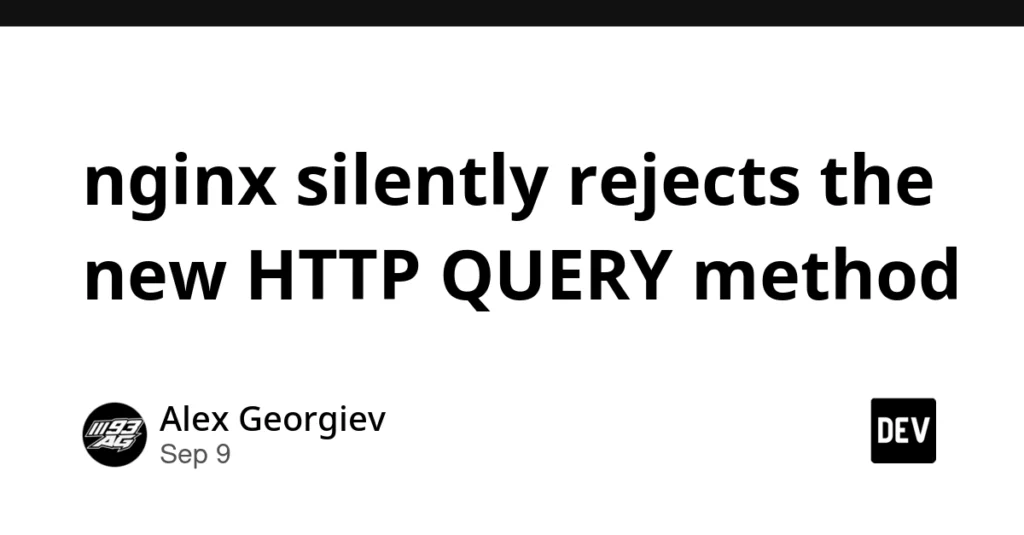

The recent elevation of RFC 10008 to a Proposed Standard by the Internet Engineering Task Force (IETF) has introduced a significant architectural shift in web development by formally defining the HTTP QUERY method. For decades, developers designing application programming interfaces (APIs) have faced a frustrating constraint: the Hypertext Transfer Protocol (HTTP) GET method is safe and idempotent, but traditionally lacks a standardized mechanism for carrying a request body. Consequently, complex search operations and advanced filtering queries—which frequently exceed standard Uniform Resource Locator (URL) length restrictions—have been forced into POST requests, muddying semantic distinctions between resource creation and data retrieval.
The newly standardized QUERY method attempts to resolve this longstanding architectural tension. On paper, it functions as a hybrid verb: it retains the safe, idempotent properties of a standard GET request while possessing the capability to transmit a payload akin to a POST request. However, the theoretical elegance of a protocol specification frequently collides with the messy reality of legacy infrastructure. Recognizing that older proxies, application frameworks, and load balancer configurations might not universally recognize the new verb, infrastructure engineer Alex Georgiev deployed a dedicated testing environment to empirically evaluate how modern software stacks handle RFC 10008 in practice.
Experimental Methodology and Infrastructure Setup
To determine how the QUERY method behaves across diverse layers of a modern web architecture, Georgiev provisioned an isolated cloud instance—a DigitalOcean Droplet running Ubuntu 24.04 with 2 virtual Central Processing Units (vCPUs) and 4 gigabytes of random-access memory (RAM) in the Frankfurt (fra1) region. The testing environment was intentionally constructed to mirror complex, multi-tiered production topologies.
The testbed incorporated a FastAPI backend listening on port 8001, powered by Python 3.x, FastAPI version 0.141.1, and Starlette version 1.6.0. Alongside this asynchronous setup, a separate Django 6.1.1 project was configured to evaluate how traditional, synchronous Python frameworks handle unconventional request verbs. To assess proxy-level behavior, three prominent reverse proxies—nginx version 1.24.0, Caddy version 2.11.4, and Traefik version 3.7.10—were positioned in front of the backend instances on independent ports. Client-side interaction was simulated using cURL version 8.5.0.
Tooling Compatibility and Native Client Support
A primary concern during the rollout of any new protocol specification is whether foundational developer tooling supports the feature natively without requiring cumbersome workarounds or third-party patches. Testing demonstrated that cURL handles the QUERY method seamlessly. When directed at a raw netcat listener, cURL transmitted a standard HTTP/1.1 request utilizing the QUERY verb alongside a valid JSON content-type and body without requiring specialized flags or non-standard configurations.
QUERY /search HTTP/1.1
Host: 127.0.0.1:8000
User-Agent: curl/8.5.0
Accept: */*
Content-Type: application/json
Content-Length: 12

"q":"test"
This out-of-the-box support at the client level indicates that developer workflows will not be hindered by the lack of command-line utility readiness. The operational friction, therefore, lies entirely downstream within server-side frameworks and intermediary proxy layers.
Framework-Level Discrepancies: FastAPI vs. Django
When the QUERY requests reached the application frameworks, divergent behaviors emerged based on how each platform handles method routing and dispatching.
In FastAPI, registering an explicit route with methods=["QUERY"] successfully captured the incoming request, parsed the payload, and returned a standard 200 OK response echoing the received method and body. When a QUERY request was directed to an unregistered route such as /docs, FastAPI correctly responded with a 405 Method Not Allowed status code accompanied by a clear Allow header listing permitted methods.
In contrast, Django presented a more restrictive developer experience due to its internal architectural design. Django’s class-based views dispatch incoming traffic by mapping lowercased HTTP verb names to class methods (e.g., get() for GET, post() for POST). Naturally, a developer might assume implementing a query() method on a class-based view would suffice to handle the new verb. However, Django evaluates incoming requests against a hardcoded class attribute, View.http_method_names, which traditionally includes only:

['get', 'post', 'put', 'patch', 'delete', 'head', 'options', 'trace']Because 'query' is absent from this default array, Django intercepts the request before it ever reaches the developer’s custom handler, returning a 405 Method Not Allowed response with an empty body and an Allow header listing only OPTIONS. To successfully process QUERY requests in Django, developers must explicitly override the attribute within their class-based views:
class SearchViewFixed(View):
    http_method_names = View.http_method_names + ["query"]

    def query(self, request, *args, **kwargs):
        return JsonResponse(
            "received_method": request.method,
            "body": request.body.decode()
        )
This nuanced failure mode underscores the warning articulated within RFC 10008: older frameworks do not necessarily crash or reject payloads outright; instead, they may silently drop or reject unfamiliar verbs in a manner indistinguishable from a standard routing typo, complicating debugging efforts in production environments.
Reverse Proxy Interoperability: nginx, Caddy, and Traefik
Intermediary reverse proxies and load balancers represent the most critical hurdle for the adoption of HTTP QUERY. Because these components sit directly on the network path between clients and upstream application servers, misconfigurations or rigid default rules can block new methods entirely.
The evaluation revealed a stark contrast between older, rule-based proxy configurations and modern, dynamic routing engines.
When nginx was configured with a basic, unrestrictive proxy_pass directive, it forwarded QUERY requests to the upstream FastAPI backend without incident:
location /
    proxy_pass http://127.0.0.1:8001;
However, a common security hardening pattern found in numerous production nginx configurations involves the use of the limit_except block to restrict allowable methods on a given location block:
location /
    limit_except GET POST HEAD
        deny all;

    proxy_pass http://127.0.0.1:8001;
When subjected to this widespread configuration pattern, nginx immediately intercepted the incoming QUERY request and returned a 403 Forbidden status code. This finding highlights a significant operational risk: systems administrators auditing their proxy configurations for security compliance may inadvertently block RFC 10008 traffic unless they explicitly append QUERY to their respective allowlists.
Conversely, newer reverse proxies such as Caddy and Traefik demonstrated seamless out-of-the-box compatibility. Operating with default configurations and standard file-provider routers respectively, both Caddy and Traefik transparently passed incoming QUERY requests to downstream servers without requiring manual method whitelisting or configuration modifications.
Broader Implications and Industry Impact
The practical validation of RFC 10008 offers encouraging news for API designers seeking to clean up semantic ambiguities surrounding data retrieval. Replacing POST /search endpoints with standardized QUERY /search calls aligns web applications more closely with the foundational tenets of RESTful architecture, allowing complex query payloads to be transmitted safely and idempotently.
Nevertheless, the findings emphasize that protocol standardization does not automatically translate to seamless enterprise deployment. Engineering teams intending to adopt the HTTP QUERY method must conduct thorough infrastructure audits. Specifically, teams must inspect proxy hardening rules—particularly nginx limit_except directives—and verify framework-level method whitelisting within older codebases before routing production traffic. While modern tooling like cURL, Caddy, and Traefik readily embrace the new standard, legacy components in the request lifecycle remain the primary source of potential friction.