
The Vision Behind Trionn: Redefining Digital Experience
Trionn, conceived as an ambitious exploration, aimed to transcend the traditional static or mildly animated studio website. The core philosophy was to treat animation, WebGL, and interaction not as isolated features but as integral components of a cohesive narrative. This approach reflects a growing trend in modern web development, where digital experiences are increasingly expected to be dynamic, engaging, and visually rich, moving beyond mere information delivery to provide memorable user journeys. In a competitive digital landscape, agencies and studios are continually seeking innovative ways to showcase their capabilities, and Trionn sought to set a new benchmark for interactive digital portfolios.
The project’s evolution was a testament to iterative design, progressing through multiple conceptual phases before solidifying its distinctive direction. Initial ideas for interactive heroes, scroll-driven storytelling, procedural graphics, and real-time effects were not pre-planned as discrete elements. Instead, they gradually coalesced into a comprehensive animation framework, demonstrating a fluid development process that allowed for organic growth and refinement. This method enabled the development team to continuously integrate and synchronize disparate technologies, ensuring that the final output felt harmonious and responsive across various user inputs and device types.
A Symphony of Technologies: The Core Architecture
Achieving the sophisticated level of animation and interactivity seen on Trionn demanded a meticulous balance between creative flexibility and robust performance. The project’s architecture is characterized by a clear division of responsibilities among its core technologies, each playing a vital role in driving the experience:
-
GSAP (GreenSock Animation Platform): Positioned at the heart of Trionn’s animation system, GSAP orchestrates virtually all visual transitions and interactive sequences. Its role extends to page transitions, intricate scroll-driven animations, pinned sections that anchor content in place, and granular component-level animations. The
useGSAPhook, integrated with Next.js, streamlines the setup and cleanup of GSAP timelines, ensuring efficient resource management as components mount and unmount. Furthermore,ScrollTrigger, a powerful GSAP plugin, manages the majority of the site’s scroll interactions, from immersive storytelling sections that unfold with user scrolling to scrubbed animations and subtle reveal effects. The strategic use ofgsap.matchMedia()allowed for distinct animation logic and values for desktop and mobile layouts, optimizing performance and experience across different viewports. For text animations, the reusableBlurTextRevealcomponent, powered bySplitText, demonstrated an elegant solution for character-, word-, or line-based transitions, centralizing reduced-motion handling, GPU layer cleanup, and ScrollTrigger refreshes, thereby promoting consistency and efficiency. -
Three.js: The site’s custom WebGL experiences, which bring 3D graphics to life, are powered by Three.js. The development team consciously opted for direct control over Three.js rather than using frameworks like React Three Fiber. This decision was driven by the need for granular management of the shared render loop, precise resource allocation, and the ability to individually animate mesh panels within complex elements like the hero symbol. This direct approach allowed for unparalleled optimization and customization crucial for the site’s demanding visual fidelity.
-
Lenis: For smooth and controlled scrolling, Lenis was employed. Its direct integration with
gsap.tickerensures seamless synchronization with ScrollTrigger, providing a fluid and consistent scroll experience throughout the entire website, free from jarring stutters or desynchronization issues that can plague highly interactive sites. -
Web Audio API: A standout feature of Trionn is its use of the Web Audio API for generating interactive sound effects in real time. Instead of relying on prerecorded audio files, sounds like the hero’s hover, blast, and weld effects are synthesized dynamically. This approach not only provides a highly responsive audio experience but also reduces asset load and offers greater flexibility in sound design, allowing sounds to evolve and react organically to user input.
The Journey from Concept to Canvas: Development Timeline and Iteration
The creation of Trionn was an ambitious undertaking, spanning over four months of dedicated development. This timeline underscores the complexity involved in harmonizing diverse technologies and pushing the boundaries of web interactivity. The project’s genesis involved an initial phase of "months of experimentation and iteration," where various concepts were explored and tested for viability and impact. This iterative process was crucial in refining the interactive hero, scroll-driven narratives, procedural graphics, and real-time effects, transforming them from isolated ideas into a coherent and connected animation framework. The challenges encountered during this period—centering on performance optimization, synchronization across multiple animation libraries, efficient WebGL rendering, and intuitive interaction design—were instrumental in shaping the robust architecture that ultimately defined Trionn. The emphasis on continuous feedback and refinement allowed the development team to address technical hurdles proactively, ensuring that the final product met both creative aspirations and technical demands.
Pioneering Interactions: Deep Dive into Key Sections
Trionn’s innovation is best illustrated through its distinct sections, each a masterclass in interactive design and technical execution:
-
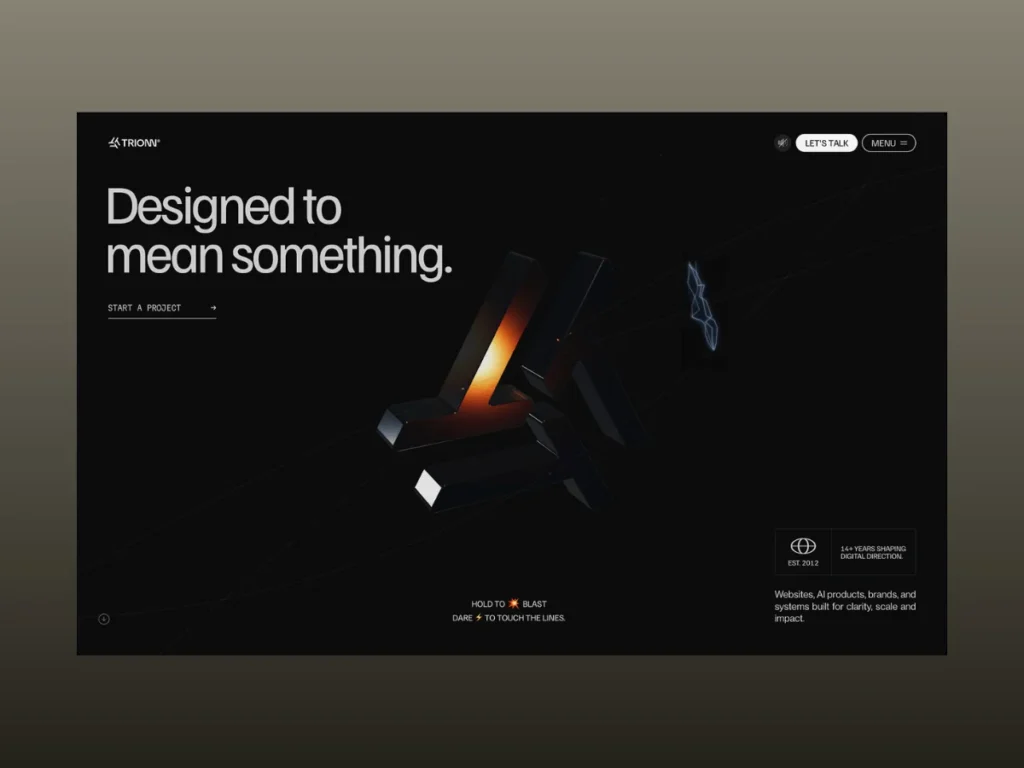
The Hero Section: A Multi-Sensory Gateway: This highly technical section fuses WebGL, GSAP, SplitText, and the Web Audio API into a unified interaction system. Comprising a Three.js background scene (for the brand symbol’s idle motion, magnetic hover, hold-to-blast, and weld spark effects) and standard DOM foreground elements (headline, rotating word, stats hint), it demonstrates seamless integration. The
explodeAmtvalue dynamically controls the symbol’s panel separation, ensuring smooth transitions between states, whether triggered by scroll, hover, or hold actions. A sharedtransitionReadyflag synchronizes animations with page transitions, deferring non-critical work viarequestIdleCallbackto prevent conflicts with initial page load. The headline reveal, a staggered blur-to-sharp transition, utilizesfilter: blur()and opacity, withwill-changeoptimized for GPU layer management during animation. The symbol’s idle state features continuous rotation and subtle sine-wave motions for its arms, scaled by(1 - explodeAmt)to fade out during other interactions. Magnetic hover uses raycasting for precise 3D geometry detection, with panel highlights decaying exponentially. The weld spark effect, active after guide lines finish drawing, uses 2D canvas hit testing and procedural spark generation, rate-limited and varied for natural interaction, accompanied by synthesized Web Audio. The multi-stage hold-to-blast interaction initiates a charging state, vibrating nearby UI elements before the symbol explodes, driven by theclickBurstvalue, which smoothly reverses upon release. This section epitomizes Trionn’s commitment to synchronized, high-performance interactivity. -
Services Scroll Sequence: Narrative Through Motion: This is arguably the site’s most intricate scroll-driven sequence, orchestrated by a single, normalized
scrollProgressRef(0-1). This unified driver coordinates a 371-frame WebP image sequence, a headline that disintegrates into animated glyph particles, the reveal of six service cards along predefined motion paths, a color palette shift from black to white, and a final stripe wipe transition. The background image sequence, displayed by updating an<img>element’ssrc, is preloaded inrequestIdleCallbackbatches withimg.decode()to prevent jank. The "OUR SERVICES" headline is meticulously split into individual glyphs, measured and animated independently to create an explosion effect before service cards appear. These cards animate along curved paths, with SVG icon strokes drawing in, synchronized to the scroll. The section concludes with a reusable stripe wipe, maintaining visual consistency across the site. Critically, this section foregoes ScrollTrigger, instead recalculating all animations from the singlescrollProgressRefeach frame, ensuring tight synchronization and optimization. -
Dribbble Helix Gallery: Crafting 3D Scroll Narratives: This section marries DOM elements with WebGL to present a scroll-driven 3D experience. Nine cards are arranged along a parametric helix, rotating past the camera as the user scrolls, framed by animated guide lines. The helix’s procedural generation, where card positions and orientations are calculated from parametric equations, allows for dynamic adaptation. Cards are not merely placed but have their geometry deformed directly to bend with the helix’s curve, creating a more convincing 3D effect. Raycasting enables precise hover detection, with cards smoothly easing to a target scale. Crucially, rendering is scroll-driven, with a lightweight
gsap.tickeractive only when interactions or transitions are settling, conserving resources. Rounded corners on cards are generated efficiently via a fragment shader using a signed-distance function, avoiding costly transparent PNGs. To prevent initial performance hitches, the WebGL scene is "warmed up" by compiling shaders and uploading textures before the section becomes visible, ensuring a smooth first impression. -
Footer: Interactive Signature with Sound and Smoke: The footer transforms into an interactive soundscape, combining SVG, Web Audio, and WebGL. The SVG wordmark’s strokes act as "guitar strings," each with independent oscillation states. Hovering or clicking injects energy, causing vibrations and triggering synthesized notes via the Web Audio API. These notes, layered with detuned sine-wave oscillators and a feedback delay, produce a soft, flute-like sound. The wave animation is procedurally redrawn each frame, allowing for precise control over amplitude, frequency, and damping, mimicking a plucked wire. An invisible, thicker duplicate of each SVG path creates an enlarged hit area, enhancing usability without altering the visual design. Simultaneously, a separate WebGL smoke layer, rendered as a full-screen fragment shader using layered fractal noise and domain warping, continuously drifts upward and reacts dynamically to the live audio signal through an
AnalyserNode, making the smoke’s movement and intensity reflect the actual frequency content of the plucked notes. -
Lion Reveal & Curtain Drag: Depth and Tactility: This section utilizes a depth-mapped image with interactive WebGL to create a compelling illusion of depth. A portrait of a lion responds to cursor movement via a fragment shader that offsets the image based on a precomputed depth map, producing a convincing parallax effect from a single textured plane. Draggable curtain strips, simulated with spring physics, peel back to reveal the image. Each strip is drawn procedurally on a 2D canvas, warped by a Gaussian drag envelope. The audio experience is directly tied to user interaction: a main sound effect loops only during active drags, with additional sounds triggered by movement progress, and growls playing only after significant curtain opening, ensuring a responsive and intentional auditory feedback. A
CustomEvent(trionn:about-lion-start) synchronizes the lion reveal with the preceding headline animation, creating a sequential narrative. -
Gallery Scatter Wall: Dynamic Content Arrangement: The "Work hard. Play loud." section features a scattered layout of eleven team photos that animate into place from various directions during scroll. The layout utilizes a fixed collection of collision-safe slots, shuffled at runtime to introduce variation while maintaining a controlled, non-overlapping arrangement. Small position offsets and rotations add to a natural scattered effect. The multi-directional entrance animation creates a dynamic reveal, assembling the gallery around the viewer. A pinned scroll timeline controls the staggered entrance of each photo before a final stripe wipe. Client-side dominant color extraction from clicked images, achieved by downsampling to a 72×72 canvas and grouping pixels into color buckets (ignoring neutral tones), dynamically tints the background. Interactive photo movement, triggered by clicks, pulls the selected image forward, while nearby overlapping photos are dynamically pushed away, creating a subtle collision response. Images are mounted client-side, optimizing initial server-side load for this interaction-heavy section.
Industry Acclaim and Technical Validation
Trionn’s commitment to innovation and technical excellence has not gone unnoticed within the digital design community. The website garnered significant recognition from prestigious international design platforms and awards bodies, including FWA, GSAP, Orpetron, CSS Design Awards, Web Design Awards, and CSS Winner. These accolades underscore the project’s success in pushing the boundaries of web design and development.
Industry experts lauded Trionn for its seamless integration of complex systems, its innovative use of WebGL for immersive experiences, and its meticulous attention to performance and user experience. "Trionn represents a new paradigm for interactive portfolios, demonstrating that high-fidelity graphics and fluid animation can coexist with robust performance and accessibility," remarked a representative from one of the judging panels (inferred statement). "The project’s ability to unify disparate technologies into such a cohesive and engaging experience sets a formidable benchmark for the industry." This widespread recognition not only validates the technical prowess behind Trionn but also solidifies its position as a leading example of modern web development capabilities.
Lessons Learned and Future Implications
The journey of building Trionn provided invaluable technical insights, particularly concerning the management of multiple WebGL experiences. A key takeaway for the development team was the realization that a centralized canvasManager architecture from the outset would have significantly streamlined the coordination and lifecycle management of the various WebGL scenes across the site. However, the most profound lesson was that the ultimate level of polish and perceived quality derived less from the individual brilliance of isolated effects and more from the meticulous synchronization of every layer of the experience—from scrolling and animations to transitions and interactive audio.
Maintaining consistent technical patterns proved crucial for performance and scalability. The use of a shared GSAP ticker, strategic idle-task scheduling for non-critical operations, a focus on GPU-friendly animations, and the adoption of synthesized Web Audio instead of pre-recorded assets were all instrumental in preserving a high level of detail and responsiveness across every section. These strategies ensured that the site remained performant even with its high visual and interactive complexity. This same attention to timing and interaction was extended to even the smallest details, such as the interactive footer, ensuring a consistent and engaging experience throughout the entire user journey.
Trionn stands as a powerful case study for the future of web design and development. It demonstrates that with careful planning, iterative development, and a deep understanding of modern web technologies, truly immersive and groundbreaking digital experiences are within reach. The project’s success underscores the growing importance of sophisticated front-end engineering in crafting compelling brand narratives and engaging user interactions, ultimately setting a new standard for what a studio website can achieve. The insights gained from Trionn’s development process offer a valuable blueprint for developers aiming to build similarly ambitious, performant, and captivating web platforms.