
A significant disconnect is emerging between the aggressive pursuit of Artificial Intelligence integration by corporations and the actual desires and experiences of end-users. While many companies operate under the assumption that a universal craving for new AI features, products, and workflows exists, evidence increasingly suggests that most individuals do not want more AI, at least not in the disruptive and often overwhelming manner envisioned by many AI leaders. This burgeoning gap is leading to low adoption and retention rates for AI-powered features, despite substantial development costs and considerable risks to brand reputation.
The Genesis of the AI Imperative
The current surge in AI development and deployment, particularly in generative AI, is not an isolated phenomenon but rather the latest wave in a cyclical pattern of technological hype. From the expert systems of the 1980s to the machine learning advancements of the early 21st century, the promise of artificial intelligence has frequently captivated both innovators and investors. The recent breakthroughs in large language models and other generative AI technologies have reignited this fervor, positioning AI as a transformative force capable of revolutionizing industries and daily life.
For businesses, the drive to integrate AI is multifaceted. It is fueled by competitive pressures, with companies fearing being left behind if they do not adopt the latest technological advancements. There’s also the perceived promise of unprecedented efficiency gains, cost reductions, and innovative product offerings that could unlock new revenue streams. Investor expectations further amplify this pressure, as a narrative of "AI-first" or "AI-powered" has become synonymous with forward-thinking and growth potential. Consequently, many corporate strategies are built on the silent assumption that AI’s inherent capabilities will automatically translate into user desire and value, leading to a proliferation of AI features.
When AI Becomes a Burden: The User Experience Perspective
Contrary to corporate optimism, user research and real-world adoption metrics paint a different picture. A critical finding from organizations like the Nielsen Norman Group (NN/g) emphasizes that "AI is not a value proposition." This distinction is crucial: AI serves as a key activity or resource within a business model, enabling certain functions, but it does not inherently represent a direct, tangible benefit that customers are actively seeking or willing to pay a premium for. New AI features, when poorly implemented, do not magically translate into happy or excited customers.
One of the primary reasons for this lukewarm reception is the way AI is often introduced. Many AI features are designed as "bolt-ons" or separate tools, forcing employees to deviate from their established, comfortable workflows. In environments where work already necessitates navigating a fragmented landscape of disconnected systems, the introduction of yet another AI tool simply adds to the cognitive load and complexity. Users find themselves hopping on and off multiple platforms, often creating more work rather than less, and frequently, this additional effort is not perceived as particularly rewarding. This fragmented experience directly contradicts the desire for seamless, integrated tools that enhance, rather than disrupt, productivity.
Furthermore, AI has a remarkable capacity to amplify existing shortcuts and shortcomings within organizations. Issues such as poor data quality, technical debt, dysfunctional internal processes, and even entrenched political dynamics become glaringly visible when AI attempts to process or automate tasks built upon these shaky foundations. Instead of magically fixing years of accumulated inefficiencies, AI often surfaces these inconsistencies, handing the burden of interpretation and problem-solving directly to the end-user. This not only frustrates users but also undermines trust in the technology itself, as it fails to deliver on the promise of simplification.
The Hidden Costs and Intensification of Work

The perceived ease of AI-generated content often masks significant hidden costs, particularly concerning accuracy and verification. Users are increasingly aware of the "cost of finding and fixing AI hallucinations." While asking AI to generate a response might initially feel easier than writing from scratch, the subsequent need to meticulously fact-check, edit, and correct errors can consume more time and mental energy than starting with a blank slate. Research indicates that AI chatbots, for instance, can inadvertently discourage error-checking, leading to a higher incidence of costly mistakes being overlooked.
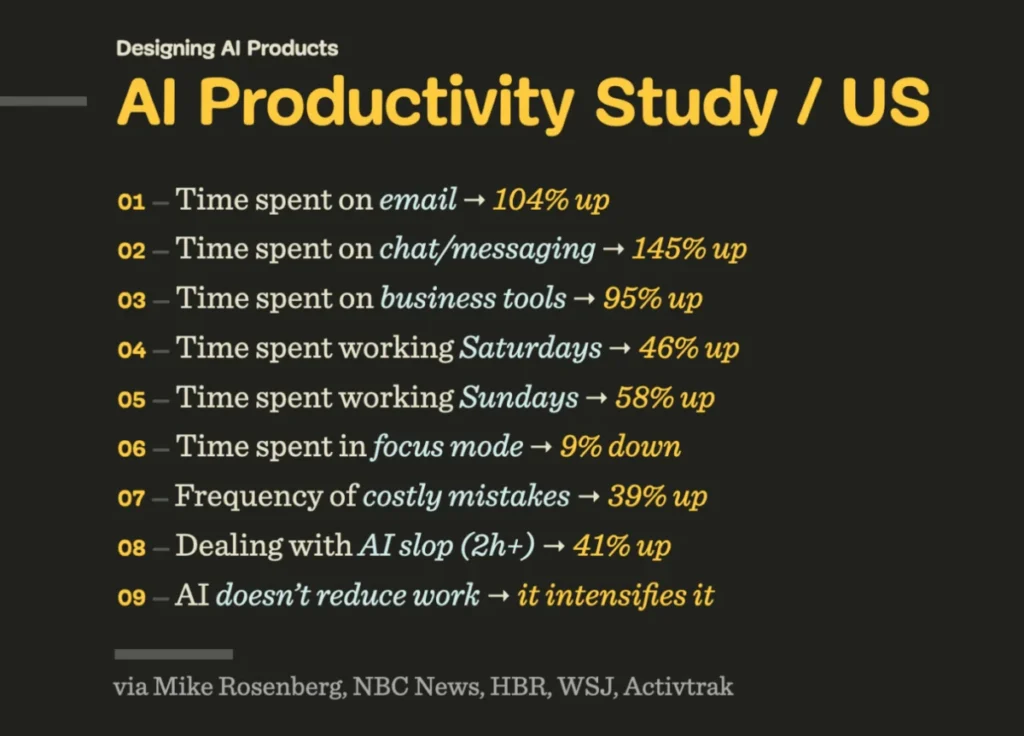
A comprehensive "AI Productivity Study," incorporating findings from various sources including NBC News, HBR, WSJ, and Activtrak, revealed a startling trend: AI, in many instances, does not reduce work but intensifies it. Key findings included:
- Email time increased by 104%.
- Chat/messaging time surged by 145%.
- Time spent on business tools rose by 95%.
- Working Saturdays were up by 46%, and Sundays by 58%.
- Focus mode decreased by 9%.
- Costly mistakes increased by 39%.
- Dealing with "AI slop" (low-quality or erroneous AI output) was up by 41%.
These statistics underscore a critical paradox: while AI promises efficiency, its current implementation often leads to an escalation of digital labor, blurring work-life boundaries and increasing the mental burden on employees. The initial novelty of AI quickly gives way to the exasperating reality of managing and correcting its unpredictable outputs, contributing to burnout and disillusionment.
User Apprehension and the Threat Perception
Beyond practical inconveniences, a deeper layer of apprehension surrounds AI. For many, AI does not arrive as a proactive choice but as an uninvited imposition, dictated by corporate agendas. This lack of agency, combined with pervasive media narratives about AI replacing human jobs, fuels significant fears and anxieties. It’s hardly surprising that the dominant perception of AI is not one of excitement, but rather resistance to change and a profound unease about one’s place in a rapidly evolving, technologically driven world.

The unpredictability and unreliability of AI further contribute to its negative perception. Unlike traditional software features that offer consistent and predictable outcomes, AI, with its propensity for errors and "hallucinations," is often viewed as a liability rather than an asset. This inherent variability makes it difficult for users to trust AI with critical tasks, leading to skepticism and caution.
The scope of AI applications also clashes with fundamental human desires. People generally do not dream of AI art museums, AI fridges, AI hotel receptionists, or AI-narrated children’s books. The idea of romantic AI partners or managing a "swarm of AI agents" to handle personal finances evokes more discomfort than desire. Fundamentally, most people do not wish to constantly interact with a magical text box or voice interface for every task; they seek intuitive tools that blend seamlessly into their lives.
The AI People Actually Need: Augmentation, Not Replacement
The prevailing sentiment among users suggests a clear preference for AI that augments, rather than replaces, their existing capabilities and workflows. The desire is for features that are fast, accessible, reliable, predictable, and genuinely useful, every single time. This means AI that takes over the most mundane, annoying, and boring tasks – the "grunt work" that offers little satisfaction – thereby freeing up human time and mental capacity for more complex, creative, and rewarding endeavors.
Many jobs, as highlighted by sources like The Washington Post, are indeed exposed to AI automation. However, within these roles, there often exists a unique, creative, or intuitive component that requires human taste, perspective, and judgment. If AI can effectively automate the tedious and mentally exhausting aspects of these jobs, it represents a significant advantage for everyone involved, enhancing productivity and injecting more joy into daily work life. This is where AI’s true value proposition lies: not in eliminating human effort, but in elevating it.

For AI to be truly valuable, it must be deeply integrated into people’s existing workflows, rather than feeling like an external bolt-on. Crucially, it must adapt to how people think and make decisions, aligning with established mental models that have been fine-tuned over years or even decades. The technology should conform to human cognition, not the other way around. Whether these features are branded as "AI," "smart," or "automation" is secondary to their functionality and user experience. What truly matters is that users are aware of the specific use cases where AI genuinely helps them, inspiring them to discover even more applications independently.
This approach defines "AI-second" tools: subtle, humble, calm, and ambient, taking a supportive role in the background for tasks that are otherwise dull and unnecessary. As Bo Young Lee succinctly articulated, "I don’t want to read books written by AI. I don’t want to gaze upon paintings by AI. I don’t want AI to teach my children. I don’t want to have an AI therapist. I don’t want AI making my medical decisions. I want AI to do all the physical and mental labor that taxes me so I can read books written by humans and go to art galleries to engage with art made by humans. I want AI that makes my life easier rather than forces me to change myself." This statement encapsulates the core user demand: AI as an enabler of human flourishing, not a substitute for human experience.
Implications for the Future of Technology and Work
The current user sentiment carries significant implications for the future direction of AI development and corporate strategy. It calls for a paradigm shift from a technology-first approach to a human-first, or "human-centered," design philosophy. This means prioritizing user needs, behaviors, and well-being at every stage of AI product development, focusing on seamless integration, reliability, and clear value delivery.
Companies must re-evaluate their R&D investments, moving away from simply adding "more AI" for its own sake, and towards solving tangible user problems with intelligent, subtle automation. Product roadmaps should be informed by genuine user research, emphasizing augmentation over disruption, and ensuring that AI tools truly reduce cognitive load rather than increasing it.

Ultimately, the goal of AI should be to enhance human life and deepen human connections, not to replace them. By automating the mundane, AI can create more time and mental space for individuals to engage in activities they love, spend quality time with loved ones, and pursue creative endeavors. The future of successful AI lies not in its ubiquity or complexity, but in its ability to quietly and reliably serve humanity, making life easier and more fulfilling without demanding constant attention or imposing unwanted change. This requires a fundamental recalibration of corporate priorities, moving from an obsession with technological capability to a profound commitment to user value and human experience.