
Data validation remains a cornerstone of robust software architecture, particularly within integration platforms where incoming payloads often arrive in unpredictable formats from external third-party APIs. Addressing a long-standing need for clean, declarative payload validation within MuleSoft ecosystems, developer Shakar Bisetty has released a comprehensive, sandbox-verified DataWeave module entitled dw-validation-utils. Designed specifically for DataWeave 2.x environments, this utility suite delivers 12 reusable validation functions aimed at streamlining field-level checks, complex pattern matching, and comprehensive bulk payload verification before downstream processing begins.
In modern enterprise integration, failing to validate inbound data early in an application flow can lead to severe runtime exceptions, corrupted databases, and difficult debugging sessions downstream. Traditionally, MuleSoft developers have relied on scattered conditional statements, complex inline DataWeave expressions, or external validation modules that often lack uniformity. The introduction of dw-validation-utils standardizes this process, offering a predictable, functional approach to checking data integrity directly inside transformation scripts. Verified using the DataWeave CLI 2.12.2, the module provides a predictable schema for error reporting, ensuring that developers receive structured feedback rather than cryptic runtime failures.

Comprehensive Overview of the 12 Validation Functions
The core of the dw-validation-utils module rests on its dozen specialized functions, each tailored to specific data hygiene scenarios. By structuring return values into predictable objects containing boolean validity flags, target field names, and descriptive error messages, the utility bridges the gap between raw data ingestion and strict schema enforcement.
The table below outlines the complete set of functions available within the module, detailing their signatures, behaviors, and verification status:
| Function | Signature | Returns / Behaviour | Source |
|---|---|---|---|
isRequired |
fun isRequired(val: Any, fieldName: String): Object = |
Returns name as valid: false, field: "name", error: "name must not be empty" , email as valid: false, field: "email", error: "email is required" , tags as valid: false, field: "tags", error: "tags must not be empty" , and status as valid: true . |
Verified in sandbox |
minLength |
fun minLength(s: String, min: Number, fieldName: String = "field"): Object = |
Returns valid as false, field as "field", and error as "field must be at least 5 characters" for strings shorter than the limit without a custom field name. |
Verified in sandbox |
maxLength |
fun maxLength(s: String, max: Number, fieldName: String = "field"): Object = |
Returns valid as false, field as "name", and error as "name must not exceed 10 characters" when input exceeds the limit. |
Verified in sandbox |
inRange |
fun inRange(n: Number, min: Number, max: Number, fieldName: String = "field"): Object = |
Returns inside as valid: true , boundary as valid: true , and outside as valid: false, field: "age", error: "age must be between 10 and 100" . |
Verified in sandbox |
matchesPattern |
fun matchesPattern(s: String, regex: String, fieldName: String = "field"): Object = |
Returns validMatch as valid: true and invalidMatch as valid: false, field: "invalidCode", error: "invalidCode does not match required pattern" . |
Verified in sandbox |
isValidDate |
fun isValidDate(s: String, fmt: String, fieldName: String = "field"): Object = |
Returns validCheck as valid: true and invalidCheck as valid: false, field: "invalidDate", error: "invalidDate is not a valid date (expected format: yyyy-MM-dd)" . |
Verified in sandbox |
isOneOf |
fun isOneOf(val: Any, allowed: Array, fieldName: String = "field"): Object = |
Returns valid as false, field as "status", and error as "status must be one of: ACTIVE, INACTIVE, PENDING" when the value falls outside the set. |
Verified in sandbox |
isUUID |
fun isUUID(s: String): Boolean = |
Returns valid as true, nil as true, and invalid as false for respective inputs. |
Verified in sandbox |
isURL |
fun isURL(s: String): Boolean = |
Returns validUrl as true and invalidWord as false for respective inputs. |
Verified in sandbox |
isPhone |
fun isPhone(s: String): Boolean = |
Returns e164 as true and sixteenDigits as false for respective inputs. |
Verified in sandbox |
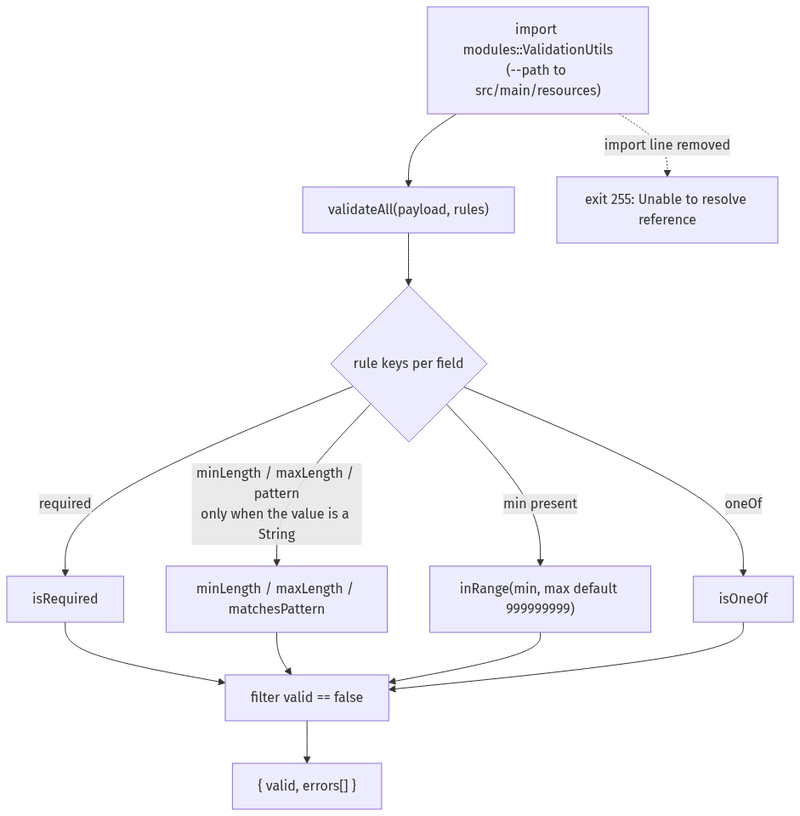
validateAll |
fun validateAll(obj: Object, rules: Object): Object = do { |
Returns valid as false and errors as [ valid: false, field: "email", error: "email is required" ] when rules fail. |
Verified in sandbox |
hasRequiredFields |
fun hasRequiredFields(obj: Object, fields: Array<String>): Object = |
Returns valid as false, missing as ["email", "phone"], and error as "Missing required fields: email, phone" when fields are absent. |
Verified in sandbox |
Chronology of DataWeave Module Development
The release of dw-validation-utils is part of a broader, ongoing initiative by community contributors to codify standard integration patterns into reusable components. As enterprise reliance on MuleSoft’s Anypoint Platform has expanded over the past decade, development teams frequently encountered the challenge of rewriting identical validation logic across disparate application portfolios.

Historically, developers addressed missing validation primitives in DataWeave by writing extensive custom mapping scripts containing nested conditionals (if/else) and manual regular expression evaluations. While effective, this approach introduced code duplication, reduced maintainability, and increased the likelihood of inconsistent error-handling responses returned to API consumers.
Recognizing these inefficiencies, open-source contributors began curating modular repositories. The development lifecycle of the dw-validation-utils library followed a rigorous engineering pathway:
- Identification of Common Bottlenecks: Analysis of frequent enterprise integration failures stemming from unvalidated string lengths, malformed dates, and missing identifiers.
- Drafting Functional Signatures: Designing pure DataWeave 2.x functions that avoid side effects and return standardized JSON-compatible objects.
- Sandbox Testing and Verification: Rigorous execution testing across various payload structures utilizing the DataWeave CLI.
- Integration into the MuleSoft Cookbook: Publishing the module alongside a collection of over 100 DataWeave patterns, accompanied by automated MUnit test suites to guarantee long-term stability.
Implementation Guidelines and Common Pitfalls
To successfully leverage dw-validation-utils within an enterprise MuleSoft application, developers must adhere to strict import syntax and structural conventions. The library must be explicitly referenced at the inception of any DataWeave script:

%dw 2.0
output application/json
import modules::ValidationUtils
---
ValidationUtils::isRequired(payload.name, "name")
Integration engineers must remain vigilant regarding common configuration traps. The most frequent error reported during initial implementation involves omitting the module import statement, which immediately triggers a runtime failure stating: Unable to resolve reference of ValidationUtils::isRequired.
Furthermore, developers utilizing helper functions such as minLength or maxLength should note that if an explicit field name parameter is omitted during the function call, the module defaults the reporting field property to the generic string "field". Ensuring precise parameter passing prevents ambiguity in downstream error-logging systems.
Broader Industry Implications and Technical Impact
The publication of structured utility modules like dw-validation-utils signifies a maturing ecosystem for functional transformation languages like DataWeave. By treating validation logic as a first-class citizen, enterprise architects can enforce domain boundaries much earlier in the integration lifecycle.

When payloads are validated via functions like validateAll or hasRequiredFields, integration flows can short-circuit before attempting resource-intensive operations such as database transactions, legacy system calls, or external SaaS API requests. This defensive programming paradigm significantly reduces unnecessary network traffic, lowers API latency during error scenarios, and enhances the overall resilience of distributed enterprise architectures.
As organizations continue to scale their API-led connectivity strategies, standardized utilities developed and verified by the community provide an essential foundation for writing clean, maintainable, and highly reliable integration code.