
Social media platform X, formerly known as Twitter, has announced a significant expansion of its user performance and transparency reporting framework. Building upon the recently introduced Under the Hood initiative, the platform will now provide creators, businesses, and everyday users with granular insights regarding post and profile visibility limitations stemming from local legal compliance and government-mandated content restrictions. This latest update aims to demystify algorithmic distribution and platform penalties, offering unprecedented clarity on how international laws affect content reach on a country-by-country basis.
The evolution of X’s transparency reporting arrives at a critical juncture for the digital media industry. For years, social media users, independent journalists, and content creators have expressed growing frustration over opaque content moderation practices, frequently citing arbitrary reach limitations commonly referred to as shadowbans. By introducing transparent compliance reporting, X is attempting to bridge the trust gap between platform administration and its user base, providing verifiable data to explain why certain posts or profiles may experience depressed engagement metrics in specific geographic regions.
Understanding the Under the Hood Initiative
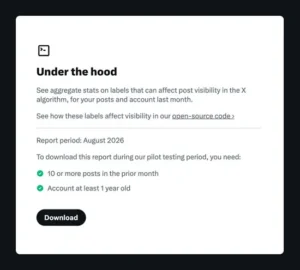
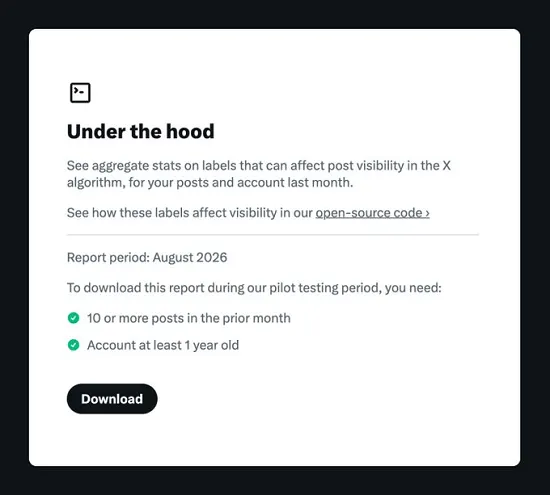
To fully comprehend the scope of the recent update, it is necessary to examine the foundational rollout of the Under the Hood framework. Last month, X launched this transparency feature to offer deeper visibility into how the platform’s underlying source code and algorithmic systems function. Alongside this code-level insight, the company deployed a simplified reporting function designed to give users a comprehensive overview of any penalties, labels, or restrictions applied to their accounts or specific posts over a trailing thirty-day period.
Initially, the tool provided surface-level metrics regarding general account status and policy enforcement flags. However, user feedback indicated a strong appetite for even greater clarity—particularly concerning how international regulations influence platform visibility. In response to this demand, X engineers expanded the reporting capabilities to explicitly detail instances where content visibility was restricted due to legal demands from foreign or domestic governments.
Under the updated system, users can log into their accounts and access dedicated reporting dashboards that reveal whether any of their individual posts have been withheld in specific nations following official legal orders. Crucially, the interface does not merely indicate that a restriction took place; it identifies the precise country of origin demanding the compliance action, providing a transparent audit trail for international content distribution.
Chronology of Transparency and Moderation Policy Shifts
The journey toward comprehensive content transparency on X has been characterized by dramatic shifts in corporate governance, public relations strategy, and regulatory pressures across multiple global jurisdictions. A chronological examination highlights how the platform’s transparency mechanisms have evolved over time.
Prior to late 2022, under its previous executive leadership, Twitter published biannual transparency reports detailing government requests for content removal and account information. However, these reports typically offered macro-level statistics rather than real-time, user-specific notifications regarding individual post suppression. Users whose content was impacted by local legal mandates rarely received direct explanations within their native account interfaces, often leaving them to guess why specific threads failed to gain traction internationally.
Following the acquisition of the platform by billionaire entrepreneur Elon Musk in late 2022, the company’s approach to public communication underwent a radical transformation. Management abandoned traditional public relations broadcasting in favor of using the platform itself as the primary channel for policy announcements. During this period, open-source initiatives were prioritized, leading to the public release of various components of the platform’s recommendation algorithms.
By early 2024, internal engineering teams began synthesizing these disparate efforts into unified user-facing dashboards. The culmination of this development cycle was the introduction of the Under the Hood update in the preceding month, which established the technological baseline for real-time penalty and restriction reporting. The current expansion—incorporating local law compliance and geographic withholding disclosures—represents the next logical phase in this ongoing evolution toward radical platform transparency.
Eligibility Criteria and Platform Accessibility
While the expansion of the Under the Hood feature is designed to benefit a wide cross-section of the digital community, access to these detailed insights is subject to specific platform requirements. According to official communications from X, the new reporting functionalities will not be immediately deployed to every single account across the global network.
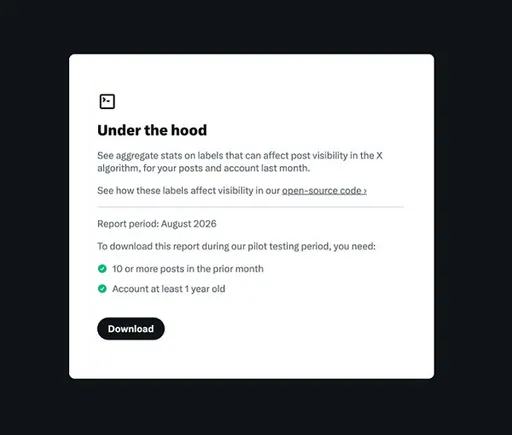
To qualify for the enhanced transparency dashboard, user profiles must meet two primary criteria:
- Account Age: The account must have been active on the platform for a minimum duration of one full year.
- Posting Activity: The account must maintain a baseline engagement history, specifically having published more than ten posts within the preceding thirty-day period.
These thresholds are implemented primarily to manage server infrastructure loads and to prevent automated bot networks from flooding analytical endpoints with unnecessary data requests. By restricting detailed compliance logs to established, active accounts, X ensures that the analytical resources are directed toward genuine human creators, verified organizations, and engaged community members who are most likely to utilize the data for strategic content planning.
Implications for the Creator Economy and Monetization
The introduction of granular geographic and legal compliance reporting carries profound implications for the modern creator economy. In recent years, X has rolled out various monetization programs designed to share advertising revenue with top-tier content creators based on user engagement and organic reach. For individuals who rely on platform payouts as a primary or secondary source of income, unexpected fluctuations in post visibility can have direct financial consequences.
Historically, when a creator noticed a sudden drop in impressions or engagement on a viral post, diagnosing the root cause was nearly impossible. Creators frequently speculated whether the algorithmic recommendation system had demoted their content due to perceived guideline violations, or if technical bugs were suppressing their metrics. With the integration of local law compliance insights into the Under the Hood dashboard, creators gain the ability to accurately contextualize their performance metrics.
For instance, if a creator produces content concerning international geopolitics, human rights, or regional governance, they may experience heavy visibility throttling in specific authoritarian regimes that demand strict adherence to local censorship laws. Previously, the creator might have assumed their entire account was shadowbanned globally. Under the new reporting structure, they can instantly verify that their reach is fully intact in permissive jurisdictions while only being withheld in the specific countries that issued legal compliance demands. This distinction allows content strategists to better understand their true global audience, tailor their distribution strategies accordingly, and eliminate guesswork regarding monetization anomalies.
Addressing the Shadowban Controversy
The term shadowban—referring to the covert suppression of a user’s content so that it remains visible to the author but invisible or heavily deprioritized to others—has long been a contentious topic in social media discourse. Users across virtually all major platforms have routinely accused tech companies of ideological bias, algorithmic discrimination, and unfair censorship.
X’s recent transparency updates represent a direct attempt to debunk or substantiate these claims with empirical data. By demystifying the mechanisms behind content filtering, the platform is shifting the paradigm from speculation to verifiable accountability. When users can view exact records of algorithmic flags, administrative labels, and government-mandated withholdings, the shroud of mystery surrounding content suppression begins to dissipate.
Industry analysts note that while transparency does not eliminate the underlying legal obligations that compel platforms to comply with foreign laws, it does empower users with the context necessary to understand why those actions occur. Rather than battling an invisible algorithmic adversary, users can view objective compliance markers that explain the structural limitations placed upon their digital footprint.
Global Legal Landscapes and Regulatory Pressures
The necessity for platforms like X to disclose local law compliance underscores the increasingly complex and fragmented nature of global internet governance. Tech companies operating on an international scale face a labyrinth of contradictory legal frameworks, sovereign mandates, and regulatory enforcement mechanisms.
Countries across Europe, Asia, the Middle East, and the Americas maintain vastly divergent definitions of acceptable speech, defamation, copyright protection, and national security. Under traditional international legal norms, digital service providers are generally required to comply with the local laws of the jurisdictions in which they operate, or risk having their services entirely blocked within those borders. This legal reality often forces platforms into a difficult balancing act between upholding commitments to free expression and complying with authoritarian or restrictive government decrees.
By explicitly labeling content that has been withheld pursuant to local legal demands, X provides a window into this geopolitical tug-of-war. Observers point out that these disclosures serve a dual purpose: they demonstrate the platform’s legal compliance to sovereign regulators while simultaneously maintaining radical transparency with the end user regarding the geopolitical forces shaping their online reach.
Official Responses and Industry Analysis
While formal statements from external regulatory bodies regarding X’s updated reporting tool remain limited, digital rights organizations and tech policy analysts have offered preliminary evaluations of the initiative. Many civil liberties advocates have welcomed the move toward greater transparency, noting that shining a light on government censorship requests is an essential step in holding state actors accountable for online suppression.
However, some analysts caution that transparency alone does not resolve the ethical dilemmas associated with complying with restrictive foreign laws. Critics argue that while knowing that a post was withheld in a specific country is a vast improvement over silent censorship, the underlying dynamic—wherein global platforms act as enforcers of local authoritarian edicts—remains a persistent challenge for the open internet.
From a commercial perspective, financial markets and media researchers view X’s product development strategy as an ongoing effort to rebuild platform utility and advertiser confidence. By positioning itself as an industry leader in transparency reporting, X is attempting to differentiate its services from competitors who maintain more opaque approaches to content moderation and algorithmic distribution.
Future Outlook for Platform Transparency
As digital communication continues to intersect with complex international legal battles, the demand for verifiable platform transparency is expected to accelerate. X’s expansion of the Under the Hood initiative sets a new operational benchmark for the social media industry, pressuring rival platforms to reconsider how they communicate content moderation decisions to their respective user bases.
Looking ahead, industry watchers anticipate that X will continue refining its analytical tools, potentially introducing more granular data feeds, historical trending analysis regarding content restrictions, and expanded access tiers for developing creator communities. Whether these measures will successfully restore universal trust in digital content distribution remains to be seen, but the platform’s current trajectory signals an irreversible shift toward open reporting, verifiable compliance, and data-driven accountability in the digital public square.