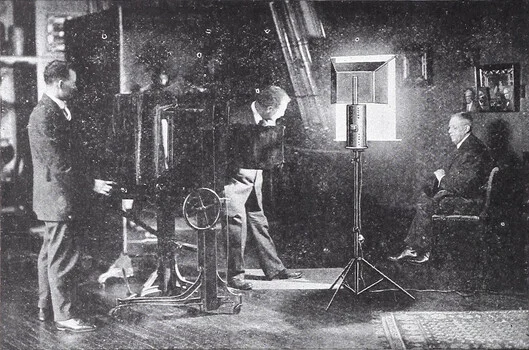

On April 3, 2013, a quiet economic earthquake swept across North American retail when CPI Corp. abruptly powered down more than 2,000 portrait studios in a single day. Operating the licensed photography centers tucked inside Sears department stores and Walmart locations under the PictureMe banner, the company’s sudden collapse dismantled a pervasive cultural institution. For nearly a century, these neighborhood studios had served as the default venue for generations of families to document their milestones, offering the ubiquitous mottled blue backdrops, laser-beam effects, and accordion-folded wallet prints that defined the American visual record. The swift shuttering of CPI Corp. marked not merely a corporate bankruptcy, but the definitive sunset of a commercial photography model that had democratized family portraiture for decades.
Origins and Evolution of Mass Portraiture
The concept of affordable, accessible portraiture for ordinary households is a relatively recent development in human history. Prior to the advent of photography in 1839, painted likenesses were luxury assets strictly limited to the wealthy and privileged. The introduction of the daguerreotype radically compressed production costs and timeframes, allowing shopkeepers, farmers, and working-class families to sit for professional likenesses within storefront studios by the mid-nineteenth century.
This democratization accelerated through mobility. Itinerant photographers traveled between towns, setting up temporary studios along high-traffic routes and inside early department stores. At high-volume tourism sites like Niagara Falls and Atlantic City, operators utilized multi-lens cameras to expose a grid of tiny images onto a single plate. These were subsequently cut apart and sold for a penny, giving rise to the term “penny picture.” By reducing the cost of a formal likeness from a month’s wages to loose pocket change, these itinerant operators established a foundational retail philosophy: price the sitting aggressively, place the camera where consumer foot traffic naturally flowed, and generate profitability through the volume of paper prints sold.
This commercial blueprint laid the groundwork for major twentieth-century empires. In the early 1930s, Olan Mills Sr. and Mary Stephenson Mills began copying and hand-tinting photographs in Selma, Alabama, before establishing a commercial studio in Tuscaloosa in 1933. Mary Mills developed a soft, hand-finished aesthetic that distinguished the brand, but the company’s true innovation was operational rather than artistic. In 1948, following an experimental telemarketing campaign that quadrupled weekly sales, Olan Mills integrated telephone booking into its core strategy. By removing the friction of scheduling and introducing structured club plans—where customers paid an upfront fee for multiple sittings across a year—the company engineered a predictable, high-volume pipeline that eventually expanded to roughly 1,000 free-standing studios and generated approximately $475 million in annual revenue at its peak.
The Rise of the Department-Store and Mall Studio
While independent chains like Olan Mills commanded the suburban landscape, the most ubiquitous footprint belonged to department-store partnerships. Founded as Rembrandt Studio in St. Louis in 1942 by Milford Bohm, CPI Corp. evolved over decades through retail integrations. After operating under various trade names and retail contracts, the enterprise secured an exclusive licensing agreement with Sears in 1973, eventually phasing out other retail accounts by 1986.
This alignment leveraged the unmatched real estate dominance of Sears during the retail boom of the 1970s and 1980s. CPI avoided the capital expenditure of real estate acquisition and traffic generation by embedding its operations within the existing foot traffic of major retail hubs. At its zenith, CPI operated over 1,000 studios across the United States and Canada, later expanding its portfolio by acquiring the PictureMe brand for Walmart locations and purchasing Kiddie Kandids in 2010 to capture the infant and toddler market within Babies R Us stores.
Simultaneously, the enclosed shopping mall birthed a specialized sub-genre of portraiture: the makeover-driven studio experience. Founded in Dallas in 1988 by Jack Counts Jr., Glamour Shots transformed the traditional photo session into an indulgent weekend event. Capitalizing on the late-1980s consumer appetite for personal transformations, the brand offered professional hair, makeup, and wardrobe styling paired with soft-focus photography for approximately $30. Expanding rapidly to roughly 380 international locations by the mid-1990s with annual sales reaching $100 million, Glamour Shots demonstrated that the mall format could successfully commercialize fantasy alongside standard family documentation.
Operational Mechanics and Economic Realities
The commercial success of mall and department-store studios was never rooted in avant-garde artistic technique. Rather, it relied on operational standardization, predictability, and ritualized convenience. Studio operators—often retail employees trained over the course of a single week—utilized fixed lighting setups, standardized posing guides, and scripted customer interactions to produce consistent results. This formula minimized human error while maximizing daily transaction volume.
For working parents juggling demanding schedules, these studios provided a reliable, frictionless service. They delivered standardized packages at predictable price points, fulfilling a domestic ritual that culminated in physical artifacts destined for mantels, family albums, and grandparent mailboxes. Despite professional critiques regarding soft lighting and repetitive backdrops, the industry fulfilled a vital socio-cultural demand: affordable permanence.
Financial Collapse and the Smartphone Disruption
Despite their apparent ubiquity, these corporate photography networks proved highly vulnerable to shifts in technology and consumer behavior. The primary catalyst for decline was not direct industry competition, but the rapid democratization of digital imaging spearheaded by the smartphone.
For generations, the commercial studio held a monopoly on two essential steps of photographic production: image capture and physical printing. The introduction of the first iPhone in 2007, followed rapidly by increasingly sophisticated camera integrations in devices like the iPhone 4 in 2010, systematically undermined the standalone point-and-shoot camera market. Overnight, consumers carried high-resolution digital cameras and instantaneous global distribution networks in their pockets. Families no longer required professional intervention to capture moments, nor did they depend on retail labs to view and share images.
The financial toll on legacy operators was swift and devastating. By 2012, CPI Corp. was buckling under mounting debt and declining transaction volumes. For the first nine months of its fiscal year, the company’s net losses expanded fivefold to exceed $60 million, while revenues dropped nearly 24 percent to $192.7 million. In April 2013, CEO Jim Abel notified employees that economic headwinds had become insurmountable, leading to the immediate, unannounced closure of more than 2,000 studios nationwide and subsequent Chapter 11 bankruptcy filings.
Competitors faced similar trajectories. Picture People filed for Chapter 11 bankruptcy in September 2016, underwent asset sales, and ultimately shuttered its remaining U.S. operations without advance notice in May 2018, stranding both employees and customers mid-order. Glamour Shots similarly contracted to a negligible handful of mall-based storefronts. Industry consolidation followed suit; Olan Mills sold its portrait and church-directory divisions to Lifetouch in November 2011, which was subsequently acquired by Shutterfly in April 2018 for $825 million.
Implications and the Modern Landscape
Today, the footprint of the traditional mall and department-store portrait industry is a fraction of its historical scale. While Lifetouch continues to operate select JCPenney Portraits studios and school photography services, the freestanding network of walk-in neighborhood studios has effectively vanished.
This structural shift has left a profound cultural footprint. Contemporary society generates a volume of digital imagery unprecedented in human history, yet an overwhelming proportion of these captures exist exclusively as volatile data streams stored on mobile devices or cloud infrastructure. Industry analysts note that while modern consumer cameras—ranging from advanced mirrorless systems to pocket-sized smartphones—vastly outperform the technical capabilities of vintage department-store lighting kits, the modern consumer has largely abandoned the physical artifact.
The legacy of the mall portrait studio resides not in its technical mastery, but in its role as a social anchor. It converted commercial real estate into a community archive, exchanging standardized portraits for enduring physical permanence. As digital storage continues to evolve, the sudden disappearance of CPI Corp. and its peers stands as a watershed moment in retail history—illustrating how rapidly consumer habits can pivot when technology decentralizes the means of cultural preservation.