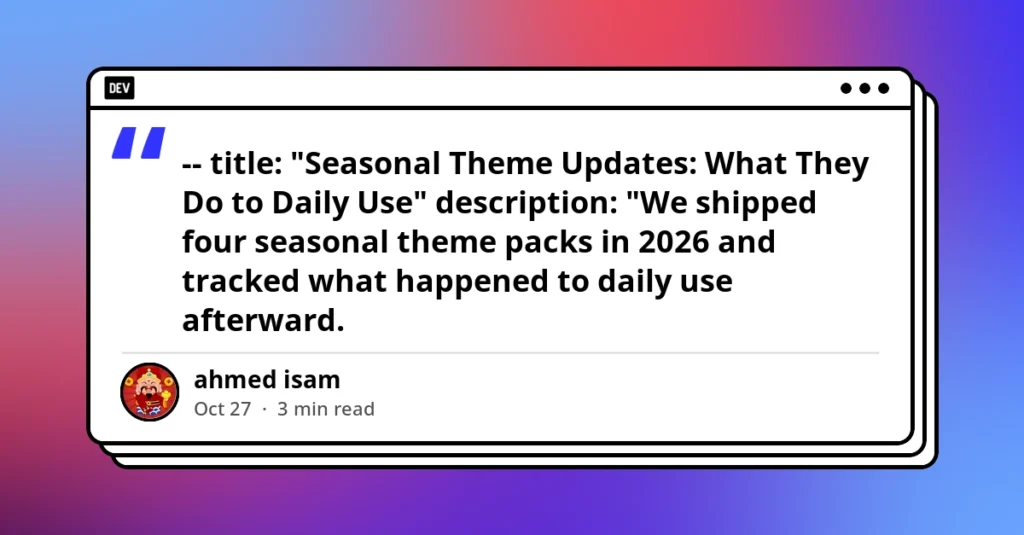

The psychological and behavioral impact of visual customization in software development environments has long been a subject of casual developer folklore, but empirical data on the matter remained remarkably scarce until recently. A comprehensive new study released by Codex Skin Studio sheds light on this phenomenon, tracking the telemetry of 3,100 installations across four distinct seasonal theme drops throughout the year 2026. The findings challenge long-held assumptions regarding developer productivity, aesthetic upgrades, and user engagement, revealing that while seasonal cosmetic refreshes undeniably trigger temporary surges in platform interaction, their long-term viability depends almost entirely on the subtlety of the design choices made by their creators.
The core metrics gathered from the 2026 releases indicate that user activity spikes by an average of 31 percent on the exact day a new seasonal theme pack becomes available. However, this initial surge is inherently fleeting. Researchers tracked user engagement against individual seven-day rolling baselines, discovering that the enthusiasm generated by a fresh visual palette decays rapidly, with activity levels completely returning to baseline by the ninth day following release. More critically, the data suggests that seasonal packs do not inherently compel developers to write more code or extend their working hours. Instead, they function primarily as re-engagement catalysts, giving developers who have temporarily drifted away from a project or environment a compelling visual reason to reopen their code editors.
This distinction carries substantial weight for product managers and design teams who might otherwise misinterpret a temporary drop-day traffic lift as organic, long-term growth. When developers open their integrated development environments (IDEs) simply to test a newly downloaded autumn or winter skin, the resulting metric bump represents a return visit rather than a fundamental shift in daily coding habits. Recognizing the boundary between temporary aesthetic curiosity and sustained workflow enhancement is essential for accurate analytics interpretation.
The 2026 release schedule provided a natural experiment in design methodology, as the four seasonal packs varied significantly in their approach to color theory and UI manipulation. Two of the released packs implemented aggressive, comprehensive palette overhauls, recoloring virtually every visual element on the screen, including syntax highlighting for various programming languages. The remaining two packs took a restrained approach, modifying only the accent colors, selection highlights, and panel backgrounds while leaving the underlying syntax colors entirely untouched.
The divergence in user retention between these two design philosophies was stark. Packs that heavily altered the entire visual ecosystem saw their adoption rates plummet as users quickly switched back to default or familiar themes within a single week. Conversely, the restrained, accent-focused packs retained a loyal user base long after the novelty wore off. Metrics revealed that 23 percent of installers were still actively utilizing an accent-only seasonal theme after 30 days, compared to a meager 7 percent retention rate for the comprehensive overhaul packs.

Industry analysts and UI/UX experts point out that aggressive syntax recoloring often introduces cognitive friction. When developers open their editors, their recognition of keywords, variables, and string literals relies heavily on established visual hierarchies and muscle memory. Disrupting those syntax colors for the sake of seasonal aesthetics forces the brain to expend unnecessary energy decoding familiar code structures, ultimately harming readability and prompting a swift reversion to standard settings. By limiting aesthetic interventions to non-intrusive structural elements like UI borders, scrollbars, and selection highlights, designers can deliver the psychological freshness of a seasonal update without compromising cognitive efficiency.
Beyond design methodology, the 2026 study underscored the critical role of timing and calendar alignment in software distribution. One of the most significant analytical takeaways emerged from an unexpected failure in the studio’s release strategy. The team deliberately timed their major New Year theme pack to launch during the peak holiday closure week, anticipating high developer engagement during downtime. Instead, the New Year release became the worst-performing drop of the entire year.
Developers, true to form, were largely away from their desks, spending time with family and disconnecting from professional tooling. The engagement metrics for the holiday drop fell drastically behind expectations. By contrast, an ordinary autumn-themed pack deployed on an unassuming Tuesday afternoon outperformed the New Year release by 26 percentage points. This sharp discrepancy highlights a broader lesson for digital product publishers: external calendar planning and behavioral habits dictate the success of aesthetic releases far more effectively than artistic execution alone. Shipped during a period of active professional routines, even a modest design update can capture attention; shipped into a vacuum of holiday inactivity, even the most polished artwork will fail to generate immediate traction.
The broader implications of these findings extend well beyond the specific ecosystem of Codex Skin Studio, offering valuable guidance for open-source maintainers, independent theme designers, and enterprise productivity software vendors alike. As digital workspaces become increasingly personalized, developers and knowledge workers frequently seek ways to combat interface fatigue. Customization is frequently touted as a panacea for user retention, yet the data confirms that superficial changes cannot permanently alter underlying work patterns.
For independent developers and designers interested in crafting their own seasonal or periodic theme packs, the empirical evidence points toward a strict minimalism. The data-driven recommendation is straightforward: modify no more than three core interface elements—specifically the accent color, the text selection color, and the background panels—and leave syntax palettes strictly alone. Venturing into comprehensive syntax recoloring risks alienating users who prioritize legibility and speed over novelty.
Furthermore, publishers must carefully weigh the timing of their updates against the natural rhythms of the target audience’s professional calendar. Aligning releases with active working days ensures maximum visibility and engagement, transforming a fleeting aesthetic novelty into a successful community touchpoint. As software customization continues to evolve as both a hobbyist art form and a UX consideration, quantitative insights of this nature provide a much-needed roadmap for balancing creative expression with practical usability in daily digital environments.