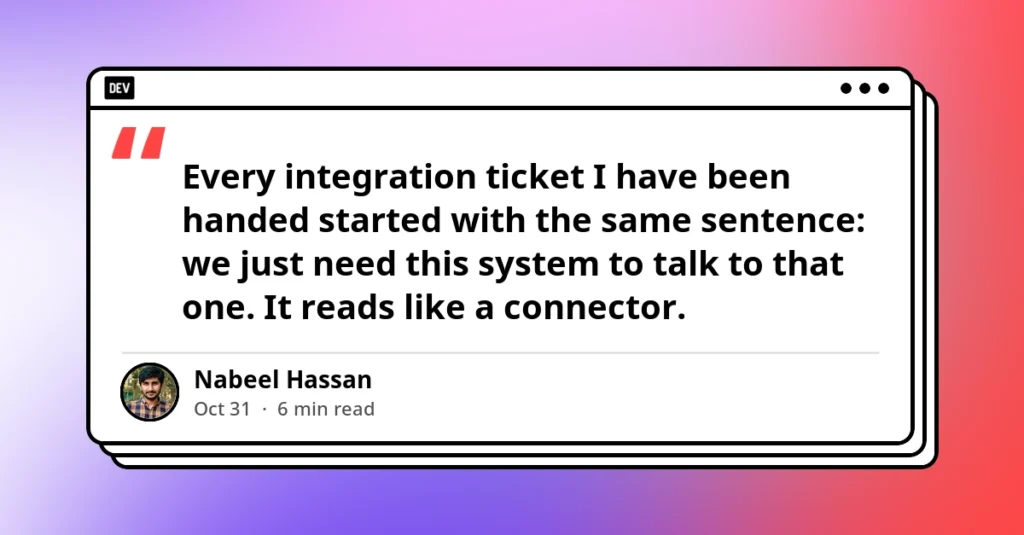

The modern enterprise software landscape is characterized by an illusion of seamless connectivity. Organizations routinely purchase SaaS platforms, customer relationship management tools, and specialized databases under the assumption that plugging them together is a trivial administrative task. Software development tickets for these tasks frequently begin with a deceptively simple premise: "We just need this system to talk to that one."
This language frames the work as a straightforward mechanical link—a connector. Consequently, engineering teams estimate these tasks as minor chores, anticipating a few hours of configuration followed by immediate deployment. However, enterprise software integration consistently metastasizes into complex, multi-week engineering projects. The root cause of this systemic underestimation is a fundamental misunderstanding of what the work actually entails. The execution of an HTTP network call is invariably the easiest component of the entire lifecycle. What consumes weeks of engineering labor is the handling of unspecified operational behaviors, edge cases, and business logic disguised as technical infrastructure.
The Hidden Complexity of System Interoperability
When two discrete software systems are linked, the technical architecture must account for numerous real-world anomalies that standard documentation rarely addresses. Systems inevitably encounter operational friction when both platforms attempt to edit the same underlying database record simultaneously. Complications multiply when a receiving system rejects a data row due to strict internal validation rules that were never communicated to the integrating team. Furthermore, human intervention introduces unpredictable variables; employees frequently modify fields manually within a database interface concurrently with automated scripts writing to those exact same fields.
These scenarios are not merely technical bugs; they represent fundamental business decisions wearing technical clothes. Resolving them requires architectural foresight, explicit data ownership rules, and robust error-handling protocols before a single line of code is written. Industry data indicates that poorly scoped integration projects account for a significant percentage of enterprise IT budget overruns and delayed software rollouts. To combat this pervasive issue, software architects and engineering studios have developed rigorous preliminary checklists to evaluate the true scope of connectivity projects prior to estimation.
Classifying the Shape of Data Integration
A comprehensive evaluation begins by classifying the architecture into one of three distinct shapes, each carrying vastly different financial and operational costs.
The first and least expensive architecture is the one-way feed. In this model, data flows unidirectionally from System A to System B and never returns. Common examples include transmitting e-commerce orders directly into an accounting ledger, piping sales leads into a CRM, or streaming event logs into a data warehouse. This shape minimizes engineering overhead because there is no ongoing requirement to reconcile conflicting data states.
The second architecture is the two-way sync, widely recognized as a financial and operational sinkhole. A two-way sync occurs when both systems possess the capability to modify the exact same record, and both modifications must be preserved or logically merged. This configuration requires strict governance: every data field must have a designated system of origin, and every potential conflict requires a programmatic resolution rule. Without these parameters, systems can become trapped in infinite loops, bouncing identical updates back and forth indefinitely. Industry experience demonstrates that the vast majority of requests for a "complete two-way sync" actually resolve into a one-way feed supplemented by a tiny fraction of fields that genuinely require bidirectional updates. Identifying this reality during the scoping phase saves weeks of development time.
The third and most complex architecture is a multi-system business process. In this scenario, a single enterprise event—such as the creation of a new customer order—triggers an intricate cascade of automated actions across four or more disparate software tools. This involves running an automated credit check, reserving inventory, generating internal notifications, and issuing an invoice, all governed by conditional logic at each step of the pipeline. Architecturally, this is no longer a simple connection; it is a fully realized distributed application whose user interface happens to consist of third-party software APIs. Consequently, it must be scoped, budgeted, and tested with the rigor of a standalone software product.
The Five Core Questions for Sizing System Integrations
To accurately size an integration project and prevent downstream architectural failures, software engineers must systematically answer five fundamental questions during the discovery phase.
1. What Does Each End Actually Provide?
In an ideal scenario, engineers are provided with two fully documented application programming interfaces complete with functional sandbox environments for testing. In practice, integration engineers frequently encounter APIs that support data retrieval (reads) but lack methods for data modification (writes). Other common obstacles include restrictive rate limits that quietly throttle the capacity to backfill historical data, or situations where one or both systems lack an API entirely. When an interface is absent, teams must resort to fragile workarounds such as scheduled file exchanges, database read replicas, vendor-provided data exports, or UI scripting. Acknowledging the fragility of these workarounds explicitly is critical, and confirming sandbox access and rate limits must be a non-negotiable prerequisite before committing to any project timeline.
2. Who Owns Which Field?
The concept of a "source of truth" must be applied at the granular level of individual data fields rather than entire software platforms. For instance, a customer relationship management platform may rightfully own a customer’s phone number, while a dedicated billing platform owns the payment terms. When multiple systems allow both automated scripts and human operators to edit the same field, developers must either designate a definitive winner or write deterministic conflict-resolution rules. Omitting this step results in unstable synchronization behaviors where data flaps continuously between conflicting values while separate departments insist their respective system is correct. In production environments, this dictates database schema design. For example, modern voice-agent architectures handle incoming webhook payloads by upserting conversation records while deliberately excluding tags, notes, summaries, and human-entered evaluations from the update payload. Those specific fields belong exclusively to human operators and analysis pipelines, ensuring that delayed automated webhooks never inadvertently overwrite human labor.
3. How Fresh Does the Data Have to Be?
Architecting a system for a nightly batch transfer versus event-driven synchronization within milliseconds requires entirely different engineering builds; it is not merely a configuration toggle. Real-time data synchronization necessitates complex infrastructure, including webhooks, message queues, strict sequencing logic, and replay mechanisms to recover events that occurred during system downtime. Architects must evaluate the genuine business impact of data latency: if information is delayed by one hour, does an operational process actually break? In many enterprise contexts, the answer is no. Establishing data freshness requirements on a per-flow basis prevents unnecessary architectural over-engineering. Furthermore, architects must remember that a webhook notification merely signals that an event occurred, not that the receiving system has successfully ingested all related data; a reliable backfill mechanism remains mandatory.
4. How Is the Same Entity Recognized Across Systems?
Disparate software platforms almost universally lack a shared, universal identifier for identical real-world entities. A single customer may exist as a distinct record ID in an email marketing platform and an entirely different contact ID in an inventory database, matched only by an email address that may have recently changed or a phone number formatted in three different ways. Engineers must establish explicit matching algorithms and implement an administrative exception queue to handle unmatchable records that require human review. Data that fails to reconcile automatically is frequently more damaging than missing data, as internal users continue to trust and act upon corrupted information.
5. What Happens When a Transfer Fails?
System failures are an statistical certainty rather than a theoretical possibility. External destination APIs will experience downtime, data rows will occasionally be rejected due to validation errors, and authentication credentials will inevitably expire. The defining characteristic of a resilient integration is its failure path. Implementing idempotency—such as establishing unique database constraints on external transaction identifiers—ensures that duplicate webhooks or automated backfill jobs safely update existing records rather than creating erroneous duplicates. Additionally, capturing raw incoming payloads in an immutable audit log before attempting to parse them allows engineers to diagnose unexpected data formats post-launch. Comprehensive failure handling routinely accounts for approximately half of the total engineering effort required for an integration project.
The Role of No-Code Tools and Artificial Intelligence
While custom engineering is frequently necessary, no-code and low-code integration platforms offer viable solutions under specific conditions. When data volume is modest, field mapping is straightforward, and a missed synchronization event results merely in a minor inconvenience rather than financial loss, no-code platforms provide rapid deployment. However, organizations outgrow these tools the moment data transformation logic becomes complex, error handling requires programmatic retries, or auditing compliance demands granular transaction control. The optimal enterprise architecture often utilizes a hybrid approach: utilizing no-code tools strictly at the operational edges for low-stakes notifications, while maintaining a robust, custom-built architectural spine for core business data.
The advent of advanced artificial intelligence and coding agents has significantly compressed the mechanical aspects of integration builds. Modern AI tools excel at generating boilerplate field-mapping code, data transformation adapters, retry loops, and comprehensive test suites under developer supervision. Certain workflows are increasingly handled entirely by autonomous AI agents that read customer databases, verify inventory, and execute transactions. However, this shift does not eliminate fundamental architectural requirements. An AI agent executing automated write operations represents an integration project subject to all standard risks. Core principles such as idempotency and strict access permissions remain paramount to prevent runaway automation errors. Ultimately, artificial intelligence cannot determine fundamental business policies, such as data field ownership or required data freshness thresholds; those decisions remain strictly within the purview of operational leadership.
Broader Implications for Enterprise Architecture
System integration is fundamentally an organizational agreement disguised as software code. It establishes explicit parameters regarding data ownership, transit velocity, and fault tolerance. When organizations approach integration projects with rigorous preliminary scoping rather than treating connectors as trivial administrative tasks, they build stable, long-lasting technical infrastructure. Conversely, skipping foundational analysis in favor of rapid prototyping inevitably yields brittle systems that require perpetual human monitoring. By treating integration architecture with the gravity of a core business strategy, enterprises can eliminate operational friction and ensure data integrity across their entire software ecosystem.