
The digital investigations community has long struggled with a persistent vulnerability: the unreliability of automated username enumeration tools. For years, open-source intelligence (OSINT) practitioners utilizing legacy platforms such as Sherlock, Maigret, and WhatsMyName have encountered a frustrating phenomenon. When querying a specific username across thousands of web platforms, the resulting aggregation frequently includes a high volume of phantom accounts. These false positives stem from various platform mechanics—such as login walls, catch-all routing systems, and error pages that improperly return an HTTP 200 OK status code instead of a traditional 404 Not Found.
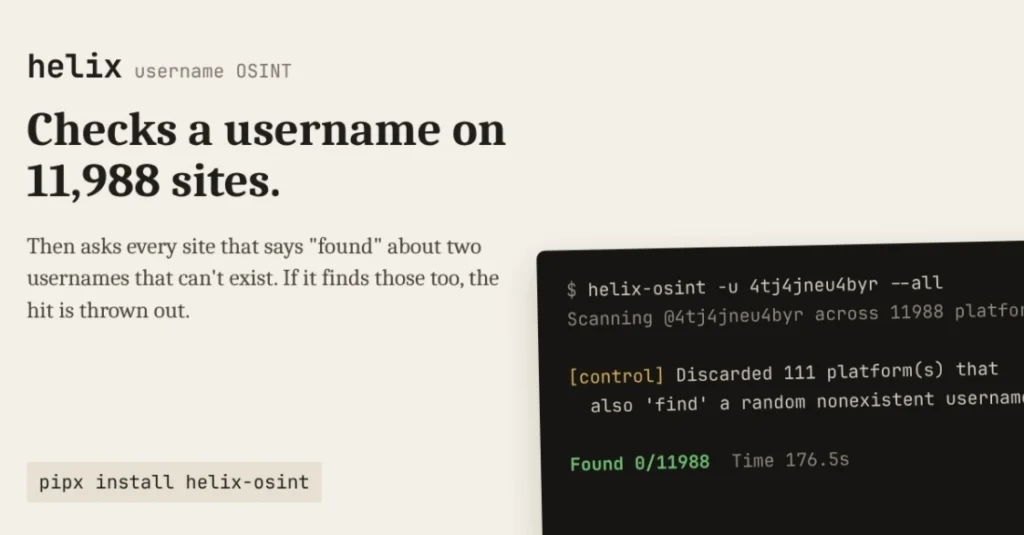
Addressing this systemic flaw, developer Thalha A. has introduced Helix, an open-source username OSINT tool designed to eliminate false positives entirely through a dynamic, live control-probe mechanism. By combining major site databases into a consolidated scan encompassing over 8,000 to nearly 12,000 platforms, Helix implements a rigorous validation standard that tests target sites in real-time. This development marks a significant methodological shift in digital reconnaissance, moving away from static, rule-based assumptions toward active, context-aware verification.
The Structural Failure of Legacy OSINT Databases
To understand the scope of the problem solved by Helix, one must examine how traditional username enumeration tools operate. Platforms like Sherlock and Maigret rely on predefined databases consisting of static rules. Each rule typically dictates a specific URL structure to request, alongside a designated HTTP status code or text string to monitor.
However, the architecture of the modern web is dynamic and constantly evolving. A static rule written two years ago can easily break, matching generalized error pages or login redirect screens in the present day. Prominent platforms such as Facebook and Instagram, for example, present identical authentication walls for both existing and non-existent profile URLs when accessed in a logged-out state. Similarly, numerous content management systems and modern web applications utilize "soft 404s," returning a standard 200 OK response header regardless of whether the requested resource actually exists.
When scaled across databases containing thousands of individual site definitions, these structural anomalies compound. In benchmark testing conducted during the development of Helix, an entirely fabricated, nonexistent username was scanned across a combined database of over 8,000 platforms. Legacy implementations routinely returned dozens of false positives—up to 72 phantom accounts in a single test run—simply because the target sites failed to properly manage non-existent paths.
For investigators, journalists, and cybersecurity professionals, manually verifying every single hit is prohibitively time-consuming. Conversely, trusting the raw output risks introducing contaminated data into intelligence reports, potentially compromising investigations or leading to erroneous attributions.
The Engineering Solution: Live Control Probes and Shape-Matching
To eradicate false positives, Helix abandons static rule reliance in favor of live site testing executed at the precise moment a positive hit is registered. When a target platform indicates that a username has been found, Helix immediately issues secondary probe requests to the same domain using randomized control names that cannot possibly correspond to real accounts.
This verification process operates without per-site manual tuning. Instead, each platform must dynamically prove during the scan that it possesses the technical capability to reliably differentiate between a genuine user profile and a fabricated query.
Initially, early iterations of the tool utilized simple strings composed of random letters for control probes. This approach revealed edge-case vulnerabilities on platforms such as developer publishing hub dev.to, which routed paths starting with a leading dot through a different controller than standard alphanumeric strings, causing random-letter controls to return clean 404s while dot-prefixed paths bypassed detection.
To counteract this, modern iterations of Helix employ advanced shape-matching algorithms for control probes. The generated fake names meticulously mimic the structural morphology of the original query: punctuation marks are mirrored in identical positions, character runs are substituted with randomized alphanumeric characters, and a minimum threshold of 12 characters is enforced to prevent accidental collisions with legitimate user accounts. Furthermore, for rules that rely exclusively on HTTP status codes or the absence of negative text strings, Helix mandates that the returned HTML content must explicitly contain the target username string. Consequently, generic rate-limiting pages, sign-in redirects, or search results pages displaying unrelated names are systematically filtered out.
Empirical Validation: Mock Web Environments and Real-World Testing
The efficacy of the control-probe methodology has been measured through rigorous benchmark testing across both simulated environments and the live internet.
In controlled conditions, the Helix repository utilizes a mock web benchmark capable of serving 6,000 simulated sites concurrently. Within this testing suite, 2% of the mock platforms are intentionally configured as catch-alls that return "found" statuses for any arbitrary input. Because the ground truth in a mock environment is absolute, precision and recall metrics can be mathematically verified. With the control probe activated, Helix achieves a precision rating of 1.000 and a recall rating of 1.000, maintaining zero false positives across standard concurrency levels as well as high-load testing parameters reaching 300 concurrent requests.
On the live internet, validation is achieved by generating randomized, non-existent usernames immediately prior to execution. Because these control strings possess no real-world counterparts, any positive return generated by the scanner represents a measurable false positive. Initial live tests demonstrated that while unverified scans accumulated dozens of phantom hits, the integration of real-time control probes reduced false-positive rates to zero.
Further empirical sampling of high-frequency real-world names—such as the common query jack, which routinely generates hundreds of platform hits—yielded similarly robust results. Manual cross-verification of random subsets against control parameters confirmed that reported accounts were overwhelmingly legitimate, with anomalies isolated primarily to edge cases such as deactivated profiles that retained historical HTTP 200 responses—a vulnerability subsequently patched within the core codebase.
Distinguishing Absence of Data from Inaccessibility
A critical distinction introduced by Helix is its transparent handling of indeterminate network states. During typical OSINT scans, a significant portion of targeted platforms fail to return definitive data due to infrastructure bottlenecks, security mitigations, or protocol failures.
In a standard scan of approximately 12,000 sites, a substantial percentage of endpoints will yield ambiguous results. These typically include automated bot-mitigation challenges (such as Cloudflare interstitial pages), connection timeouts, hard network errors, and HTTP 403 Forbidden responses. Legacy tools frequently categorize these non-responsive endpoints quietly under the umbrella of "not found," conflating infrastructure blockages with the actual absence of a user account.
Helix adopts a rigorous evidentiary standard by explicitly classifying these inconclusive endpoints as "not checked," accompanied by the specific diagnostic reason for failure. Investigators recognize this differentiation as vital: establishing that an account does not exist on a platform is fundamentally distinct from confirming that the platform could not be reached during the investigative window.
Contextualizing Identity: The Limits of Username Matches
While achieving a zero-false-positive rate ensures that every reported account physically exists on the target platform, the development team emphasizes a foundational principle of digital forensics: finding an active account matching a specific username does not automatically confirm ownership by the target individual.
To illustrate this limitation, querying a common identifier such as torvalds across a wide database yields multiple verified, legitimate accounts—including a Substack profile belonging to an individual named Nicolas, an Instagram account operated by a user named Marco Migozzi, and a Steam profile utilizing a pseudonym. While these accounts are verifiably real, none of them belong to Linux kernel creator Linus Torvalds.
To mitigate the risk of misattribution, Helix incorporates an automated identity-grading system that categorizes results into HIGH, MEDIUM, or LOW confidence tiers. This grading matrix evaluates independent cross-platform evidentiary markers, such as shared avatar hashes, reciprocal hyperlinks declared between accounts, verified email confirmation indicators, or matching geographic location metadata. A standalone username match is automatically designated as a LOW confidence finding, ensuring investigators are explicitly alerted when profiles exhibit divergent real-world identities.
evidentiary Integrity for Journalistic and Legal Standards
For investigative journalists, legal professionals, and corporate security teams, maintaining an unalterable audit trail is paramount. Helix integrates specialized flags designed to preserve the legal and evidentiary integrity of digital reconnaissance data.
The --record-attempt function generates a cryptographically sealed JSON record of the entire scanning session. This documentation includes precise UTC start and end timestamps, the exact database version paired with its SHA-256 cryptographic hash, the individual outcomes for every queried platform, and a comprehensive file fingerprint. Subsequent validation can be performed using the --verify-evidence command to ensure the dataset has not been tampered with.
Additionally, the --save-pages parameter captures and preserves the raw HTML content associated with every reported account, applying local hashing and timestamping protocols. This feature ensures that even if a target profile is subsequently deleted, modified, or suspended by platform administrators, investigators retain a verifiable snapshot of the exact content observed at the time of discovery.
Availability and Future Development
Written under the permissive MIT license, Helix is available for deployment via Python’s package ecosystem (pipx install helix-osint). Practitioners can execute rapid targeted scans using built-in profile lists, scale investigations across the comprehensive database of nearly 12,000 sites via the --all flag, or route traffic securely through the Tor network using the --tor parameter.
The development team continues to maintain the open-source repository on GitHub (https://github.com/thalha-a9/helix), inviting the global security community to submit bug reports and edge-case platform anomalies to further refine the accuracy of modern username reconnaissance.