
Unveiling Ridgeline: A New Frontier for Webflow and Real-Time 3D
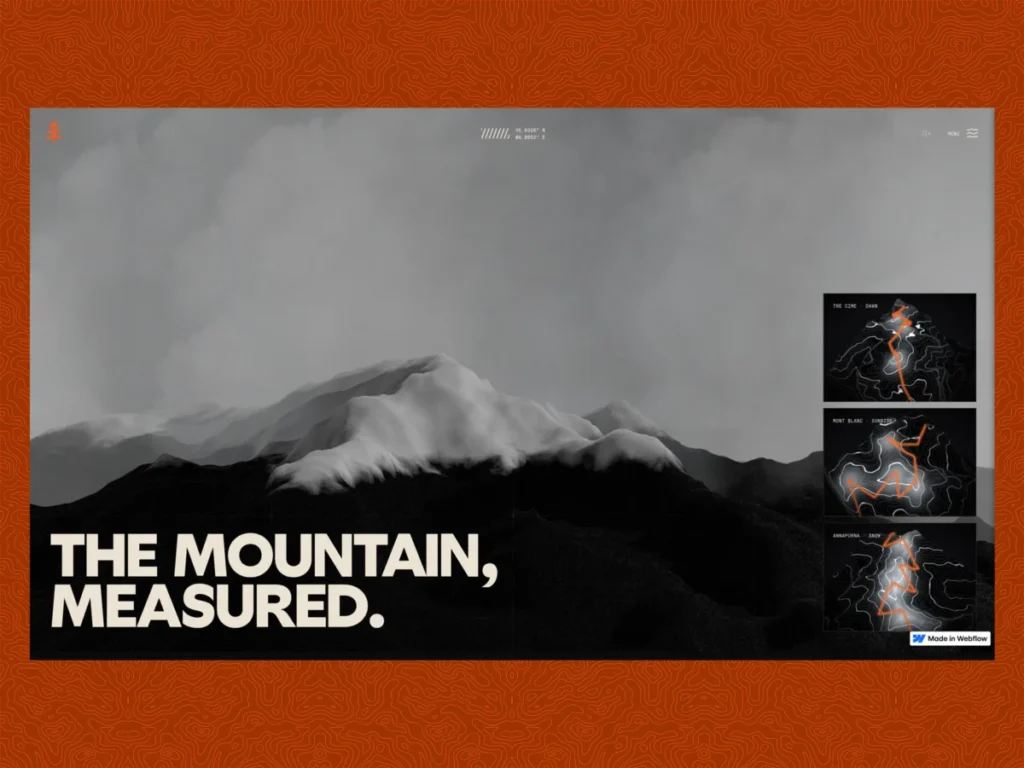
Ridgeline stands as a testament to innovative web engineering, presenting users with an immersive hiking and photography experience. Far from being a mere showcase of static imagery or pre-rendered video loops, the site features dynamic, real-time 3D topographical environments derived from actual elevation data. This pivotal technical achievement answers a fundamental question posed by the project’s creator: Can a Webflow site truly host and render authentic 3D terrain, leveraging Digital Elevation Models (DEMs) draped as survey-contour meshes, without compromising the platform’s core advantages? The affirmative answer, meticulously documented through a comprehensive build log, reveals a development philosophy centered on a single, guiding principle: "I don’t care if it’s a built-in component or external JS, I want to SEE it." This unwavering focus on visual fidelity and interactive realism ultimately dictated the entire architectural design, leading to a hybrid development approach that marries Webflow’s intuitive interface with robust custom code.
The finished Ridgeline experience comprises three distinct "condition" scenes, each intricately mapped to real-world alpine treks: "Dawn," depicting a stormy ascent in Tre Cime, Italy; "Sunrise," capturing the serene blue-hour transition to pink over Mont Blanc, France; and "Snow," portraying a night-blue landscape with falling snow on Annapurna, Nepal. These captivating environments are seamlessly interwoven with scroll-driven photography, ambient soundscapes, and an interactive atlas homepage that allows users to fly through the terrain previews before selecting a scene. Crucially, every element within these scenes, from the undulating peaks to the subtle lighting, is generated from real geometry, painstakingly built and maintained programmatically through the Webflow Model Context Protocol (MCP), yet remaining fully accessible and editable as a standard Webflow project. This dual capability underscores a significant leap forward in blending custom, high-performance web applications with low-code platforms, opening new avenues for interactive storytelling and data visualization on the web.
The genesis of the "Dawn" trek, specifically, highlights the project’s commitment to authenticity. The creator meticulously recorded a personal hike above Cortina in the Tre Cime, exporting the activity as a GPS track (GPX) from Strava. After careful cleaning to remove typical GPS anomalies, this real-world trace was then accurately draped onto the true SRTM (Shuttle Radar Topography Mission) slope data. While a normalized, coordinate-free version of the track is utilized to protect privacy, the terrain remains instantly recognizable, providing a tangible connection to the actual landscape. For the "Sunrise" and "Snow" scenes, plausible synthesized routes were employed, maintaining the illusion of real-world exploration even in the absence of recorded personal tracks. This meticulous attention to detail, from geographical accuracy to the user experience, defines the innovative spirit of the Ridgeline project.
The Genesis of a Vision: Challenging Webflow’s Capabilities
The ambition behind Ridgeline was to explore the uncharted territory of high-fidelity 3D within Webflow, a platform renowned for its visual development environment and ease of use, rather than its prowess in handling complex WebGL applications. The creator’s initial query—whether a Webflow site could genuinely render live 3D terrain using actual elevation data—stemmed from a desire to push the boundaries of what "no-code" or "low-code" platforms could achieve. Historically, integrating real-time 3D on the web has been a domain reserved for highly customized coding environments, often requiring extensive knowledge of JavaScript libraries like Three.js, WebGL shaders, and complex asset pipelines. Performance, asset management, and the sheer complexity of maintaining such systems typically deterred their integration into platforms like Webflow.
Webflow, with its market share steadily growing among designers and agencies seeking rapid prototyping and deployment without extensive coding, has consistently evolved to offer more customizability through its custom code embeds and more recently, its DevLink and Code Components features. However, a project of Ridgeline’s scope—one demanding live mesh rendering, sophisticated shaders, and dynamic interaction—represented a significant stress test for the platform’s flexibility. The core challenge was not just to display 3D, but to make it editable within Webflow’s design interface, ensuring that the 3D elements could be positioned, styled, and managed without requiring a deep dive into code for every minor adjustment. This commitment to Webflow’s philosophy of visual control, even for complex 3D, shaped the entire development process and the architectural decisions made along the way.
Architectural Choices: React Integration and the "Embed" Advantage

A critical architectural decision in Ridgeline’s development involved integrating React, a popular JavaScript library for building user interfaces, into the Webflow environment. Webflow offers a native pathway for such integrations through its Code Component feature, deployable via DevLink or a shared library. These components appear as first-class elements directly within the Webflow Designer, offering a seamless drag-and-drop experience. While this approach is ideal for UI-shaped components, Ridgeline’s requirements were fundamentally different. The project demanded a single, heavy WebGL bundle, complete with its own build step, the Three.js rendering engine, a Blender-baked asset pipeline, and GLB files hosted on Cloudflare R2. Routing such an extensive and performance-critical machinery through a conventional component system presented significant overheads and potential limitations.
Consequently, the creator weighed the native Code Component against a self-hosted JavaScript embed, ultimately opting for the latter. This decision, while sacrificing the immediate drag-and-drop convenience within the Designer, offered unparalleled flexibility and control over the custom 3D environment. The trade-offs were instructive: the embed allowed for direct management of the Three.js canvas, greater optimization potential for the WebGL context, and a more streamlined asset delivery pipeline independent of Webflow’s component build process. This autonomy was crucial for achieving the desired performance and visual fidelity.
To mitigate the embed’s lack of direct Designer integration, an attribute-driven mounting strategy was implemented. The self-hosted JavaScript embed was programmed to "hunt" for specific host elements placed by the designer within Webflow, identified by custom attributes such as [data-terrain-scene] or [data-terrain-card]. Upon detection, the 3D scenes would dynamically mount into these designated slots. This ingenious solution effectively maintained the designer’s control over the layout and placement of 3D elements, allowing them to arrange the page structure visually in Webflow, while the custom code handled the complex rendering and behavior. This separation of concerns—where the designer defines "where" and the code dictates "what"—exemplifies a pragmatic approach to blending advanced custom development with a low-code platform. This methodology provides a blueprint for future projects that aim to integrate highly specialized functionalities without abandoning the benefits of visual development tools.
AI-Powered Development: Claude and the Webflow Model Context Protocol
Perhaps one of the most surprising and forward-looking aspects of the Ridgeline project was the pervasive role of artificial intelligence in its development. The entire site—encompassing pages, components, classes, CSS, variables, custom code, and even SEO configurations—was not manually built but rather generated and maintained by an AI agent, specifically Claude (utilizing Opus 4.8 and Fable 5 models). This agent interacted directly with the Webflow Model Context Protocol (MCP) server, a powerful API that exposes programmatic control over a Webflow project. The speed of this AI-assisted workflow was remarkable, bringing the entire site to fruition in approximately one week, a timeframe that would be extraordinarily challenging for a human developer given the project’s complexity.
The Webflow MCP is a sophisticated interface designed to allow external systems, like AI agents or custom scripts, to interact with and modify a Webflow project’s underlying data model. This means the AI wasn’t just generating code snippets; it was actively creating and managing Webflow elements, classes, styles, and even publishing settings. The outcome of this AI-driven process was a fully functional Webflow project that remained completely "normal" and human-editable. A designer could open the project in the Webflow Designer and make manual adjustments, demonstrating a seamless integration between AI generation and human oversight.
The governing rule for this agentic workflow was clearly defined: "Markup and CSS live in the Webflow Designer as named components and classes. Behavior, 3D, and animation live in versioned JS on R2. The Designer holds structure; the CDN holds behavior." This clear demarcation allowed the AI to efficiently manage the structural and stylistic aspects within Webflow, while the more complex, dynamic behaviors and heavy 3D rendering logic were housed in external JavaScript files, versioned and served from Cloudflare R2. This strategy not only optimized performance but also streamlined the development process, allowing the AI to focus on generating the Webflow-specific assets while maintaining a robust, external codebase for the core interactive elements.
This pioneering use of AI in web development, particularly within a platform like Webflow, offers profound implications. It suggests a future where AI agents could significantly accelerate the initial build phase, handle repetitive coding tasks, and ensure consistency across large projects. For the web development community, Ridgeline serves as a compelling case study for the potential of AI-assisted development, highlighting its capacity for rapid iteration and the creation of highly sophisticated digital experiences. It underscores a paradigm shift where developers might increasingly act as orchestrators and refiners of AI-generated code, rather than sole authors.
Crafting Realism: The 3D Pipeline from Blender to Three.js

The bedrock of Ridgeline’s immersive experience is its unwavering commitment to real geometry. The non-negotiable requirement was that every terrain depicted originates from actual Digital Elevation Models (DEMs), specifically SRTM elevation datasets, for real mountain massifs. This commitment to authentic geographical data sets Ridgeline apart from projects relying on stylized or procedurally generated landscapes. The pipeline for transforming raw elevation data into interactive 3D scenes was meticulously crafted, involving a sophisticated workflow from Blender to glTF, ultimately rendered in Three.js.
The process began with modeling the chosen massifs in Blender, a powerful open-source 3D creation suite. Here, the DEM data was imported and processed to create the base terrain mesh. Blender’s capabilities were essential for refining the geometry, applying necessary modifiers, and preparing the assets for web deployment. Crucially, the Blender workflow itself benefited from the same "agentic" setup as the Webflow project, with an AI agent automating model tweaks and adjustments directly within Blender. This eliminated the need for manual round-trips through the user interface for every minor modification, further accelerating the asset preparation phase.
Once the models were prepared in Blender, they were exported to glTF (GL Transmission Format), an open-standard, royalty-free specification for 3D scenes and models. glTF is often referred to as the "JPEG of 3D" due to its efficiency and widespread support across various platforms and engines, making it ideal for web-based 3D. A key optimization during the export process was the mandatory use of Draco mesh compression. This powerful compression algorithm, enabled with specific quantization levels, significantly reduced the file size of static meshes, shrinking them by factors of 5 to 13 (e.g., from 11 MB to approximately 1 MB). This drastic reduction ensured that the three terrain GLBs, each landing at a compact 540-580 KB after compression, were small enough that their download was never a bottleneck in the user experience. Instead, performance challenges shifted to GPU and main thread processing, which were addressed through subsequent optimizations.
The distinctive survey-map aesthetic, characterized by crisp contour lines and nuanced shading, was achieved not through textures, but through a custom fragment shader written in GLSL (OpenGL Shading Language). This shader dynamically reads the mesh’s world-space height to generate contour bands. A pivotal technique employed was fwidth(), a GLSL function that calculates the rate of change of a value across screen space. By using fwidth() to derive the anti-aliasing width from the band index, the contour lines remained consistently one pixel wide and perfectly crisp, regardless of camera distance or zoom level. This sophisticated approach avoided the common aliasing artifacts seen with traditional texture-based methods.
Further enhancing the visual realism, the shader incorporated hillshading derived from the surface normal, elevation-based tinting, and a dynamic snow line. Every scene, despite its unique lighting and atmospheric conditions (Dawn, Sunrise, Snow), utilized the exact same shader, with variations achieved by simply adjusting a different set of uniform variables (ground and contour colors, snow strength, light direction). A subtle but impactful addition was a tiny per-pixel dither, applied using a hash function based on screen coordinates. This effectively eliminated the distracting 8-bit banding artifacts that often appear as grainy blotches in near-black gradients, particularly noticeable in scenes like "Dawn." This holistic approach to 3D asset management and rendering, combining real-world data, efficient formats, and sophisticated shader techniques, underscores the technical depth of the Ridgeline project.
Seamless Motion: Scroll-Driven Animations and Performance Traps
Ridgeline’s interactive experience is heavily reliant on scroll-driven animations, a popular technique for creating engaging and dynamic web narratives. The cardinal rule established early in development was that React, the project’s UI library, would never re-render on scroll events. Instead, scroll progress was channeled into a mutable ref and subsequently read within the optimized render loop of the 3D engine. This critical separation prevents unnecessary React reconciliation and DOM manipulations, which are major culprits of performance degradation during high-frequency events like scrolling.
The animation stack employed Lenis, a lightweight and highly performant JavaScript library for smooth scrolling, seamlessly integrated with GSAP (GreenSock Animation Platform), a industry-standard animation library. This pairing allowed for granular control over scroll behavior and complex timeline-based animations. Lenis was configured to drive GSAP’s ticker, ensuring that all scroll-related animations were synchronized and ran efficiently.
Two specific animation patterns presented significant challenges and yielded valuable lessons. The first involved a "frame-collapse" section, where a full-screen image gracefully collapses into a smaller 4:5 aspect ratio plate, while surrounding image columns stream into view. The initial pitfall was animating the width and height properties of the image, which, due to the changing aspect ratio, forced the browser’s object-fit property to re-crop the image on every frame. This constant re-cropping resulted in a visible, jarring jump. The elegant solution was to fix the element’s aspect ratio as a 4:5 box, sized once to cover the viewport, and then animate it purely using transform: scale. By maintaining a constant box and aspect ratio, the browser computed the object-fit crop only once, eliminating per-frame layout recalculations and ensuring a buttery-smooth animation.

The second, more insidious trap, which consumed considerable development time, involved a CSS drift animation whose keyframes began from an offset state (e.g., scale(1.04) translate(...)). The moment this animation engaged mid-scroll, the element would abruptly snap to that pre-offset state, creating an unwelcome "jump." This subtle issue persisted through numerous attempts to fix the collapse math, as it was unrelated to the aspect ratio problem. The crucial lesson derived was that any animation toggled on mid-scroll must inherently start from the element’s natural, resting (identity) state to prevent an instantaneous visual pop. These insights underscore the importance of understanding browser rendering pipelines and meticulously designing animations to avoid layout thrashing and unexpected visual artifacts, particularly in performance-critical, scroll-driven experiences.
Polishing the Edges: Preloaders, Audio Gates, and UX Refinements
While the core 3D rendering and animation logic formed the technical backbone of Ridgeline, much of the development time was dedicated to refining the "seams"—the transitional moments and user experience details that often dictate perceived quality. These seemingly minor elements, such as preloaders, first-paint flashes, and audio management, proved to be significant hurdles, each offering valuable lessons.
The "first-paint flash" was a common issue where, upon a hard reload, users would briefly glimpse a plain background before the intended dark preloader appeared. This timing problem arises because the site’s main JavaScript, which manages the preloader, is injected by a loader and thus executes after the browser has already painted the raw HTML. To circumvent this, a critical style block was placed directly in the Webflow head custom code. This synchronous styling, executed at first paint, immediately set the background to a dark color and used visibility: hidden to obscure all other body content until the JavaScript could take over. A failsafe timeout was also implemented to remove this guard after a set period (e.g., 8 seconds), preventing a blank page if the JavaScript failed to load. Once the main JavaScript initialized, it synchronously removed the #topo-fp-guard and launched the real preloader, ensuring a seamless transition without any flash.
Another crucial UX consideration was the "audio gate." Modern browsers universally block autoplaying audio and video until a user gesture (like a click or touch) is registered. Ignoring this policy leads to console errors and a silent experience. Ridgeline elegantly integrated this requirement by designing the preloader to conclude with an explicit user choice: "Enter" or "Enter muted." This interaction served as the necessary user gesture, unlocking the ambient audio bus and allowing the scene-specific soundscapes to begin playing. This approach not only adhered to browser policies but also empowered the user with control over their audio experience from the outset.
Once the audio bus was unlocked, each scene featured its own subtle, ambient audio layer. This was carefully crafted to enhance the atmosphere rather than dominate it, operating as background immersion rather than a prominent soundtrack. Examples include the distant rumble of thunder during "Dawn" or the gentle rustle of wind during "Sunrise." The guiding principle was that "sound should be the thing you’d miss if it were gone, not the thing you notice when it’s there." This meticulous attention to audio design, coupled with robust solutions for common web UX challenges, underscores the comprehensive approach to delivering a polished and immersive digital experience.
Fluid Navigation: Persistent WebGL Context and Async Compilations
Navigating between the distinct 3D scenes in Ridgeline is a masterclass in seamless transitions, leveraging a PJAX (PushState AJAX) swap mechanism beneath a dynamic WebGL "flood" cover. This topographic-contour reveal, which gracefully sweeps in, holds, and then drains, is a critical element in maintaining user immersion. The architectural cornerstone enabling this fluidity is the commitment to a single, persistent WebGL context. Instead of tearing down and recreating the entire canvas with each navigation, which often leads to evicted contexts and jarring black flashes, the project simply swaps the scene data (setScene). This strategy ensures that the GPU remains "warm" and ready, avoiding the performance penalties associated with context reinitialization.
Despite the persistent WebGL context, a subtler performance bottleneck emerged: the "shader compile stall." The flood transition was designed to drain once a new scene’s mesh was "parsed." However, parsing the mesh occurs before its associated shader materials are fully compiled on the GPU. This meant that the shader compilation, a CPU-intensive process, would stall the main thread during the visible reveal, causing a momentary freeze or stutter.

The solution to this critical issue involved implementing compileAsync, a Three.js method that utilizes the parallel-shader-compile extension (if available in the browser). This allowed the heavy work of compiling the swapped-in scene’s shader and uploading its GLB assets to be offloaded from the main thread. The scene-ready event, which triggers the draining of the flood, was then made contingent not just on mesh parsing, but on the successful completion of the asynchronous GPU compilation. A failsafe timeout was also included to prevent indefinite hanging in case of compileAsync failure or browser incompatibility. This optimization eliminated a roughly one-second freeze that previously occurred on the first reveal of a new scene, making the transitions genuinely smooth. The same compileAsync trick was also employed to pre-warm the summit-cairn scene before it scrolled into view, eradicating another visible performance hitch.
A candid note from the development log acknowledged approximately 110ms of synchronous work (primarily the innerHTML swap and re-wiring of the new page’s JavaScript) that still occurs during transitions. However, this work is intentionally executed while the WebGL flood cover is fully opaque and holding, rendering it completely invisible to the user. This pragmatic decision—prioritizing perceived smoothness over absolute technical purity when the latter offers no visible gain—underscores a mature approach to web performance. The focus remained on delivering a flawless visual experience, even if it meant tolerating hidden complexities.
The Pursuit of 60 FPS: Strategic Performance Optimizations
Achieving a locked 60 frames per second (FPS) throughout Ridgeline was a relentless process of identifying and eliminating unnecessary work. The core philosophy was simple: "stop doing work that doesn’t change a pixel." To guide this optimization effort, a tiny in-page FPS profiler was built, togglable with a keypress. This tool provided real-time feedback, bucketing frame rates by scroll depth and labeling sections (e.g., min 34 @ 46% (Frames)), transforming vague "jankiness" into quantifiable performance targets.
The impact of these optimizations was dramatic across various sections of the site:
| Where | Before | After |
|---|---|---|
| Homepage intro (terrain canvases) | 46fps, min 33 | 60, min 56 |
| Snow scene (falling snow) | 37fps | 60 |
| Summit reveal (first scroll-in) | ~1000ms freeze | gone |
| Footer entrance | min 7 | min 57 |
These significant gains were achieved through a series of strategic interventions, none of which compromised visual quality:
- Culling off-screen 3D content: The homepage, featuring multiple terrain canvases, initially suffered from low FPS because all scenes were rendering continuously, even when not in view. Implementing frustum culling, a technique that prevents objects outside the camera’s view from being rendered, dramatically improved performance by ensuring only visible 3D elements consumed GPU cycles.
- GPU-accelerated snowfall: The "Snow" scene initially used CPU-based particle simulations, leading to a significant FPS drop. This was re-architected to a GPU-based snowfall system, where particle positions were uploaded once, and the shader handled all falling and wrapping logic. This offloaded computationally intensive work to the GPU, freeing up the main thread and restoring 60 FPS.
- Throttling and debouncing scroll events: Although not explicitly detailed in the provided content, common practice for scroll-heavy sites includes throttling or debouncing scroll event handlers to limit their execution frequency, preventing excessive DOM manipulation or costly calculations.
- Lazy loading and deferred initialization: Resources not immediately needed (e.g., distant images, heavy JavaScript modules for later sections) were lazy-loaded or initialized only when they entered the viewport or were explicitly required. This reduced initial load times and the amount of active work the browser had to manage.
- Removing unnecessary CSS animations: The footer entrance, a particularly problematic area with a reported
min 7FPS, was optimized by stripping away extraneous CSS animations that were triggering layout recalculations or paint cycles on elements that weren’t visually changing. - Optimizing image assets: Ensuring images were correctly sized, compressed, and served in modern formats (e.g., WebP) also contributed to overall performance by reducing file sizes and improving decoding efficiency.
The overarching lesson from Ridgeline’s performance journey reinforces a fundamental principle in web development: "the fastest frame is the one that doesn’t do work."