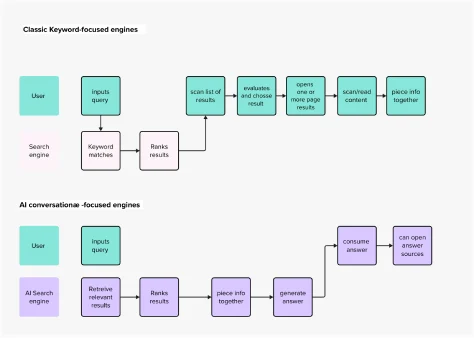

The digital landscape is undergoing a profound transformation with the ascent of conversational AI search engines, tools powered by sophisticated large language models (LLMs) capable of retrieving, synthesizing, and summarizing information from the vast expanse of the Internet. This emergent technology, highlighted by a February 2024 report in Fast Company, represents a significant evolution in how users interact with information, offering a compelling alternative to the long-established keyword-based search paradigm championed by Google. The rapid proliferation of generative AI since late 2022 has ignited fervent enthusiasm and a wave of academic and scientific experimentation, positioning conversational AI search at the forefront of digital innovation.
The Genesis of a New Search Paradigm
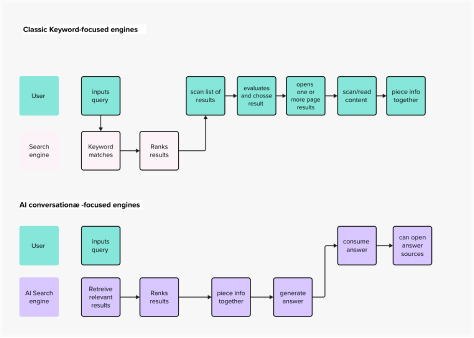
The current surge in conversational AI search engines is a direct consequence of breakthroughs in generative AI, particularly the widespread adoption and public exposure to tools like ChatGPT. While the core user need—finding answers—remains timeless, the method of achieving this goal is radically shifting. Traditional search engines present users with a list of links, requiring them to sift through multiple web pages to extract relevant information. Conversational AI, by contrast, aims to deliver direct, synthesized answers, mirroring the natural give-and-take of human conversation.
This shift is not merely incremental but represents a fundamental reimagining of the search experience. Companies like Perplexity AI and Andi are at the vanguard of this movement, showcasing distinct approaches to integrating AI into search. Perplexity AI, for instance, offers a homepage that, at first glance, shares visual similarities with classic search engines—an input field, a central results display, and supplementary widgets. However, the underlying mental model is fundamentally different. Instead of a conduit to external web pages, it functions as a conversational chatbot, a user interface concept that has become increasingly familiar and accepted thanks to the broad impact of generative AI applications.
Andi, another notable player, pushes this conversational paradigm even further in its layout and interactions, though its information architecture retains elements more akin to traditional search. These developments largely represent a "technology push," where the sheer power and novelty of generative AI are driving market evolution, rather than a direct response to a pre-existing, unmet user demand. While this approach can accelerate innovation, it also carries strategic risks if the human element and genuine user benefit are not meticulously considered.
Market Dynamics and the AI Investment Boom

The rise of conversational AI search is occurring within a burgeoning market for artificial intelligence. According to a report by Statista, the global artificial intelligence market size was valued at approximately USD 196.63 billion in 2023 and is projected to grow substantially, reaching over USD 1.8 trillion by 2030. Within this, investments in generative AI specifically have skyrocketed, with venture capital pouring into startups developing LLM-powered applications. Companies like Perplexity AI have attracted significant funding, signaling investor confidence in their ability to carve out a niche in the search market. Google, the undisputed leader in traditional search, has also heavily invested in its own generative AI capabilities, integrating LLMs into its search experience with features like Search Generative Experience (SGE), which offers AI-powered overviews and conversational follow-ups. Microsoft, with its integration of OpenAI’s models into Bing Chat (now Microsoft Copilot), has likewise signaled its commitment to a conversational search future. This competitive landscape indicates that major tech players and nimble startups alike view AI as the inevitable next frontier for information retrieval.
Enhancing the User Experience: Efficiency and Intuition
From a usability standpoint, conversational AI search engines present several compelling advantages. The most immediate improvement lies in the direct delivery of answers. Unlike classic search engines, which provide a list of links that users must then navigate and parse, tools like Perplexity collate and summarize information from multiple sources, presenting a concise, ready-made answer. This streamlines the user journey, eliminating the need for users to evaluate individual search results, make educated guesses about content relevance, or spend time scanning multiple web pages.
This direct Q&A format aligns closely with natural human conversation patterns, inherently meeting a crucial usability heuristic: "Match between system and the real world." Users are accustomed to asking questions and receiving direct answers, and AI search engines replicate this intuitive interaction. Other Nielsen usability heuristics that these engines often address include:
- Visibility of system status: By clearly indicating when the AI is processing a query or generating an answer, and by often citing sources, these systems keep users informed.
- Flexibility and efficiency of use: Experienced users can often get answers faster, while new users find the conversational interface easy to grasp.
- Aesthetic and minimalist design: Many AI search interfaces prioritize clean, uncluttered layouts, focusing on the conversational interaction.
- Error prevention: While not foolproof, the aim is to reduce user errors by delivering a synthesized answer, rather than requiring users to correctly interpret and navigate a list of links.
These enhancements undoubtedly make the search experience more efficient and less burdensome. The reduction in cognitive load—the mental effort required to process information—is significant. Users can quickly obtain answers, saving time and effort, particularly for straightforward queries. The immediate gratification offered by a direct answer can be highly appealing, leading to a smoother and more rewarding interaction. However, the question remains whether this improved efficiency comes at a cost, and whether this new standard for search is universally beneficial.
Broader Implications: Trust, Explainability, and Human Agency
While the convenience of conversational AI search is undeniable, its broader implications extend far beyond mere usability, touching upon critical aspects of trust, explainability, and human agency. When a tool like Perplexity deploys generative technology to synthesize an answer from disparate content, it performs a complex series of selections, extractions, and summarizations based on its algorithmic assessment of relevance. A key challenge arises from the inherent lack of transparency in this process: the application often falls short of clearly communicating why certain sources were prioritized over others, or how specific pieces of information were weighted. This deficit in "AI explainability" directly impacts the trustworthiness of the system.
Francesca Rossi, IBM’s Global Ethics Leader, emphasizes that AI’s ability to make important decisions fairly, align with human values, and explain its reasoning is paramount for building trust. In the enterprise world, the risks of an untrustworthy AI system—including regulatory penalties, reputational damage, and legal liabilities—are becoming increasingly pressing. Yet, for individual "Internauts" (highly skilled, habitual internet users), the implications are often less immediately apparent but potentially more insidious.
As Gen Z expert Roberta Katz eloquently observes, "first you make the building and then the building makes you." Just as physical environments shape human behavior, the architecture of our digital tools profoundly influences users. The danger with highly convenient, authoritative-sounding AI-generated answers is that users may become accustomed to accepting information uncritically, without pausing to question its accuracy, bias, or underlying veridicality. While these tools typically provide links to source documents, users may struggle to ascertain:
- The extent to which the AI has accurately reflected the content of the source.
- The criteria by which the AI selected specific sources over others.
- The potential for "hallucinations," where the AI generates plausible-sounding but factually incorrect information.
Even with full explainability, the sheer ease of obtaining synthesized answers could, in the long run, impact users’ critical thinking skills. The process of sifting through traditional search results, comparing information from various articles, and synthesizing one’s own understanding, though more tedious, serves as valuable exercise for analytical and critical faculties. This active engagement can foster a healthier skepticism and reduce uncritical over-reliance on AI models. If the prevailing mental model of a search engine evolves into a tool that always knows the right answer, the societal implications for discerning truth from falsehood could be immense, particularly in critical domains such as policymaking, scientific research, and civil discourse.
The economic implications for content creators and publishers are equally profound. Kevin Roose of The New York Times succinctly articulated this concern: "If AI search engines can reliably summarize what’s happening in Gaza or tell users which toaster to buy, why would anyone visit a publisher’s Web site ever again?" This raises existential questions for the "link economy" and the business models of online content creation. If AI search engines become the primary interface for information consumption, direct traffic to news sites, blogs, and other informational platforms could significantly decline, impacting advertising revenue and subscription models. The debate over fair compensation for data used to train LLMs, and the attribution of summarized content, is already a contentious issue within the industry.
However, not all AI search experiences are designed identically. Andi’s architecture, for example, consciously retains a structure closer to traditional search, despite its conversational interface. In queries, Andi might provide a brief answer—often a direct snippet from a primary source like Wikipedia—alongside a prominent list of all relevant sources with clickable links. This design choice actively encourages users to click through to the original web sites, demonstrating how thoughtful UX and UI design can mitigate some of the risks to content publishers and promote more desirable user behaviors, fostering a healthier information ecosystem.
The Imperative of Trustworthy AI
The future of AI search engines is not a question of if AI will be integrated, but how. Generative capabilities offer undeniable enhancements to user experience, promising faster access to knowledge. Therefore, the more critical questions revolve around:

- How can AI search engines be designed to be demonstrably trustworthy?
- What ethical frameworks and technical safeguards are necessary to ensure responsible deployment?
- How can we balance convenience with the preservation of critical thinking and a robust information ecosystem?
A study published in Nature highlighted the conflicting views among researchers regarding AI science search engines; some found them invaluable and accurate, while others expressed concerns about inconsistency and a lack of trust in retrieval performance. This dichotomy underscores the central challenge: trust remains a primary barrier to widespread AI adoption.
Addressing this requires a multi-faceted approach, focusing on two key areas:
-
Technical and Design Solutions:
- Retrieval-Augmented Generation (RAG): Implementing RAG techniques, which ground LLM responses in verifiable, external knowledge bases, can significantly reduce "hallucinations" and improve factual accuracy. This ensures that answers are not merely plausible but are directly supported by retrieved information.
- Comprehensive Source Citation: Moving beyond simple links, AI search engines need to provide detailed, easily accessible information about how sources were used, including specific excerpts and explanations for their selection.
- Transparency in Algorithmic Decision-Making: While full algorithmic transparency might be impractical, efforts towards "explainable AI" should aim to provide users with a clearer understanding of the AI’s reasoning process, perhaps through confidence scores or highlighted reasoning pathways.
- Human Oversight and Feedback Loops: Integrating mechanisms for human review and correction, along with robust user feedback systems, can help identify and rectify errors, continuously improving the AI’s performance and trustworthiness.
- Bias Mitigation: Proactive measures to identify and mitigate biases in training data and algorithmic processes are essential to ensure fair and equitable information delivery.
-
Regulatory and Ethical Frameworks:
- Emerging AI Regulations: Global regulatory bodies are increasingly developing frameworks (e.g., the EU AI Act, proposed regulations in the US) to ensure the safer and ethical use of AI. AI search engines will need to comply with these regulations, particularly concerning transparency, accountability, and data privacy.
- Industry Standards and Best Practices: Collaborative efforts within the tech industry to establish voluntary standards for AI search can foster a shared commitment to ethical development and deployment.
- Promoting AI Literacy: Educating users about the capabilities and limitations of AI search engines, and fostering critical information literacy skills, will be crucial in empowering individuals to engage responsibly with these tools.
Ultimately, the advent of conversational AI search engines forces a critical re-evaluation of what constitutes a "good" search experience. While user-friendliness and efficiency are paramount, they must be balanced with accuracy, trustworthiness, comprehensiveness, and the preservation of human critical thinking. As we delegate increasingly significant portions of our decision-making and information synthesis to LLMs, the design efforts must prioritize building systems that are not just intelligent, but also accountable, transparent, and aligned with human values. The future of AI search demands much more than just a superb conversational user interface; it requires a foundational commitment to responsible innovation that benefits both individuals and the broader information ecosystem.