
The modern web ecosystem is undergoing a quiet, fundamental shift as browser vendors and the W3C align on standardized, high-performance native APIs. For over a decade, the developer community relied heavily on the npm ecosystem to fill gaps in browser functionality, leading to bloated package.json files and significant bundle sizes. However, the rise of the Baseline project—a collaborative effort by the WebDX Community Group—has provided a clear, reliable standard for identifying when web platform features are ready for production use. By auditing dependencies against Baseline’s “Widely” and “Newly” available status, developers can reclaim between 60KB and 90KB of gzipped code in a typical mid-sized application, drastically improving performance without sacrificing feature parity.
The Evolution of the Web Platform
In the early 2010s, the disparity between browser capabilities necessitated the rise of "polyfill" culture and utility libraries. Developers turned to packages like axios for HTTP requests, lodash for data manipulation, and various custom libraries for modal dialogs and internationalization. Each dependency brought with it a maintenance tax, security vulnerabilities, and, crucially, additional payload weight.
The Baseline initiative was established to solve the "is it safe to use?" dilemma. By providing a clear classification system—categorizing features as "Newly available" (supported in all current major browsers) or "Widely available" (supported for at least 30 months)—the project has empowered engineering teams to move away from legacy dependency patterns. This transition is not merely a cost-saving measure; it is a strategic shift toward a native-first architecture that leverages browser-level optimizations and C++ implementations of logic that previously ran as interpreted JavaScript.
Strategic Auditing: A Decision Framework
To effectively prune a dependency tree, developers must move beyond surface-level bundle analysis. A rigorous audit should be governed by a three-tiered decision framework:

- Baseline Compatibility: Does the native feature align with the browser support requirements of the target audience? If an application serves a niche B2B market on modern browsers, "Newly available" features are viable candidates for replacement. Conversely, public-facing sites with high traffic from legacy devices must weigh these features against polyfill overhead.
- The Cost of Replacement: Replacing a library is rarely zero-cost. If a native feature requires a heavy, custom-built polyfill, the net performance gain may be negative.
- Functional Parity: Libraries often include "batteries-included" features that native APIs do not. For instance, while
fetchcan replaceaxios, it lacks native interceptors or request retries. Engineering teams must conduct a gap analysis of their actual usage patterns before migration.
Cluster 1: The Internationalization Revolution
Perhaps the most significant area for immediate optimization lies in the Intl namespace. Previously, libraries such as timeago.js, pluralize, and numeral were essential for localized formatting. Today, Intl.RelativeTimeFormat, Intl.NumberFormat, and Intl.ListFormat are widely supported.
The efficiency gains here are substantial. A standard set of internationalization utilities can account for up to 14KB of gzipped dependencies. By shifting to native methods, developers can achieve the same localized output—such as the Oxford comma in lists or localized relative time strings—with zero external footprint. The browser’s implementation is not only smaller but often more performant, as it hooks directly into the operating system’s locale data, ensuring a more consistent user experience.
Cluster 2: Rethinking HTTP Clients
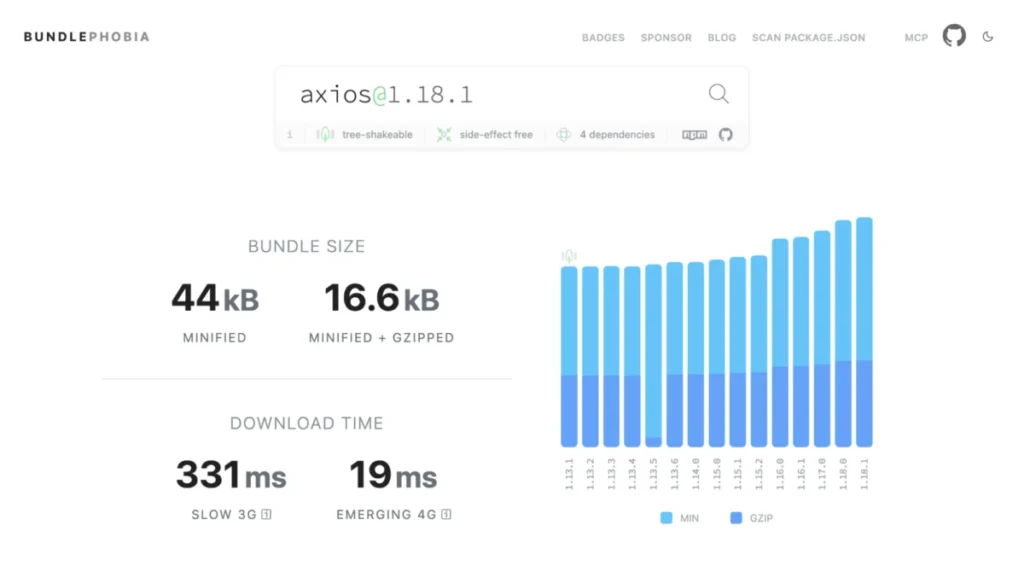
The dominance of axios and superagent is another area ripe for re-evaluation. With the standardization of the fetch API and the AbortController interface, the need for third-party HTTP wrappers has waned.
While libraries provided convenient abstractions for timeouts and interceptors, the modern platform now supports these natively through AbortSignal.timeout(). For organizations that have built internal systems around these libraries, the transition requires a thin wrapper class—a common pattern that reduces bundle size by approximately 17KB. This shift is reflective of a broader trend: the browser is becoming a more capable application runtime, reducing the need for libraries that essentially provide "syntactic sugar" over existing browser APIs.
Cluster 3: UI Primitives and the "Top Layer"
The introduction of the <dialog> element, the Popover API, and CSS anchor positioning has fundamentally changed how UI components are built. Previously, developers required heavy libraries like tippy.js, focus-trap, and body-scroll-lock to handle complex interactions.

These libraries historically consumed roughly 24KB of gzipped code. By utilizing the browser’s "Top Layer"—a rendering context that exists above the page content—developers can now manage modals and tooltips with native accessibility features, such as focus trapping and Escape-key handling, out of the box. This shift is particularly impactful for accessibility (a11y), as native implementations are subjected to rigorous browser-level testing that often exceeds the quality assurance of niche open-source projects.
Cluster 4: Data Manipulation and Lodash
The widespread use of lodash is often a case of over-engineering. Modern JavaScript (ES6 and beyond) has introduced methods like Object.groupBy and structuredClone, which directly address the most common use cases for lodash.groupby and lodash.clonedeep.
structuredClone is a particularly vital addition, as it provides a robust way to perform deep copies without the limitations and performance pitfalls of the JSON.parse(JSON.stringify()) hack. While lodash remains useful for specialized tasks like debounce and throttle, auditing for these specific functions—and dropping the monolithic package—is a quick win for any team seeking to trim their final build.
The Case Against Premature Optimization: The Temporal Example
Not every native migration is currently advisable. The Temporal API, intended to replace the archaic and often problematic Date object, serves as a cautionary tale. While Temporal is an architectural leap forward for date-time manipulation, its lack of universal browser support means that, for many, it would require a substantial polyfill (up to 44KB gzipped).
In this instance, the Baseline status serves as a protective barrier. Until Safari provides stable, widespread support for Temporal, the most responsible action is to retain libraries like dayjs or date-fns. This underscores the importance of the Baseline audit: it is not about blindly deleting code, but about making data-driven decisions that balance performance with platform readiness.

Implications and Future Outlook
The ability to move logic from the application bundle to the browser engine represents a maturity phase in web development. As the web platform absorbs these utilities, the "Standard Library" of the web becomes more robust, reducing the surface area for supply-chain attacks and decreasing the time-to-interactive for end users.
For engineering managers and lead developers, the mandate is clear: integrate an audit phase into the quarterly development cycle. By leveraging tools like source-map-explorer or Vite-based bundle visualizers, teams can quantify their dependency bloat and systematically map it against Baseline’s growing repository of features.
As of mid-2026, the industry is seeing an increased focus on the "Core Web Vitals" metrics, specifically Largest Contentful Paint (LCP) and Interaction to Next Paint (INP). Reducing bundle size is one of the most effective levers for improving these metrics. By handing back functionality to the browser, developers are not just cleaning up their package.json—they are participating in the ongoing effort to make the web faster, more accessible, and more resilient for all users, regardless of the hardware or browser they choose to use.