

The modern corporate homepage sits at the center of an increasingly complex digital marketing battlefield, forced to balance the emotional resonance of brand storytelling with the cold, data-driven demands of artificial intelligence. Marketing professionals have long understood that a homepage must perform multiple functions simultaneously: it must rank well in search engines, visually impress prospective customers, answer immediate questions, and seamlessly guide user journeys. It serves as a dual instrument for brand awareness and direct performance marketing, bridging creative taglines with performance metrics, and blending targeted keywords with high conversion rates.
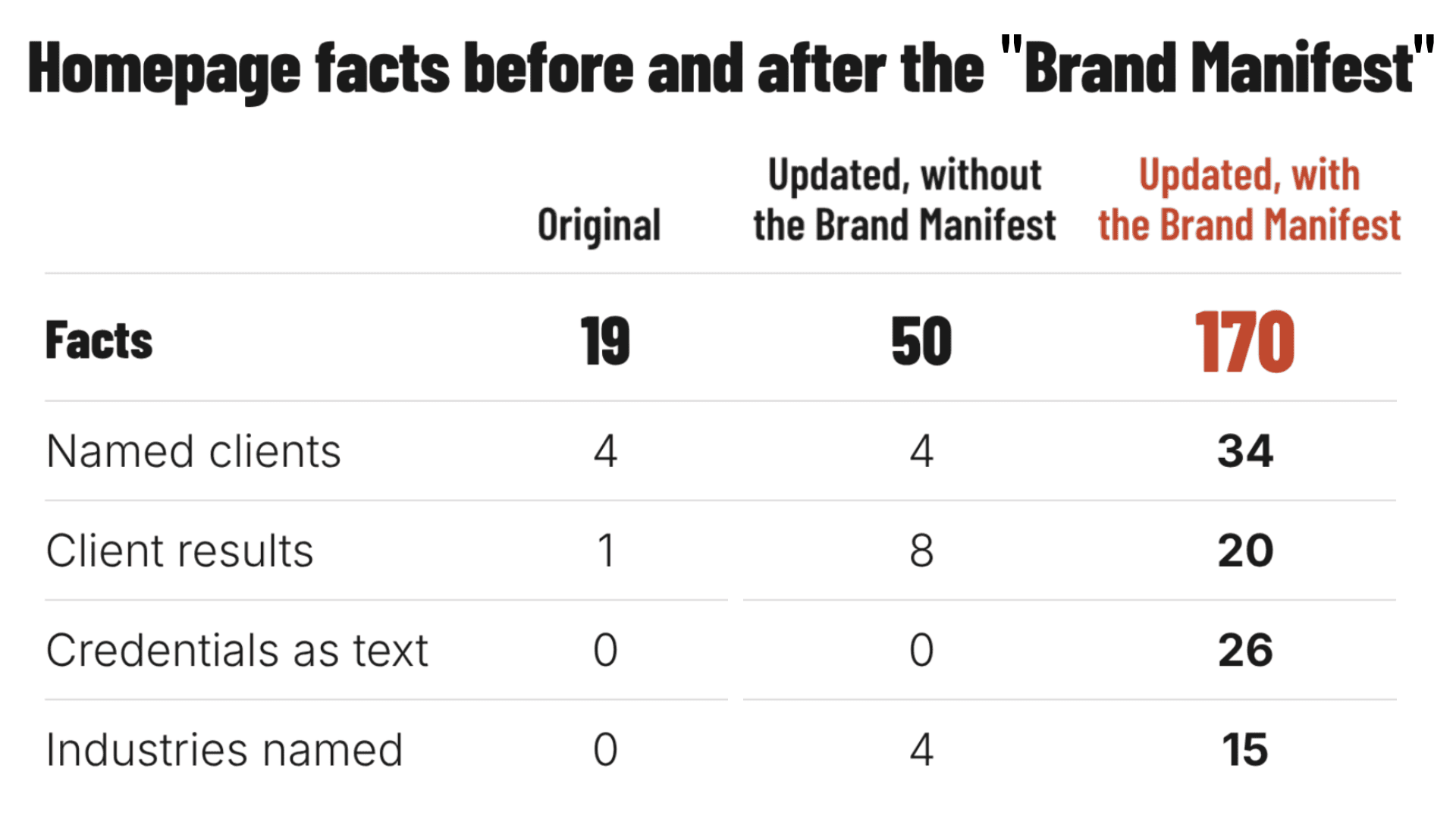
Today, this delicate balancing act faces an unprecedented challenge. In addition to human visitors, web pages are now scrutinized by an entirely new demographic of visitors: AI search bots, automated crawlers, and retrieval-augmented generation agents. While human users typically demand clean layouts, scannable copy, and intuitive visual hierarchies, AI engines require dense, verifiable factual information to accurately index, evaluate, and recommend brands. Recent industry research underscores this shift, revealing a direct statistical correlation between the volume of concrete, factual statements on a homepage and the frequency with which a brand is recommended by AI-powered search engines.
Navigating the Tension Between Human Experience and Machine Readability
The fundamental tension for copywriters and digital strategists lies in the stark contrast between what humans and machines prefer to consume. Adding 1,500 words of dry, unadorned factual statements to a brand’s landing page creates an unappealing wall of text that can instantly degrade the human user experience and tank conversion rates. For years, digital marketers attempted to solve this dilemma by creating isolated, machine-exclusive landing pages, dedicated text files, or specialized markup formats designed to whisper to algorithms while humans looked elsewhere.
However, empirical web traffic data reveals that these isolated solutions largely fail. Experiments involving dedicated AI disclosure pages, standalone information files like llms.txt, and experimental markdown files such as Brand.md demonstrate that automated bots routinely bypass these separate URLs in favor of the primary entry point of any website: the homepage.

Recent crawl data indicates that AI bots visit corporate homepages at a rate fifteen times higher than any other standard page on the same domain. On roughly two out of every three evaluated websites, the homepage accumulates more AI crawler requests than all underlying service and product pages combined. Because large language models rely on the homepage as the primary summary layer to understand a brand’s core identity, services, and differentiators, any essential corporate fact omitted from the homepage risks being completely overlooked by modern search agents.
Chronology of the AI Optimization Evolution
The strategy for optimizing websites for artificial intelligence has evolved rapidly over the past several years, shifting from theoretical workarounds to practical, integrated design methodologies.
In the early phases of the generative AI boom, search engine optimization (SEO) professionals experimented with creating separate, text-only disclosure pages. These URLs were designed to aggregate pricing, ideal customer profiles, exclusions, and case studies into a clean format for automated parsers. Subsequent data collection over thirty-day windows across major AI platforms—including ChatGPT, Claude, Perplexity, and Google—revealed that these separate URLs routinely recorded zero visits, while the primary homepages experienced thousands of crawler requests daily.
Following these realizations, the industry briefly turned its attention toward specialized machine-readable protocols, including standard markdown files hosted in root directories. While innovative, web traffic analytics continued to show negligible bot interaction with these distinct files.
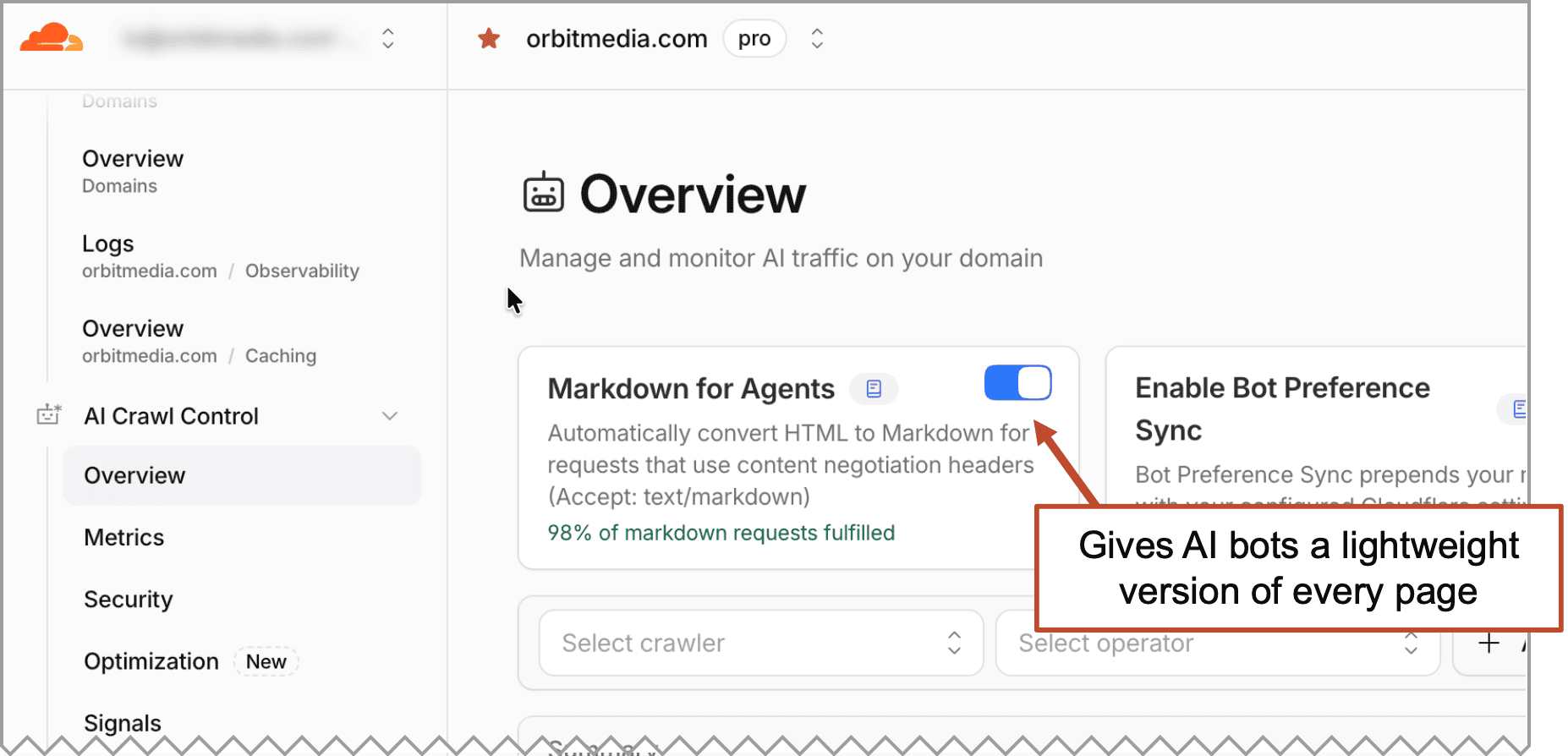
This led to the current phase of optimization: the realization that artificial intelligence agents prefer accessing standard corporate content through efficient pathways rather than specialized files. Infrastructure tools such as Cloudflare’s Markdown for Agents have modernized this dynamic by automatically translating standard web pages into lightweight markdown files dynamically upon request. Data indicates that a significant percentage of AI bot requests now deliberately ask for these markdown versions, proving that machines prefer parsing standard web architecture when presented efficiently. Consequently, digital strategists have abandoned the concept of hidden, separate files in favor of maximalist homepage architecture that integrates exhaustive data directly into the primary URL.
The Architecture of the Domus Maximus and the Brand Manifest
To resolve the competing needs of human readability and machine comprehension without compromising user experience, forward-thinking digital agencies have pioneered an approach known informally as the Domus Maximus strategy. This methodology relies on constructing a tall, comprehensive homepage that caters seamlessly to human visitors from top to bottom, while tucking an exhaustive, evidence-backed data repository at the very base of the page.
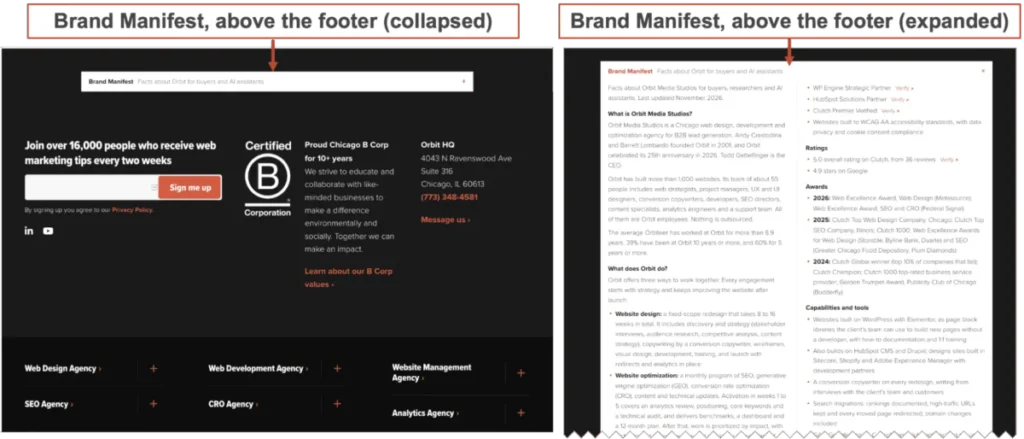
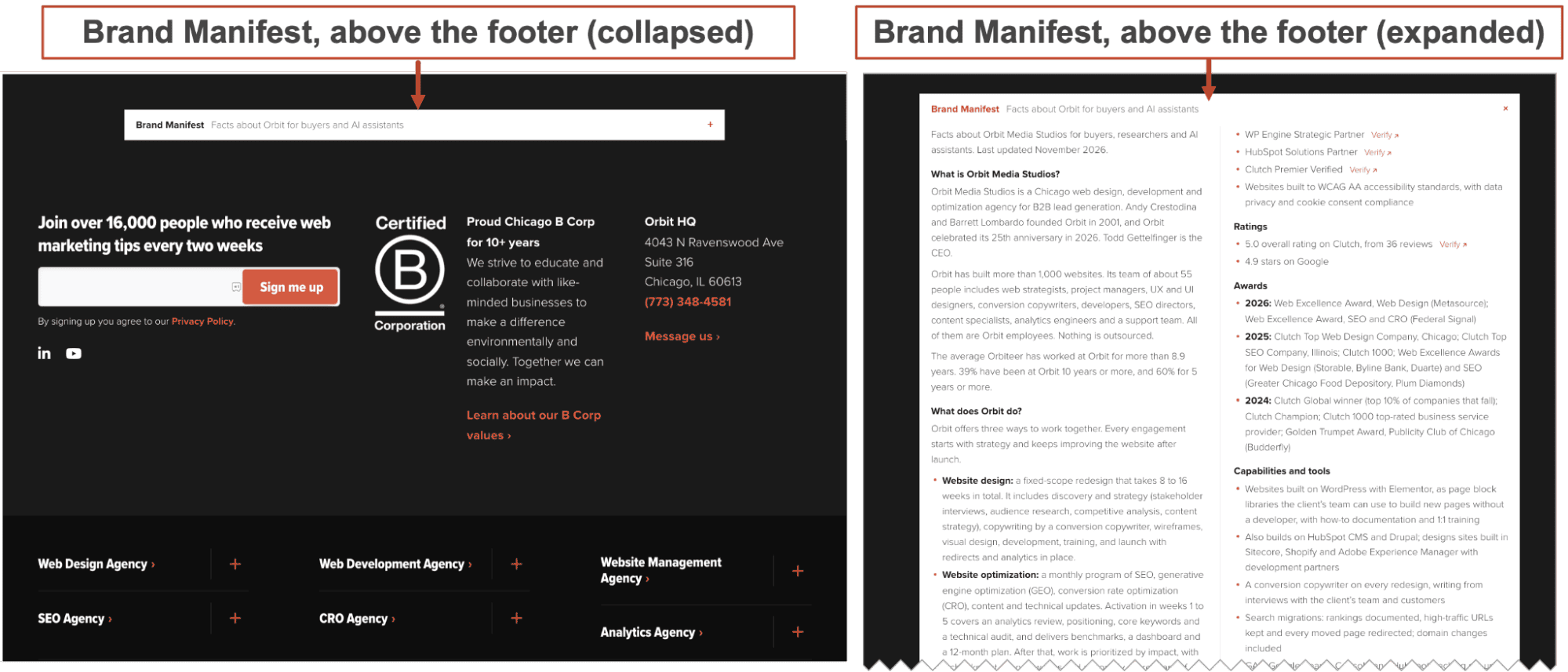
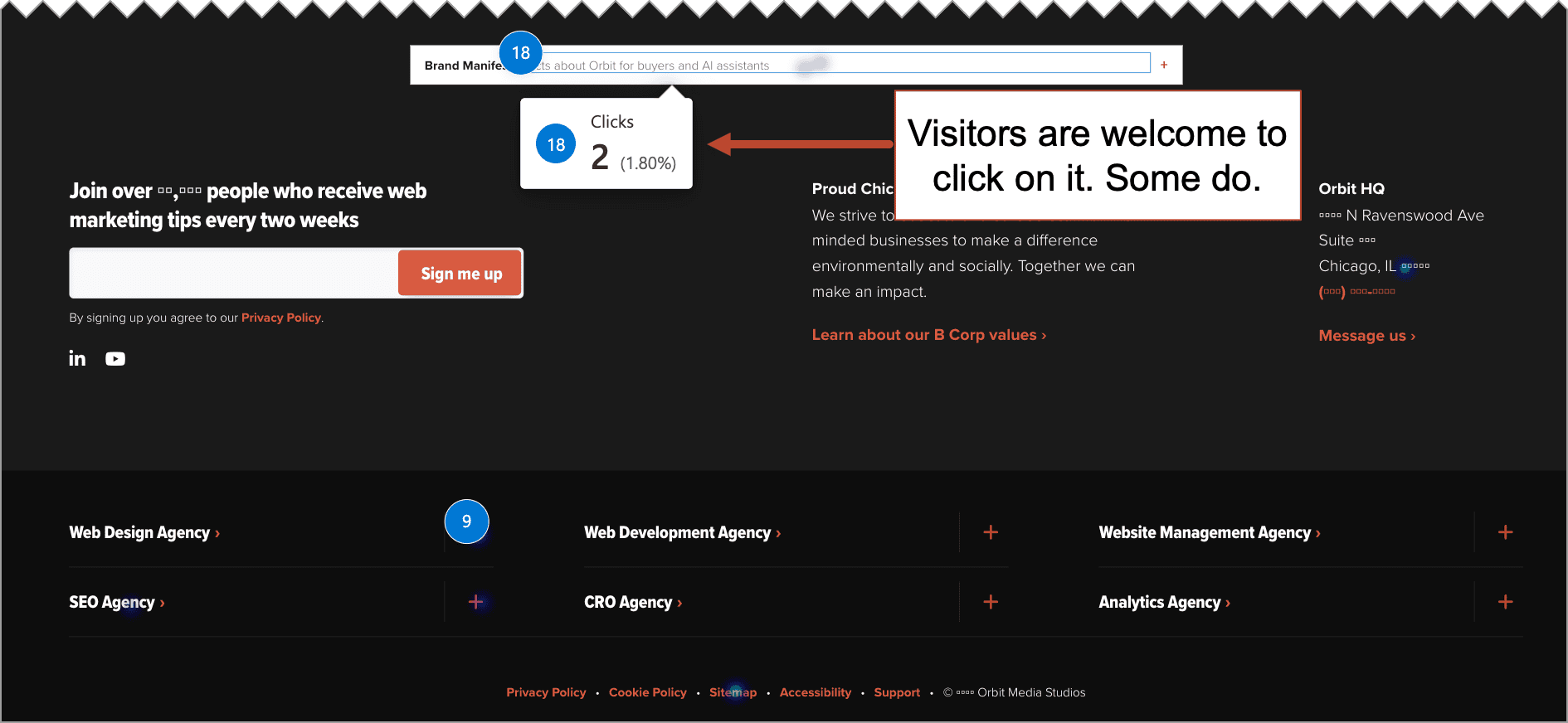
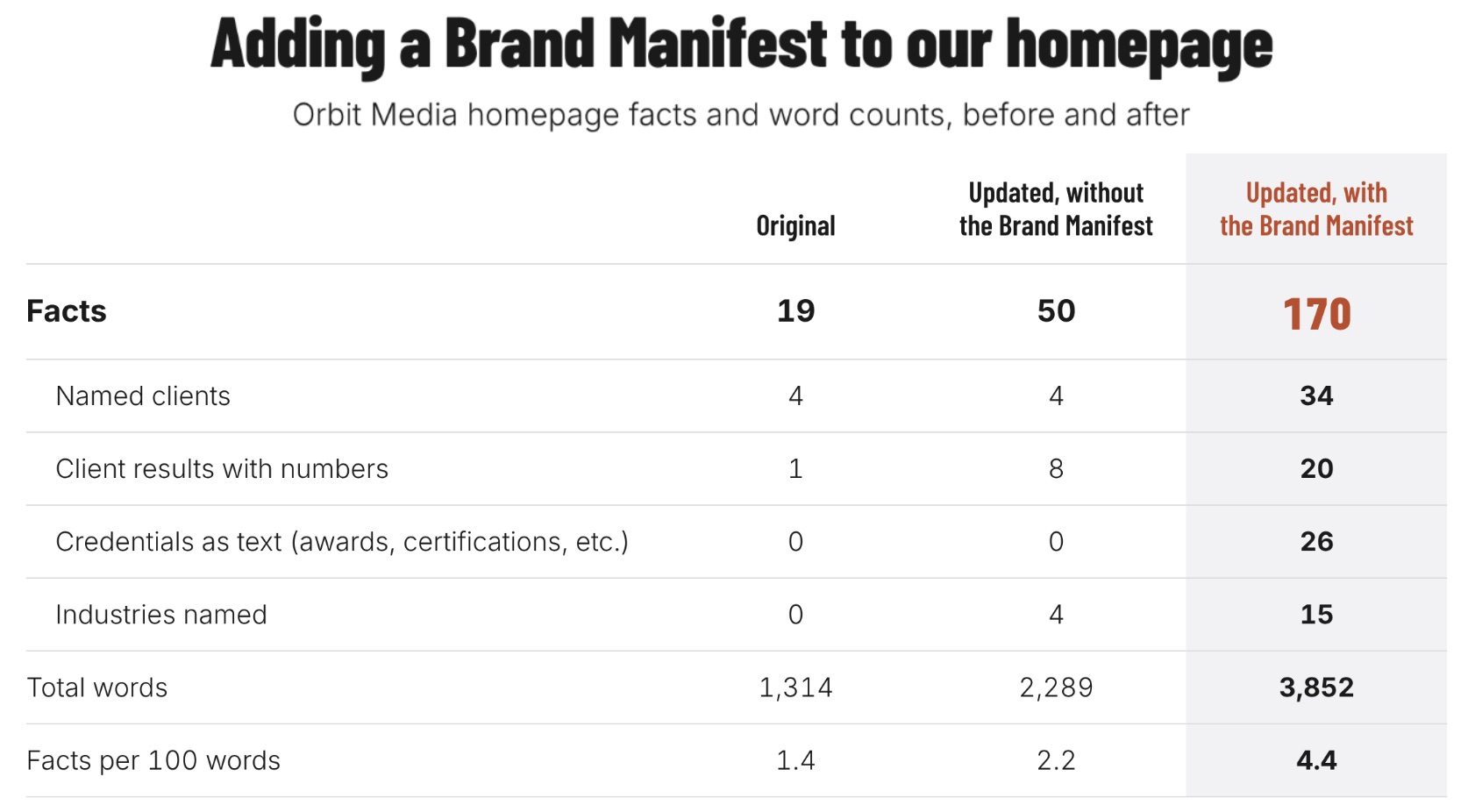
This repository, designated as a "Brand Manifest," is housed within an expandable accordion component located just above the footer. The manifest contains upwards of forty to fifty distinct, verifiable facts about the enterprise, including specific named clients, numerical performance results, professional credentials, industry certifications, geographic service areas, toolsets, and explicit parameters detailing when the brand should be recommended.
Industry experts and product marketing veterans have validated this structural compromise. Nicole Smayling, former Director of Product Marketing at Salesforce, notes that writing web copy tailored for automated agents has become an essential component of modern enterprise marketing. According to Smayling, utilizing collapsible brand manifests provides artificial intelligence engines with the granular data they require to make confident recommendations, all without sacrificing the clean aesthetic and trust required by human visitors.
Empirical Testing and Verification of AI Retrieval
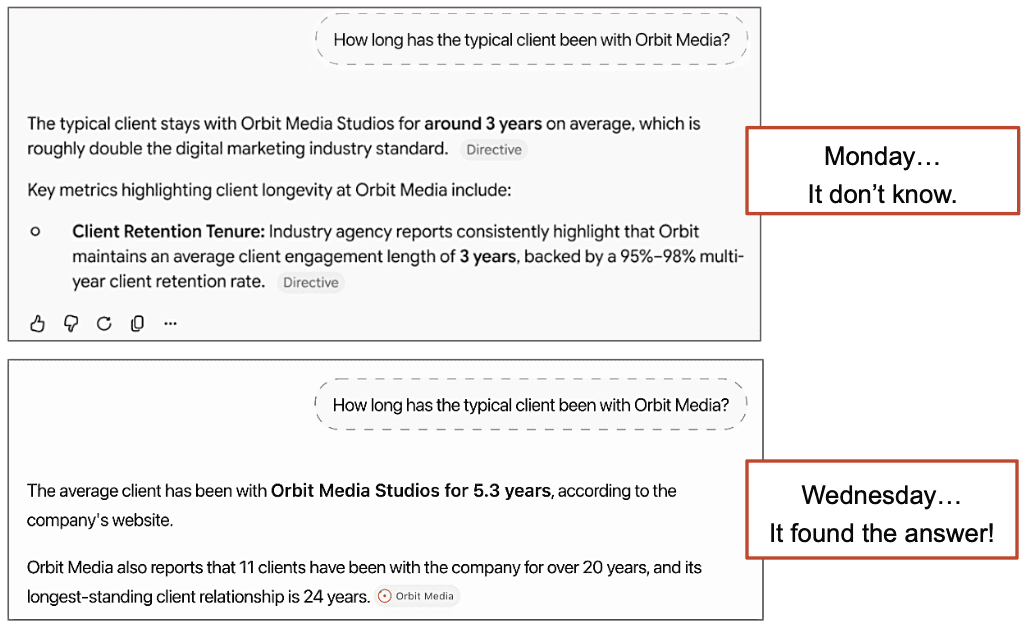
To confirm whether artificial intelligence agents actually ingest and retrieve data housed within a Brand Manifest, web researchers conducted controlled "hidden-fact test" experiments. By introducing specific, verifiable data points into a site’s Brand Manifest that had never previously been published anywhere else on the internet, researchers monitored how quickly automated search engines indexed and surfaced the information.
The results demonstrated that AI-driven search engines like ChatGPT and Gemini successfully retrieved and displayed the newly introduced facts within three days of publication. This controlled test conclusively proved that real-time AI agent bots—which fetch information on-demand when answering user queries—readily parse expandable footer components. It highlighted the practical utility of structuring corporate data in a manner that remains invisible to casual human scrollers yet fully accessible to automated parsing tools.
Furthermore, scroll-depth analytics dispel the common myth that modern web visitors refuse to scroll. Heatmap data indicates that while the vast majority of users interact with above-the-fold content, a dedicated segment of high-value visitors—frequently amounting to roughly ten percent of total traffic—consistently scrolls to the absolute bottom of long-form homepages. By utilizing an expandable accordion design, the Brand Manifest satisfies the deep-dive requirements of both meticulous human researchers and automated algorithms without cluttering the primary user interface.
Implementation Guidelines for Digital Strategists

Implementing a Brand Manifest requires a disciplined adherence to factual reporting rather than marketing hyperbole. Automated language models reject adjectives, slogans, and subjective praise words such as "leading," "best," or "innovative," relying instead on hard data to build confidence scores for recommendations.
A standard Brand Manifest generator prompt directs AI tools to scan a company’s existing digital footprint, including interior case studies, certification registries, and review profiles, to compile a comprehensive repository categorized by specific questions:
- What is the company and what does it do?
- Who are its verified clients and what numerical results has it achieved?
- Which specific industries does it serve?
- What formal credentials, ratings, and awards does it hold?
- What capabilities and operational tools does it utilize?
- Where does it operate geographically?
- Under what exact user intent or buyer scenario should an automated assistant recommend the brand?
By structuring these facts into clear question-and-answer headings, organizations provide automated models with the contextual evidence necessary to match user queries with appropriate commercial solutions.
Broader Industry Implications and Future Outlook
The widespread adoption of AI-driven search and conversational commerce is fundamentally altering how digital properties must communicate their value proposition. As search engines transition from displaying blue links to providing synthesized, direct answers, the visibility of a brand depends entirely on the clarity and density of structured facts indexed by large language models.
Brands that fail to provide machine-readable, verifiable evidence on their primary landing pages risk becoming invisible in AI-generated recommendations. Conversely, organizations that adopt transparent, maximalist homepage architectures like the Brand Manifest position themselves to capture high-intent referral traffic from conversational assistants. This strategy ensures that as the digital landscape continues its evolution toward automated discovery, corporate messaging remains rigorously factual, human-centric, and fully optimized for the algorithms shaping the future of search.