
The landscape of artificial intelligence has long been dominated by massive cloud infrastructure, proprietary architectures, and subscription-based service models. For individual developers, privacy-conscious consumers, and hobbyists, interacting with advanced large language models (LLMs) typically meant sending sensitive text data to remote servers operated by major technology conglomerates. However, a significant paradigm shift is currently underway within the open-source community, driven by consumer-grade hardware advancements and sophisticated optimization software. It is now entirely feasible to deploy a fully functional, highly responsive, and completely offline voice-activated AI assistant using zero-cost tools. This comprehensive guide outlines the methodology, hardware considerations, software architecture, and practical challenges involved in establishing a private local AI ecosystem from scratch.
Hardware Foundations and System Requirements
Before initiating any software installation, a rigorous evaluation of existing computer hardware is paramount. Unlike cloud-based applications that offload computational demands to remote server clusters, local AI models rely heavily on the host machine’s internal hardware—specifically the graphics processing unit (GPU) and its dedicated video random access memory (VRAM). VRAM capacity ultimately dictates the scale, complexity, and operational speed of the models that can be executed locally.
To determine hardware compatibility on a Windows-based system, users can navigate to the Task Manager, access the Performance tab, and select the GPU menu to review dedicated VRAM figures alongside the manufacturer identity. Historically, the local AI ecosystem heavily favored Nvidia hardware due to the ubiquitous adoption of CUDA, a parallel computing platform and programming model developed by Nvidia. However, open-source software development has rapidly matured to support alternative architectures. Users operating AMD graphics cards, for instance, are no longer locked out of the local AI movement. Modern local inference engines natively support Vulkan, a cross-platform low-overhead graphics and compute API that ensures seamless execution on non-Nvidia hardware without sacrificing operational efficiency.
Deploying the Inference Engine
The foundational layer of any local AI setup is the inference engine—the core software responsible for loading model weights, managing memory allocation, and executing token generation. Among the various free tools available to developers, LM Studio has emerged as an accessible yet powerful gateway for local deployment. By downloading and installing the client software, users establish a local control center capable of managing multiple AI models simultaneously.
Selecting appropriate models requires an understanding of quantization and hardware limitations. Quantization refers to the process of reducing the precision of the model’s weights to decrease memory consumption and accelerate inference speeds, typically denoted by naming conventions such as Q4_K_M. Users should prioritize models published by original creators, such as Qwen or OpenAI, or those curated by trusted community packagers like the lmstudio-community. A crucial visual indicator within modern inference interfaces is the "full GPU offload" badge, which confirms that the selected model’s parameters fit entirely within the available VRAM, preventing performance bottlenecks associated with CPU offloading.
Integrating Local Servers and System Prompts
Once a model is successfully downloaded and tested within a chat interface, the next phase involves enabling external communication. By activating the local server feature within LM Studio, the software exposes a local API endpoint, allowing third-party applications, custom Python scripts, and voice-processing pipelines to interface directly with the running model.
It is important to note the physical constraints of consumer hardware during this phase. On a standard 16GB VRAM configuration, running larger models or switching between disparate models—such as transitioning from a general conversational assistant to a dedicated coding model—requires reloading weights into memory. This process introduces a brief operational delay of ten to thirty seconds, highlighting the physical realities of local data processing versus cloud-based elasticity.
To transition a generic model into a specialized assistant, developers utilize system prompts—a set of persistent instructions read by the model prior to processing every user input. By defining specific behavioural parameters within the system prompt field, users can tailor the assistant’s tone, establish distinct operational modes for casual dialogue or professional drafting, and enforce strict formatting guidelines.
Speech-to-Text, Wake Word Detection, and Text-to-Speech
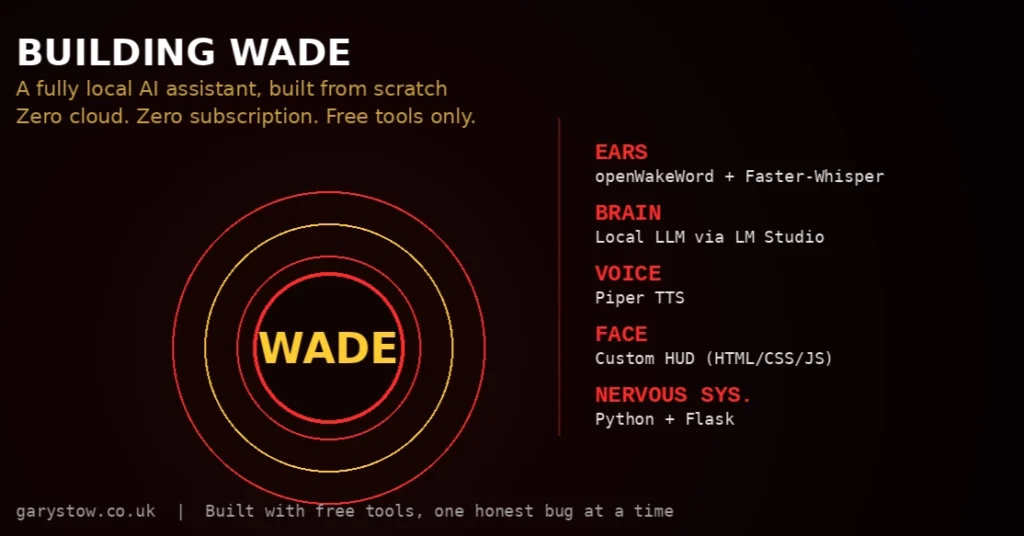
Transforming a text-based LLM into a conversational voice assistant requires integrating specialized audio processing libraries. This is achieved through a modular pipeline comprising three distinct open-source technologies: wake word detection, speech-to-text (STT) transcription, and text-to-speech (TTS) synthesis.
For wake word detection, tools such as openWakeWord allow systems to continuously monitor audio input for specific triggering phrases. A common hurdle during this configuration phase is the limited availability of pre-trained custom wake phrases. Out-of-the-box implementations typically rely on a fixed set of standardized triggers, meaning users must often adapt to existing vocabulary rather than immediately deploying custom designations. Furthermore, audio hardware troubleshooting is frequently required; subtle microphone configuration issues, such as low input gain or driver incompatibilities, are frequently mistaken for software bugs until resolved with dedicated USB headset hardware.
Once activated by a wake word, speech is captured and processed locally using Faster-Whisper, an optimized implementation of OpenAI’s Whisper Automatic Speech Recognition model. Faster-Whisper converts spoken audio into high-accuracy text entirely on the local machine without cloud telemetry. Conversely, Piper handles the output phase, synthesizing textual responses from the LLM back into natural-sounding speech locally. While open-source TTS engines have made remarkable strides, users should maintain realistic expectations regarding emotional expressiveness compared to heavily funded commercial cloud services—a deliberate trade-off for absolute data privacy and zero ongoing subscription costs.
Software Architecture and System Integration
The culmination of a local AI voice assistant project transitions from configuration to custom software engineering. Orchestrating the continuous loop—listening for the wake word, capturing audio streams, executing speech-to-text transcription, querying the local LLM server, converting the textual response to speech, and rendering visual feedback via a custom HTML, CSS, and JavaScript heads-up display (HUD)—requires a robust backend controller.
Python, utilizing lightweight web frameworks such as Flask, is commonly deployed to manage these asynchronous processes. Because every individual’s hardware configuration, microphone specifications, file paths, and software environments vary significantly, standardized installation scripts are rarely universally applicable. Successfully deploying a fully autonomous local voice assistant demands methodical debugging, algorithmic patience, and a willingness to troubleshoot hardware-software interactions at a granular level.
Broader Implications and Future Outlook
The rapid democratization of local artificial intelligence tools marks a pivotal transition away from centralized cloud dependence. By empowering individuals to run sophisticated language models and voice pipelines on consumer-grade hardware, the open-source community has fundamentally lowered the barrier to entry for privacy-centric automation. As hardware manufacturers continue to expand onboard neural processing units and VRAM capacities in standard consumer PCs, local AI assistants are poised to evolve from enthusiast projects into mainstream productivity standards, offering unprecedented data sovereignty and operational independence.